
Ab Rollouts: Form, Muscles & Progressions | Combat Fitness
Ab Rollouts: How to Do Them, Muscles Worked & Progressions
Ab rollouts are one of the hardest anti-extension core exercises you can do. You roll an ab wheel or loaded barbell forward and back while your trunk works to stop your spine from arching. That is the same bracing job your core does under a ruck, a plate carrier, or a heavy deadlift, which is why we build the ab wheel rollout into our military fitness programs.
Electromyography (EMG) research ranks rollouts among the most effective exercises for activating the rectus abdominis and obliques, with relatively low hip flexor involvement. This guide covers the muscles worked, proper form, how to protect your lower back, kneeling-to-standing progressions, equipment options, and how many reps to program. We start with what the movement is.
Key Takeaways:
The ab rollout is an anti-extension exercise. Its job is to stop your lower back from arching, not to make your abs bend your spine.
It trains the whole anterior core, plus the lats, serratus, and shoulders that control the rollout and pull you back.
Your lower back is at risk only when you roll farther than your abs can control. Brace, tuck the pelvis, and earn range from the knees first.
Low reps of high quality beat high-rep sets. For most athletes, 2 to 3 sessions a week is enough.
What Is an Ab Rollout?
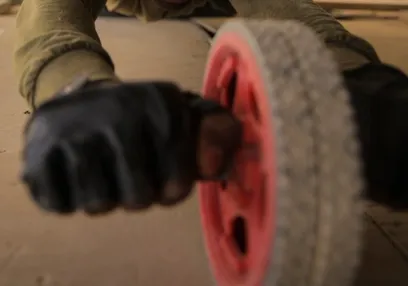
An ab rollout is a core exercise where you kneel or stand, grip an ab wheel or barbell, roll it forward until your body is nearly parallel to the floor, and pull it back using your abs. The core’s job is to resist spinal extension the whole time, which makes the movement an anti-extension drill.
You will see it called ab rollouts, ab wheel rollouts, the ab roller rollout, or the ab wheel rollout exercise. They are all the same movement. The tool changes the feel, but the demand stays the same: a long lever arm that tries to pull your hips toward the floor while your trunk holds a rigid line.
What Muscles Do Ab Rollouts Work?
Ab rollouts work the rectus abdominis, external and internal obliques, and transverse abdominis, with the serratus anterior, latissimus dorsi, shoulders, and triceps assisting. The abdominals stop the spine from extending as you roll out. The lats and shoulders control the arms overhead and help pull the wheel back.
Here is the role each group plays:
Rectus abdominis: the main anti-extension muscle. It keeps the ribs pulled toward the pelvis.
Obliques: stiffen the trunk and add anti-rotation control, especially on uneven surfaces.
Transverse abdominis: contributes to the brace that keeps internal pressure high.
Serratus anterior and lats: control the shoulder angle and do much of the work on the return.
Glutes: hold the pelvis in a slight posterior tilt so the lower back stays neutral.
Do ab rollouts work your lower abs? The rectus abdominis is one long muscle, so you cannot isolate a “lower” section. Controlling the pelvis does load the lower fibers and obliques hard, and research comparing abdominal exercises found rollout-style movements produced strong lower rectus and oblique activity while keeping hip flexor and lumbar extensor activity relatively low.
Why the Ab Rollout Builds Tactical Core Strength
Ab rollouts are effective because they train your trunk to resist extension under a long lever, which is the core strength that carries over to loaded tactical work. A ruck pulls your torso backward and your hips forward. Body armor shifts your center of mass. A heavy deadlift or casualty drag needs a rigid trunk to transfer force from your legs.
In each case, the failure point is a spine that buckles into extension. Load carriage research links heavy packs to back and lower-body injuries, and the trunk’s ability to hold position is part of how you tolerate that load. This is also the reasoning behind functional strength for military performance: train the positions the job demands, not the muscles a mirror shows.
The benefits of ab rollouts are practical. A wheel costs little and fits in a duffel. A barbell does the same job in any gym. It also complements the other two core demands: anti-rotation, which cable ab workouts like the Pallof press cover, and back extension, which the superman covers.
Be honest about the evidence. Core training reliably improves trunk endurance and control, but research directly linking it to fewer injuries is mixed. We treat the rollout as one strong tool in a complete plan. If you are weighing how core work fits a full training block, our guide to choosing a strength & endurance program explains how to judge a plan’s structure.
How to Do an Ab Rollout With Proper Form
To do an ab rollout properly, kneel with the wheel under your shoulders, brace and tuck your pelvis, roll forward with straight arms until you approach the limit of your control, then pull the wheel back using your abs. Range is earned, not assumed.
Set up. Kneel on a pad with the wheel on the floor directly under your shoulders. Grip the handles with straight arms.
Brace. Take a breath into your belly, tighten your abs as if bracing for a punch, and squeeze your glutes to tuck your pelvis slightly.
Roll out. Push the wheel forward slowly. Your hips and shoulders move forward together. Keep your ribs down and your back flat or slightly rounded.
Stop before you sag. Go only as far as you can hold that position. Your arms end up near overhead.
Pull back. Drive the wheel back toward your knees by pulling with your abs and lats. Do not lead with your hips.
What position should your shoulders be in? They start stacked over the wheel and move into overhead flexion as you extend. Keep them active, pushing away from the floor, rather than shrugging toward your ears. You should feel ab rollouts mainly in your abs, with some work in your lats and triceps. If you feel them in your lower back, you went too far.
Common Form Mistakes
Letting the hips sink, which drops the lower back into an arch.
Pushing the hips back first on the return instead of pulling with the trunk.
Bending the elbows, which shortens the lever and hides weakness.
Rushing the eccentric, so momentum does the work your abs should.
Are Ab Rollouts Bad for Your Lower Back?
Ab rollouts are not bad for your back when done within your range, but they can strain the lumbar spine if you roll past the point where your abs control extension. When the abs lose the fight, the pelvis tips forward and the lower back hyperextends under a long lever, the exact position the exercise is meant to resist.
Spine biomechanics researchers treat rollouts as an advanced progression. They create high abdominal demand along with meaningful spinal load, which is why range has to be earned. If your rollouts hurt your back, or you see an arched back on video, three cues fix most of it:
Brace before you move. Set the brace in the starting position and hold it through the full rep.
Keep a slight posterior pelvic tilt. Tuck the tailbone and squeeze the glutes so the lumbar spine cannot drop.
Start from the knees and use a wall stop. A wall in front of the wheel caps the range until your strength catches up.
If you have current back pain, a diagnosed spinal condition, or symptoms that radiate into the leg, get cleared by a qualified clinician first. Pain during a rollout is a stop signal, not something to push through.
Ab Rollout Progressions: Kneeling to Standing
Progress ab rollouts by mastering short-range kneeling reps, then building to full-range kneeling, then partial standing reps, and finally full standing rollouts. Each step lengthens the lever or reduces support, so move up only when your current level is clean for every rep.
This progression works for beginners and advanced athletes alike:
Stability ball rollout. Forearms on the ball. Shorter lever, more forgiving.
Kneeling rollout to a wall. Set the wall close and move it back as you get stronger.
Full-range kneeling rollout. The standard kneeling ab wheel rollout, controlled throughout.
Kneeling rollout with a pause or a slow 3 to 5 second eccentric.
Standing rollout to a wall or up an incline. Partial range from the feet.
Full standing rollout. An advanced strength skill few athletes perform cleanly.
To make ab rollouts harder before you can stand, add a pause at full extension, slow the lowering, or wear a weight vest. Weighted ab rollouts with a vest or a band anchored in front of you add load without changing the lever, which is a useful bridge to standing work.
Ab Rollouts With a Barbell, Ball, Rings, or TRX
You can do ab rollouts with a barbell, stability ball, gymnastic rings, a TRX, or sliders, so you do not need an ab wheel at all. Each option changes the lever or stability, which lets you scale the movement to your level.
Barbell Ab Rollouts
Load a barbell with round plates and roll it like a wide wheel. Larger plates set the bar higher, which shortens the range slightly. Smaller plates lower the bar and make it harder. The wide grip adds stability, which is why many athletes find barbell ab rollouts easier to control than a single wheel.
Stability Ball Rollouts
Kneel with your forearms on the ball and roll it forward. Research comparing Swiss ball exercises found the ball rollout strongly activated the rectus abdominis while keeping hip flexor and lumbar extensor activity low. It is a sound entry point.
Ring and TRX Fallouts
Ring ab rollouts and TRX fallouts use straps instead of a wheel. Stand leaning into the handles and let your arms travel overhead. Lower handles and a more horizontal body make the movement harder, so you can adjust difficulty in small steps.
Ab Rollouts Without a Wheel
Use sliders or a towel on a smooth floor, or slide a plate on carpet. The setup and cues are the same: brace, tuck the pelvis, control the range, and pull back with the trunk.
How Many Ab Rollouts Should You Do?
Most athletes should do 2 to 4 sets of 5 to 10 controlled kneeling ab rollouts, 2 to 3 times per week. Stop each set when your form slips, not when you hit a number. Standing rollouts are harder, so 3 to 5 clean reps per set is plenty.
Should you do ab rollouts every day? We do not recommend it. The rollout is a high-intensity eccentric movement, and core training follows the same principles as any strength work: adequate recovery and progressive overload. Daily high-effort sets tend to cost form before they build strength.
How many ab rollouts is advanced? Our coaching benchmark: 10 or more strict, full-range kneeling reps with a pause shows a strong base, and a set of 3 to 5 strict standing rollouts is advanced. Place rollouts after your main lifts or at the end of a session, so a tired trunk never has to brace a heavy deadlift.
Rollouts sit inside a complete core rotation alongside anti-rotation work, back extension, and traditional flexion moves like sit-ups and bicycle crunches. Our guide to core exercises for men lays out how those pieces fit, and a strength workout for athletes shows how core work slots into a full session.
FAQ: Frequently Asked Questions
What muscles do ab rollouts work?
Ab rollouts mainly work the rectus abdominis and obliques, with the transverse abdominis helping to brace. The lats, serratus anterior, shoulders, and triceps control the arms and drive the return, while the glutes hold the pelvis in position. Together they train the whole anterior core to resist spinal extension.
How do you do an ab rollout with proper form?
Kneel with the wheel under your shoulders, brace your abs, and tuck your pelvis slightly. Roll forward with straight arms only as far as you can keep your lower back from arching, then pull the wheel back using your abs and lats. Move slowly and keep your ribs down throughout.
Are ab rollouts bad for your lower back?
Ab rollouts are safe for most healthy athletes when range matches strength. Problems start when you roll past your control point and your lower back arches under the long lever. Brace hard, hold a slight posterior pelvic tilt, start from the knees, and use a wall stop until your form holds at full range.
How do you progress from kneeling to standing ab rollouts?
Build full-range kneeling rollouts first, then add pauses and slow eccentrics. Next, perform standing rollouts to a wall or up an incline to limit range. Move the wall back gradually until you can complete a full standing rep with a neutral spine. Expect this to take months, not weeks.
Can you do ab rollouts with a barbell or no wheel at all?
Yes. A barbell loaded with round plates works like a wide ab wheel and is often easier to control. Without any wheel, use a stability ball, rings, a TRX, sliders, or a towel on a smooth floor. Each option trains the same anti-extension pattern with a different lever.
How many ab rollouts should you do?
Most athletes do best with 2 to 4 sets of 5 to 10 controlled kneeling reps, 2 to 3 times per week. End each set when form breaks. Standing rollouts are much harder, so 3 to 5 strict reps per set is a solid target for advanced athletes.
Are ab rollouts effective for building core strength?
Ab rollouts are among the most effective core exercises available. EMG studies place rollout-style movements near the top for rectus abdominis and oblique activation. Because they train the trunk to resist extension, the strength carries over to rucking, lifting, and wearing body armor.
Ab rollouts earn their place because they train the core the way tactical work loads it: holding the spine rigid against a force that wants to bend it. Master the kneeling version, own your range, protect your lower back, and progress only when every rep is clean. Strength built this way shows up under a ruck, under armor, and under a loaded bar. Put the rollout into a structured plan, train it consistently, and let your trunk become the most reliable link in your body.
References:
Escamilla RF, Babb E, DeWitt R, et al. Electromyographic analysis of traditional and nontraditional abdominal exercises: implications for rehabilitation and training. Physical Therapy. 2006;86(5):656-671.
Escamilla RF, Lewis C, Bell D, et al. Core muscle activation during Swiss ball and traditional abdominal exercises. Journal of Orthopaedic & Sports Physical Therapy. 2010;40(5):265-276.
McGill SM. Core training: evidence translating to better performance and injury prevention. Strength and Conditioning Journal. 2010;32(3):33-46.
McGill SM, Karpowicz A. Exercises for spine stabilization: motion/motor patterns, stability progressions, and clinical technique. Archives of Physical Medicine and Rehabilitation. 2009;90(1):118-126.
McGill SM. Low Back Disorders: Evidence-Based Prevention and Rehabilitation. 3rd ed. Champaign, IL: Human Kinetics; 2016.
Knapik JJ, Reynolds KL, Harman E. Soldier load carriage: historical, physiological, biomechanical, and medical aspects. Military Medicine. 2004;169(1):45-56.
Huxel Bliven KC, Anderson BE. Core stability training for injury prevention. Sports Health. 2013;5(6):514-522.
Willardson JM. Core stability training: applications to sports conditioning programs. Journal of Strength and Conditioning Research. 2007;21(3):979-985.
Kibler WB, Press J, Sciascia A. The role of core stability in athletic function. Sports Medicine. 2006;36(3):189-198.
Behm DG, Drinkwater EJ, Willardson JM, Cowley PM. The use of instability to train the core musculature. Applied Physiology, Nutrition, and Metabolism. 2010;35(1):91-108.
Contreras B, Schoenfeld B. To crunch or not to crunch: an evidence-based examination of spinal flexion exercises, their potential risks, and their applicability to program design. Strength and Conditioning Journal. 2011;33(4):8-18.
Snarr RL, Esco MR. Electromyographical comparison of plank variations performed with and without instability devices. Journal of Strength and Conditioning Research. 2014;28(11):3298-3305.
Headquarters, Department of the Army. FM 7-22: Holistic Health and Fitness. Washington, DC; 2020.
Disclaimer: This article is for educational purposes only and is not medical advice. Consult a qualified healthcare provider before starting a new exercise program, especially if you have a history of back pain, spinal injury, or shoulder injury. Stop any exercise that causes pain and seek professional evaluation.


