
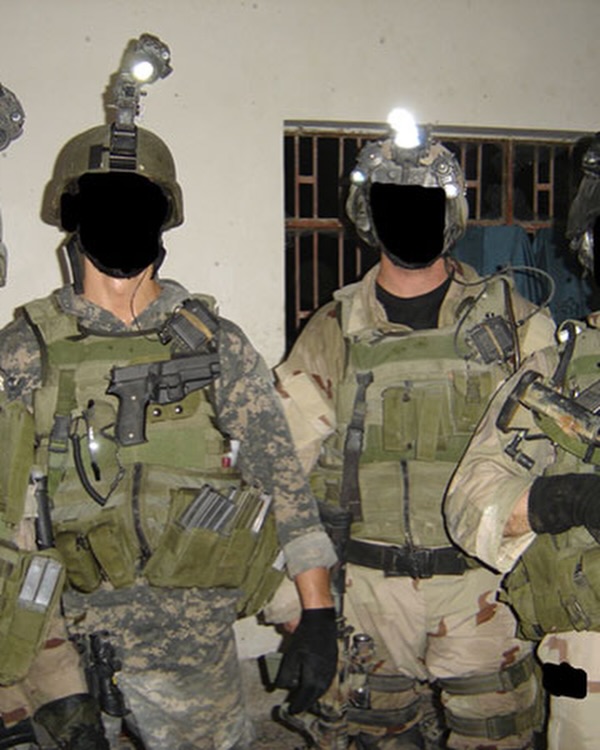
5th Special Forces Group: The Legion | Combat Fitness
5th Special Forces Group (Airborne): The Legion, Explained
The 5th Special Forces Group (Airborne) is one of the five active-duty Special Forces Groups in the U.S. Army, headquartered at Fort Campbell, Kentucky, and regionally aligned on the Middle East, Central Asia and the Horn of Africa. Its soldiers, and the Army's own releases, call it the Legion. The group ran the longest Special Forces campaign of the Vietnam War and put the first American teams on the ground in Afghanistan in 2001. If you are training toward that world, our tactical fitness programs build the base Selection screens for. Below: what the group is, where it sits, what the flash means, how the seven Special Forces Groups differ, and how a soldier ends up wearing that flash.
Key Takeaways:
The 5th Special Forces Group (Airborne), or 5th SFG, is an active-duty Army Special Forces Group based at Fort Campbell, Kentucky.
It is regionally aligned on the U.S. Central Command area of responsibility: the Middle East, the Persian Gulf, Central Asia and the Horn of Africa.
The nickname the Legion appears in official Army releases, but the Army has never published where it came from.
The beret flash carries a yellow diagonal stripe with three red stripes, restored in 2016 to mark the group's Vietnam service.
You do not enlist into the 5th Group. You pass Selection and the Qualification Course, and the Army assigns you.
What Is the 5th Special Forces Group?
The 5th Special Forces Group (Airborne) is a U.S. Army Special Forces unit headquartered at Fort Campbell, Kentucky, and oriented on the Middle East and Central Asia. It was activated on September 21, 1961 at Fort Bragg, North Carolina, and it is one of five active-duty Special Forces Groups, alongside two more in the Army National Guard.
The unit is written several ways, all pointing at the same organization: 5th SFG, 5th SFG(A), 5th Group Special Forces, fifth Special Forces Group, and U.S. Army 5th Special Forces Group. The Airborne in the title is the formal designation, not a slogan. Special Forces Groups are airborne units and their soldiers hold jump status.
A Special Forces Group is not a small team. It is a brigade-sized organization of Special Forces soldiers, support soldiers and the enablers that keep small teams running far from friendly infrastructure. The Green Berets inside it are the sharp end; the rest of the group is what makes that sharp end usable at distance.
Why the 5th Group Is Called The Legion
The Army and its soldiers call the 5th Special Forces Group the Legion, and official releases use the term in print. A 2021 change of command release described how "the Legion has played an integral part in nearly all of our nation's modern-day conflicts," and the outgoing commander closed with the group's paired mottos: "Strength and honor, de oppresso liber."
Here is the honest part. No Army lineage document, unit history page or heraldry record explains where the nickname came from or when it was adopted. What exists is unit lore, and the accounts conflict.
One version, told by Vietnam-era veterans, places it in the early 1960s, when a group commander remarked that a job handed to one understrength team should have taken a legion. Another puts it just after Desert Storm, as a term used mostly by commanders rather than team members. A third set of veterans notes that "strength and honor" spread through the force after 2000, and that they never heard either phrase before that.
If a site gives you a definitive origin with no source, it invented one.
Where the 5th Group Is Based
The 5th Special Forces Group is based at Fort Campbell, Kentucky, on the Kentucky and Tennessee line near Clarksville. The group shares the post with the 101st Airborne Division and the 160th Special Operations Aviation Regiment.
The group was not always there. It spent its first 27 years at Fort Bragg, North Carolina, including the Vietnam deployment. The colors were cased at Fort Bragg on June 10, 1988 and uncased at Fort Campbell six days later.
Sharing a post with the 160th, the Army's special operations aviation unit, puts the group's teams and their primary lift behind the same gates. Habitual relationships between assault force and aircrew get built in garrison, not in theater.
What Is the 5th Group's Area of Responsibility?
Each Special Forces Group is regionally aligned, and the 5th Group is oriented on the U.S. Central Command area of responsibility: the Middle East, the Persian Gulf, Central Asia and the Horn of Africa. That alignment is the single fact that explains the unit's shape.
Regional alignment drives language training, area study, which partner forces a team works with year after year, and the deployment history that follows. The 5th Group deployed for Desert Shield and Desert Storm from August 1990 to April 1991. It was the first American unit committed to Operation Enduring Freedom in October 2001, where its teams linked up with Northern Alliance forces.
Special Forces works through other people's armies, which only functions if the team speaks the language and knows the ground. That takes years, so the Army keeps groups pointed at one region instead of rotating them across the map. The same logic separates all seven groups, which is covered below.
How the 5th Group Is Organized
A Special Forces Group is built in layers. The group headquarters commands line battalions plus a group support battalion that provides the logistics, signal, intelligence and medical backbone. Each line battalion is built from companies, and each company fields Operational Detachment Alphas, the 12-soldier teams that do the work. Battalion numbering follows the standard pattern, so 1st Battalion, 5th Special Forces Group and 2nd Battalion, 5th Special Forces Group are subordinate elements of the same unit, not separate organizations.
The ODA is where the capability lives. Each team is staffed by the 18-series specialties, two deep in most positions, so the detachment can split and still function. That includes the 18D Special Forces medic and the 18E Special Forces communications sergeant.
We are not rebuilding it here. For how an ODA is manned, how it splits and what each position does, read our breakdown of Special Forces team structure.
The 5th Group in Vietnam
The 5th Special Forces Group fought the longest and largest Special Forces campaign of the Vietnam War. Advisory elements deployed from the early 1960s, the full group deployed by February 1965, and it was headquartered at Nha Trang. From there it ran the Civilian Irregular Defense Group program, establishing roughly 270 camps that raised and trained local forces across South Vietnam's four military regions. After 1967 it also supported personnel serving with MACV-SOG, the classified cross-border reconnaissance organization.
The group returned to Fort Bragg on March 5, 1971. The Army's account of the 2016 flash ceremony records 785 Special Forces soldiers lost in the conflict and 18 Medal of Honor recipients.
Looking for a 5th Group Vietnam roster
If you are looking for a 5th Special Forces Group Vietnam roster, no site hosts a complete one, and the pages that claim to are partial veteran-submitted lists. Individual service records, the Official Military Personnel File, are held by the National Personnel Records Center in St. Louis. Veterans and next of kin can request them through the eVetRecs system or by mailing Standard Form 180. Records become archival and open to the public 62 years after separation, which now covers the early Vietnam years.
Unit-level records, including staff journals and after-action reports, sit in Record Group 472, Records of the U.S. Forces in Southeast Asia, at the National Archives, searchable through the National Archives Catalog.
The 5th Group Patch and Insignia
The 5th Special Forces Group patch most people mean is the beret flash: a black shield with a white border, crossed by a diagonal yellow stripe carrying three narrow red stripes. The yellow and red are the colors of the Republic of Vietnam, and the design dates to the group's war there.
The group wore a plain black flash with a white border for decades before restoring the Vietnam-era design on March 23, 2016 at Fort Campbell. The commander framed it as an acknowledgment of the group's Vietnam history and the soldiers lost in it.
The flash is one of three pieces of insignia worn together. The shoulder sleeve insignia is the Special Forces arrowhead, approved in August 1955: a teal blue arrowhead with an upturned dagger and three lightning flashes. Army heraldry reads the arrowhead as the fieldcraft Special Forces soldiers are trained in, the dagger as the unconventional nature of the work, and the three flashes as the ability to strike by air, land or sea. The branch insignia is crossed arrows, and the regimental motto is De Oppresso Liber, to free the oppressed.
Are 5th Special Forces Group Soldiers Green Berets?
Yes. Every Special Forces soldier in the 5th Group is a Green Beret, because Green Beret is the informal name for a soldier who has completed the Special Forces Qualification Course and been awarded an 18-series military occupational specialty and the beret itself.
The confusion comes from what each term names. Green Beret describes the individual qualification. Special Forces Group describes the unit those qualified soldiers are assigned to. So 5th Special Forces Group versus Green Beret is not a comparison between two things. One is the soldier, the other is the organization.
A Special Forces Group also contains support soldiers, from signal to intelligence to logistics, who are assigned to the group without being Special Forces qualified. They are 5th Group soldiers. They are not Green Berets, and that distinction matters to the people who hold the tab.
For what the qualification involves, from the Q Course phases to the timeline, see our guide to Green Beret training.
The Seven Special Forces Groups
There are seven Special Forces Groups in the U.S. Army: five active duty and two in the Army National Guard. Each is aligned on a region, which sets its language training, its partner forces and most of its deployments.
Figure 1.1 - the seven US Army Special Forces Groups with home station, regional orientation and component: 1st at Joint Base Lewis-McChord for the Indo-Pacific, 3rd at Fort Bragg for Sub-Saharan Africa, 5th at Fort Campbell for CENTCOM, 7th at Eglin Air Force Base for Latin America, 10th at Fort Carson for Europe, and the two National Guard groups, 19th at Camp Williams, Utah and 20th at Birmingham, Alabama. Seven groups cover five geographic combatant commands, and the Guard groups reinforce rather than own a region, which is why Latin America appears twice, with 20th Group standing behind 7th, while 19th Group backs 1st, 5th and 10th across three theaters. Two battalions live overseas permanently rather than on deployment: 1st Battalion of 1st Group at Torii Station, Okinawa, and 1st Battalion of 10th Group at Panzer Kaserne outside Stuttgart.
The 19th and 20th are Army National Guard groups whose soldiers hold the same qualification and meet the same standard. The 1st Special Forces Group keeps a forward battalion in Okinawa and the 10th Special Forces Group keeps one in Germany, which puts teams inside their regions rather than flying to them.
Group numbering is a lineage artifact, not a ranking. The 3rd Special Forces Group, the 7th Special Forces Group and the 20th Special Forces Group are not subordinate to the 5th, and none sits a tier above another. They are peer organizations pointed at different parts of the map, and we will cover each of them in its own guide.
How to Join the 5th Group
You do not enlist into the 5th Special Forces Group. Assignment comes at the end of the pipeline, and the Army makes it.
The route runs in the same order for everyone. First, the entry point: a civilian can enlist on the 18X Special Forces candidate contract, which routes through Infantry One Station Unit Training and Airborne School into Selection, while serving soldiers volunteer from their current unit.
Second, Special Forces Assessment and Selection, the screening course that decides who continues. Third, the Special Forces Qualification Course, where candidates earn an 18-series specialty and the beret. Group assignment is made from there, and language aptitude is part of the calculation. A candidate's Defense Language Aptitude Battery score and assigned language are matched against the needs of the regionally aligned groups, which ties assignment back to the area of responsibility.
Weighing the civilian route? Read our breakdown of the 18X contract, then the 18X MOS path for the specialty side. For the screening gate itself, start with SFAS selection.
Training to Special Forces Standards
Regional alignment changes what a team studies. It does not change what Selection demands of the body. The baseline is identical for a candidate headed to the 5th Group or the 10th, because the gate is the same course.
That baseline is load carriage over distance, repeated on short sleep, with land navigation and decision-making stacked on top. Rucking is the discriminator, and it is trained, not improvised. Running volume matters, upper-body strength endurance matters, and recovery between events matters more than any single test score.
If you want that decision made for you, our guide to choosing a training program lays out how to pick. For the programming itself, look at our structured tactical training programs, and for the Special Forces track specifically, our SOF training programs compared covers the options. Inside a year of a Selection date the sequencing changes, and peaking for selection is where that is handled.
FAQ: Frequently Asked Questions
What is the 5th Special Forces Group?
The 5th Special Forces Group (Airborne) is an active-duty U.S. Army Special Forces unit based at Fort Campbell, Kentucky. Activated in 1961, it is regionally aligned on the U.S. Central Command area of responsibility, and its Special Forces soldiers are Green Berets organized into battalions, companies and 12-soldier teams.
Why is the 5th Special Forces Group called the Legion?
The Army has not published an official origin. The term appears in official releases and in the group's own use, alongside the motto "strength and honor," but the explanations circulating in the community place it anywhere from the early 1960s to the years after Desert Storm. None is documented.
What is the 5th Group's area of responsibility?
The 5th Group's area of responsibility is the U.S. Central Command region: the Middle East, the Persian Gulf, Central Asia and the Horn of Africa. That alignment drives its language training, its partner forces and its deployments, from Desert Storm to Afghanistan in 2001.
How many Special Forces Groups are there?
There are seven Special Forces Groups. Five are active duty, the 1st, 3rd, 5th, 7th and 10th, and two are Army National Guard, the 19th and 20th. Each is aligned on a geographic region, and the numbering reflects lineage rather than any ranking.
What did the 5th Group do in Vietnam?
From its headquarters at Nha Trang, the 5th Group ran the Civilian Irregular Defense Group program, establishing roughly 270 camps that raised and trained local forces across South Vietnam, and after 1967 it supported personnel assigned to MACV-SOG. The group returned to Fort Bragg in March 1971.
How many battalions are in the 5th Special Forces Group?
A group headquarters commands line battalions plus a group support battalion. Each line battalion is built from companies, and each company fields Operational Detachment Alphas of 12 soldiers. Battalion numbering is standard, so 1st Battalion and 2nd Battalion are elements of the group.
The 5th Special Forces Group is not a mystery unit. It is a regionally aligned organization at Fort Campbell with a documented lineage, a flash that means something specific, and an assignment process that runs through one gate. Everything distinctive about the Legion sits downstream of soldiers who got through Selection first. That part is not assigned. It is earned before anyone sees a flash. Build the load-carriage base and the aerobic engine now, and make the pipeline a training problem instead of a gamble.
References:
U.S. Army Special Operations Command, "5th Special Forces Group (Airborne) History."
U.S. Army Garrison Fort Campbell, "5th Special Forces Group (Airborne)."
U.S. Army, "Beret flash changeover ceremony ties together past, present 5th SFG (A) Soldiers," March 2016.
DVIDS, "5th Special Forces Group Change of Command," July 20, 2021.
USASOC History Office, ARSOF History, "The Special Forces Patch: History and Origins."
1st Special Forces Command (Airborne), U.S. Army.
National Archives, "Record Group 472: Records of the U.S. Forces in Southeast Asia, 1950-1975."
National Archives, "Request Military Service Records" (eVetRecs, Standard Form 180, National Personnel Records Center).
National Archives, "Guide to Federal Records, Record Group 472."
Green Beret Foundation, "Who We Serve" (Special Forces Group locations and regional alignments).
Professional Soldiers forum, "The Legion" discussion thread (Special Forces community accounts of the nickname, cited as community discussion rather than an official source).
Disclaimer: This article is for informational purposes and reflects publicly available Army sources at the time of publication. Unit structure, basing and regional alignments change. Training guidance here is general and is not medical advice. Consult a physician before beginning any new training program, and confirm current enlistment and selection requirements with an Army Special Operations recruiter.


