
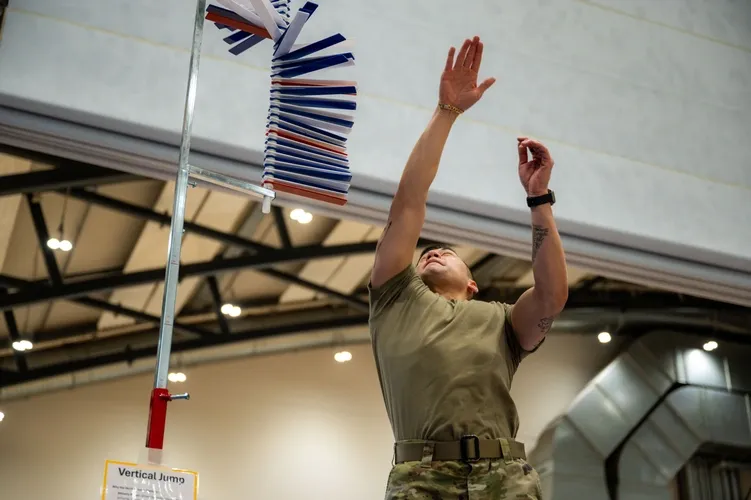
Vertical Leap Training: A 12-Week Program | Combat Fitness
Vertical Leap Training: How to Increase Your Vertical Jump
Vertical leap training builds lower-body strength, reactive power, and jump technique so you leave the ground faster and higher. It is not a gimmick program or a pair of shoes. For tactical athletes, a bigger vertical shows explosive lower-body power, the same quality you use to clear an obstacle, get over a wall, or close distance fast. If you want that power built into a complete plan alongside your running, rucking, and work capacity, our military fitness programs program it for you.
This guide covers what builds a vertical, the strength and plyometric work that moves the number, the technique that adds free inches, and a 12-week vertical jump program you can start Monday. We program explosive work for military, law enforcement, and first-responder athletes, and everything below follows the research rather than the marketing.
Key Takeaways:
Strength sets your jump ceiling. Plyometrics and technique decide how much of it you use.
Heavy lower-body strength work combined with plyometrics outperforms either method alone in the research.
Arm swing and a clean approach add inches with no new fitness.
Plyometric volume is counted in ground contacts, and quality beats volume in every session.
For tactical athletes, the vertical jump stands in for the explosive power used to clear obstacles and scale walls.
What Builds a Bigger Vertical Jump?
A bigger vertical jump comes from five inputs working together: maximal lower-body strength, rate of force development, plyometric reactivity, jump technique, and strength relative to bodyweight. Strength sets the ceiling. Power and reactivity decide how much of that strength you express before takeoff, and technique decides how much reaches the jump.
The timing problem drives everything. The push-off phase of a jump lasts a few tenths of a second, and research in the Journal of Applied Physiology shows that reaching peak muscular force often takes longer than that. You never use your full strength in a jump. You use whatever force you can produce fast.
Maximal strength: a stronger squat and hinge raise the force you have available to draw on.
Rate of force development (RFD): how quickly you reach high force, trained by heavy lifting with fast intent and by power work.
Plyometric reactivity: how well your tendons and muscles store and return energy during a quick stretch-shortening cycle.
Technique: arm swing, countermovement depth, and approach mechanics.
Relative strength: jump height depends on force relative to the mass you move, so excess body mass costs inches.
How you train the vertical jump depends on which input limits you. A lifter with a strong squat and a flat jump needs reactive work and technique. An athlete who jumps well but squats less than bodyweight needs strength first. Most tactical athletes sit in the second group, which is why every vertical jump exercise program we write starts with the barbell.
Strength Work for the Vertical: Which Lifts Matter?
Vertical leap weight training should center on heavy squats and hinges, a loaded jump variation, and single-leg work. These lifts build the force your jump draws on. A major review in Sports Medicine linked greater relative strength to higher jumps, faster sprints, and a better response to later power training.
In that review, Suchomel and colleagues found that relatively stronger athletes outperformed weaker peers on jumping and sprinting and gained more from power-focused work. For most readers, the fastest route to a higher vertical is a stronger squat. If you need the full strength base laid out, start with a strength workout for athletes and build the jump work on top of it.
Back Squat and Front Squat
The squat is the primary strength lift for the vertical because it trains hip and knee extension through a range close to your jump. A 2004 study in the British Journal of Sports Medicine found maximal squat strength correlated strongly with vertical jump height and sprint speed in elite soccer players. Front squats keep the torso upright and load the quads harder, which suits athletes who jump knee-dominant.
Trap-Bar Deadlift and Trap-Bar Jump
The trap bar places the load in line with your center of mass, so you can pull heavy with less lower-back stress. A biomechanical comparison in the Journal of Strength and Conditioning Research found the hexagonal bar produced higher peak force, velocity, and power than a straight bar. Light trap-bar jumps, loaded well below your deadlift max, bridge strength and plyometrics because you can load the jump without a bar on your back.
Romanian Deadlift
The Romanian deadlift trains the hamstrings and glutes through a loaded hip hinge. That reinforces the hip drive at the top of your jump and prepares the hamstrings for the sprint and bound work in the program. Keep it in the 6 to 10 rep range as an accessory lift.
Bulgarian Split Squat
Takeoff in an approach jump, a bound, or a wall climb is often off one leg. The Bulgarian split squat builds unilateral strength, exposes left-to-right imbalances, and loads the legs hard with less spinal compression than a heavy back squat.
Do Plyometrics Increase Your Vertical Jump?
Plyometrics increase vertical jump height reliably. A 2007 meta-analysis in the British Journal of Sports Medicine found plyometric training improved countermovement jump height by high single-digit percentages on average, and a 2009 meta-analysis found plyometrics combined with weight training produced larger gains than plyometrics alone.
Plyometrics train the stretch-shortening cycle: a rapid eccentric stretch followed immediately by a concentric contraction. Done well, they teach your tendons to store and return elastic energy and your nervous system to produce force faster. To what extent plyometric training helps your vertical leap depends on your strength base. Weaker athletes get less from depth jumps because they cannot absorb the landing forces that make the drill work.
Jump Training Exercises That Transfer
Progress through these from lowest to highest demand:
Box jumps: high takeoff output with low landing stress, since you land on the box. Good for learning to produce force fast.
Broad jumps: horizontal power and hip extension, plus a hard stuck landing that trains deceleration.
Pogo hops: short, stiff ankle contacts that build tendon stiffness and ankle reactivity.
Bounds: alternating single-leg takeoffs that develop unilateral power for approach jumps and sprinting.
Depth jumps: step off a box, land, and rebound as fast and high as possible. The most potent and most demanding drill on the list.
Depth jumps deserve respect. Research on drop jumping in Sports Medicine shows that drop height and rebound strategy change what the drill trains. We start athletes on a low box and raise it only while ground contact stays short and rebound height holds. For the full library of drills by movement pattern, see our guide to explosive exercises by body part.
Count plyometric volume in ground contacts, not sets. NSCA guidance places beginners around 80 to 100 contacts per session, with more advanced athletes tolerating higher totals. Every contact should be a max-intent rep.
How Does Jump Technique Add to Your Vertical?
Jump technique adds to your vertical by putting more of the force you already have into the takeoff. Biomechanics research shows an aggressive arm swing raises jump height by roughly 10 percent compared with hands-on-hips jumping, and a clean approach converts running speed into height. These are inches gained without any new fitness.
Arm Swing
Swing your arms down and back during the countermovement, then drive them up hard as you extend. Research in the Journal of Biomechanics shows the arms build energy that transfers into the body and keep the legs loaded longer into the push-off. Athletes who jump with lazy arms leave height on the table every rep.
Standing vs Approach Vertical
A standing vertical starts from a stationary position and measures pure lower-body power. An approach vertical uses a few running steps and usually scores higher because you convert horizontal speed into vertical lift. The key is the penultimate step: make it slightly longer and lower, then plant the final step fast. Keep the countermovement quick rather than deep. Sinking too low slows the transition and bleeds off the stored energy.
Why Explosive Power Matters for Tactical Athletes
For tactical athletes, the vertical jump is a field test of explosive lower-body power and rate of force development. Those qualities decide how fast you clear an obstacle, get a leg over a wall, mount a vehicle, or explode up from the prone. Higher hops are a side effect, not the goal.
Military strength research makes the same point. A review in the Journal of Strength and Conditioning Research identified power as a core requirement for warfighter tasks, and Army FM 7-22 treats power as a distinct component of soldier fitness. Law enforcement agility tests and foot pursuits put the same demand on officers through fences, walls, and sudden direction changes.
Load makes power more important. A study in Military Medicine found that carried load impaired performance on an explosive military task. Body armor and a fighting load reduce what you can express, so the athlete with more power in reserve keeps more of it once the kit goes on. This is why we treat jump training as functional strength for military performance rather than a sport add-on.
A Sample Vertical Leap Training Program (12 Weeks)
This 12-week vertical leap training program runs in three phases: a strength base, a strength-power block, and a power and peaking block ending in a test week. It uses two lower-body sessions per week and fits alongside your running, rucking, and conditioning.
The best vertical jump program is the one that matches your limiter. This vert program assumes you can squat bodyweight for clean reps. If you cannot, run Phase 1 twice before moving on. If you need this jump work to sit inside a full hybrid plan with your endurance training, our guide to choosing a strength & endurance program walks through what to look for.
Rules for every session: warm up for 10 minutes, do jumps before lifts, rest 2 to 3 minutes between jump sets, and end any set when reps slow down or landings get loose.
Phase 1: Strength Base (Weeks 1 to 4)
Day A:
Pogo hops: 3 sets of 15 contacts
Box jump: 4 sets of 3
Back squat: 4 sets of 5, leaving 2 reps in reserve
Romanian deadlift: 3 sets of 8
Day B:
Broad jump: 4 sets of 3, stick every landing
Trap-bar deadlift: 4 sets of 5
Bulgarian split squat: 3 sets of 8 per leg
Single-leg calf raise: 3 sets of 12 per leg
Add load each week while bar speed stays crisp. Week 4 cuts volume by about a third.
Phase 2: Strength-Power (Weeks 5 to 8)
Day A:
Pogo hops: 3 sets of 20 contacts
Depth jump from a low box: 4 sets of 3
Back squat: 5 sets of 3
Trap-bar jump, light: 4 sets of 3
Day B:
Bounds: 4 sets of 6 total contacts
Front squat: 4 sets of 4
Bulgarian split squat: 3 sets of 6 per leg
Romanian deadlift: 3 sets of 6
Week 8 is a deload. Reduce volume by about 40 percent and keep the loads.
Phase 3: Power and Peaking (Weeks 9 to 12)
Day A:
Approach jumps: 5 sets of 2, full rest
Depth jump: 4 sets of 3
Back squat: 3 sets of 2, heavy and fast
Trap-bar jump: 3 sets of 3
Day B:
Broad jump: 3 sets of 3
Single-leg box jump: 3 sets of 3 per leg
Trap-bar deadlift: 3 sets of 3
Bulgarian split squat: 2 sets of 6 per leg
Week 12 halves the volume. Test your standing and approach vertical at the end of the week, fresh.
How Often Should You Do Jump Training?
Most athletes should do jump training twice per week, with at least 48 hours between hard plyometric sessions. Plyometric frequency matters less than quality. Every set should be fast and crisp, and the set ends the moment ground contacts slow down or landings get sloppy.
Sequencing Plyometrics Around Strength
Jump first, lift second. Plyometrics demand a fresh nervous system, and fatigue turns a reactive drill into a slow one that trains the wrong quality. Keep hard jump days away from interval runs and long rucks so your legs show up ready to produce force.
Vertical Jump Recovery and Deloads
Jump training stresses tendons and the neuromuscular system more than its short session times suggest. A deload every fourth week lets tendons catch up with muscle. A meta-analysis in the Journal of Science and Medicine in Sport supports using the countermovement jump to monitor fatigue: if your jump drops noticeably below baseline, back off that day.
How to Measure Your Vertical
The simplest test is jump-and-reach. Record your standing reach, then jump and touch as high as you can, and subtract the two. A wall-mounted vane device, a jump mat, or a validated phone app such as My Jump gives cleaner numbers. Test under the same conditions every four weeks and record the best of three attempts.
Frequently Asked Questions
Is strength training or plyometrics better for the vertical?
Strength training and plyometrics work best together, and meta-analytic research shows the combination beats either method alone. Your starting point decides the emphasis. Weaker athletes gain more from heavy squats and hinges first. Athletes who already squat well gain more from depth jumps, bounds, and technique work. Most tactical athletes should lead with strength.
What are the best exercises to jump higher?
The best exercises to jump higher are the back squat, front squat, trap-bar deadlift, trap-bar jump, Bulgarian split squat, and Romanian deadlift for strength, paired with box jumps, broad jumps, pogo hops, bounds, and depth jumps for reactive power. Run them in a structured progression rather than as a random circuit.
How long does it take to add inches to your vertical?
Technique changes such as arm swing can add height within a few sessions. Gains from plyometric and power work typically show over 6 to 12 weeks, the length of most programs in the research. Strength-driven improvements build across months. Results vary with training age, bodyweight, and consistency, so no honest program guarantees a number.
Do vertical-jump shoes work?
We have not seen convincing evidence that platform-style jump shoes add vertical beyond what standard calf work and plyometrics already deliver. They also change your landing mechanics, which can load the Achilles in ways you do not want. Put that money and attention into a structured strength and jump program instead.
Vertical leap training comes down to three things done in order: build the strength, teach it to express fast through plyometrics, and stop wasting it with poor technique. Run the 12 weeks, test honestly, and adjust to whatever input still limits you. If you want jump work programmed inside a complete tactical plan with your running, rucking, and conditioning, start with CF ONE. Selection candidates heading into a SOF pipeline should look at CF PRO, which builds this power into pipeline-specific preparation.
References:
Aagaard P, Simonsen EB, Andersen JL, Magnusson P, Dyhre-Poulsen P. Increased rate of force development and neural drive of human skeletal muscle following resistance training. Journal of Applied Physiology. 2002;93(4):1318-1326.
Balsalobre-Fernández C, Glaister M, Lockey RA. The validity and reliability of an iPhone app for measuring vertical jump performance. Journal of Sports Sciences. 2015;33(15):1574-1579.
Bobbert MF. Drop jumping as a training method for jumping ability. Sports Medicine. 1990;9(1):7-22.
Claudino JG, Cronin J, Mezêncio B, et al. The countermovement jump to monitor neuromuscular status: a meta-analysis. Journal of Science and Medicine in Sport. 2017;20(4):397-402.
Cormie P, McGuigan MR, Newton RU. Developing maximal neuromuscular power: Part 1, biological basis of maximal power production. Sports Medicine. 2011;41(1):17-38.
Cormie P, McGuigan MR, Newton RU. Developing maximal neuromuscular power: Part 2, training considerations for improving maximal power production. Sports Medicine. 2011;41(2):125-146.
de Villarreal ES, Kellis E, Kraemer WJ, Izquierdo M. Determining variables of plyometric training for improving vertical jump height performance: a meta-analysis. Journal of Strength and Conditioning Research. 2009;23(2):495-506.
Haff GG, Nimphius S. Training principles for power. Strength and Conditioning Journal. 2012;34(6):2-12.
Haff GG, Triplett NT, eds. Essentials of Strength Training and Conditioning. 4th ed. Champaign, IL: Human Kinetics; 2016.
Harman EA, Rosenstein MT, Frykman PN, Rosenstein RM. The effects of arms and countermovement on vertical jumping. Medicine and Science in Sports and Exercise. 1990;22(6):825-833.
Kraemer WJ, Szivak TK. Strength training for the warfighter. Journal of Strength and Conditioning Research. 2012;26(Suppl 2):S107-S118.
Lees A, Vanrenterghem J, De Clercq D. Understanding how an arm swing enhances performance in the vertical jump. Journal of Biomechanics. 2004;37(12):1929-1940.
Maffiuletti NA, Aagaard P, Blazevich AJ, Folland J, Tillin N, Duchateau J. Rate of force development: physiological and methodological considerations. European Journal of Applied Physiology. 2016;116(6):1091-1116.
Markovic G. Does plyometric training improve vertical jump height? A meta-analytical review. British Journal of Sports Medicine. 2007;41(6):349-355.
Markovic G, Mikulic P. Neuro-musculoskeletal and performance adaptations to lower-extremity plyometric training. Sports Medicine. 2010;40(10):859-895.
Suchomel TJ, Nimphius S, Stone MH. The importance of muscular strength in athletic performance. Sports Medicine. 2016;46(10):1419-1449.
Swinton PA, Stewart A, Agouris I, Keogh JW, Lloyd R. A biomechanical analysis of straight and hexagonal barbell deadlifts using submaximal loads. Journal of Strength and Conditioning Research. 2011;25(7):2000-2009.
Szivak TK, Kraemer WJ. Physiological readiness and resilience: pillars of military preparedness. Journal of Strength and Conditioning Research. 2015;29(Suppl 11):S34-S39.
Treloar AKL, Billing DC. Effect of load carriage on performance of an explosive, anaerobic military task. Military Medicine. 2011;176(9):1027-1031.
U.S. Department of the Army. FM 7-22: Holistic Health and Fitness. Washington, DC: Headquarters, Department of the Army; 2020.
Wisløff U, Castagna C, Helgerud J, Jones R, Hoff J. Strong correlation of maximal squat strength with sprint performance and vertical jump height in elite soccer players. British Journal of Sports Medicine. 2004;38(3):285-288.
Disclaimer: This article is for educational purposes only and is not medical advice. Plyometric and heavy strength training carry injury risk, especially for athletes with existing joint, tendon, or back issues. Consult a qualified healthcare provider before starting a new training program, and stop any exercise that causes pain. Individual results vary.


