
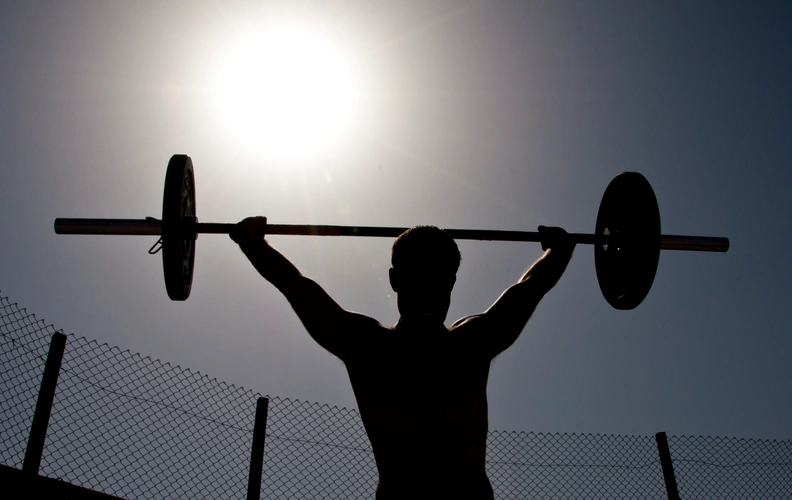
Snatch Exercise: 3 Ways to Train It | Combat Fitness
The Snatch: What It Is, the Three Variations, and How to Train It
The snatch exercise is a ballistic, full-body power pull: you drive a load from the floor or the hang to locked-out overhead in one continuous movement, with no pause and no press. You can snatch a barbell, a dumbbell, or a kettlebell, and each one trains the same quality. If you want the snatch built into a full plan rather than bolted onto random sessions, our military fitness programs program it by phase.
We program snatches for soldiers, operators, and firefighters because the job rewards moving a load fast. Below: what the snatch works, how the three implements differ, and which one to train first.
What Is the Snatch Exercise and What Muscles Does It Work?
The snatch exercise is a lift that moves a load from below the knees to overhead in a single explosive pull, using the hips and legs to generate speed and the upper body to guide and receive it.
Research on Olympic lifting has documented for decades that the snatch and its derivatives produce some of the highest power outputs of any resistance exercise (Garhammer, 1993). The NSCA’s position statement on weightlifting for sports performance supports using these lifts and their derivatives to build strength-speed and speed-strength in athletes outside the sport of weightlifting (Comfort et al., 2023).
Triple Extension: Why the Snatch Builds Power
The engine of every snatch is triple extension: the hips, knees, and ankles extend hard and nearly at once. That pattern drives a sprint start, a wall climb, and a casualty lift. Training it with load teaches you to produce force fast.
This is the same explosive-power family as the standing power throw. The Army dropped that event when the Army Fitness Test replaced the ACFT on June 1, 2025, citing injury risk and limited value for readiness (U.S. Army, 2025). The quality still matters on the job. That is the case for functional strength for military performance: train movements that transfer to tasks, and the snatch transfers.
Snatch Muscles Worked
Glutes and hamstrings: generate most of the hip extension that accelerates the load.
Quads: drive the floor away during the first pull and stand you up out of the catch.
Calves: finish the extension and add the last increment of speed.
Traps and upper back: shrug and pull the load high and keep it close.
Shoulders and triceps: punch through to lockout and hold the load overhead.
Core and spinal erectors: keep the trunk rigid so force transfers instead of leaking.
What Is the Barbell Snatch?
The barbell snatch is the competitive Olympic lift: a wide-grip pull from the floor to overhead, received in a full squat. It produces the highest loads and the highest skill demand of the three implements, and it is best learned under a qualified coach.
The barbell family has four main variations:
Squat snatch: the full competition lift, caught in a deep overhead squat.
Power snatch: caught above parallel. The most useful barbell version for tactical athletes.
Hang snatch and hang power snatch: started from above the knee, which shortens the pull and isolates the explosive second pull.
Muscle snatch: no rebend of the knees. A technique and upper-back builder.
The barbell version is a coached skill. Poor positions repeated at speed are how shoulders and lower backs get hurt, so we treat it as something you earn, not something you start with. If you already power clean, the snatch is its faster cousin: lighter loads, a wider grip, and a longer path.
What Is the Dumbbell Snatch?
The dumbbell snatch is a single-arm snatch with a dumbbell, pulled from between the feet to overhead in one motion. It delivers most of the power benefit of the barbell lift with a fraction of the technical barrier, which makes it the version we start most tactical athletes on.
The one-arm dumbbell snatch, also called the single-arm dumbbell snatch, works for three reasons. The load starts close to your center of mass, so the pull path is short and forgiving. Each shoulder finds its own overhead position instead of being locked into a fixed bar, which matters for athletes with old shoulder injuries. And it trains unilateral stability, which is how you carry loads on the job: one side, uneven, and moving.
It also needs one dumbbell, which covers a power session in a hotel gym or a deployed weight tent. For power, we program 3 to 5 sets of 3 to 5 reps per arm and end the set when speed drops. Higher-rep alternating sets turn it into conditioning.
What Is the Kettlebell Snatch?
The kettlebell snatch is a one-arm ballistic lift that swings the bell between the legs and drives it overhead in a single arc, punching the hand through so the bell lands softly on the forearm. It is the best of the three implements for combining power with work capacity.
The mechanics overlap heavily with the swing. A biomechanics study of 22 men found the kettlebell snatch and the two-handed swing produced similar mechanical output, and the authors recommended coaches use them interchangeably for ballistic training (Lake, Hetzler, and Lauder, 2014). Swing training in turn improved half-squat strength by 9.8 percent and vertical jump by close to 20 percent in six weeks, comparable to jump squat training (Lake and Lauder, 2012).
The conditioning case is just as strong. In a four-week study, collegiate soccer players who added a 20-minute protocol of 15 seconds of snatching and 15 seconds of rest, three days a week, increased VO2max by about 6 percent, while a circuit-training control group barely moved (Falatic et al., 2015). For a tactical athlete, that is two training effects from one bell: hip power and the engine to repeat it.
Which Snatch Should You Train?
Which snatch you train should be set by your skill level, equipment, and goal. For most tactical athletes, the dumbbell or kettlebell snatch delivers the power and conditioning the job needs with far less risk and coaching time than the barbell.
This is where we differ from Olympic-lifting purists. Weightlifters train the barbell snatch because it is their sport. You train it for explosive hips and a durable overhead position, and the research supports getting much of that stimulus from simpler derivatives (Suchomel, Comfort, and Stone, 2015). A study of female collegiate athletes found hang snatches and hang cleans produced similar gains in jump height, squat strength, and sprint speed (Ayers et al., 2016), so you do not need the full competition lift to earn the adaptation.
Use this order:
Start with the kettlebell swing and the dumbbell snatch.
Add the kettlebell snatch once your swing is crisp and your overhead lockout is stable.
Learn the barbell power snatch only under coaching, starting from the hang with a light bar.
Reserve the squat snatch for athletes with the mobility and coaching to support it.
If you are deciding how snatches fit into a broader plan that balances strength, running, and rucking, start with choosing a strength & endurance program. Snatches belong early in a session, while you are fresh, ahead of heavy strength work, the structure shown in a strength workout for athletes.
Snatch Complexes for Work Capacity
A snatch complex chains several variations without putting the load down, such as a hang pull, a power snatch, and an overhead squat. It builds technique under fatigue and trains power and conditioning in one block. It comes after you own the individual lifts.
Mobility and Safety for Overhead Work
You need enough shoulder flexion and thoracic extension to hold a load overhead with a vertical arm, ribs down, and no lower-back arch. If you cannot hold an empty bar there, fix the position before you add speed.
The injury picture is reasonable when the lift is coached. Elite weightlifters at U.S. Olympic Training Centers sustained about 3.3 injuries per 1,000 hours of training, mostly minor strains and tendinitis, and 90.5 percent of injuries cost one training day or less (Calhoon and Fry, 1999). A systematic review placed weightlifting injury incidence at 2.4 to 3.3 per 1,000 hours, with the spine, shoulder, and knee most affected (Aasa et al., 2017). Those are the joints the snatch loads, so protect them with good positions and honest loads.
FAQ: Frequently Asked Questions
What muscles does the snatch work?
The snatch works the glutes, hamstrings, and quads to drive the load, the traps and upper back to pull it high, and the shoulders and triceps to lock it out. The core and spinal erectors keep the trunk rigid throughout, making it one of the most complete full-body lifts you can train.
What is the difference between the barbell, dumbbell, and kettlebell snatch?
The barbell snatch is a two-handed Olympic lift with the highest loads and skill demand. The dumbbell snatch is a single-arm version with a short, forgiving pull path. The kettlebell snatch is a single-arm ballistic lift that blends power with conditioning. All three train triple-extension power.
Is the snatch good for building power?
Yes. The snatch and its derivatives produce some of the highest power outputs measured in resistance training, and the NSCA supports them for athletic power development. Kettlebell and dumbbell versions build power too, without the barbell’s skill demand.
What snatch variation should a beginner start with?
A beginner should start with the dumbbell snatch, built on a solid kettlebell swing. It teaches hip drive and overhead stability without the barbell’s complex catch. Add the kettlebell snatch next, and learn the barbell power snatch from the hang under a coach.
Is the dumbbell snatch easier than the barbell snatch?
The dumbbell snatch is easier to learn than the barbell snatch. The load starts closer to your body, each arm finds its own path, and there is no wide-grip catch to master. It is not easier to do hard: heavy sets are a serious power and conditioning effort.
Do you need mobility to snatch safely?
You need enough shoulder and upper-back mobility to hold a load overhead with a vertical arm and a neutral lower back. The squat snatch also demands deep hip and ankle mobility. Build the position first, because speed magnifies a bad one.
The snatch exercise trains the quality tactical work demands most: moving a load fast, from the ground to overhead, with control. The barbell snatch is the most technical expression of it, but the dumbbell and kettlebell snatch give most athletes the power and conditioning they need with a far lower skill barrier. Start with the dumbbell, add the kettlebell, and earn the barbell under coaching. To get the progression in one place, grab our free explosive-power primer, then build it into your week with a structured program.
References:
Aasa U, Svartholm I, Andersson F, Berglund L. Injuries among weightlifters and powerlifters: a systematic review. British Journal of Sports Medicine. 2017;51(4):211-219.
Ayers JL, DeBeliso M, Sevene TG, Adams KJ. Hang cleans and hang snatches produce similar improvements in female collegiate athletes. Biology of Sport. 2016;33(3):251-256.
Calhoon G, Fry AC. Injury rates and profiles of elite competitive weightlifters. Journal of Athletic Training. 1999;34(3):232-238.
Comfort P, Haff GG, Suchomel TJ, et al. National Strength and Conditioning Association position statement on weightlifting for sports performance. Journal of Strength and Conditioning Research. 2023;37(6):1163-1190.
Falatic JA, Plato PA, Holder C, Finch D, Han K, Cisar CJ. Effects of kettlebell training on aerobic capacity. Journal of Strength and Conditioning Research. 2015;29(7):1943-1947. doi:10.1519/JSC.0000000000000845
Garhammer J. A review of power output studies of Olympic and powerlifting: methodology, performance prediction, and evaluation tests. Journal of Strength and Conditioning Research. 1993;7(2):76-89.
Lake JP, Hetzler BS, Lauder MA. Magnitude and relative distribution of kettlebell snatch force-time characteristics. Journal of Strength and Conditioning Research. 2014;28(11):3063-3072.
Lake JP, Lauder MA. Kettlebell swing training improves maximal and explosive strength. Journal of Strength and Conditioning Research. 2012;26(8):2228-2233.
Suchomel TJ, Comfort P, Stone MH. Weightlifting pulling derivatives: rationale for implementation and application. Sports Medicine. 2015;45(6):823-839. doi:10.1007/s40279-015-0314-y
U.S. Army. Army introduces new fitness test for 2025. Army.mil, May 14, 2025.
Disclaimer: This article is for educational purposes and is not medical advice. The snatch is a high-velocity overhead lift; learn it with light loads, ideally under a qualified coach, and consult a physician or physical therapist before training through any shoulder, back, or knee injury. Individual results vary.


