
Single Leg Romanian Deadlift: Form, Muscles & Variations
Single-Leg Romanian Deadlift: How to Do It, Muscles Worked & Variations
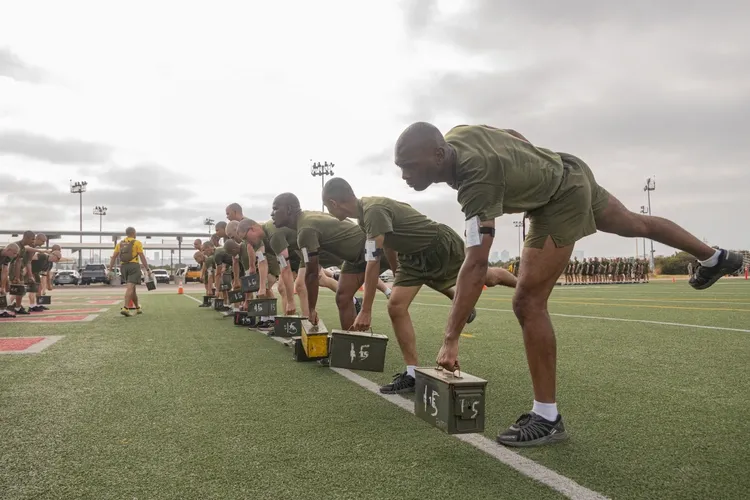
The single leg Romanian deadlift (SLRDL) is a one-leg hip hinge that loads your hamstrings and glutes while forcing the small hip stabilizers to hold your pelvis level. It is a fixture in our military fitness programs because the job rarely happens on two even feet. You ruck over broken ground, step down off vehicles, and push off one leg thousands of times on every run.
This guide covers what the movement is, the muscles it trains, step-by-step form, every equipment variation worth using, beginner progressions, how it compares to the standard RDL, and how to program it. Start with the definition, because the hinge is the whole exercise.
Key Takeaways:
The single-leg Romanian deadlift trains the hamstrings and glutes one side at a time and places heavy demand on the gluteus medius for pelvic control.
One-leg strength exposes and corrects the left-to-right imbalances that bilateral lifts hide.
Hip position beats load. Keep the hips square and the spine neutral before you add weight.
A dumbbell in the opposite hand is the best default. Kettlebell, landmine, cable, and barbell versions each solve a specific problem.
Program it for 3 to 4 sets of 6 to 12 reps per leg, after your main lift, once or twice per week.
What Is a Single-Leg Romanian Deadlift?
The single-leg Romanian deadlift is a hip-hinge exercise performed on one leg. You push the hips back and lower the torso toward parallel while the free leg extends behind you as a counterbalance. The standing knee stays softly bent, and the load travels close to the shin.
The name tells you its lineage. A Romanian deadlift starts from the top instead of the floor and keeps the knee angle nearly fixed, so the hamstrings and glutes do the work through a long range of motion. Take one leg away and you keep that hinge pattern while adding a balance and anti-rotation problem your body has to solve on every rep.
You will see it written as SLRDL, single-leg RDL, or Romanian single-leg deadlift. They all describe the same single leg Romanian deadlift exercise.
What Muscles Does the Single-Leg Romanian Deadlift Work?
The single-leg Romanian deadlift works the hamstrings and gluteus maximus as prime movers. The spinal erectors hold the torso, while the gluteus medius, adductors, and foot and ankle muscles stabilize the stance leg. You train hip extension strength and single-leg control in the same rep.
Hamstrings: lengthen under load, then extend the hip. Eccentric hamstring strength protects against strain injury in running.
Gluteus maximus: drives the hip forward to stand tall. Powers climbing, sprinting, and rucking up grade.
Gluteus medius: keeps the pelvis level on one leg. Controls hip and knee alignment on uneven terrain.
Spinal erectors: hold a neutral spine. Protect the low back when the torso is horizontal.
Adductors and deep hip rotators: resist hip rotation and collapse. Stabilize the stance through the full range.
Foot and ankle complex: make constant balance corrections. Builds ankle stability for load carriage.
The Gluteus Medius Factor
This is where the single-leg version separates from bilateral hinging. In a widely cited EMG study of common therapeutic exercises, the single-limb deadlift ranked near the top for both gluteus maximus and gluteus medius activation (Distefano et al., 2009). Boren and colleagues (2011) reported similar findings for single-leg stance exercises.
The reason is mechanical. On one leg, the glute medius has to stop your pelvis from dropping toward the free side. If you have ever watched a knee cave inward on a step down off a ledge, you have seen a glute medius that lost that fight.
The hinge itself does targeted hamstring work. Bourne et al. (2017) found that hip-extension exercises such as the RDL preferentially load the long head of the biceps femoris, the hamstring muscle most often strained during high-speed running (Opar et al., 2012).
Why the Single-Leg RDL Matters for Tactical Athletes
The single-leg RDL matters because tactical work happens one leg at a time under load. It builds unilateral hip strength, exposes left-to-right imbalances, and trains the stabilizers that keep you upright on uneven ground. Those adaptations carry directly to rucking, running economy, and lower-body injury resistance.
It corrects imbalances. Bilateral lifts let the stronger side cover for the weaker one. Inter-limb asymmetries have been linked to reduced jumping and change-of-direction performance (Bishop et al., 2018), and hamstring strength imbalances have been linked to higher strain risk (Croisier et al., 2008). Training each side alone shows you the gap and closes it.
It builds durability under load. Load carriage alters gait and raises lower-extremity injury risk (Knapik et al., 2004). Musculoskeletal injuries are the leading driver of medical non-readiness in the Army (Molloy et al., 2020). A hip that holds alignment under a pack keeps you training and deployable.
It trains stability that transfers. Unstable-base training improves balance and trunk muscle activation (Behm & Anderson, 2006). The SLRDL delivers that stimulus while still allowing meaningful load, which most balance drills cannot.
It supports running mechanics. Running is a series of single-leg landings. Hamstrings and glutes that are strong at long muscle lengths absorb the braking forces at the end of each stride.
This is the core argument behind functional strength for military performance: strength has to show up in the positions the job puts you in. Unilateral work does not cost you bilateral strength, either. Short-term studies show unilateral and bilateral programs produce similar strength gains on both types of test (McCurdy et al., 2005; Speirs et al., 2016).
If you are balancing lifting with ruck and run mileage, our guide to choosing a strength & endurance program explains how to build both without one eating the other.
How to Do a Single-Leg Romanian Deadlift (Form & Setup)
To do a single-leg Romanian deadlift, stand on one leg with a soft knee, push your hips back as the free leg extends behind you, and lower the weight along the shin until your torso nears parallel. Then drive the hip forward to stand tall, keeping both hips square to the floor throughout.
Step by step, with a dumbbell in the opposite hand:
Set the stance. Stand on your left leg with the knee slightly unlocked and your weight over the middle of the foot. Hold the dumbbell in your right hand.
Brace. Breathe in, tighten your trunk, and pull your shoulders back and down. Keep your spine neutral from head to tailbone.
Hinge. Push your left hip straight back as your right leg reaches behind you. Your torso and rear leg move as one lever.
Lower under control. Take two to three seconds on the way down, with the weight tracking close to the standing shin.
Stop at your range. When the hamstring reaches full tension or your hips start to rotate open, stop. For most athletes that is torso near parallel.
Drive back up. Squeeze the glute of the standing leg and push the hip forward, bringing the torso and rear leg back to vertical together.
Finish the side. Complete every rep on one leg before switching.
Balance Cues That Work
Point the back toe at the floor. A toe turned out means the hip has opened.
Grip the floor with the whole foot, big toe included.
Fix your eyes on a spot on the floor a few feet ahead to keep the neck neutral.
Reach long through the back heel, as if pressing it into a wall behind you.
Slow the lowering phase. Most balance losses happen when athletes drop fast.
Common Form Mistakes
Hips rotating open. This takes the glute medius out of the lift. Point the back toe down and drop the load until you can hold position.
Squatting the stance knee. Extra knee bend turns a hinge into a squat and shifts work to the quads. Set the knee angle at the start and keep it.
Rounding to get deeper. Range comes from the hip, not the spine. Stop where your hamstrings stop you.
Weight drifting forward. A load out in front lengthens the lever on your low back. Keep it over the midfoot.
Equipment Variations: Dumbbell, Kettlebell, Barbell & More
Every variation trains the same hinge. The equipment changes where the load sits, which changes what limits the set.
Dumbbell Single-Leg Romanian Deadlift
The dumbbell single-leg Romanian deadlift is the default and the most popular version for good reason. Holding the dumbbell in the hand opposite the standing leg (contralateral) increases rotational demand and glute medius work. Holding it on the same side (ipsilateral) is easier to balance. Once balance is solid, a single leg Romanian deadlift with dumbbells in both hands lets you add total load without changing the pattern.
Kettlebell Single-Leg RDL
A kettlebell sits with its mass below your hand, so it tracks close to the shin and feels natural at the bottom. It works well in garage gyms and for athletes who struggle to keep a dumbbell from swinging. Two kettlebells serve the same purpose as two dumbbells.
Barbell Single-Leg RDL
The barbell single-leg Romanian deadlift offers the most load potential but the hardest balance challenge, because a long bar amplifies any rotation. It also places more demand on the upper back to hold the bar. Reserve it for athletes who own the dumbbell version.
Landmine and Cable Variations
A landmine single-leg Romanian deadlift anchors one end of the bar, which guides the path and reduces balance demand. That makes it a strong choice for heavier loading or for training late in a session when stability fades. A low-pulley cable keeps tension on the hamstrings at the bottom of the rep and suits slower tempo work.
Dumbbell (contralateral): best as the default and for glute medius emphasis. Trade-off: load is capped by grip and balance.
Kettlebell: best for a natural path close to the shin. Trade-off: fewer small weight increments.
Barbell: best for the heaviest loading. Trade-off: highest rotational and balance demand.
Landmine: best for heavier work with a guided path. Trade-off: less stability training.
Cable: best for constant tension and tempo work. Trade-off: requires a cable station.
Bodyweight and Beginner Progressions
Yes, a bodyweight single-leg Romanian deadlift is an effective starting point. With no weight, you learn to hinge and balance before load enters the equation. Most beginners are limited by balance, not hamstring strength, so building control first is the fastest route to loading the lift heavy.
Progress through these stages in order:
Supported SLRDL. Hold a rack, wall, or dowel lightly with one hand to take balance out of the equation while you learn the hinge.
Bodyweight SLRDL with reach. Perform the single leg Romanian deadlift with no weight, reaching both hands toward the floor to counterbalance.
Banded single-leg Romanian deadlift. Stand on a light band and hold the ends. The band adds resistance at the top, where the glute finishes the rep, without making the bottom harder to balance.
Light dumbbell, contralateral. Introduce load in the opposite hand.
Load and tempo. Add weight or slow the lowering phase to three or four seconds.
Move to the next stage when you can complete 2 sets of 10 per leg with no touch-downs and square hips on every rep.
Single-Leg RDL vs. RDL vs. Single-Leg Deadlift
The single-leg RDL and the RDL use the same hip hinge. The RDL loads both legs for maximum weight, while the single-leg version trades load for unilateral strength and balance. “Single-leg deadlift” often describes the same lift, but some coaches use it for a version with more knee bend that starts from the floor.
Single-leg RDL: one-leg stance with a slight, fixed knee bend, starting from the top. It emphasizes the hamstrings, glutes, and glute medius at moderate load. Best for balance, asymmetry, and durability.
RDL: two-leg stance with a slight, fixed knee bend, starting from the top. It emphasizes the hamstrings, glutes, and erectors and allows the highest load. Best for absolute posterior-chain strength.
Single-leg deadlift (knee-dominant version): one-leg stance with greater knee bend that changes through the rep, often starting from the floor. It emphasizes the glutes, quads, and hamstrings at moderate load. Best for single-leg power and pickup mechanics.
Most tactical athletes benefit from both main hinges. Use the RDL to build absolute posterior-chain strength, and use the single-leg RDL as an accessory to train balance and side-to-side symmetry. They complement each other rather than compete.
Single-Leg Romanian Deadlift Alternatives
When balance, equipment, or injury rules out the full single-leg RDL, these swaps keep the training effect:
B-stance (kickstand) RDL. The back foot rests lightly on its toes for balance while most of the load stays on the front leg. This is the closest alternative to the single-leg Romanian deadlift.
Staggered-stance RDL. A split stance with more weight shared between legs. Good for heavier loading or fatigue.
Hamstring curl. Isolates knee flexion when hinging is off the table. The Nordic hamstring curl in particular has reduced hamstring injury rates in field athletes (van der Horst et al., 2015).
Single-leg hip thrust. Trains the glute through hip extension with no balance demand.
These overlap with the broader family of hamstring exercises we cover in depth elsewhere, which is the next stop if you want to build out a full posterior-chain day.
How to Program the Single-Leg RDL
The single-leg RDL works best as an accessory after your main lift, on a lower-body or posterior-chain day. Because balance limits load, keep reps moderate to high and stop each set with one to three reps left in reserve. Rep ranges from roughly 6 to 15 build strength and muscle when sets are taken close to failure (Schoenfeld et al., 2021).
Strength: 3 to 4 sets of 6 to 8 reps per leg, 90 to 120 seconds rest. Use a dumbbell, kettlebell, or landmine.
Durability and muscle: 3 sets of 8 to 12 reps per leg, 60 to 90 seconds rest. Use a controlled 3-second lowering.
Balance and entry level: 2 to 3 sets of 10 to 15 reps per leg, 60 seconds rest. Use bodyweight or a band.
How much weight? Load is limited by balance before it is limited by the hamstrings, so expect to use far less than your two-legged RDL. Add weight when you hit the top of the rep range on every set with square hips and no touch-downs.
Where it fits. Train it once or twice per week. Pair it with lunges as a unilateral block, or place it after a heavy squat or trap-bar pull. Keep it at least a day away from your longest ruck so your hamstrings are fresh for the load. For a complete template to slot it into, see a strength workout for athletes.
FAQ: Frequently Asked Questions
How do you do a single-leg Romanian deadlift with correct form?
Stand on one leg with a soft knee and hold the weight in the opposite hand. Push your hips back as the free leg extends behind you, keeping hips square and spine neutral. Lower until your torso nears parallel or your hamstring reaches full tension, then squeeze the standing glute to return to vertical.
What is the difference between a single-leg RDL and a regular RDL?
Both use the same hip hinge with a slight, fixed knee bend. The regular RDL loads both legs and allows the heaviest weight for posterior-chain strength. The single-leg RDL uses less load but adds a balance and anti-rotation demand that trains the gluteus medius and exposes left-to-right imbalances.
Can you do a single-leg Romanian deadlift with just bodyweight?
Yes. The bodyweight version is the right starting point for most athletes, because balance limits performance before strength does. Use a light hand support first, then progress to no support. Once you can do 2 sets of 10 per leg without touching down, add a band or light dumbbell.
Dumbbell or kettlebell for the single-leg RDL: which is better?
The dumbbell is the better default because it offers small weight jumps and works well in the opposite hand for glute medius emphasis. The kettlebell tracks more naturally close to the shin and suits garage gyms. Both train the same pattern, so use whichever lets you hold square hips.
How do you keep your balance during a single-leg RDL?
Grip the floor with your whole foot, point the back toe down, and fix your eyes on a spot a few feet ahead. Move the torso and rear leg as one lever and slow the lowering phase. Most balance losses come from rushing the descent or letting the hips rotate open.
What is a good single-leg Romanian deadlift alternative?
The B-stance (kickstand) RDL is the closest alternative. Your back foot rests lightly on its toes for balance while the front leg does most of the work. Staggered-stance RDLs, hamstring curls, and single-leg hip thrusts also work depending on whether balance, equipment, or injury is the limiter.
The single leg Romanian deadlift earns its place by building what bilateral lifts miss: hamstring and glute strength one side at a time, a glute medius that holds your pelvis level, and balance that holds up on uneven ground with a load on your back. Master the bodyweight version, load the dumbbell variation, and program it as a consistent accessory after your main lift.
Knowing the movement is the easy part. Placing it correctly within a week of heavy lifting, rucking, and running is where most athletes stall. Start a CF ONE plan and get the single-leg RDL programmed alongside the rest of your training, with the load and volume already worked out.
References:
Distefano LJ, Blackburn JT, Marshall SW, Padua DA. Gluteal muscle activation during common therapeutic exercises. Journal of Orthopaedic & Sports Physical Therapy. 2009;39(7):532-540.
Boren K, Conrey C, Le Coguic J, Paprocki L, Voight M, Robinson TK. Electromyographic analysis of gluteus medius and gluteus maximus during rehabilitation exercises. International Journal of Sports Physical Therapy. 2011;6(3):206-223.
Bourne MN, Williams MD, Opar DA, Al Najjar A, Kerr GK, Shield AJ. Impact of exercise selection on hamstring muscle activation. British Journal of Sports Medicine. 2017;51(13):1021-1028.
Opar DA, Williams MD, Shield AJ. Hamstring strain injuries: factors that lead to injury and re-injury. Sports Medicine. 2012;42(3):209-226.
Croisier JL, Ganteaume S, Binet J, Genty M, Ferret JM. Strength imbalances and prevention of hamstring injury in professional soccer players: a prospective study. American Journal of Sports Medicine. 2008;36(8):1469-1475.
Bishop C, Turner A, Read P. Effects of inter-limb asymmetries on physical and sports performance: a systematic review. Journal of Sports Sciences. 2018;36(10):1135-1144.
Knapik JJ, Reynolds KL, Harman E. Soldier load carriage: historical, physiological, biomechanical, and medical aspects. Military Medicine. 2004;169(1):45-56.
Molloy JM, Pendergrass TL, Lee IE, et al. Musculoskeletal injuries and United States Army readiness part I: overview of injuries and their strategic impact. Military Medicine. 2020;185(9-10):e1461-e1471.
Behm DG, Anderson KG. The role of instability with resistance training. Journal of Strength and Conditioning Research. 2006;20(3):716-722.
McCurdy KW, Langford GA, Doscher MW, Wiley LP, Mallard KG. The effects of short-term unilateral and bilateral lower-body resistance training on measures of strength and power. Journal of Strength and Conditioning Research. 2005;19(1):9-15.
Speirs DE, Bennett MA, Finn CV, Turner AP. Unilateral vs. bilateral squat training for strength, sprints, and agility in academy rugby players. Journal of Strength and Conditioning Research. 2016;30(2):386-392.
van der Horst N, Smits DW, Petersen J, Goedhart EA, Backx FJ. The preventive effect of the Nordic hamstring exercise on hamstring injuries in amateur soccer players: a randomized controlled trial. American Journal of Sports Medicine. 2015;43(6):1316-1323.
Schoenfeld BJ, Grgic J, Van Every DW, Plotkin DL. Loading recommendations for muscle strength, hypertrophy, and local endurance: a re-examination of the repetition continuum. Sports. 2021;9(2):32.
Lauersen JB, Bertelsen DM, Andersen LB. The effectiveness of exercise interventions to prevent sports injuries: a systematic review and meta-analysis of randomised controlled trials. British Journal of Sports Medicine. 2014;48(11):871-877.
Haff GG, Triplett NT, eds. Essentials of Strength Training and Conditioning. 4th ed. National Strength and Conditioning Association. Human Kinetics; 2016.
Headquarters, Department of the Army. FM 7-22: Holistic Health and Fitness. 2020.
Disclaimer: This article is for educational purposes and does not replace individualized medical advice. Consult a qualified healthcare provider before starting a new training program, especially if you have a current or previous injury. Stop any exercise that causes sharp pain and seek professional evaluation.


