
Rear Delt Exercises: 6 Best Moves | Combat Fitness
Rear Delt Exercises: The Best Moves for Stronger, Healthier Shoulders
Rear delt exercises are the cheapest shoulder insurance a tactical athlete can buy. The posterior deltoid pulls the upper arm back and helps hold the shoulder in a stable position. Most training plans starve it while they load the front of the shoulder with presses, push-ups, and carries, which is why our tactical fitness programs build rear delt work into every upper-body week.
We program for soldiers, police officers, and firefighters who spend long hours under plate carriers and ruck straps, and this guide reflects that. You will get the six best rear delt exercises, options for dumbbells, cables, machines, and bands, a sample rear delt workout, and the dosing that makes the work stick. First, why the muscle matters.
Key Takeaways:
Rear delts and the mid-back muscles counter the forward-rounded posture that pressing volume and load carriage build over time.
The best rear delt exercises share one pattern: the upper arm moves backward in a horizontal plane while the shoulder blade stays controlled.
Light loads and high reps (12 to 25) work best here, because the rear delt is small and the traps take over once the weight gets heavy.
Two to four short sessions a week beat one long session for a muscle you train for durability.
Every option scales from a full gym down to a single resistance band.
Why Train Your Rear Delts?
Rear delts are worth training because they balance the pressing and carrying that dominate tactical work. The posterior deltoid moves the arm backward and rotates it outward. Working with the rhomboids, middle trapezius, and rotator cuff, it helps keep the shoulder centered and stable under load.
What Are the Rear Delts and Where Are They?
The deltoid has three heads: front (anterior), side (lateral), and rear (posterior). The rear delt muscle starts on the spine of the shoulder blade, wraps across the back of the shoulder, and attaches to the outside of the upper arm bone. To find the rear delt muscle location, reach across your chest and press the back of your shoulder, just above the armpit crease. That is the head doing the work when you pull your arm back and out to the side.
Its main jobs are horizontal abduction (pulling the arm back from in front of you), shoulder extension, and external rotation. Those three motions show up in every rowing, pulling, and arm-back-overhead position you use, which is why a weak rear delt shows up as a weak link in all of them.
Why Tactical Athletes Need Rear Delt Work More Than Most
A typical tactical program is front-heavy. Bench press, push-ups, overhead pressing, and the push-up event on most fitness tests all load the anterior delt and chest. Then you add hours under ruck straps and plate carriers that pull the shoulders forward and down. Research on soldier load carriage documents how heavy packs alter posture and loading through the shoulders and upper back.
Altered shoulder blade position and control is associated with a range of shoulder complaints in the clinical research. That is why strengthening the posterior shoulder and scapular muscles is a standard part of shoulder rehab and prehab programming. Rear delt work will not guarantee a healthy shoulder, but it removes one of the most common imbalances we see. That is durability, not aesthetics, and it is the same logic behind functional strength for military performance. Rear delt training also sits inside a complete shoulder plan, alongside side-delt and front-delt work.
The Best Rear Delt Exercises
The best rear delt exercises are the rear delt fly, the face pull, the reverse pec deck, the rear-delt row, the chest-supported rear-delt raise, and the band pull-apart. Each one moves the upper arm backward with the shoulder blade controlled. That keeps the posterior deltoid as the prime mover instead of the traps.
We ranked these good rear delt exercises on three criteria: how well each one isolates the rear delt, how easy the equipment is to find in a unit gym or a hotel room, and how well it takes progressive overload without the traps hijacking it. The same thinking applies to whole programs. If you are comparing options, our guide to choosing a strength & endurance program walks through what to look for.
1. Rear Delt Fly (Top Pick)
Hinge at the hips until your torso is close to parallel with the floor. Hold the dumbbells under your chest with a slight bend in the elbows. Sweep your arms out and back until they reach shoulder height, lead with the elbows, and lower under control.
The rear delt fly is the purest isolation option on this list and works with dumbbells, cables, or a machine. Verdict: if you only do one of these great rear delt exercises, do this one.
2. Face Pull
Set a rope at upper-chest to face height. Pull the rope toward your forehead, split the ends apart, and finish with your hands beside your ears and your elbows high. The face pull trains the rear delts, mid traps, and the external rotators in one movement, which makes it the best value for shoulder health. Verdict: the best all-in-one shoulder-health move.
3. Reverse Pec Deck
Sit facing the pad, grab the handles at shoulder height, and open your arms back until they line up with your body. The machine fixes your torso, so you can push close to failure without form breaking down. Verdict: the best choice for chasing growth safely.
4. Rear-Delt Row
Row a dumbbell, cable, or barbell with your elbows flared out to roughly 70 to 90 degrees from your torso, and pull toward your upper chest instead of your hip. Flaring the elbows shifts the work away from the lats and onto the rear delts and upper back. Verdict: the best way to load rear delts heavier with a compound pull.
5. Chest-Supported Rear-Delt Raise
Lie face down on an incline bench set around 30 to 45 degrees. Let the dumbbells hang, then raise them out to the sides with a slight elbow bend. The bench removes momentum and lower-back strain, so the rear delts cannot cheat. Verdict: the cleanest dumbbell version for lifters who swing their reps.
6. Band Pull-Apart
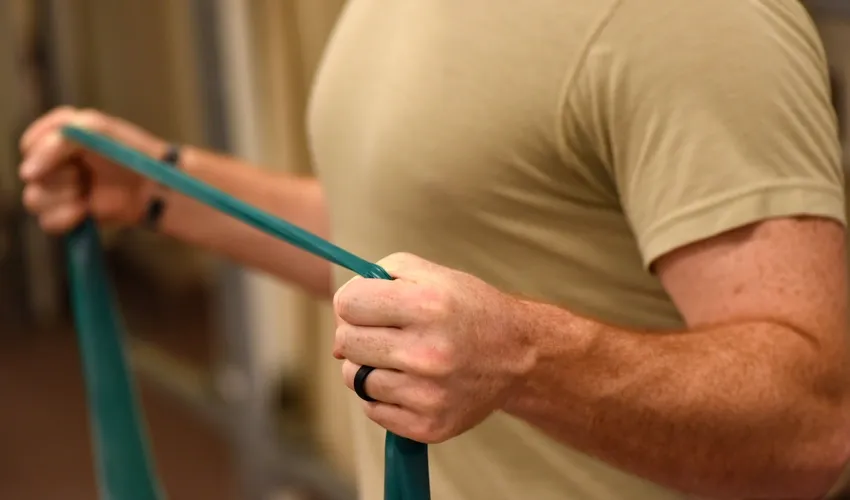
Hold a light band at shoulder height with straight arms and pull it apart until it touches your chest. It takes 30 seconds, needs no gym, and fits between sets of anything. Verdict: the most useful rear delt exercise for high frequency.
Dumbbell Rear Delt Exercises
The best dumbbell rear delt exercises are the bent-over fly, the chest-supported rear delt raise, the dumbbell rear-delt row, and the side-lying rear delt raise. Dumbbells let each arm work independently, which exposes and corrects side-to-side imbalances that a barbell or machine can hide.
These four rear delt exercises with dumbbells cover every angle you need:
Bent-over dumbbell fly: the standard back delts exercise, done standing or seated on the end of a bench with your chest on your thighs.
Chest-supported rear delt raise: the strictest dumbbell rear delt raise, because the bench locks your torso in place.
Dumbbell rear-delt row: an elbows-out row that lets you handle more load than any fly.
Side-lying rear delt raise: lie on your side and raise the top arm up and back, which loads the muscle hardest near the top of the motion.
Pick a weight you can move for 15 clean reps without shrugging or swinging. For most lifters, that is far lighter than their lateral raise weight. If your neck tightens and your shoulders climb toward your ears, the load is too heavy and your traps are doing the job.
Cable Rear Delt Exercises
Cables keep tension on the rear delt through the full range, including the start of the rep where dumbbells go slack. That makes these rear delt cable exercises a strong second option after dumbbells.
Cable Rear Delt Fly
Set both pulleys at shoulder height, cross the cables so each hand holds the opposite side, and pull your arms back and apart. A single-arm cross-body version works well for fixing a weaker side.
Cable Face Pull
The cable face pull is the go-to cable option for rear delts, rotator cuff, and upper back in one move. Set up as described above and keep the elbows high through every rep. Cable face pulls tend to get rushed with too much weight, so slow the lowering phase and own the finish position.
Machine Rear Delt Exercises
The reverse pec deck is the main rear delt machine, and most commercial and unit gyms have one. It works as the same station as the chest fly, with you facing the opposite direction.
Set the seat so the handles sit at shoulder height. Use a neutral or palms-down grip, keep a soft bend in the elbows, and stop when your arms line up with your torso. Pushing past that point pulls the shoulder blades together and shifts the work to the rhomboids and traps. The rear delt fly machine is also the easiest place to run drop sets, because changing the pin takes two seconds.
At-Home and Band Rear Delt Exercises
You can train rear delts at home with nothing more than a band and the floor. Elastic resistance produces strength gains comparable to free weights in the research, and muscle activation during band exercises is similar to dumbbell versions when the effort matches.
These band and bodyweight rear delt exercises need no gym:
Band pull-apart: palms down, palms up, and diagonal variations all count.
Band rear fly: stand on the band or anchor it low, hinge forward, and fly the arms back.
Banded face pull: anchor the band at head height on a door or post and pull to your face.
Prone T raise: lie face down on the floor with arms out to the sides, thumbs up, and lift your arms off the ground. Hold each rep for two seconds at the top.
The prone T raise is the best bodyweight rear delt option because the hold at the top creates enough tension without any load. It travels well, which matters if you are deployed, in the field, or on shift.
A Sample Rear Delt Workout
A good rear delt workout takes 10 to 15 minutes, uses three or four moves, and fits at the end of a pull or upper-body day. You do not need a dedicated rear deltoid workout day. A short finisher done often outperforms one long session done rarely.
The Combat Fitness rear delt finisher:
Reverse pec deck: 3 sets of 15 to 20 reps, 60 seconds rest.
Chest-supported rear delt raise: 3 sets of 12 to 15 reps, 60 seconds rest.
Cable face pull: 2 sets of 15 to 20 reps, 45 seconds rest.
Band pull-apart: 1 set of 50 total reps, in as few sets as you need.
No gym? Swap the pec deck for a band rear fly, the cable face pull for a banded face pull, and the chest-supported raise for prone T raises. The structure stays the same, so this rear shoulder workout travels with you.
How Often Should You Train Rear Delts?
Train rear delts two to four times per week, building toward roughly 10 or more hard sets across the week. Research on training volume links higher weekly set counts to greater muscle growth, and training a muscle at least twice a week supports better results than once.
How Much Load and How Many Reps?
Light loads work. Studies comparing heavy and light training show similar muscle growth when sets go close to failure. For rear delts, that favors 12 to 25 reps, where you can keep strict form and stop the traps from taking over. Progress by adding reps first, then a one-second pause at the top, then load.
How Many Rear Delt Exercises Per Session?
Use one or two rear delt exercises per session and rotate three or four across the week. Placement options that work in a tactical schedule:
At the end of pull days: a full finisher when you are already warm.
Before pressing: two sets of band pull-aparts to prime the upper back.
On ruck or run days: a few band sets to offset the strap position.
The hard part is not knowing the moves. It is fitting them into a week of running, rucking, and heavy lifting without stacking junk volume. That is what structured programming solves.
Frequently Asked Questions
What are the best rear delt exercises?
The best rear delt exercises are the rear delt fly, face pull, reverse pec deck, rear-delt row, chest-supported rear-delt raise, and band pull-apart. Start with the rear delt fly for isolation and the face pull for overall shoulder health, then add the others based on your equipment.
Where are the rear delts and what do they do?
The rear delts sit on the back of the shoulder, running from the shoulder blade to the outside of the upper arm. They pull the arm backward, extend the shoulder, and rotate the arm outward. Together with the upper-back muscles, they help keep the shoulder stable and centered under load.
What are the best dumbbell rear delt exercises?
The best dumbbell rear delt exercises are the bent-over fly, chest-supported rear delt raise, dumbbell rear-delt row, and side-lying rear delt raise. The chest-supported version is the strictest, because the bench removes momentum. Use light dumbbells and stop any rep where your shoulders shrug toward your ears.
How do you train rear delts at home with no equipment?
Train rear delts at home with prone T raises on the floor, holding each rep for two seconds at the top. If you own a single resistance band, add band pull-aparts, band rear flies, and banded face pulls. Those four moves cover the full rear delt pattern without a gym.
Rear delt fly vs face pull: which is better?
Neither one wins outright, because they do different jobs. The rear delt fly isolates the posterior deltoid better and suits growth. The face pull trains the rear delts, mid traps, and external rotators together, which makes it the stronger shoulder-health choice. Most tactical athletes should use both each week.
How often should you train rear delts?
Train rear delts two to four times per week. The muscle is small, recovers quickly, and responds well to frequent high-rep work. Spreading 10 or more hard sets across several short sessions is easier to recover from than cramming them into one day.
Why won’t my rear delts grow?
Rear delts usually stall because the traps are doing the work. The fix is lighter weight, slower reps, and a chest-supported setup. Keep your shoulders down and away from your ears, lead with the elbows, and focus on the back of the shoulder. Research shows that deliberately focusing on the target muscle can improve its activation and growth.
Rear delt exercises are not a vanity add-on for tactical athletes. They are the counterweight to every rep of pressing and every mile under a ruck, and they take less than 15 minutes a few times a week. Pick two moves from this list, start tomorrow at the end of your next pull session, and progress the reps before you add load. If you want rear delt work, strength, and conditioning built into one plan that fits your job and your test, start a structured Combat Fitness program and let the programming handle the balance.
References:
Neumann DA. Kinesiology of the Musculoskeletal System: Foundations for Rehabilitation. 3rd ed. Elsevier; 2017.
Kendall FP, McCreary EK, Provance PG, Rodgers MM, Romani WA. Muscles: Testing and Function with Posture and Pain. 5th ed. Lippincott Williams & Wilkins; 2005.
Knapik JJ, Reynolds KL, Harman E. Soldier load carriage: historical, physiological, biomechanical, and medical aspects. Military Medicine. 2004;169(1):45-56.
Ludewig PM, Reynolds JF. The association of scapular kinematics and glenohumeral joint pathologies. Journal of Orthopaedic & Sports Physical Therapy. 2009;39(2):90-104.
Kibler WB, Sciascia A. Current concepts: scapular dyskinesis. British Journal of Sports Medicine. 2010;44(5):300-305.
Cools AM, Dewitte V, Lanszweert F, et al. Rehabilitation of scapular muscle balance: which exercises to prescribe? American Journal of Sports Medicine. 2007;35(10):1744-1751.
Reinold MM, Escamilla RF, Wilk KE. Current concepts in the scientific and clinical rationale behind exercises for glenohumeral and scapulothoracic musculature. Journal of Orthopaedic & Sports Physical Therapy. 2009;39(2):105-117.
Schoenfeld BJ, Ogborn D, Krieger JW. Dose-response relationship between weekly resistance training volume and increases in muscle mass: a systematic review and meta-analysis. Journal of Sports Sciences. 2017;35(11):1073-1082.
Schoenfeld BJ, Ogborn D, Krieger JW. Effects of resistance training frequency on measures of muscle hypertrophy: a systematic review and meta-analysis. Sports Medicine. 2016;46(11):1689-1697.
Schoenfeld BJ, Grgic J, Ogborn D, Krieger JW. Strength and hypertrophy adaptations between low- vs. high-load resistance training: a systematic review and meta-analysis. Journal of Strength and Conditioning Research. 2017;31(12):3508-3523.
Schoenfeld BJ. The mechanisms of muscle hypertrophy and their application to resistance training. Journal of Strength and Conditioning Research. 2010;24(10):2857-2872.
Lopes JSS, Machado AF, Micheletti JK, et al. Effects of training with elastic resistance versus conventional resistance on muscular strength: a systematic review and meta-analysis. SAGE Open Medicine. 2019;7:2050312119831116.
Andersen LL, Andersen CH, Mortensen OS, et al. Muscle activation and perceived loading during rehabilitation exercises: comparison of dumbbells and elastic resistance. Physical Therapy. 2010;90(4):538-549.
Calatayud J, Vinstrup J, Jakobsen MD, et al. Importance of mind-muscle connection during progressive resistance training. European Journal of Applied Physiology. 2016;116(3):527-533.
Schoenfeld BJ, Vigotsky A, Contreras B, et al. Differential effects of attentional focus strategies during long-term resistance training. European Journal of Sport Science. 2018;18(5):705-712.
Haff GG, Triplett NT, eds. Essentials of Strength Training and Conditioning. 4th ed. National Strength and Conditioning Association; Human Kinetics; 2016.
Headquarters, Department of the Army. FM 7-22: Holistic Health and Fitness. Washington, DC; 2020.
Disclaimer: This article is for educational purposes only and is not medical advice. If you have shoulder pain, a past injury, or a medical condition, consult a qualified healthcare provider before starting a new exercise program. Stop any exercise that causes sharp or worsening pain.


