
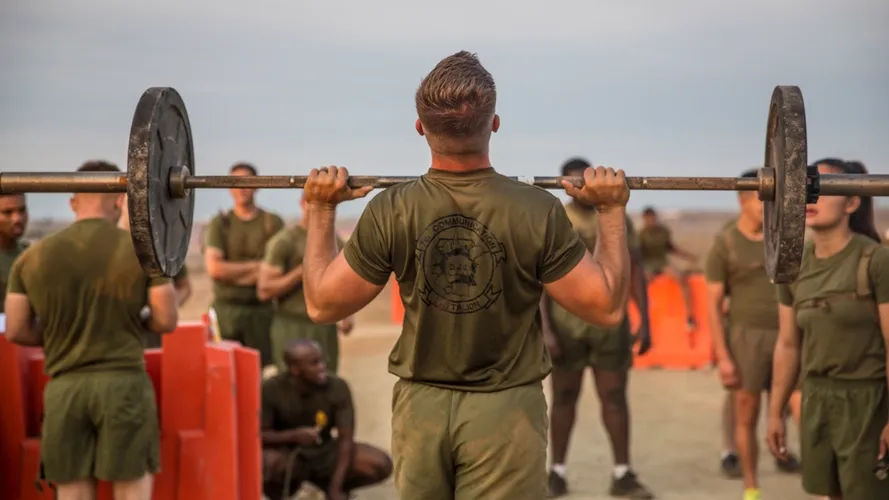
Overhead Press (Shoulder Press): Form, Muscles & Variations
Overhead Press (Shoulder Press): Muscles Worked, Form & Variations
The overhead press is any lift that drives a load from your shoulders to full lockout above your head. The shoulder press is the same movement under a different name. It builds the pressing strength and shoulder stability you use to load gear onto racks, push equipment overhead, and hold position under a plate carrier, which is why our military fitness training programs treat it as a core strength lift.
This guide settles the naming question, then covers the muscles the overhead shoulder press trains, how to do it with clean form, standing versus seated, dumbbell versus barbell, and the programming we use to drive the number up.
Key Takeaways:
The overhead press and the shoulder press are the same movement family. The military press is the strict, standing barbell version inside that family.
The lift trains the front and side delts, triceps, and upper chest, while your traps and serratus rotate the shoulder blade to clear the arm overhead.
Standing versions build braced, whole-body strength. Seated versions load the shoulders with less demand on the trunk and low back.
Barbell variations move the most weight. Dumbbells expose side-to-side imbalances and offer a more shoulder-friendly path.
Progress it with 2 to 3 sessions per week and small load jumps once you beat your rep target on consecutive sessions.
What Is the Overhead Press?
The overhead press is a compound upper-body exercise in which you press a barbell, dumbbells, kettlebells, or a machine handle from shoulder height to straight arms overhead. “Overhead press,” “shoulder press,” and “overhead shoulder press” all name this same pattern: the vertical push, the overhead counterpart to the bench press.
Strength coaches sort upper-body lifts by direction of force. Horizontal pushes move the load away from your chest, and vertical pushes move it above your head. The overhead shoulder press exercise is the standard vertical push because few lifts load the shoulder through its full overhead range while forcing the trunk to stay rigid (Haff and Triplett, 2016).
The equipment and body position can change. The pattern does not: start with the load at the shoulders, finish with elbows locked and the load stacked over your midfoot.
Overhead Press vs. Shoulder Press vs. Military Press: What’s the Difference?
There is no difference between the overhead press and the shoulder press. Both describe pressing a load from the shoulders to lockout overhead. The military press is one specific version inside that family: a strict, standing barbell press with a narrow stance, no leg drive, and the whole body held rigid.
The confusion comes from labeling habits. Gyms and apps tend to call machines and seated dumbbell work a “shoulder press,” while barbell lifters say “overhead press” or “OHP.” Some coaches reserve “shoulder press” for seated work and “overhead press” for standing work. That is a convention, not a definition. When you see either name, assume the same movement and check the equipment and stance.
The military press is named for its rigid, attention-style posture, and historically lifters performed it with heels together. Its defining rule is strictness. Once you dip and drive with your legs, the lift becomes a push press, which lets you handle heavier loads but shifts work away from the shoulders. The strict standing barbell variant is a lift worth programming on its own terms, and we treat it as a distinct variant within this family.
Overhead press: the umbrella term for any vertical press to lockout. Done with a barbell, dumbbells, kettlebells, or a machine. No leg drive.
Shoulder press: the same movement, often used for seated and machine versions. Done with dumbbells, a machine, or a barbell. No leg drive.
Overhead shoulder press: a combined name for the same lift. Any equipment. No leg drive.
Military press: a strict standing barbell press with a narrow stance and a rigid body. Barbell only. No leg drive.
Push press: an overhead press started with a dip and drive from the legs. Done with a barbell or dumbbells. Uses leg drive.
What Muscles Does the Overhead Press Work?
The overhead press works the anterior (front) and lateral (side) deltoids as prime movers, the triceps to straighten the elbow, and the upper chest early in the press. The upper trapezius and serratus anterior rotate the shoulder blade upward, and your core, glutes, and legs stabilize the load when you stand.
Anterior deltoid: the main driver from the rack position to forehead height.
Lateral deltoid: contributes more as the arm travels toward lockout and with wider or dumbbell paths.
Triceps: finish the press by extending the elbow, and they often decide whether a heavy rep locks out.
Upper chest (clavicular pectoralis): helps start the bar off the shoulders.
Upper trapezius and serratus anterior: rotate the shoulder blade so the arm can reach overhead.
Rotator cuff: keeps the head of the upper arm centered in the socket throughout the lift (Escamilla et al., 2009).
Core, glutes, and legs: resist arching and lean when you press standing.
What part of the shoulder does the overhead press work?
The front delt carries the heaviest share, with the side delt close behind near the top. The shoulder blade matters as much as the delts. Reaching overhead requires the scapula to rotate upward alongside the arm, a coordination first described as scapulohumeral rhythm (Inman et al., 1944). Poor control of that rotation is associated with shoulder pain and impingement (Ludewig and Reynolds, 2009; Kibler and Sciascia, 2010). Range of motion also changes which muscles contribute, with upper traps working harder as the press approaches full lockout (Paoli et al., 2010).
Does the overhead press work all shoulder muscles?
No. The posterior (rear) deltoid contributes little to a vertical press, because its main jobs are pulling the arm backward and rotating it outward. The overhead press is the compound pressing base of complete shoulder training, but it needs lateral raises and rear-delt work alongside it to build a balanced, durable shoulder.
Why the Overhead Press Matters for Tactical Athletes
Is the overhead shoulder press good for tactical athletes? Yes, because the job puts loads above your head and asks your shoulders to stay stable under fatigue. The benefits of the overhead shoulder press show up in three places.
Overhead work capacity. The Marine Corps Combat Fitness Test includes the ammunition can lift, in which Marines press a 30-pound ammo can from shoulder height to overhead lockout for as many reps as possible in two minutes (U.S. Marine Corps, MCO 6100.13A). The firefighter Candidate Physical Ability Test includes a ladder raise and a ceiling breach that drives a pike pole upward (IAFF and IAFC). Both reward overhead strength and the endurance to repeat it.
Braced, standing strength. Pressing on your feet trains your trunk to transfer force without leaking it through an arched back. That same quality keeps you stable when you lift, push, or hold gear while wearing armor (Kraemer and Szivak, 2012; McGill, 2010). Army doctrine treats strength of this kind as a foundation of physical readiness, not an add-on (Department of the Army, FM 7-22). The overhead press is one of the lifts that builds functional strength for military performance, because it trains the shoulders and trunk to work as a unit.
Shoulder resilience. Load carriage places sustained stress on the shoulder girdle through pack straps and body armor (Knapik et al., 2004). Shoulders that are strong through their full overhead range and controlled at the shoulder blade tolerate that stress better than shoulders trained only through partial ranges.
Pressing also has to share your week with running and rucking. If you are weighing how much heavy lifting fits beside endurance work, our guide to choosing a strength & endurance program breaks down how hybrid plans balance both.
How Do You Do an Overhead Press with Proper Form?
You do an overhead press by gripping the bar just outside your shoulders, bracing your trunk, pressing in a straight vertical line, and finishing with locked elbows and the bar over your midfoot. Here is the standing barbell version, step by step.
Set your grip. Place your hands just outside shoulder width with thumbs wrapped. Seat the bar low in your palm, over your forearm bones, so your wrists stay stacked instead of bent back.
Take the rack position. Rest the bar on your front delts or upper chest with elbows slightly in front of the bar. Stand with feet about hip-width apart.
Brace. Breathe into your belly, squeeze your glutes, and pull your ribs down. This keeps your low back from arching as the weight goes up.
Press straight up. Pull your chin back slightly and drive the bar in a straight line past your face. Moving your head is easier than moving the bar around it.
Get under the bar. Once the bar clears your forehead, push your head through so the bar finishes over the back of your neck and midfoot.
Lock out. Straighten your elbows fully with biceps near your ears, and shrug up slightly to finish rotating the shoulder blade.
Lower with control. Bring the bar back to the rack position, reset your brace, and press the next rep.
Common overhead press form mistakes
Leaning back too far. Excess low-back arch turns the lift into an incline press and loads your spine. Squeeze your glutes harder.
Pressing the bar forward. A bar that loops around your face drifts in front of your center of mass and gets heavy fast.
Flaring the elbows at the start. Elbows pointed out to the sides kill leverage off the shoulders. Keep them slightly forward.
Stopping short of lockout. Half reps skip the top range, where the shoulder blade does its most important work.
Bent-back wrists. A bar sitting in your fingers bends the wrist and wastes force. Move it down into your palm.
Standing vs. Seated Overhead Press: Which Should You Do?
Do the standing overhead press as your main lift if you want strength that transfers to work on your feet, because your trunk and legs have to stabilize the load. Use the seated overhead shoulder press when you want to load the shoulders with less trunk fatigue, or when your low back needs a break.
Research comparing the two supports that split. In a study of barbell and dumbbell shoulder presses performed seated and standing, lifters handled more weight seated, while standing versions demanded more from the stabilizing muscles (Saeterbakken and Fimland, 2013). The back pad does part of the stabilizing for you, so more of your effort goes into the press itself.
That makes the standing overhead shoulder press the better primary lift for a tactical athlete. The seated version earns its place as an accessory: after heavy deadlifts or a long ruck when your low back is fatigued, or late in a session when you want shoulder volume without another bracing demand. Set the backrest close to vertical. A reclined pad shifts the lift toward an incline press and more upper chest.
Core and leg demand: high when standing, low when seated.
Load you can handle: lower when standing, higher when seated.
Transfer to work on your feet: direct when standing, limited when seated.
Low-back fatigue: moderate when standing, minimal when seated.
Best use: standing is your main strength lift. Seated is for accessory and volume work.
Dumbbell, Barbell & Machine Overhead Press: Which Variation Fits?
Each overhead press variation trains the same pattern with a different trade-off between load, stability, and joint freedom.
Barbell overhead shoulder press
The barbell lets you press the most weight and progress in small, measurable jumps. Both arms share one bar, so a stronger side can quietly cover for a weaker one. The overhead shoulder press with a bar is the best choice for building maximal pressing strength, and the strict, standing barbell form of it is the military press.
Dumbbell overhead shoulder press
The overhead dumbbell shoulder press makes each arm work independently, which exposes imbalances a barbell hides. You can also press with a neutral grip (palms facing each other), a path many lifters with cranky shoulders tolerate better. Unstable loads such as dumbbells reduce the force you can produce compared with a barbell, so expect lighter numbers (Kohler et al., 2010; Saeterbakken and Fimland, 2013). A single-arm dumbbell press adds an anti-side-bend challenge for the core.
Overhead shoulder press machine
The overhead shoulder press machine runs on a fixed path, so it needs little skill and is safe to push close to failure. That makes it useful for extra volume at the end of a session or for working around a minor shoulder issue. The trade-off is minimal stabilizer demand and little carryover to free-weight pressing.
For most athletes, the answer is both: a barbell press for strength, then a dumbbell or machine press for volume and balance.
How Do You Program and Improve Your Overhead Press?
The overhead press is a compound exercise, since it moves the shoulder, elbow, and shoulder blade together. Program it like one: early in an upper-body or push session, when you are fresh, 2 to 3 times per week.
Sets, reps, and load. For strength, trained lifters typically work in the 1 to 6 rep range with heavy loads, while newer lifters build a base with 8 to 12 reps at moderate loads (American College of Sports Medicine, 2009). For muscle growth, 10 or more weekly sets per muscle group outperform lower volumes (Schoenfeld et al., 2017), and training a muscle at least twice per week beats once (Schoenfeld et al., 2016).
Progression. Add load when you beat your target reps by one or two on two consecutive sessions. The ACSM recommends increases of roughly 2 to 10 percent at that point (American College of Sports Medicine, 2009). The shoulders are smaller muscles than the hips or legs, so your press will climb more slowly than your squat or deadlift. Fractional plates let you add 2.5 pounds instead of 5 and keep progress moving.
How to increase your overhead press:
Strengthen the triceps. Close-grip bench press and dips build the lockout.
Balance the pulling. Pull-ups and rows keep the shoulder stable and protect it from pressing-heavy imbalances.
Overload the top. The push press lets you handle heavier weight overhead and build confidence under it.
Own strict technique. Most stalled presses come from a bar drifting forward, not weak delts.
Manage fatigue. Avoid heavy pressing the day after a hard upper-body session or a long ruck.
Standing barbell overhead press, 4 x 4-6: your main lift, with 2-3 minutes of rest between sets.
Weighted pull-up, 4 x 5-8: balances your pressing volume.
Seated dumbbell shoulder press, 3 x 8-10: a neutral grip is optional.
Rear-delt fly or face pull, 3 x 12-15: covers the rear delt.
Dips, 3 x 8-12: builds the triceps for lockout.
This session slots into a strength workout for athletes as the upper-body push day, paired with a lower-body day built around squats and hinges.
FAQ: Frequently Asked Questions
Is the overhead press the same as the shoulder press?
Yes. The overhead press and the shoulder press are the same movement: pressing a load from shoulder height to lockout overhead. The names are used interchangeably, though gyms often label seated and machine versions “shoulder press” and standing barbell versions “overhead press.” The equipment and stance change the variation, not the movement.
What is the difference between the overhead press and the military press?
The overhead press is the umbrella term for any vertical press. The military press is one strict version of it: a standing barbell press with a narrow stance, a rigid body, and no leg drive. Every military press is an overhead press, but not every overhead press is a military press.
What muscles does the overhead press work?
The overhead press primarily works the front and side deltoids and the triceps, with the upper chest helping start the press. The upper traps and serratus anterior rotate the shoulder blade upward, and the rotator cuff stabilizes the joint. Standing versions also train the core, glutes, and legs as stabilizers.
Is the overhead press a compound exercise?
Yes. The overhead press is a compound, multi-joint exercise because it moves the shoulder, elbow, and shoulder blade together and recruits several muscle groups at once. Standing versions add a whole-body bracing demand, which is why coaches program it as a main lift rather than an accessory.
Dumbbell or barbell overhead press: which is better?
The barbell is better for building maximal strength because it allows the heaviest loads and the smallest progression jumps. Dumbbells are better for exposing side-to-side imbalances and for a shoulder-friendly neutral grip. Most athletes get the best results using the barbell as the main lift and dumbbells for accessory volume.
How do you increase your overhead press?
Increase your overhead press by pressing 2 to 3 times per week, adding small loads once you beat your rep target on consecutive sessions, and strengthening the triceps and upper back. Clean up bar path first, since a bar drifting forward stalls more lifters than weak shoulders. Fractional plates keep progress steady.
The overhead press is the standard vertical push for a reason: it builds shoulder strength through the full overhead range while teaching your trunk to stay braced under load, the same demands you face lifting gear, pushing equipment, and working in armor. Make the standing barbell press your main lift, use dumbbell and seated variations for volume and balance, and track the number every week.
Knowing the lift is the easy part. Progressing it for months alongside running and rucking takes structure. Start a CF ONE plan and get your pressing, conditioning, and load carriage programmed together from day one.
References:
American College of Sports Medicine. (2009). Progression models in resistance training for healthy adults. Medicine & Science in Sports & Exercise, 41(3), 687-708.
Department of the Army. (2020). FM 7-22: Holistic Health and Fitness. Headquarters, Department of the Army.
Escamilla, R. F., Yamashiro, K., Paulos, L., & Andrews, J. R. (2009). Shoulder muscle activity and function in common shoulder rehabilitation exercises. Sports Medicine, 39(8), 663-685.
Haff, G. G., & Triplett, N. T. (Eds.). (2016). Essentials of Strength Training and Conditioning (4th ed.). National Strength and Conditioning Association. Human Kinetics.
Inman, V. T., Saunders, J. B., & Abbott, L. C. (1944). Observations on the function of the shoulder joint. Journal of Bone and Joint Surgery, 26(1), 1-30.
International Association of Fire Fighters & International Association of Fire Chiefs. Candidate Physical Ability Test (CPAT) Program.
Kibler, W. B., & Sciascia, A. (2010). Current concepts: scapular dyskinesis. British Journal of Sports Medicine, 44(5), 300-305.
Knapik, J. J., Reynolds, K. L., & Harman, E. (2004). Soldier load carriage: historical, physiological, biomechanical, and medical aspects. Military Medicine, 169(1), 45-56.
Kohler, J. M., Flanagan, S. P., & Whiting, W. C. (2010). Muscle activation patterns while lifting stable and unstable loads on stable and unstable surfaces. Journal of Strength and Conditioning Research, 24(2), 313-321.
Kraemer, W. J., & Szivak, T. K. (2012). Strength training for the warfighter. Journal of Strength and Conditioning Research, 26(Suppl 2), S107-S118.
Ludewig, P. M., & Reynolds, J. F. (2009). The association of scapular kinematics and glenohumeral joint pathologies. Journal of Orthopaedic & Sports Physical Therapy, 39(2), 90-104.
McGill, S. (2010). Core training: evidence translating to better performance and injury prevention. Strength and Conditioning Journal, 32(3), 33-46.
Paoli, A., Marcolin, G., & Petrone, N. (2010). Influence of different ranges of motion on selective recruitment of shoulder muscles in the sitting military press: an electromyographic study. Journal of Strength and Conditioning Research, 24(6), 1578-1583.
Saeterbakken, A. H., & Fimland, M. S. (2013). Effects of body position and loading modality on muscle activity and strength in shoulder presses. Journal of Strength and Conditioning Research, 27(7), 1824-1831.
Schoenfeld, B. J., Ogborn, D., & Krieger, J. W. (2016). Effects of resistance training frequency on measures of muscle hypertrophy: a systematic review and meta-analysis. Sports Medicine, 46(11), 1689-1697.
Schoenfeld, B. J., Ogborn, D., & Krieger, J. W. (2017). Dose-response relationship between weekly resistance training volume and increases in muscle mass: a systematic review and meta-analysis. Journal of Sports Sciences, 35(11), 1073-1082.
U.S. Marine Corps. MCO 6100.13A: Marine Corps Physical Fitness and Combat Fitness Tests.
Disclaimer: This article is for educational purposes only and is not medical advice. Consult a qualified healthcare provider before starting a new training program, especially if you have a shoulder, neck, or back injury. Individual results vary with training history, recovery, and consistency.


