
One-Arm Cable Chest Press: How to Do It | Combat Fitness
The One-Arm Cable Chest Press: A Press and an Anti-Rotation Core Drill in One
The one-arm cable chest press is a standing horizontal press done with a single handle. It trains your chest, shoulders, and triceps while your trunk works to keep the cable from rotating you. That second job is the reason to choose it over a two-arm press, and it is why the movement shows up in our military fitness programs as both a pressing accessory and a core drill.
You will also see it called the single arm cable chest press, the one arm chest press cable, or the cable single arm chest press. All of these describe the same movement. Research on the standing cable press shows that load is limited by balance and trunk stability rather than chest strength, which is exactly the quality a tactical athlete needs. Below you get the step-by-step setup, the muscles worked, how it differs from the crossover, the variations worth using, and how to program it.
How to Do the One-Arm Cable Chest Press, Step by Step
The standing one arm cable chest press rewards a strict setup. Most errors come from the stance and the brace, not the press itself.
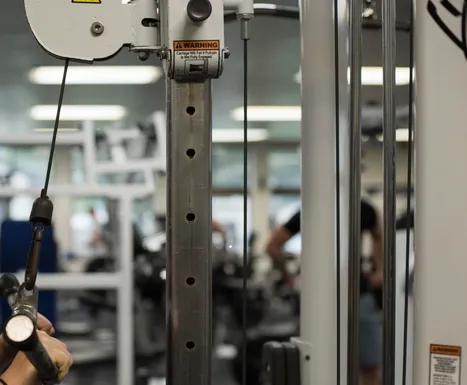
Set the pin at chest height. Attach a single D-handle and set the pulley roughly level with your sternum so the line of pull runs straight back through your working hand.
Take a split stance. Face away from the stack, handle in your right hand, and step your left foot forward. Staggering the feet widens your base against the rotational pull.
Brace before you move. Ribs down, glutes squeezed, abdominals tight as if you are about to take a punch. Your free hand can rest on your hip or extend forward as a reference point.
Press straight forward. Drive the handle out in line with your chest until the elbow is close to locked. The elbow bends and extends; the arm does not sweep in an arc.
Return under control. Let the handle travel back over two to three seconds until your hand sits just outside your chest. Stop before the shoulder rolls forward.
Resist the pull the whole time. Your hips and shoulders stay square to the front. If your torso turns toward the stack, the weight is too heavy.
Complete every rep on one side before switching. Starting with your weaker side keeps rep counts honest.
What Muscles Does the One-Arm Cable Chest Press Work?
The one-arm cable chest press works the pectoralis major, anterior deltoid, and triceps as the pressing muscles, while the obliques, transverse abdominis, and hip stabilizers resist rotation. The trunk demand is what separates it from a machine or bench press, where the bench removes the need to stabilize.
Here is how the work splits:
Pectoralis major: the prime mover for the horizontal push.
Anterior deltoid: assists the press, more so at higher pin settings. Lifters searching for a one arm cable shoulder chest press are describing this blend.
Triceps brachii: extends the elbow through lockout.
Obliques and deep trunk muscles: fight the cable’s attempt to twist you toward the stack.
Glutes and hip rotators: anchor the pelvis so the brace has a stable base.
In a kinetic and EMG comparison, Santana, Vera-Garcia, and McGill found the standing one-arm cable press produced substantial trunk muscle activation, and that the press was limited by the body’s ability to stay stable rather than by chest strength. That trade-off is the point. You give up some chest loading and gain a midline stability stimulus.
This matters on the job. Shoving a door, creating space from a person, or pressing yourself off the ground one-handed all load one side of the body while the trunk keeps you from twisting. We cover that bigger picture in our breakdown of functional strength for military performance. If you would rather have unilateral pressing and core work slotted into a complete plan, our guide to choosing a strength & endurance program walks through what to look for.
One-Arm Cable Chest Press vs. Crossover: What Is the Difference?
The press is a push and the crossover is an arc. In the press, your elbow bends and your triceps drive the handle straight forward. In the one-arm cable crossover, your arm stays relatively straight and sweeps across the body, which isolates the chest through shoulder adduction.
Use each for what it does well:
Choose the press when you want pressing strength, triceps involvement, and anti-rotation core work in one movement.
Choose the crossover when you want chest isolation and a stretch under load with less trunk demand.
The two movements complement each other, but they are not interchangeable. Pick the press when the goal is strength you can use; pick the crossover when the goal is building the chest itself. Our dedicated guide to the one-arm cable crossover covers that movement in full.
One-Arm Cable Chest Press Variations
Each variation changes either the angle of the press or how much the trunk is challenged. Master the standard version before you add any of these.
Twisting Standing One-Arm Chest Press
The cable twisting standing one arm chest press adds deliberate rotation. Start with your torso turned toward the stack, then rotate through the hips as you press. This turns an anti-rotation drill into a rotational power drill, which carries over to throwing a strike or driving a shoulder into an opponent. Keep the load lighter and let the hips lead.
Incline and Decline One-Arm Cable Chest Press
Changing the pin height changes the press angle. A cable one arm incline chest press (low pin, pressing up and forward) shifts more work to the upper chest and front delt, consistent with bench-angle EMG research. A cable one arm decline chest press (high pin, pressing down and forward) emphasizes the lower chest and feels closer to pushing an object away at waist height.
Reverse-Grip One-Arm Cable Chest Press
The one arm cable reverse grip chest press uses a palm-up hand position. Studies on grip during pressing found a supinated grip increased upper chest activity. It also keeps the elbow tighter to the body, which some lifters find easier on the shoulder.
How to Program It in a Cable Chest Workout
Treat this movement as an accessory or a core finisher, not your main press. Your heavy pressing still comes from barbell, dumbbell, or bodyweight work; this fills the gap those movements leave. It fits naturally into a full cable chest workout, and it slots into the accessory block of a strength workout for athletes.
Two ways to use it:
As a pressing accessory: 3 to 4 sets of 8 to 12 reps per side, after your main press. Choose a load that lets you finish every rep without the torso turning.
As a core finisher: 2 to 3 sets of 6 to 10 slow reps per side with a three-second return, or timed holds at full extension for 20 to 30 seconds.
These ranges sit within established resistance-training guidance for building strength and muscle. Progress by adding reps first, then a heavier pin, and only when your hips and shoulders stay square. For a full session template around this, see our guide on a strength workout for athletes.
FAQ: Frequently Asked Questions
What is the one-arm cable chest press?
The one-arm cable chest press is a standing, single-handle horizontal press performed at a cable station. You press straight forward from chest height while your trunk resists the rotational pull of the cable. It trains the chest, front shoulder, and triceps alongside the obliques and deep core muscles in one movement.
Why press with one arm instead of two?
Pressing with one arm creates an asymmetric load that tries to twist your torso. Resisting that rotation trains midline stability that a two-arm press cannot provide. It also exposes strength differences between sides and builds the kind of one-sided pushing strength needed to move doors, people, or your own body under load.
How do you keep from twisting during the press?
Use a split stance with the opposite foot forward, brace your abdominals, keep your ribs down, and squeeze your glutes before every rep. Keep your hips and shoulders facing forward throughout. If your torso turns toward the stack, reduce the load. Rotation means the weight is beating your brace.
Is the one-arm cable chest press a core exercise?
Yes. Research comparing the standing cable press to the bench press found that the standing version relies heavily on trunk stabilization, with load limited by stability rather than chest strength. That makes it a legitimate anti-rotation core exercise as well as a press, which is why we program it in both roles.
How many sets and reps should you do?
For strength and muscle, do 3 to 4 sets of 8 to 12 reps per side after your main press. As a core finisher, do 2 to 3 sets of 6 to 10 slow reps per side or 20 to 30 second holds at full extension. Progress only when your torso stays square.
The one-arm cable chest press earns its place because it builds two qualities at once: horizontal pressing strength and the trunk stability to use it when the load is uneven. Get the split stance and the brace right, keep the press straight, and let the core work before the chest gives out. Then put it to work. Add it to your next upper-body session as an accessory, track whether both sides hold square, and build from there with a plan designed around the demands of your job.
References:
Santana JC, Vera-Garcia FJ, McGill SM. A kinetic and electromyographic comparison of the standing cable press and bench press. Journal of Strength and Conditioning Research. 2007;21(4):1271-1279.
McGill SM. Low Back Disorders: Evidence-Based Prevention and Rehabilitation. 3rd ed. Champaign, IL: Human Kinetics; 2016.
Behm DG, Drinkwater EJ, Willardson JM, Cowley PM. The use of instability to train the core musculature. Applied Physiology, Nutrition, and Metabolism. 2010;35(1):91-108.
Saeterbakken AH, van den Tillaar R, Fimland MS. A comparison of muscle activity and 1-RM strength of three chest-press exercises with different stability requirements. Journal of Sports Sciences. 2011;29(5):533-538.
Trebs AA, Brandenburg JP, Pitney WA. An electromyography analysis of 3 muscles surrounding the shoulder joint during the performance of a chest press exercise at several angles. Journal of Strength and Conditioning Research. 2010;24(7):1925-1930.
Lauver JD, Cayot TE, Scheuermann BW. Influence of bench angle on upper extremity muscular activation during bench press exercise. European Journal of Sport Science. 2016;16(3):309-316.
Rodríguez-Ridao D, Antequera-Vique JA, Martín-Fuentes I, Muyor JM. Effect of five bench inclinations on the electromyographic activity of the pectoralis major, anterior deltoid, and triceps brachii during the bench press exercise. International Journal of Environmental Research and Public Health. 2020;17(19):7339.
Lehman GJ. The influence of grip width and forearm pronation/supination on upper-body myoelectric activity during the flat bench press. Journal of Strength and Conditioning Research. 2005;19(3):587-591.
American College of Sports Medicine. Progression models in resistance training for healthy adults. Medicine and Science in Sports and Exercise. 2009;41(3):687-708.
Schoenfeld BJ, Ogborn D, Krieger JW. Dose-response relationship between weekly resistance training volume and increases in muscle mass: a systematic review and meta-analysis. Journal of Sports Sciences. 2017;35(11):1073-1082.
Headquarters, Department of the Army. FM 7-22: Holistic Health and Fitness. Washington, DC; 2020.
Disclaimer: This content is for educational purposes only and is not medical advice. Consult a qualified healthcare provider before starting a new exercise program, especially if you have a shoulder, back, or other injury. Individual results vary with training history, consistency, and recovery.


