
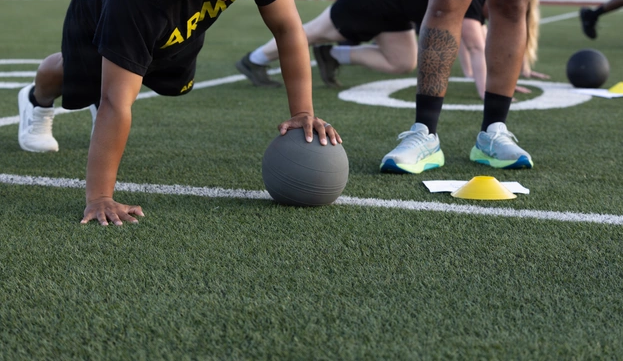
Medicine Ball Workouts for Beginners: 5 Moves + a Plan
Medicine Ball Workouts for Beginners: Weight, Exercises, and a Starter Routine
Medicine ball workouts for beginners come down to three decisions: pick a light ball (6 to 10 pounds for most people), learn five movements, and run them as a short circuit two or three times a week. The medicine ball is the best entry point to explosive power we know of, because throws and slams teach fast force production with almost no skill barrier. We build this same power base into our tactical fitness programs before athletes move on to heavier power work.
This guide gives you the weight to start with, the five best beginner medicine ball exercises, a starter routine you can run this week, and a clear way to progress it. The goal is not cardio with a ball. The goal is learning to produce force fast, the quality the Army measured with the standing power throw on the ACFT.
What Weight Should a Beginner Start With?
A beginner should start with a 6 to 10 pound medicine ball for most throws and presses. Smaller or newer athletes can drop to 4 pounds for chest and rotational throws. If the ball slows down mid-rep, or your form changes to get it moving, it is too heavy. Speed is the training stimulus.
Most beginners grab a ball that is too heavy. Power is force multiplied by velocity, and a throw only trains power if the ball leaves your hands fast. A heavy ball turns a power drill into a slow strength drill, and you lose the adaptation you came for. Research on ballistic training shows that peak power output for throwing and jumping movements sits at light loads, and the intent to move fast drives much of the training effect.
Use this weight guide by movement:
Chest pass and rotational throws: 4 to 8 pounds
Squat-to-press and Russian twist: 6 to 10 pounds
Overhead slams: 8 to 15 pounds, using a dead-bounce slam ball
Go lighter than you think for throws. Move up 2 to 4 pounds only when every rep stays fast and clean for two straight sessions.
The Best Beginner Medicine Ball Exercises
The best beginner medicine ball exercises are the chest pass, overhead slam, squat-to-press, Russian twist, and rotational throw. Together they cover upper-body pushing power, total-body power, a basic strength pattern, rotational core control, and rotational power. None of them takes weeks to learn.
1. Chest Pass (Wall Throw)
Stand two to three feet from a solid wall, ball at your chest, elbows wide. Drive the ball into the wall as hard as you can, catch the rebound, and reset. It is the simplest way to feel what explosive intent means.
2. Overhead Slam
Reach the ball overhead on your toes, then pull it down into the floor with your lats and abs as you hinge. Pick it up with a flat back and repeat. The slam trains total-body power and trunk flexion speed, and it is hard to do wrong at a light weight.
3. Squat-to-Press
Hold the ball at your chest, squat to depth, then drive up and press it overhead in one motion. It grooves the squat and links leg drive to an overhead press.
4. Russian Twist
Sit with knees bent, lean back slightly with a long spine, and rotate the ball from hip to hip. Keep the movement in your ribs and shoulders, and don’t round your lower back. This is the beginner medicine ball core and ab exercise, and it trains your obliques to control rotation before you produce it.
5. Rotational Throw
Stand side-on to a wall, ball at your back hip. Rotate from the ground up (feet, hips, then torso) and release the ball into the wall. This move carries over to grappling, striking, and carrying awkward loads, because almost every real-world effort involves rotation.
These five are a starter set, not the full menu. Our full medicine ball exercise library covers dozens more variations once these feel automatic. Rotational core work such as the wood chop and landmine core exercises builds directly on the twist and the rotational throw.
A Starter Medicine Ball Workout for Beginners
This beginner circuit takes about 20 minutes: a 5-minute warm-up, then three rounds of five exercises with short rest between moves and 90 seconds between rounds. Run it twice a week on non-consecutive days for four weeks before adding weight or volume.
Warm up for 5 minutes: easy jog or row, leg swings, arm circles, 10 bodyweight squats, and a few light practice throws.
Chest pass: 8 reps
Squat-to-press: 8 reps
Overhead slam: 6 reps
Rotational throw: 5 reps per side
Russian twist: 8 reps per side
Rest 20 to 30 seconds between exercises and 90 seconds between rounds. Repeat for three rounds.
The reps stay low on purpose. Fatigue slows the ball, and slow throws are conditioning, not power training. Stop the set when speed drops.
If you want this circuit placed inside a full training week with running and strength work, our guide to choosing a strength & endurance program walks through what to look for.
Space and Safety
Wall throws need a real wall: concrete, brick, or cinder block, or a purpose-built rebounder. Drywall will not survive them. Give yourself about 10 feet of clear space. Do slams on rubber flooring with a dead-bounce slam ball, because a standard rubber medicine ball can rebound straight back at your face.
How to Progress (and Why the Medicine Ball Builds Power)
Progress medicine ball training in this order, changing one variable at a time:
Speed and form first. Every rep should look and feel explosive before anything else changes.
Add a round. Move from three rounds to four.
Add weight. Go up 2 to 4 pounds on the movements that feel fast.
Add complexity. Introduce harder throws, such as the backward overhead throw.
The medicine ball works so well for beginners because you let go of it. In a dumbbell press, you have to slow the weight down at the top so it stays in your hands. A throw lets you accelerate all the way through, which trains rate of force development, the speed at which you can produce force. Studies in handball players, baseball players, and high school students have found that structured medicine ball training improves strength and power measures.
The next step is the standing power throw, a backward overhead throw for distance. The Army used it as an ACFT event until the 2025 Army Fitness Test dropped it, and it remains a simple field test of total-body power. From there, this power base feeds directly into functional strength for military performance, where fast force output matters under load. Pair your medicine ball work with heavier lifting, such as a strength workout for athletes, so you build both ends of the force-velocity curve.
FAQ: Frequently Asked Questions
What weight medicine ball should a beginner use?
Most beginners should use a 6 to 10 pound medicine ball. Drop to 4 to 8 pounds for chest and rotational throws, and use 8 to 15 pounds for slams with a dead-bounce slam ball. The ball should move fast on every rep. If it slows down, go lighter.
What are the best medicine ball exercises for beginners?
The chest pass, overhead slam, squat-to-press, Russian twist, and rotational throw. These five cover pushing, total-body, and rotational power plus a squat pattern and core control, and all of them are easy to learn with a single ball.
Can you do a full workout with just a medicine ball?
Yes. A medicine ball covers power, a squat pattern, an overhead press, and core work in one session, which makes it a complete beginner workout. It will not replace heavy strength training long term, but it is a solid standalone session when equipment is limited.
How often should a beginner do medicine ball workouts?
Two to three sessions per week on non-consecutive days is enough. That matches general resistance training guidance and gives your shoulders, trunk, and nervous system time to recover between explosive sessions.
Do medicine ball workouts build muscle or just conditioning?
Medicine ball workouts mainly build power and conditioning, not much muscle. Light balls do not create enough mechanical tension to drive significant muscle growth. They work best paired with heavier resistance training, which builds the muscle and strength the ball then teaches you to express fast.
What is the difference between a medicine ball and a slam ball?
A medicine ball is usually rubber or leather and bounces, which makes it right for wall throws and passes. A slam ball has a thick shell filled with sand or gel, so it lands dead without bouncing. Use slam balls for slams and medicine balls for throws.
Do you need a wall for medicine ball workouts?
Not for every exercise. Slams, squat-to-press, and Russian twists need only floor space. Chest passes and rotational throws need a solid wall (concrete, brick, or cinder block) or a rebounder. Without a wall, throw to a partner or throw for distance outdoors.
Medicine ball workouts for beginners work because they are simple: a light ball, five movements, and a short circuit run with full intent. Start lighter than your ego wants, keep every rep fast, and progress one variable at a time. Run the starter routine twice a week for four weeks and you will own a power base most athletes skip.
References:
Cormie P, McGuigan MR, Newton RU. Developing maximal neuromuscular power: Part 2, training considerations for improving maximal power production. Sports Medicine. 2011;41(2):125-146.
Behm DG, Sale DG. Intended rather than actual movement velocity determines velocity-specific training response. Journal of Applied Physiology. 1993;74(1):359-368.
Ignjatovic A, Markovic Z, Radovanovic D. Effects of 12-week medicine ball training on muscle strength and power in young female handball players. Journal of Strength and Conditioning Research. 2012;26(8):2166-2173.
Szymanski DJ, Szymanski JM, Bradford TJ, Schade RL, Pascoe DD. Effect of twelve weeks of medicine ball training on high school baseball players. Journal of Strength and Conditioning Research. 2007;21(3):894-901.
Faigenbaum AD, Mediate P. Effects of medicine ball training on fitness performance of high-school physical education students. The Physical Educator. 2006;63(3):160-167.
Earp JE, Kraemer WJ. Medicine ball training implications for rotational power sports. Strength and Conditioning Journal. 2010;32(4):20-25.
Raeder C, Fernandez-Fernandez J, Ferrauti A. Effects of six weeks of medicine ball training on throwing velocity, throwing precision, and isokinetic strength of shoulder rotators in female handball players. Journal of Strength and Conditioning Research. 2015;29(7):1904-1914.
Stockbrugger BA, Haennel RG. Validity and reliability of a medicine ball explosive power test. Journal of Strength and Conditioning Research. 2001;15(4):431-438.
Ikeda Y, Kijima K, Kawabata K, Fuchimoto T, Ito A. Relationship between side medicine-ball throw performance and physical ability for male and female athletes. European Journal of Applied Physiology. 2007;99(1):47-55.
American College of Sports Medicine. Progression models in resistance training for healthy adults. Medicine and Science in Sports and Exercise. 2009;41(3):687-708.
Garber CE, et al. Quantity and quality of exercise for developing and maintaining cardiorespiratory, musculoskeletal, and neuromotor fitness in apparently healthy adults. Medicine and Science in Sports and Exercise. 2011;43(7):1334-1359.
Kraemer WJ, Ratamess NA. Fundamentals of resistance training: progression and exercise prescription. Medicine and Science in Sports and Exercise. 2004;36(4):674-688.
Haff GG, Triplett NT, eds. Essentials of Strength Training and Conditioning. 4th ed. National Strength and Conditioning Association. Human Kinetics; 2016.
Alvar BA, Sell K, Deuster PA, eds. NSCA’s Essentials of Tactical Strength and Conditioning. Human Kinetics; 2017.
McGill SM. Low Back Disorders: Evidence-Based Prevention and Rehabilitation. 3rd ed. Human Kinetics; 2016.
Headquarters, Department of the Army. FM 7-22, Holistic Health and Fitness. October 2020.
U.S. Army. Army Fitness Test (AFT) implementation guidance. 2025.
Disclaimer: This article is for educational purposes only and is not medical advice. Talk to a qualified healthcare provider before starting a new exercise program, especially if you have a current injury or medical condition. Explosive training carries risk of injury if performed with poor technique, unsafe equipment, or inadequate space. Individual results vary.


