
Medicine Ball Slam: Form, Muscles, Workout | Combat Fitness
The Medicine Ball Slam: Build Explosive Full-Body Power
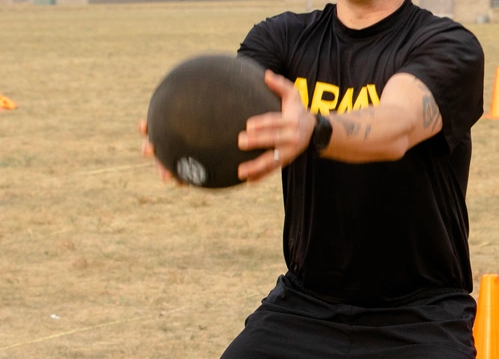
The medicine ball slam is a full-body explosive power exercise: you reach a ball overhead, then drive it into the floor as hard as you can, with your lats, core, hips, and legs firing as one unit. It trains maximum output with almost no lowering phase, so you can train power hard and often. If you want power work like this built into a complete plan, our tactical fitness programs program it alongside your strength, running, and rucking.
We program med ball slams for service members who need to produce force fast, not just lift it slowly. Below: the muscles worked, how to do a medicine ball slam with clean form, four variations, the right ball to use, how to program it, and a ready-to-run slam workout.
Key Takeaways:
The medicine ball slam is a power exercise, not a strength or burnout exercise. Low reps and full intent on every rep.
It works the lats, abs, shoulders, glutes, and legs together, and the skill it trains is speed of force, not size.
The ball does the lowering for you, so slams cause little of the soreness that comes from eccentric work, and they recover quickly.
Use a non-bouncing slam ball. A bouncing rubber medicine ball can rebound into your face.
Rotational and side slams build the rotational power that carries over to throwing, bracing, and striking.
What Muscles Does a Medicine Ball Slam Work, and Why Does It Build Power?
A medicine ball slam works the lats, abdominals, obliques, shoulders, triceps, glutes, hamstrings, and quads in one movement. The lats and abs pull the ball down from overhead, the hips and legs extend to drive the reach and then flex to follow the ball, and the shoulders and triceps finish the throw.
You rise onto your toes to load the stretch, then your trunk and arms lead the ball down while your hips snap back to add speed. The core links the two halves, which is why core stiffness matters for every throw and strike (Kibler et al., 2006; McGill, 2010).
The slam is a power stimulus because power is force times velocity. A slam ball is light enough to move fast, so the exercise trains the high-velocity end of the force-velocity curve that heavy lifting does not reach (Cormie et al., 2011a, 2011b; Haff and Nimphius, 2012). Heavy squats and deadlifts make you strong. Slams teach you to use that strength quickly.
Twelve-week medicine ball programs have improved power in handball players and rotational strength in baseball players (Ignjatovic et al., 2012; Szymanski et al., 2007).
The No-Eccentric Advantage
Most of the muscle damage and soreness from training comes from eccentric work, the lowering half of a rep (Clarkson and Hubal, 2002; Douglas et al., 2017; Hody et al., 2019). The slam has almost none. You throw the ball down and pick it up off the floor, so the movement is close to purely concentric.
That matters for a tactical athlete. You can train explosive output two or three times a week, the day before a ruck or a run, without paying for it in sore legs.
How to Do a Medicine Ball Slam
To do a medicine ball slam, stand with feet shoulder-width apart, lift the ball overhead while rising onto your toes, then pull it down hard in front of your feet by bending at the hips and knees. Pick it up off the floor, reset, and repeat.
Set up. Feet shoulder-width apart, ball held at your chest with both hands.
Reach and load. Drive the ball straight overhead with arms long and rise onto your toes. Get tall and stretch your lats and abs.
Pull down. Snap the ball toward the floor just in front of your toes, using your lats and abs first and your arms last.
Drop the hips. Push your hips back and bend your knees as the ball goes down, so your whole body follows the throw.
Release hard. Let go at about waist height and throw through the floor, not at it.
Pick it up with a flat back. Squat or hinge to the ball. Never round over to grab it.
Reset. Return to tall and start the next rep with full intent.
The most common fault is an arms-only slam, where the hips and trunk never move. The second is a rounded-back pickup late in the set. Aim for the spot just in front of your feet, not out in front of you.
Intent is the point of the exercise. Research shows that trying to move fast drives speed adaptations, even when the load limits how fast you move (Behm and Sale, 1993). A half-effort slam is just cardio.
The Medicine Ball Slam Variations
Each variation changes the direction of force. Use the overhead slam as your base, then add the planes your job needs.
Overhead Slam
The overhead slam is the standard version described above. It trains vertical power through the hips, trunk, and lats, and it is the easiest version to learn. Start here.
Side Slam (Lateral Slam)
For a side slam, bring the ball over one shoulder and slam it down beside the outside of the opposite foot. The lateral slam loads the obliques and teaches you to produce force off the side of your body. Do equal reps on each side.
Rotational Slam
The medicine ball rotational slam starts with the ball overhead, then rotates your trunk and pivots your back foot as you slam it outside one hip. The hips lead and the shoulders follow. This is the variation that builds rotational power, the same hip-to-trunk sequencing used in throwing, striking, and shoving an opponent away (Earp and Kraemer, 2010). Side throw performance with a medicine ball is strongly linked to trunk rotation strength and power (Ikeda et al., 2007).
It also trains anti-rotation, because your trunk has to stop the turn and brace, the same bracing that keeps you stable in a clinch.
Chest Slam
For a chest slam, hold the ball at your chest and drive it down hard at your feet, like a downward chest pass. The range is short, so the chest slam suits athletes with limited shoulder mobility or anyone who wants a faster, shorter rep.
The Right Ball: Medicine Ball vs. Slam Ball
A slam ball is a soft-shelled, sand-filled ball built not to bounce. A traditional medicine ball is usually solid rubber and bounces hard. That difference decides which one you can slam.
Can you slam a medicine ball? Only if it is a dead ball. A bouncing rubber medicine ball can rebound off the floor straight into your face. That rebound is the main safety risk on this exercise. A soft wall ball splits at the seams if you slam it.
The rule is simple:
Slam ball or dead ball: made for slams. Use it for every slam variation.
Rubber medicine ball: built for throws against a wall and partner tosses. Do not slam it unless it is rated as a dead ball.
Soft wall ball: built for wall throws. Keep it off the floor.
For weight, pick a ball you can move fast. Most athletes start between 10 and 20 pounds for overhead slams and go lighter for rotational work. If your reps slow down or your back rounds, the ball is too heavy. Heavier is not better here, because the point is speed.
How to Program the Medicine Ball Slam
Program the medicine ball slam as power work first: 3 to 5 sets of 3 to 6 reps, full intent, and 60 to 90 seconds of rest. Place it early in the session, after your warm-up and before heavy lifting, when you are fresh enough to move fast (Haff and Triplett, 2016).
Power drops off as fatigue builds. Studies on velocity loss show that sets kept short of fatigue preserve speed and improve jump performance better than sets taken to exhaustion (Pareja-Blanco et al., 2017). Stop the set when the slam gets slower or quieter.
Slams also work for conditioning, but a 20-rep set trains work capacity, not power. The Army's Holistic Health and Fitness doctrine treats power and endurance as separate qualities (Department of the Army, 2020).
If you are trying to fit power work into a full week, our guide to choosing a strength & endurance program shows where it belongs in a hybrid plan.
Medicine Ball Slam Alternatives
The best medicine ball slam alternative depends on what you have. With no ball, use battle rope slams for the same overhead pull, or sledgehammer strikes on a tire for rotational power. For lower-body power without the throw, kettlebell swings and broad jumps train fast hip extension. Each one keeps the same rule: low reps and maximum intent. Explosive power like this is a core piece of functional strength for military performance.
A Medicine Ball Slam Workout
This 20-minute medicine ball slam workout builds power in all three directions. Run it once or twice a week at the start of a lower-body or full-body day.
Power block (full intent, stop if reps slow down):
Overhead slam: 4 sets of 5, rest 60 to 90 seconds.
Rotational slam: 3 sets of 4 per side, rest 60 seconds.
Side slam: 3 sets of 4 per side, rest 60 seconds.
Chest slam: 2 sets of 6, rest 60 seconds.
Optional conditioning finisher (work capacity, not power):
5. Every minute on the minute for 8 minutes: 8 overhead slams, then rest the remainder of the minute.
Add sets before you add weight, and keep every power rep fast. These medicine ball slam exercises fit at the front of a strength workout for athletes, so you get your power work done before the heavy lifting.
New to medicine ball training? Start with medicine ball workouts for beginners to build basic throwing and catching skills, then come back to slams.
Frequently Asked Questions
What muscles does the medicine ball slam work?
The medicine ball slam works the lats, abdominals, obliques, shoulders, and triceps through the pull-down, and the glutes, hamstrings, and quads through the reach and drop. It trains them together, so the payoff is full-body power, not size.
How do you do a medicine ball slam correctly?
Lift the ball overhead while rising onto your toes, then pull it down hard just in front of your feet using your lats and abs first. Push your hips back as it falls, release at waist height, and pick it up with a flat back. Every rep should be at full effort.
Can you slam a regular medicine ball?
You can slam a medicine ball only if it is a dead ball that does not bounce. A solid rubber medicine ball can rebound off the floor into your face, and a soft wall ball will split at the seams. Use a sand-filled slam ball for every slam variation.
What is the difference between a slam ball and a medicine ball?
A slam ball is sand-filled with a thick, soft shell, so it lands dead and does not bounce. A medicine ball is usually solid rubber and bounces, which suits wall throws. Slam balls are built for the floor; medicine balls are not.
What is a good medicine ball slam weight?
A good medicine ball slam weight is one you can move fast for every rep. Most athletes start between 10 and 20 pounds for overhead slams and go lighter for rotational slams. If the reps slow down or your back rounds on the pickup, the ball is too heavy.
How many medicine ball slams should you do?
For power, do 3 to 5 sets of 3 to 6 slams with 60 to 90 seconds of rest, and end the set when reps slow down. Higher reps train conditioning, not power, so program the two separately.
What is a good alternative to the medicine ball slam?
Good alternatives to the medicine ball slam are battle rope slams for the overhead pull, sledgehammer tire strikes for rotational power, and kettlebell swings or broad jumps for hip power. Keep the same rules: low reps, full intent, and plenty of rest.
The medicine ball slam is one of the simplest ways to train explosive full-body power, and because the ball does the lowering, you can train it hard without losing your next day. Learn the overhead slam, add the rotational and side variations, use a dead ball, and keep every rep fast. Run the workout this week, and download the free power and conditioning workout to keep it in your plan.
References:
Behm DG, Sale DG. Intended rather than actual movement velocity determines velocity-specific training response. Journal of Applied Physiology. 1993;74(1):359-368.
Clarkson PM, Hubal MJ. Exercise-induced muscle damage in humans. American Journal of Physical Medicine & Rehabilitation. 2002;81(11 Suppl):S52-S69.
Cormie P, McGuigan MR, Newton RU. Developing maximal neuromuscular power: part 1, biological basis of maximal power production. Sports Medicine. 2011;41(1):17-38.
Cormie P, McGuigan MR, Newton RU. Developing maximal neuromuscular power: part 2, training considerations for improving maximal power production. Sports Medicine. 2011;41(2):125-146.
Douglas J, Pearson S, Ross A, McGuigan M. Eccentric exercise: physiological characteristics and acute responses. Sports Medicine. 2017;47(4):663-675.
Earp JE, Kraemer WJ. Medicine ball training implications for rotational power sports. Strength and Conditioning Journal. 2010;32(4):20-25.
Haff GG, Nimphius S. Training principles for power. Strength and Conditioning Journal. 2012;34(6):2-12.
Haff GG, Triplett NT, eds. Essentials of Strength Training and Conditioning. 4th ed. National Strength and Conditioning Association. Champaign, IL: Human Kinetics; 2016.
Headquarters, Department of the Army. FM 7-22: Holistic Health and Fitness. Washington, DC; 2020.
Hody S, Croisier JL, Bury T, Rogister B, Leprince P. Eccentric muscle contractions: risks and benefits. Frontiers in Physiology. 2019;10:536.
Ignjatovic AM, Markovic ZM, Radovanovic DS. Effects of 12-week medicine ball training on muscle strength and power in young female handball players. Journal of Strength and Conditioning Research. 2012;26(8):2166-2173.
Ikeda Y, Kijima K, Kawabata K, Fuchimoto T, Ito A. Relationship between side medicine-ball throw performance and physical ability for male and female athletes. European Journal of Applied Physiology. 2007;99(1):47-55.
Kibler WB, Press J, Sciascia A. The role of core stability in athletic function. Sports Medicine. 2006;36(3):189-198.
McGill S. Core training: evidence translating to better performance and injury prevention. Strength and Conditioning Journal. 2010;32(3):33-46.
Pareja-Blanco F, Rodriguez-Rosell D, Sanchez-Medina L, et al. Effects of velocity loss during resistance training on athletic performance, strength gains and muscle adaptations. Scandinavian Journal of Medicine & Science in Sports. 2017;27(7):724-735.
Szymanski DJ, Szymanski JM, Bradford TJ, Schade RL, Pascoe DD. Effect of twelve weeks of medicine ball training on high school baseball players. Journal of Strength and Conditioning Research. 2007;21(3):894-901.
Disclaimer: This article is for educational purposes and is not medical advice. If you have back or shoulder pain, a past injury, or a diagnosed condition, get cleared by a qualified clinician before starting a new exercise program. Stop any exercise that causes sharp or worsening pain. Results vary by individual, and no program guarantees performance gains or injury prevention.


