
Leg Extension Alternatives: 8 Quad Moves | Combat Fitness
Leg Extension Alternatives: Build Your Quads Without the Machine
The best leg extension alternative for most tactical athletes is the Bulgarian split squat. It loads the quads hard, needs only a bench and a pair of dumbbells, and builds the single-leg strength you use under a ruck. Most field gyms, unit weight rooms, and garage setups do not have a leg extension machine, and our tactical fitness programs are built for athletes who train wherever the job puts them.
Below are eight substitutes, the at-home, dumbbell, and band versions of each, and how to program quad work when there is no weight stack.
Key Takeaways:
The Bulgarian split squat is the best all-around leg extension alternative: heavy quad loading, minimal equipment, and direct carryover to rucking and climbing.
Squats grow three of the four quad muscles well. The sissy squat and Spanish squat cover the fourth (rectus femoris) by loading the knee while the hip stays open.
At home, a wall, a sturdy step, and one resistance band cover the full range the machine trains.
Without a weight stack, progress with reps, tempo, pauses, range, and a weight vest or ruck.
The machine still has a place in clinician-directed knee rehab.
Why Look for a Leg Extension Alternative?
A leg extension alternative is any exercise that loads the quadriceps through knee extension without the machine. Tactical athletes need one for three reasons: most field gyms lack the machine, closed-chain movements spread force across the hip and ankle, and standing single-leg work carries over to what the job demands.
What the Leg Extension Trains
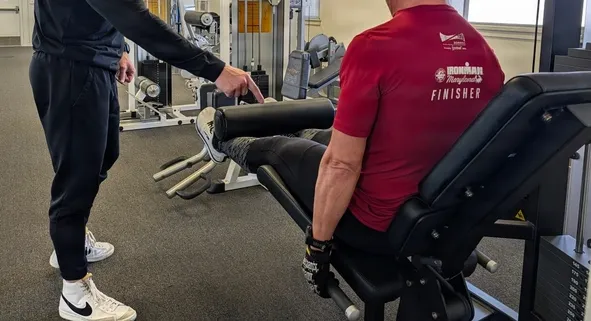
The leg extension isolates the quadriceps: vastus lateralis, vastus medialis, vastus intermedius, and rectus femoris. The rectus femoris is the only quad muscle that also crosses the hip, and that detail decides which substitutes work. In a squat, the hip and knee bend together, so the rectus femoris barely changes length. Training studies show that squats grow the three vasti well but add little rectus femoris size, while knee-extension work does (Ema et al., 2013; Kubo et al., 2019; Mangine et al., 2018; Zabaleta-Korta et al., 2021). Alternatives that keep the hips open while the knees bend close that gap.
Why Standing Quad Work Fits the Job
Rucking, sprinting, clearing obstacles, and dragging a casualty are all closed-chain tasks performed mostly on one leg at a time. Load carriage stresses the knees, hips, and feet together, and lower-extremity injuries make up the largest share of musculoskeletal injuries in the Army (Knapik et al., 2004; Molloy et al., 2020). Training the quads in those same standing patterns builds the functional strength for military performance that holds up under a pack. In trained athletes, split squats have produced strength and sprint gains comparable to back squats (Speirs et al., 2016).
The knee load also changes. Open-chain extension puts peak ligament and kneecap stress near full extension, while closed-chain squatting shifts stress deeper into the bend and adds hamstring co-contraction that steadies the joint (Escamilla et al., 1998; Wilk et al., 1996). Neither is dangerous for a healthy knee. They are different, so choose based on what your knees tolerate.
When the Machine Still Has a Place
The leg extension is not useless. Open-chain quad work within protected ranges is a standard part of ACL rehabilitation (van Melick et al., 2016), and it remains the most direct way to grow the rectus femoris. If a clinician has you on terminal knee work after an injury, keep doing it.
What Are the Best Leg Extension Alternatives?
The best leg extension alternatives are the Bulgarian split squat, step-up, sissy squat, Spanish squat, reverse lunge, heels-elevated squat, goblet squat, and terminal knee extension. We ranked them by quad demand, equipment needed, and carryover to field tasks. The sissy squat and terminal knee extension mimic the machine most closely; the rest add strength the machine cannot.
Where these exercises land in your week depends on everything else you run and carry. Our guide to choosing a strength & endurance program covers how to balance lifting against running and rucking.
1. Bulgarian Split Squat
Rear foot on a bench, front foot two to three feet ahead. Lower the back knee toward the floor while the front knee travels forward over the toes, then drive up through the whole front foot. A shorter stance and an upright torso bias the quads; a longer stance shifts work to the glutes. Who it’s for: everyone. Verdict: the top pick, because light dumbbells become a heavy stimulus and it trains balance under fatigue.
2. Step-Up
Use a box that puts your thigh at or just above parallel. Plant the whole foot, lean slightly forward, and stand up without pushing off the trail leg, then lower under control. Who it’s for: rucking and obstacle-course candidates. Verdict: the most job-specific option here, since it mirrors climbing hills, stairs, and walls with a load.
3. Sissy Squat
Stand tall with heels raised, holding a post for balance. Drive the knees forward and lean back while the hips stay extended, so your body forms a straight line from knees to shoulders. Go only as deep as you can control, then extend. Who it’s for: athletes chasing quad size without a machine. Verdict: the closest bodyweight match to the leg extension, because the open hip loads the rectus femoris at long length.
4. Spanish Squat
Loop a heavy band behind both knees and anchor it to a rack or post. Sit back into the band with vertical shins and an upright torso, holding 60 to 90 degrees of knee bend for 30 to 45 seconds or moving through slow reps. Who it’s for: athletes with irritable patellar tendons. Verdict: a knee-friendly quad builder; isometric quad holds have reduced patellar tendon pain in the short term (Rio et al., 2015).
5. Reverse Lunge
Step back, lower the rear knee toward the floor, and drive up through the front foot. Stepping back keeps the front foot planted and the descent controlled, which most athletes find easier on the knees than stepping forward. Who it’s for: anyone building single-leg control. Verdict: a reliable volume builder. We keep lunges short here on purpose, because forward, walking, and lateral variations deserve their own breakdown.
6. Heels-Elevated (Cyclist) Squat
Set your heels on a 1- to 2-inch plate or wedge, feet close together, holding a dumbbell or wearing a vest. Squat straight down and let the knees travel well past the toes. Raising the heels increases forward knee travel and knee bending demand, shifting work toward the quads (Escamilla, 2001). Who it’s for: athletes with limited ankle mobility. Verdict: the best two-leg quad squat for a minimal gym.
7. Goblet Squat
Hold one dumbbell or kettlebell at the chest, elbows inside the knees, and squat to full depth with an upright torso. The front load keeps you vertical and puts more of the work on the quads. Who it’s for: newer lifters and high-rep conditioning blocks. Verdict: the simplest loaded option. Full technique for the goblet squat gets its own guide; here, treat it as your entry-level loaded squat.
8. Terminal Knee Extension
Loop a band around the back of one knee, anchor it in front, and step back until the band pulls the knee into a slight bend. Squeeze the quad to straighten the knee fully, hold one second, and return. Who it’s for: rehab, prehab, and warm-ups. Verdict: the most direct mimic of the machine’s final range, and one we keep in nearly every program.
How Do You Do Leg Extensions at Home Without a Machine?
You do leg extensions at home without a machine by choosing exercises that bend the knee under bodyweight or band tension: sissy squats, wall sits, step-ups, bodyweight terminal knee extensions, and reverse lunges. A wall, a sturdy step, and one band cover the full range the machine trains.
Home and field setups are where most tactical athletes train, especially on deployment or shift rotations. Army H2F doctrine builds lower-body strength around bodyweight and minimal-equipment movements for exactly that reason (FM 7-22, 2020). Without external load, intensity comes from leverage, tempo, and proximity to failure. That works: light loads taken close to failure built muscle comparably to heavy loads in a meta-analysis by Schoenfeld et al. (2017).
A no-equipment session looks like this:
Sissy squat, assisted by a doorframe: 3 sets of 8 to 15.
Wall sit, thighs parallel: 3 holds of 45 to 60 seconds.
Step-up on a stair or sturdy chair: 3 sets of 10 to 12 per leg.
Bodyweight terminal knee extension: sit on the floor with a rolled towel under one knee, press the knee down to lift the heel, and hold 2 seconds; 2 sets of 15 to 20.
Reverse lunge, adding a loaded backpack when bodyweight gets easy: 3 sets of 10 to 12 per leg.
For a true bodyweight leg extension, the towel version and the sissy squat are your two tools: one trains the end range, the other loads the whole quad.
Dumbbell Leg Extension Alternatives
A pair of dumbbells covers most of what the machine does and adds the balance and trunk demand the machine removes.
Goblet squat: 3 to 4 sets of 8 to 12.
Dumbbell split squat (rear foot on the floor or a bench): 3 to 4 sets of 6 to 10 per leg.
Dumbbell step-up: 3 sets of 8 to 10 per leg.
Seated dumbbell leg extension: sit high on a bench, grip a dumbbell between your feet, and extend the knees.
The seated dumbbell leg extension is the only option that copies the machine’s motion, and it has limits. Load is capped by how well your feet hold the dumbbell, and the weight sits at the end of a long lever, so keep it light, move slowly, and pause at lockout. Treat leg extensions with dumbbells as a finisher; the split squat and goblet squat do the heavy work.
Can a Resistance Band Replace the Leg Extension Machine?
A resistance band can replace the leg extension machine for end-range strength, warm-ups, and rehab, but rarely for heavy hypertrophy work alone. Band tension rises as it stretches, so resistance peaks at full knee extension, the range the machine targets and the range athletes lose first after a knee injury.
Three band options cover it:
Banded terminal knee extension, described above, for lockout strength.
Seated band leg extension: anchor a band to a chair leg behind you, loop it over your ankle, and extend the knee against it.
Banded sissy squat: anchor a band behind you at knee height and loop it around the front of your knees for support, so you can lean back further with control while you build the full movement.
Clinicians use banded knee extensions after injury to restore quad activation and full extension (van Melick et al., 2016). If you are in that phase, follow your provider’s progression.
How to Program Quad Work Without the Machine
Program two to three quad exercises per leg day: one heavy primary lift, one single-leg secondary, and one accessory that targets the end range or the rectus femoris. Across the week, aim for roughly 10 or more hard sets for the quads; more weekly volume generally drives more growth up to a point (Schoenfeld, Ogborn, & Krieger, 2017).
A complete leg extension workout without the machine:
Primary: Bulgarian split squat or heels-elevated goblet squat, 3 to 4 sets of 6 to 10.
Secondary: step-up or reverse lunge, 2 to 3 sets of 8 to 12 per leg.
Accessory: sissy squat or Spanish squat, 2 to 3 sets of 10 to 20 reps or 30- to 45-second holds.
Finisher: banded terminal knee extension, 2 sets of 15 to 20.
Those ranges sit inside established resistance-training guidelines (ACSM, 2009). Without a stack, progress in this order: add reps, slow the lowering phase to three seconds, add a pause at the bottom, increase range with a deficit, then add load with a vest or ruck. Adding reps has produced strength and size gains similar to adding load (Plotkin et al., 2022).
Quad work is one piece of a larger week. Our breakdown of a strength workout for athletes shows where lower-body sessions sit alongside upper-body lifting and conditioning.
Frequently Asked Questions
What is the best leg extension alternative?
The Bulgarian split squat is the best leg extension alternative for most tactical athletes. It loads the quads heavily with minimal equipment and builds single-leg strength that carries over to rucking and climbing. If rectus femoris size is the goal, add sissy squats.
How do you do leg extensions at home without a machine?
Use sissy squats, wall sits, step-ups, and a seated towel extension, where you press the back of the knee into a rolled towel to lift the heel. Add a band or a loaded backpack for resistance, and take sets close to failure.
What muscles do leg extensions work?
Leg extensions work all four quadriceps: vastus lateralis, vastus medialis, vastus intermedius, and rectus femoris. A good alternative program should hit all four, which means including at least one movement, such as the sissy squat, that bends the knee while the hip stays extended.
What is a good dumbbell leg extension alternative?
The dumbbell split squat and goblet squat are the best dumbbell options for strength and size. The seated dumbbell leg extension copies the machine’s motion but is limited by how much weight your feet can hold, so use it as a light finisher.
Can a resistance band replace the leg extension machine?
Yes, for end-range strength, warm-ups, and rehab, because band tension peaks at full knee extension. For muscle growth, pair band work with loaded split squats or step-ups, since a band alone gives little resistance in the deep part of the range.
Are leg extension alternatives better than the machine for athletes?
For most athletes, yes. Standing alternatives train the quads in the single-leg positions used in running, rucking, and climbing, and they build balance the machine removes. The machine still has value for isolated rectus femoris growth and supervised knee rehab.
Is the sissy squat a safe leg extension substitute?
The sissy squat is safe for healthy knees when you scale depth and use support. It places high load on the patellar tendon in deep knee bend, so start with partial range while holding a post, progress slowly, and skip it during active knee pain unless a clinician clears you.
The right leg extension alternative depends on your equipment and your knees, but the principle holds: train the quads standing, on one leg, and through full knee extension, and the strength shows up under a pack. Pick one primary lift, one single-leg movement, and one end-range accessory, then progress them every week. If you would rather have that progression written for you around the gear you actually have, start a structured CF ONE plan and train for the job, not the machine.
References:
American College of Sports Medicine. (2009). Progression models in resistance training for healthy adults. Medicine & Science in Sports & Exercise, 41(3), 687-708.
Ema, R., Wakahara, T., Miyamoto, N., Kanehisa, H., & Kawakami, Y. (2013). Inhomogeneous architectural changes of the quadriceps femoris induced by resistance training. European Journal of Applied Physiology, 113(11), 2691-2703.
Escamilla, R. F. (2001). Knee biomechanics of the dynamic squat exercise. Medicine & Science in Sports & Exercise, 33(1), 127-141.
Escamilla, R. F., Fleisig, G. S., Zheng, N., Barrentine, S. W., Wilk, K. E., & Andrews, J. R. (1998). Biomechanics of the knee during closed kinetic chain and open kinetic chain exercises. Medicine & Science in Sports & Exercise, 30(4), 556-569.
Headquarters, Department of the Army. (2020). FM 7-22: Holistic Health and Fitness. Washington, DC.
Knapik, J. J., Reynolds, K. L., & Harman, E. (2004). Soldier load carriage: Historical, physiological, biomechanical, and medical aspects. Military Medicine, 169(1), 45-56.
Kubo, K., Ikebukuro, T., & Yata, H. (2019). Effects of squat training with different depths on lower limb muscle volumes. European Journal of Applied Physiology, 119(9), 1933-1942.
Mangine, G. T., Redd, M. J., Gonzalez, A. M., et al. (2018). Resistance training does not induce uniform adaptations to quadriceps. PLoS ONE, 13(8), e0198304.
Molloy, J. M., Pendergrass, T. L., Lee, I. E., et al. (2020). Musculoskeletal injuries and United States Army readiness part I: Overview of injuries and their strategic impact. Military Medicine, 185(9-10), e1461-e1471.
Plotkin, D., Coleman, M., Van Every, D., et al. (2022). Progressive overload without progressing load? The effects of load or repetition progression on muscular adaptations. PeerJ, 10, e14142.
Rio, E., Kidgell, D., Purdam, C., et al. (2015). Isometric exercise induces analgesia and reduces inhibition in patellar tendinopathy. British Journal of Sports Medicine, 49(19), 1277-1283.
Schoenfeld, B. J., Grgic, J., Ogborn, D., & Krieger, J. W. (2017). Strength and hypertrophy adaptations between low- vs. high-load resistance training: A systematic review and meta-analysis. Journal of Strength and Conditioning Research, 31(12), 3508-3523.
Schoenfeld, B. J., Ogborn, D., & Krieger, J. W. (2017). Dose-response relationship between weekly resistance training volume and increases in muscle mass: A systematic review and meta-analysis. Journal of Sports Sciences, 35(11), 1073-1082.
Speirs, D. E., Bennett, M. A., Finn, C. V., & Turner, A. P. (2016). Unilateral vs. bilateral squat training for strength, sprints, and agility in academy rugby players. Journal of Strength and Conditioning Research, 30(2), 386-392.
van Melick, N., van Cingel, R. E., Brooijmans, F., et al. (2016). Evidence-based clinical practice update: Practice guidelines for anterior cruciate ligament rehabilitation based on a systematic review and multidisciplinary consensus. British Journal of Sports Medicine, 50(24), 1506-1515.
Wilk, K. E., Escamilla, R. F., Fleisig, G. S., Barrentine, S. W., Andrews, J. R., & Boyd, M. L. (1996). A comparison of tibiofemoral joint forces and electromyographic activity during open and closed kinetic chain exercises. American Journal of Sports Medicine, 24(4), 518-527.
Zabaleta-Korta, A., Fernández-Peña, E., Torres-Unda, J., Garbisu-Hualde, A., & Santos-Concejero, J. (2021). The role of exercise selection in regional muscle hypertrophy: A randomized controlled trial. Journal of Sports Sciences, 39(20), 2298-2304.
Disclaimer: This article is for educational purposes only and is not medical advice. Consult a qualified healthcare provider before starting a new training program, especially if you have a current or past knee injury. Individual results vary, and no exercise or program guarantees a specific outcome.


