Hammer Curl vs Bicep Curl: Which Wins? | Combat Fitness
Hammer Curl vs. Bicep Curl: Which Builds Bigger, Stronger Arms?
Hammer curl vs bicep curl comes down to one variable: your grip. The hammer curl uses a neutral grip, with your palms facing each other. That grip shifts work toward the brachialis and the brachioradialis of the forearm, and it lets you handle more weight. The standard bicep curl uses a supinated grip, with your palms up. That grip puts the biceps brachii in its strongest position and builds the peak. Every arm block in our military fitness programs includes both, but we lead with the hammer.
The reason is carryover. Soldiers, officers, and firefighters need hands and forearms that hold up under casualty drags, kettlebell carries, rope climbs, and a rifle held steady after hours under load. This post covers:
the muscles each curl trains
which curl builds more size
which curl builds more strength and grip
our verdict on hammer curls or bicep curls
how to program both in one session
Key Takeaways:
Grip is the difference. A neutral grip (hammer) and a supinated grip (bicep curl) change which elbow flexors take the load.
The hammer curl trains the brachialis and brachioradialis. It adds arm and forearm thickness and usually moves more weight.
The bicep curl trains the biceps brachii. That is the muscle that builds the visible peak.
Tactical athletes should lead with the hammer curl. It carries over to grip and forearm demands. Follow it with a supinated curl.
Programming both beats choosing one. Each grip covers a gap the other leaves.
Hammer Curl vs Bicep Curl at a Glance
Here is the head-to-head on the variables that matter for a tactical athlete:
Grip: The hammer curl is neutral, with thumbs up. The bicep curl is supinated, with palms up.
Primary emphasis: The hammer curl works the brachialis and brachioradialis. The bicep curl works the biceps brachii (long and short head).
Load: The hammer curl typically allows heavier dumbbells. The bicep curl runs lighter at the same reps.
Grip and forearm carryover: High for the hammer curl, moderate for the bicep curl.
Best use: The hammer curl builds arm thickness, forearms, and job-relevant grip. The bicep curl builds the biceps peak and full supination strength.
What Is the Difference in Grip and Muscles Worked?
Forearm position is the difference between a hammer curl and a bicep curl. In a supinated bicep curl, the biceps brachii works as both an elbow flexor and a forearm supinator, so it takes the largest share of the load. In a neutral-grip hammer curl, the brachioradialis gets better leverage and the brachialis keeps working hard, so the load spreads across all three elbow flexors.
The Three Muscles That Bend Your Elbow
Biceps brachii. The biceps has a long head and a short head. It crosses both the shoulder and the elbow, and it also turns your palm up. In classic EMG work by Basmajian and Latif, biceps activity dropped when the forearm was pronated. Over the same range of positions, the brachialis stayed active in every one.
Brachialis. The brachialis sits underneath the biceps and attaches to the ulna. Forearm rotation barely changes its leverage, which is why it works hard in every curl variation. Coaches call it the workhorse of elbow flexion.
Brachioradialis. The brachioradialis runs from the lower humerus to the radius near the wrist. It does most of its work with the forearm in a neutral position. This is the thick muscle on top of your forearm that a hammer curl builds.
Why a Neutral Grip Shifts the Load
Moment-arm modeling by Murray, Delp, and Buchanan showed two things. The brachioradialis has the largest leverage of the elbow flexors, and forearm rotation changes how much leverage the biceps has. EMG data from Kleiber and colleagues confirm the pattern in practice. As the hand turns from palms-up toward palms-down, biceps contribution falls and brachioradialis contribution rises.
That answers a common search, “neutral grip bicep curl vs hammer curl”: they are the same movement. A neutral-grip curl is a hammer curl. On bicep curl vs hammer curl muscles worked, both curls train the same three muscles. The grip only changes how the work is split among them.
What Is a Hammer Curl?
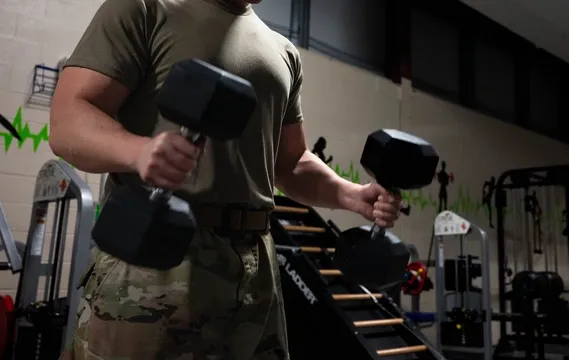
A hammer curl is a dumbbell elbow-flexion exercise performed with your thumbs up and palms facing your body through the full rep. You hold the dumbbell the way you would hold a hammer. It suits athletes who need forearm and grip strength, who want thicker arms, or whose wrists complain during palms-up work.
The execution standard is simple:
Keep your elbows pinned to your sides.
Keep your torso still.
Lower for two to three seconds.
Reach full elbow extension at the bottom.
The hammer curl has enough variations (seated, alternating, cross-body, and rope cable) to warrant its own guide. Here we focus on how it stacks up against the supinated curl.
What Is a Bicep Curl?
A bicep curl is the standard supinated curl, performed with palms up from bottom to top. It can be done with dumbbells, a barbell, or a cable. With dumbbells, you can rotate your palms up as you lift, which brings in the biceps’ supinator role.
On dumbbell bicep curl vs hammer curl, the elbow travels the same path in both. Only the hand rotation differs. On cable bicep curl vs hammer curl, the cable changes the strength curve. A dumbbell curl is easiest at the bottom because gravity pulls straight down while your forearm hangs vertical. A cable keeps tension on the biceps through that range. Human strength-curve research by Kulig, Andrews, and Hay explains why the resistance profile matters.
Shoulder position matters as well. Oliveira and colleagues found that changing the shoulder angle across dumbbell curl variations shifted biceps EMG across the range of motion. Cable bicep exercises add even more angles, which makes them a topic of their own. The supinated curl is the right tool when you want biceps peak or supination strength, such as turning a valve, wrench, or door handle under resistance.
Are Hammer Curls Better Than Bicep Curls for Arm Size?
Neither curl wins on its own for arm size. Hammer curls add thickness by building the brachialis and brachioradialis. Bicep curls build the biceps peak. Because the brachialis sits under the biceps, a bigger brachialis pushes the biceps outward and makes the whole upper arm look wider from the front and side.
Muscle growth tracks the number of hard sets each muscle receives. A meta-analysis by Schoenfeld, Ogborn, and Krieger found a graded dose-response between weekly set volume and hypertrophy. Each grip biases a different part of the elbow-flexor group, so splitting your curl volume between the two trains the whole group. Running every set with one grip leaves a part of the arm underloaded.
The hammer curl also builds the upper forearm, which most lifters neglect. If you want the biggest arm possible, program both at roughly equal volume and give priority to whichever area lags.
Which Is Better for Strength and Grip?
The hammer curl is better for strength and grip. Elbow flexion is strongest with the forearm in a neutral position, so most lifters can hammer curl noticeably heavier dumbbells than they can supinated curl. That heavier load also makes the forearm and grip work harder, which is the carryover tactical athletes need.
Measurements of maximal elbow torque, going back to Provins and Salter, show flexion strength changing with forearm position, with the midposition among the strongest. That is the mechanical reason the hammer curl moves more weight.
Are Hammer Curls Harder Than Bicep Curls?
The answer depends on what “harder” means. In absolute load, the hammer curl is heavier because three muscles share it well. The bicep curl often feels harder on the biceps, because the supinated grip puts more of the load on one muscle.
On hammer curl weight vs bicep curl weight, expect to use heavier dumbbells for hammers. Do not force your supinated curl to match that weight. Matching it costs you form and recruits momentum from your lower back.
Why Grip Strength Matters on the Job
Grip strength is a well-validated marker of overall strength and long-term health. Bohannon’s review of hand-grip dynamometry summarizes that evidence. It is also a direct job demand. The Army’s physical readiness doctrine in FM 7-22 includes loaded carries in its testing and training. Firefighters haul hose and tools, and obstacle courses end in rope and wall climbs.
A hammer curl does not replace carries and hangs. It builds the forearm flexor mass that supports them. That is the logic behind functional strength for military performance: train the qualities the job taxes first.
Should You Do Hammer Curls or Bicep Curls? Our Verdict
Do both, but lead with the hammer curl. For tactical athletes, the neutral grip trains the forearm and grip qualities that show up in carries, drags, and climbs, and it lets you load heavier. Follow it with a supinated curl to cover the biceps’ supination role and build the peak.
How to weigh the two by goal:
Prioritize the hammer curl if your grip fails before your back or legs on carries and pulls, if your forearms lag, or if supinated curls irritate your wrists or elbows. Many lifters find the neutral grip easier on those joints.
Prioritize the bicep curl if your goal is the biceps peak, if you need supination strength, or if you already train grip heavily through carries and climbing.
Split the volume evenly in a general strength phase with no specific weakness.
On hammer curl vs bicep curl for women, the answer does not change. The anatomy and mechanics are the same. Female athletes facing the same carry and drag standards benefit from the same hammer-first approach.
If you are deciding how arm work fits into your full training week, our guide to choosing a strength & endurance program walks through what to look for.
How to Program Hammer Curls and Bicep Curls in One Workout
Program both curls after your compound pulls, hammer first. In order:
Finish your heavy pulling first (pull-ups, rows, deadlifts). Curls are accessories, not the main event.
Hammer curl while you are fresh: 3 sets of 8 to 12 reps.
Supinated curl next: 2 to 3 sets of 10 to 15 reps.
Rest 60 to 90 seconds between sets, and stop one to two reps short of failure.
Run this one to two times per week, adding reps first and load second.
The heavier movement goes first because it needs the most from your grip and nervous system. Moderate rep ranges work because hypertrophy occurs across a wide range of loads when sets are taken close to failure. Schoenfeld and colleagues’ re-examination of the repetition continuum supports this, as do the ACSM progression guidelines. Your elbow flexors already work hard during every pull. For most athletes, four to six direct curl sets per session completes the weekly volume without stealing recovery from runs and rucks.
A sample hammer and bicep curl workout for the end of a pull day looks like this:
weighted pull-ups
dumbbell rows
dumbbell hammer curls, 3 sets of 8 to 10 reps
supinated dumbbell curls, 3 sets of 12 reps
farmer’s carries, 3 rounds of 40 meters
Slot it into the upper-body day of a a strength workout for athletes to see how the pieces fit across a full week.
Frequently Asked Questions
What muscles does each curl work?
Both curls train the biceps brachii, brachialis, and brachioradialis. The grip changes the split. The supinated bicep curl puts the most load on the biceps, because the biceps both bends the elbow and turns the palm up. The neutral hammer curl shifts more load onto the brachialis and the brachioradialis, the thick muscle on top of your forearm.
Which is better for building bigger arms?
Both together build the biggest arms. Hammer curls grow the brachialis, which pushes the biceps outward and adds width, along with the upper forearm. Bicep curls grow the biceps peak. Split your curl volume roughly evenly between the two grips, and give priority to whichever area is lagging.
Are hammer curls harder than bicep curls?
Hammer curls are heavier, but they rarely feel harder. Elbow flexion is strongest in a neutral grip, so you can load more weight. Bicep curls often feel harder on the biceps because the palms-up grip concentrates the work on that one muscle. Use heavier dumbbells for hammers than for supinated curls.
Which builds more grip and forearm strength?
The hammer curl builds more grip and forearm strength. The neutral grip loads the brachioradialis directly, and the heavier dumbbells force your hands to hold more weight on every rep. For tactical athletes, that carries over to kettlebell carries, casualty drags, and rope climbs. Pair it with loaded carries for the full effect.
Should you do hammer curls or bicep curls, or both?
Do both, and lead with the hammer curl. The hammer builds grip, forearms, and arm thickness with heavier loads, which matters more on the job. The supinated curl covers the biceps’ supination role and builds the peak. Using one grip only leaves part of the elbow-flexor group undertrained.
How do you program both in one workout?
Place both at the end of a pull day, after rows and pull-ups. Do the hammer curl first for 3 sets of 8 to 12 reps. Then do the supinated curl for 2 to 3 sets of 10 to 15 reps. Rest 60 to 90 seconds between sets, stop one to two reps short of failure, and train them once or twice per week.
The hammer curl vs bicep curl question has a clear answer for anyone who trains for a job. Lead with the hammer for heavier loading and grip carryover, then finish with the supinated curl for the biceps peak. Knowing the split is the easy part. Running it week after week, with progression and recovery built around your runs, rucks, and test prep, is what changes your arms and your grip. Pick the CF ONE plan that matches your job, and let the programming carry the details.
References:
Basmajian JV, Latif A. Integrated actions and functions of the chief flexors of the elbow: a detailed electromyographic analysis. Journal of Bone and Joint Surgery (American). 1957;39-A(5):1106-1118.
Murray WM, Delp SL, Buchanan TS. Variation of muscle moment arms with elbow and forearm position. Journal of Biomechanics. 1995;28(5):513-525.
Kleiber T, Kunz L, Disselhorst-Klug C. Muscular coordination of biceps brachii and brachioradialis in elbow flexion with respect to hand position. Frontiers in Physiology. 2015;6:215.
Boland MR, Spigelman T, Uhl TL. The function of brachioradialis. Journal of Hand Surgery (American). 2008;33(10):1853-1859.
Provins KA, Salter N. Maximum torque exerted about the elbow joint. Journal of Applied Physiology. 1955;7(4):393-398.
Kulig K, Andrews JG, Hay JG. Human strength curves. Exercise and Sport Sciences Reviews. 1984;12:417-466.
Oliveira LF, Matta TT, Alves DS, Garcia MA, Vieira TM. Effect of the shoulder position on the biceps brachii EMG in different dumbbell curls. Journal of Sports Science and Medicine. 2009;8(1):24-29.
Schoenfeld BJ, Ogborn D, Krieger JW. Dose-response relationship between weekly resistance training volume and increases in muscle mass: a systematic review and meta-analysis. Journal of Sports Sciences. 2017;35(11):1073-1082.
Schoenfeld BJ, Grgic J, Van Every DW, Plotkin DL. Loading recommendations for muscle strength, hypertrophy, and local endurance: a re-examination of the repetition continuum. Sports. 2021;9(2):32.
American College of Sports Medicine. Progression models in resistance training for healthy adults. Medicine and Science in Sports and Exercise. 2009;41(3):687-708.
Bohannon RW. Muscle strength: clinical and prognostic value of hand-grip dynamometry. Current Opinion in Clinical Nutrition and Metabolic Care. 2015;18(5):465-470.
Headquarters, Department of the Army. FM 7-22, Holistic Health and Fitness. Washington, DC: Department of the Army; October 2020.
Disclaimer: This article is for educational purposes and is not medical advice. Consult a qualified healthcare provider before starting a new training program, especially if you have an existing elbow, wrist, or shoulder injury. Individual results vary with training history, recovery, and consistency.


