
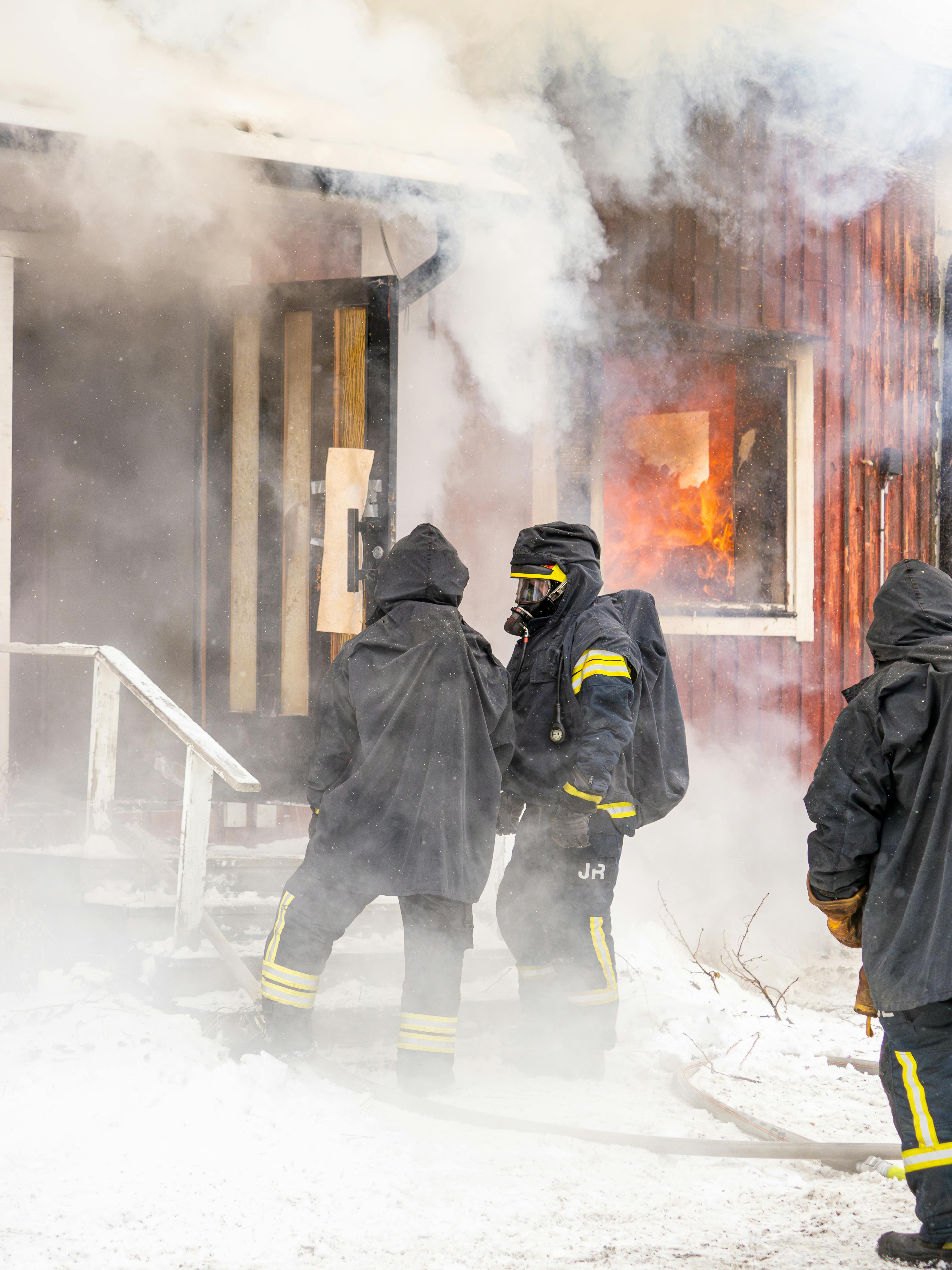
Firefighter Durability Training: Build Real Resilience
Building Real Resilience for Demanding Fireground Performance
Firefighter durability training is the deliberate development of the strength, work capacity, tissue tolerance, and recovery a firefighter needs to perform repeatedly under load without breaking down. Firefighting is not a sport, it's a profession of unpredictable intensity, prolonged effort, and high physical consequence. One minute you're standing still, the next you're hauling weight, climbing stairs in full gear, dragging hoses, carrying victims, or performing repeated maximal efforts under a heavy load. This isn't something that can be addressed with sporadic conditioning sessions, it's the kind of adaptation that purpose-built tactical fitness programs for first responders are designed to develop.
Firefighters need durability, a blend of strength, work capacity, resilience, recovery efficiency, and functional robustness that holds up under exacting conditions. What does durability actually mean for firefighters? How do you train it without breaking down? More importantly: how do you design a training system that prepares you for duty without causing injury before you ever get there?
Let’s unpack it.
What “Durability” Really Means in Firefighting
Durability isn’t a single metric like VO2max or 1-rep max squat. It’s a multi-system adaptive capacity that includes:
Musculoskeletal resilience
Neuromuscular coordination under fatigue
Cardiovascular robustness
Load tolerance
Recovery efficiency
Movement quality under stress
A durable firefighter can:
Maintain posture and technique under load
Absorb and distribute mechanical stress across joints
Sustain performance across repeated efforts
Recover quickly between demands
Reduce the chance of overuse injury
Durability is the bridge between fitness on paper and functional performance on the fireground. Picture the difference on a real call. Two firefighters post identical 1.5-mile run times, but on the third floor of a working structure fire, forty minutes into an SCBA bottle, after two hose advances and a forcible-entry effort, one still moves a downed victim with controlled mechanics while the other's posture collapses and grip fails. Same test score, very different fireground outcome. Durability is what separates them: the capacity to keep producing quality force after fatigue, heat, and load have already stacked up. That gap is exactly what durability training is built to close.
Why Firefighters Need Durability, Not Just Fitness
Fitness tests are useful, but they’re often limited in scope. A 1.5-mile run, a beep test, or a strength test tells you about a specific capacity. But real fires require:
Repeated high intensity bursts
Heavy external load with SCBA and turnout gear
Unpredictable demands on movement and force
Cognitive focus under metabolic stress
This combination of intermittent load, variable intensity, and environmental stress makes conditioning alone insufficient without durability training, which is also why the program you choose matters: seeing how Combat Fitness versus other training programs actually stack up tells you which one is built to develop durability rather than just conditioning. The same logic applies to your tools, comparing options to find the better tactical training app comes down to which one drives durable performance under load.
Durability training prepares the body to absorb stress and perform when it matters most, not just to pass a generalized fitness test. The distinction matters because fireground demand is intermittent and unscheduled. A run test measures steady-state output; a structure fire delivers maximal bursts separated by unpredictable recovery, all while wearing 45-plus pounds of SCBA and turnout gear that shifts your mechanics and raises core temperature. Cognitive load compounds it, you're making decisions under metabolic stress, not jogging a known course. A firefighter can clear a department fitness standard comfortably and still gas out on the second hose line, because the test never measured the quality that the job actually taxes.
The Firefighter’s Durability Demand Profile
Here’s what firefighters actually face:
Repeated high intensity efforts
Sprints, stair climbs, forceful movements, and rescues.
Load carriage under fatigue
SCBA, tools, and hose lines add significant weight and change movement mechanics, which is why load carriage and conditioning deserve their own focus in a firefighter's plan.
Movement unpredictability
Uneven terrain, obstacles, confined spaces.
Fatigue management
Long shifts with irregular rest intervals affect recovery capacity.
Durability demands are multi-vector: strength + energy system capacity + structural resilience + neuromuscular coordination, and mapping them well starts with understanding capacity versus capability. No single one of these vectors carries a fireground task on its own. Dragging a charged hose line needs strength and structural resilience to brace the spine under an off-axis pull; climbing a flight in full gear needs energy-system capacity to keep working through oxygen debt; carrying a victim down stairs needs neuromuscular coordination to hold technique when the legs are shaking. Train any one in isolation and the others become the failure point. This is why a firefighter's program has to develop the vectors together, the way the job loads them.
How the Body Adapts to Durability Training
Durability adaptations are multi-layered:
1. Structural and Tissue Adaptation
Joint capsules, tendons, and fascia grow stronger under progressive load, improving force absorption.
2. Neuromuscular Efficiency
The nervous system learns to sequence and coordinate muscles under fatigue.
3. Metabolic Resilience
Aerobic and anaerobic systems adapt to repeated bouts of high intensity with partial recovery.
4. Recovery Systems
Hormonal regulation, sleep quality, and metabolic balance all influence how quickly an individual recovers between sessions.
These adaptations require thoughtful progression, stress plus recovery, not just repetition. These systems also adapt on different timelines, which is the part most programs get wrong. Metabolic and neuromuscular changes show up in weeks; connective-tissue remodeling in tendons and joint capsules lags well behind, often by months. That mismatch is where overuse injuries hide, the engine can suddenly handle more work than the structure has caught up to. Durability training respects the slowest-adapting tissue and progresses load to it, not to how good the cardio feels. Patience on the structural side is what keeps a firefighter on the truck instead of on light duty.
Common Durability Training Mistakes
Conventional training approaches often miss the mark:
Only prioritizing long, slow cardio
Treating strength and conditioning separately
Ignoring movement mechanics under load
High impact every session without load variation
Failure to manage cumulative stress
Conditioning alone will not build the structural resilience necessary for fireground tasks, and traditional strength alone will not prepare you for repeated metabolic demand, so durability training overlaps these domains, which is the core logic behind concurrent training for firefighters. The most common version of this mistake in the firehouse is volume without variation, the same high-impact circuit run hard every shift, with no deliberate load management or attention to training density. It feels productive because it's exhausting, but cumulative stress with no planned recovery is precisely how connective tissue gets overrun. The opposite error is just as costly: long, slow cardio alone builds an aerobic base but leaves the structure unprepared for the heavy, awkward, off-axis loads the fireground actually delivers. Durability training sits between those failure modes, blending the stimulus and managing the dose.
A Better Framework for Firefighter Durability
Here’s what effective durability training looks like:
1. Progressive Load Exposure
Train with incremental increases in load, whether it’s a ruck, kettlebell, sandbag, or sled. Force the body to adapt structurally without overwhelming it.
2. Mixed Modal Efforts
Circuit work that blends metabolic conditioning with strength demands prepares the body for unpredictable task sequences.
3. Neuromuscular Control Under Fatigue
Practice movement patterns after fatigue sets in, this improves movement quality when it matters most.
4. Recovery and Readiness Monitoring
Use simple readiness indicators, sleep quality, soreness, mood, to adjust training stimulus and avoid overtraining.
Durability isn’t about working harder, it’s about working smarter and progressively. In practice these four pieces aren't separate programs, they're one weekly structure. Progressive load exposure sets the strength floor; mixed-modal circuits rehearse the unpredictable task sequences of a real call; fatigued-state movement work protects technique for the moment it matters; and readiness monitoring decides how hard any of it should be pushed that day. A firefighter following this kind of integrated build is training the way the job loads the body, rather than borrowing a bodybuilding split or a marathon plan and hoping it transfers.
What Science Says About Training and Durability
The stakes here are not abstract. Kales and colleagues (2007), in the New England Journal of Medicine, found that heart disease accounts for roughly 45% of on-duty firefighter deaths, with the risk concentrated during and immediately after fire suppression, a small fraction of annual duty hours carrying a disproportionate share of fatalities. That is a durability problem as much as a cardiology one: the cardiovascular system has to absorb sudden, maximal demand and then recover from it, repeatedly.
On the injury side, Gabbett (2016) reframed load management around the training-injury relationship, showing that appropriately progressed workloads build the capacity to tolerate high demand, while sharp spikes in load are what drive injury. Applied to the firehouse, that is the entire case for progressive, monitored durability work over volume-for-volume's-sake conditioning: it is the dosing of stress, not the avoidance of it, that keeps a firefighter durable. When durability is trained as a system, not a silo, adaptation becomes both safer and more transferable.
How to Measure Durability Progress
Unlike a single performance metric, durability must be evaluated across multiple dimensions:
Movement quality under fatigue
Time under load with task sequences
Recovery markers (heart rate variability, sleep, mood)
Strength under fatigue
Repeat effort capacity
This tells a deeper story than a stopwatch or a single fitness test ever could. The practical move is to track a couple of these markers consistently rather than chasing all of them. A simple example: time a standardized loaded task sequence, a stair climb, a hose drag, a sled push, and re-test it under the same fatigue conditions every four to six weeks, while logging morning readiness (sleep, soreness, mood) the same way each day. If the loaded sequence holds or improves while readiness stays stable, durability is trending up. If task quality slips while readiness craters, the program is outrunning recovery, and the load needs to back off before something breaks.
Why Durability Trumps Raw Fitness
A 5-minute mile means little if, after 3 bouts of heavy load, your posture collapses and your technique deteriorates.
Durability means your best movement quality is accessible under pressure, and your body can recover from stress efficiently, over hours, days, and cumulative shifts.
That’s the fireground reality.
So the goal isn't to abandon fitness tests, they still set useful floors. The goal is to stop treating a single number as the finish line. A firefighter who trains durability builds a body that performs its best when conditions are at their worst: late in the bottle, deep into the shift, on the second and third call of the night. That is the standard the job sets, and it's the standard durability training is built to meet.
References
Gabbett, T. J. (2016). The training - injury prevention paradox: should athletes be training smarter and harder? British Journal of Sports Medicine, 50(5), 273–280.
Kales, S. N., Soteriades, E. S., Christophi, C. A., & Christiani, D. C. (2007). Emergency duties and deaths from heart disease among firefighters in the United States. New England Journal of Medicine, 356(12), 1207–1215


