
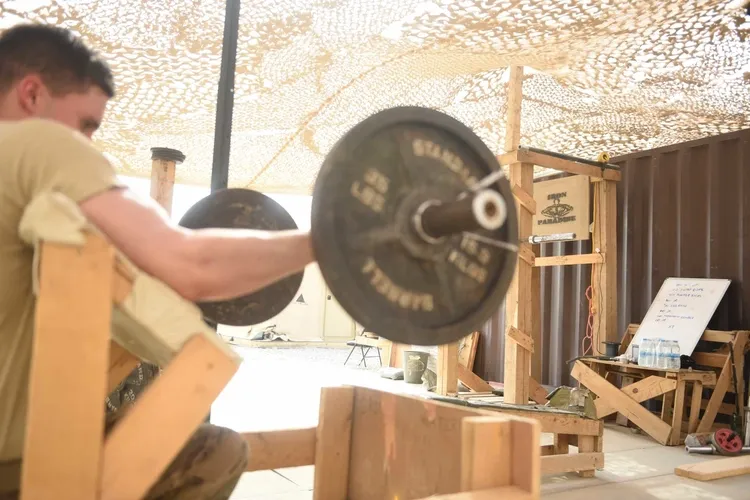
Dumbbell Preacher Curl: How to Do It Right | Combat Fitness
Dumbbell Preacher Curl Guide: Muscles Worked, Form, and Variations
The dumbbell preacher curl is a strict elbow-flexion exercise done with your upper arm braced on an angled pad, which removes shoulder swing and forces the biceps and brachialis to move the weight on their own. In our tactical fitness programs, it sits where it belongs: accessory work that builds honest arm strength behind the pull-ups, carries, and drags the job demands.
This guide covers what the movement trains, exact setup and cues, how to do it without a preacher bench, the single-arm version, how it compares to barbell, machine, and incline curls, and how to program it. Start with the muscles.
What Muscles Does the Dumbbell Preacher Curl Work?
The dumbbell preacher curl works the biceps brachii, the brachialis, and the forearm muscles that assist elbow flexion and stabilize the wrist. Because the pad holds your upper arm in front of your body, the elbow flexors do the work without help from your shoulders, hips, or lower back.
The biceps has two heads. The long head crosses the shoulder joint, and the short head attaches to the coracoid process on the front of the shoulder blade. Both insert on the radius, so the biceps flexes the elbow and turns the palm up. With your arm forward on the pad, the long head sits shorter at the shoulder, which is why the preacher curl is commonly credited with short-head emphasis. EMG research shows biceps activation shifts with shoulder position across curl variations, but no curl isolates one head completely.
The brachialis sits under the biceps and attaches to the ulna, so it flexes the elbow whatever your grip. It is the quiet workhorse of every pull. The brachioradialis in the forearm joins in, more so with a neutral grip.
The main benefit is mechanical. A standard 45-degree pad places the heaviest load in the bottom half of the curl, near full extension, where the muscle is lengthened. Studies training elbow flexors on a preacher bench found full range of motion beat partial range for strength and muscle thickness, and training the extended range produced strong gains. For a tactical athlete, that strength shows up in rope climbs, casualty drags, and every carry where your arms hold the load. It supports functional strength for military performance, but it never replaces the pulls and carries themselves.
How to Do a Dumbbell Preacher Curl (With or Without a Bench)
To do a dumbbell preacher curl, set the pad snug under your armpit, lay the back of your upper arm flat on it, curl the dumbbell up without lifting your elbow, then lower it for two to three seconds to a nearly straight arm.
Set the seat height. The top of the pad should sit in your armpit with your chest against it. Too low and you lean over and shrug; too high and your shoulder hikes up.
Position the arm. The back of your upper arm lies flat on the pad, elbow pointing down the slope, palm up, wrist straight.
Brace. Feet flat, chest on the pad, shoulders down. Nothing moves except your forearm.
Curl. Lift until your forearm approaches vertical, stopping just before tension drops off.
Lower under control. The bottom is where the bench loads the biceps hardest, so own that part instead of rushing it.
Stop short of a hard lockout. Keep a slight bend at the bottom and never bounce. Distal biceps tendon ruptures typically happen when a flexed elbow is forced into extension under heavy eccentric load, which is why the bottom gets control, not momentum.
Cues to repeat every rep: armpit on the pad, elbow glued down, wrist straight, slow to the bottom.
Bench angle matters too. The standard 45-degree face loads the stretched bottom position. If your bench has a vertical face, curling over it moves peak tension toward the middle of the range, a useful change of stimulus.
Preacher Curl With a Dumbbell and No Bench
No preacher bench in your gym or garage? Three setups replicate it well:
Incline bench: set an adjustable bench to roughly 45 to 60 degrees, stand or kneel behind it, and drape your arm over the backrest. This is the closest match.
Thigh brace: sit on a bench and press the back of your upper arm against your inner thigh. It works at home with one dumbbell.
Box or rack brace: kneel and rest your arm on a padded box or a folded mat on a low surface, keeping the upper arm angled down and away from you.
The rules stay the same: the upper arm stays pinned, and the lowering phase stays slow.
Single-Arm Dumbbell Preacher Curl: Why Train One Side at a Time?
The single-arm dumbbell preacher curl trains one elbow at a time, which exposes and corrects side-to-side strength gaps and lets you focus fully on one arm’s range. Most lifters produce slightly more force per limb when working unilaterally, a pattern researchers call the bilateral deficit.
Set up the same way, then use your free hand to steady the pad or spot your last rep. Start each set with your weaker arm and match the rep count on the stronger side. The two-arm version is faster and fine for building volume, but a dominant arm can quietly carry the set while the weaker one falls behind.
Unilateral work also fits the job. Real tasks are rarely symmetrical: a rifle in one hand, one litter handle, a one-arm drag through a doorway. Training each side independently keeps both elbows ready for that.
Dumbbell vs. Barbell, Machine, and Incline Curl: Which Is Better?
No single curl is better; each loads the elbow flexors differently. The dumbbell preacher curl offers unilateral control and a free wrist path, the barbell version allows more total load, a machine keeps tension even on a fixed path, and the incline dumbbell curl trains the biceps from a stretched shoulder position.
Dumbbell preacher curl: each arm works alone and your wrist rotates naturally. The trade-off is less total load.
Barbell or EZ-bar preacher curl: both arms share one bar, so you can load heavier and progress in smaller jumps. A straight bar can irritate wrists, and the stronger arm can carry the weaker one.
The machine preacher curl: a cam smooths resistance across the range on a fixed path, so you can push close to failure safely. You lose the stabilization demand, and fit depends on your limb length.
Incline dumbbell curl: the reverse shoulder position, with your arm hanging behind your body, puts the long head on stretch. The preacher curl locks out cheating; the incline curl stretches the long head. Use both across a training block.
Is the preacher curl better than standard dumbbell curls? It is stricter, not better. Standing curls allow more load and some body English; the preacher curl removes both.
Hammer, Reverse, and Zottman Preacher Curls
Dumbbell hammer preacher curl: a neutral grip shifts more work to the brachialis and brachioradialis, with direct carryover to grip.
Reverse dumbbell preacher curl: palms down puts the biceps at a disadvantage and makes the forearm extensors work hard. Expect to use less weight.
Zottman preacher curl: curl up palm up, rotate palm down at the top, and lower with the reverse grip for a biceps-driven lift and a forearm-heavy negative.
Common Dumbbell Preacher Curl Mistakes and How to Fix Them
Lifting the elbow off the pad. This turns the curl into a front raise. Fix it by dropping the weight and pressing your armpit into the pad.
Cutting the negative. Dropping the dumbbell skips the most productive part of the rep. Count two to three seconds down.
Half reps. Partial reps leave gains behind compared with full range. Go nearly straight at the bottom and close to vertical at the top.
Going too heavy. If you cannot control the bottom third, the load is too heavy. Ego weight here is how elbows get hurt.
Starting cold. Do one or two light sets of 15 to 20 reps first; warm-ups improve performance and prepare the tendon for loading.
Curling the wrist. Flexing the wrist at the top shifts work to the forearm. Keep the wrist in line with the forearm.
How to Program Dumbbell Preacher Curls
Program dumbbell preacher curls as accessory work after your main lifts: two to four sets of 8 to 15 reps, one or two times per week, stopping one to two reps short of failure. Count those sets toward your total weekly biceps volume rather than treating them as a priority lift.
The reasoning is straightforward. Muscle growth occurs across a wide load range when sets are taken close to failure, and weekly set volume shows a dose-response relationship with hypertrophy. Rest 60 to 120 seconds so reps stay clean; longer rest periods support more total volume.
Place preacher curls at the end of a pull day, after pull-ups and rows in a strength workout for athletes. Rotate them every few weeks with incline curls and cable bicep exercises so the elbow flexors are trained at different lengths. During heavy ruck or run phases before selection, cut arm accessory volume first; recovery for the main events matters more.
If you are still deciding how arm work fits into your week, our guide to choosing a strength & endurance program breaks down how a complete plan balances lifting, conditioning, and accessories.
Frequently Asked Questions
What muscles does the dumbbell preacher curl work?
The dumbbell preacher curl works the biceps brachii, brachialis, and brachioradialis. The angled pad fixes your upper arm in front of your body, which removes shoulder and hip involvement and keeps the elbow flexors doing all the work, with extra load on the lengthened bottom range.
How do you do a dumbbell preacher curl correctly?
Set the pad snug in your armpit, lay your upper arm flat on it, and curl without lifting your elbow. Lower over two to three seconds to a slight bend at the bottom. Keep your wrist straight and never bounce out of the bottom position.
Is the single-arm or two-arm preacher curl better?
Single-arm is better for fixing imbalances and focusing on one side, and most lifters handle slightly more weight per arm. Two-arm saves time and builds volume. Use single-arm when one side lags, and two-arm when time is short.
What is the difference between dumbbell, barbell, and machine preacher curls?
Dumbbells train each arm independently with a natural wrist path. A barbell or EZ bar allows heavier total loads. A machine runs a fixed path with more even resistance and no stabilization demand. All three train the same muscles; the trade-off is control versus load versus consistency.
How much weight should you use for dumbbell preacher curls?
Use a weight you can lower for two to three seconds for 8 to 15 clean reps without your elbow leaving the pad. For most lifters that is noticeably lighter than a standing curl, because the bench removes the momentum that usually helps.
How do you program preacher curls?
Do two to four sets of 8 to 15 reps once or twice a week, after your main pulling work, stopping one to two reps short of failure. Rotate with incline and cable curls every few weeks, and cut volume first during demanding conditioning phases.
The dumbbell preacher curl earns its place by being honest: the pad removes cheating, the bench loads the stretched range, and your elbow flexors get stronger for the pulls, carries, and drags that matter. Treat it as accessory work, own the lowering phase, and keep both arms even. Add it to your next pull day, and if you want it built into a complete plan, start CF ONE and train with structure from day one.
References:
Standring S, ed. Gray’s Anatomy: The Anatomical Basis of Clinical Practice. 42nd ed. Elsevier; 2020.
Oliveira LF, Matta TT, Alves DS, Garcia MA, Vieira TM. Effect of the shoulder position on the biceps brachii EMG in different dumbbell curls. Journal of Sports Science and Medicine. 2009;8(1):24-29.
Pinto RS, Gomes N, Radaelli R, Botton CE, Brown LE, Bottaro M. Effect of range of motion on muscle strength and thickness. Journal of Strength and Conditioning Research. 2012;26(8):2140-2145.
Sato S, Yoshida R, Kiyono R, et al. Elbow joint angles in elbow flexor unilateral resistance exercise training determine its effects on muscle strength and thickness of trained and non-trained arms. Frontiers in Physiology. 2021;12:734509.
Schoenfeld BJ, Grgic J. Effects of range of motion on muscle development during resistance training interventions: a systematic review. SAGE Open Medicine. 2020;8:2050312120901559.
Safran MR, Graham SM. Distal biceps tendon ruptures: incidence, demographics, and the effect of smoking. Clinical Orthopaedics and Related Research. 2002;(404):275-283.
Škarabot J, Cronin N, Strojnik V, Avela J. Bilateral deficit in maximal force production. European Journal of Applied Physiology. 2016;116(11-12):2057-2084.
Schoenfeld BJ, Ogborn D, Krieger JW. Dose-response relationship between weekly resistance training volume and increases in muscle mass: a systematic review and meta-analysis. Journal of Sports Sciences. 2017;35(11):1073-1082.
Schoenfeld BJ, Grgic J, Ogborn D, Krieger JW. Strength and hypertrophy adaptations between low- vs. high-load resistance training: a systematic review and meta-analysis. Journal of Strength and Conditioning Research. 2017;31(12):3508-3523.
Refalo MC, Helms ER, Trexler ET, Hamilton DL, Fyfe JJ. Influence of resistance training proximity-to-failure on skeletal muscle hypertrophy: a systematic review with meta-analysis. Sports Medicine. 2023;53(3):649-665.
Schoenfeld BJ, Pope ZK, Benik FM, et al. Longer interset rest periods enhance muscle strength and hypertrophy in resistance-trained men. Journal of Strength and Conditioning Research. 2016;30(7):1805-1812.
Fradkin AJ, Zazryn TR, Smoliga JM. Effects of warming-up on physical performance: a systematic review with meta-analysis. Journal of Strength and Conditioning Research. 2010;24(1):140-148.
American College of Sports Medicine. Progression models in resistance training for healthy adults. Medicine and Science in Sports and Exercise. 2009;41(3):687-708.
Schoenfeld BJ. The mechanisms of muscle hypertrophy and their application to resistance training. Journal of Strength and Conditioning Research. 2010;24(10):2857-2872.
Haff GG, Triplett NT, eds. Essentials of Strength Training and Conditioning. 4th ed. Human Kinetics; 2016.
Headquarters, Department of the Army. FM 7-22: Holistic Health and Fitness. Washington, DC; 2020.
Disclaimer: This article is for educational purposes only and is not medical advice. Consult a qualified healthcare provider before starting a new training program, especially if you have elbow, wrist, or shoulder pain or a history of tendon injury. Stop any exercise that causes sharp or worsening pain.


