
What Is a Deload Week in Lifting? Guide | Combat Fitness
What Is a Deload Week? How to Program Recovery That Makes You Stronger
A deload week in lifting is a planned, temporary reduction in training volume, intensity, or both, usually every 4 to 8 weeks, that lets accumulated fatigue clear so your body can absorb the work and come back stronger. It is not a week off, and it is not an injury break. Every one of our tactical fitness programs builds deloads into the calendar for that reason.
An international panel of strength coaches now defines deloading as reduced training stress designed to cut physical and mental fatigue and prepare you for the next block (Bell et al., 2023). Below: what a deload week is, the signs you need one, how to run one, and a done-for-you sample week.
What Is a Deload Week in Lifting?
A deload week is seven days of deliberately easier training inside a longer program. You keep the same lifts and the same schedule, but you cut sets, load, or effort so fatigue drops faster than fitness does.
What Deload Means in Weightlifting
In weightlifting, "deload" means taking load off the system. Hard training produces two things at once: fitness and fatigue. Fatigue fades faster than fitness, so a short drop in training stress lets fatigue clear while most of the adaptation stays (Zatsiorsky et al., 2021). Coaches call the rebound that follows supercompensation: you return to the bar recovered and able to handle more (Bompa & Buzzichelli, 2019).
A Deload Is Active, Not a Week on the Couch
A deload keeps you training. You still squat, press, pull, and condition, just at a dose low enough to recover from. Full rest is a different tool. In one trial, lifters who stopped training entirely for a week mid-program saw smaller lower-body strength gains than those who kept training, with no difference in muscle growth (Coleman et al., 2024). Reduced work, not zero work, is the standard.
Why and When You Need a Deload
Most lifters need a deload every 4 to 8 weeks of hard training. In a survey of strength and physique athletes, the typical deload came about every 5 to 6 weeks and lasted close to one week (Bell et al., 2024).
Signs You Need a Deload
Watch for a cluster of these, not one bad day:
Stalled or falling lifts for two or more weeks at the same effort
Poor sleep, or sleep that no longer restores you
Nagging joint or tendon aches that linger between sessions
Flat motivation and a higher resting heart rate in the morning
These markers track the early stages of overreaching, and left alone they can slide toward overtraining syndrome, which takes weeks to months to resolve (Meeusen et al., 2013; Kreher & Schwartz, 2012).
Planned vs Reactive Deloads
A reactive deload happens after you are wrecked; a planned one sits on the calendar before you need it. Coaches in the Delphi panel favored building deloads into the program ahead of time while keeping the option to move one earlier if signs show up (Bell et al., 2023).
How to Run a Deload Week
Run a deload by keeping your normal lifts and schedule while cutting volume by roughly 40 to 60 percent, lowering intensity, or both. Taper research shows the biggest performance gains come from large volume cuts with intensity held near normal (Bosquet et al., 2007). Pick one method below and keep moving every day.
Cut volume (most common): keep your working weights and drop sets by about half. Four sets of five becomes two sets of five.
Cut intensity: keep your sets and reps but drop the load to about 60 to 70 percent of your working weight.
Cut both: drop sets by a third and load by about 10 to 20 percent, and leave 3 to 4 reps in reserve on every set (Helms et al., 2016).
Keep moving: walk, ride, or swim easy on off days.
If you are still deciding on a plan, choosing a strength & endurance program covers what a good one schedules, recovery included. Deloads also live inside the broader base described in what GPP (general physical preparedness) is, where moderate full-body work is the default.
The Tactical Case for a Deload Week (and Deloading Your Running)
Recovery is programmed, not earned by crashing. You train in long blocks toward selection, a fitness test, or a deployment, and you cannot afford to break down in week ten of sixteen. A scheduled deload is a tactical reset: it keeps you durable across months of training instead of forcing a week off once you are already hurt.
Army doctrine makes the same point, treating rest and recovery as part of the training plan rather than a reward for finishing it (Department of the Army, 2020). The lifts you build in the weight room only carry over to the job if you show up healthy enough to use them, which is the core of functional strength for military performance.
Deloading Your Running Mileage
Your running needs the same treatment. During a deload week, cut weekly mileage by about 30 to 50 percent, drop or shorten interval and tempo sessions, and keep the easy runs. If you ruck, cut distance before you cut weight. Deload lifting and running in the same week so total fatigue falls.
A Sample Deload Week
This sample deload week assumes a four-day lifting split with two run days, using the volume-cut method. Keep working weights from your last hard week, halve the sets, and stop every set well short of failure. Lifters following a strength workout for athletes can drop this straight in after week four or week eight.
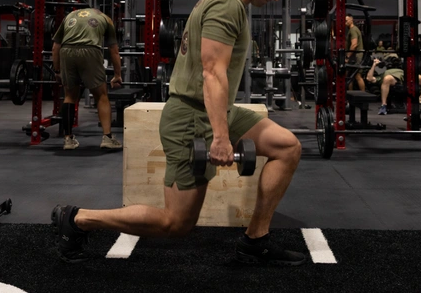
Monday, lower: back squat 2 x 5, Romanian deadlift 2 x 8, walking lunge 1 x 10 per leg.
Tuesday, easy run: 20 to 30 minutes at conversational pace.
Wednesday, upper: bench press 2 x 5, pull-ups 2 x 6, overhead press 2 x 6.
Thursday, active recovery: 30-minute walk or easy bike, plus 10 minutes of hip and upper-back mobility.
Friday, lower: trap-bar deadlift 2 x 4, split squat 2 x 8 per leg, farmer's carry 2 x 40 meters.
Saturday, upper and easy run: push-ups 2 x 12, dumbbell row 2 x 10, then 20 minutes easy.
Sunday: full rest.
Next week, return to full training at or slightly above your last hard week.
Frequently Asked Questions
What is a deload week in lifting?
A deload week in lifting is a planned week of reduced training, usually with about 40 to 60 percent less volume, lower intensity, or both. It lets fatigue clear while you keep the strength you built. Most programs schedule one every 4 to 8 weeks, and you keep training throughout it.
What does deload mean?
Deload means taking load off your body for a short period by lowering training stress. In lifting, that usually means fewer sets or lighter weights for about a week. The goal is to reduce physical and mental fatigue so the next training block starts fresh and productive.
How often should you take a deload week?
Take a deload week every 4 to 8 weeks of hard training. Older lifters, heavier lifters, and athletes juggling running, rucking, and shift work usually need one closer to every 4 weeks. Move it earlier if the warning signs stack up.
How much should you reduce weight on a deload?
If you cut weight, drop to about 60 to 70 percent of your normal working loads and keep your sets and reps. If you cut volume instead, keep the weight the same and halve your sets. Either way, finish each set with three or more reps in reserve.
Is a deload week the same as a rest week?
A deload week is not the same as a rest week. A deload keeps you training at a lower dose, which maintains skill and strength. A rest week stops training entirely. Research suggests a full week off can slightly blunt strength gains compared with continued training, so deload by default.
Do you lose strength during a deload week?
You do not lose meaningful strength during a deload week. Strength and muscle are retained over short periods of reduced training, and fatigue clears faster than fitness fades (Mujika & Padilla, 2000). Most lifters return the following week feeling stronger, not weaker.
A deload week in lifting is a planned cut in volume or intensity that lets fatigue clear so you can keep progressing across a long block. Schedule it before you need it, keep training through it, and treat it as part of the work. Put your next deload on the calendar now, and start your next block with full strength available.
References:
Bell, L., Strafford, B. W., Coleman, M., Androulakis Korakakis, P., & Nolan, D. (2023). Integrating deloading into strength and physique sports training programmes: An international Delphi consensus approach. Sports Medicine - Open, 9, 87.
Bell, L., Nolan, D., Immonen, V., Helms, E., Dallamore, J., Wolf, M., & Androulakis Korakakis, P. (2022). "You can't shoot another bullet until you've reloaded the gun": Coaches' perceptions, practices and experiences of deloading in strength and physique sports. Frontiers in Sports and Active Living, 4, 1073223.
Bell, L., Strafford, B. W., Coleman, M., Androulakis Korakakis, P., & Nolan, D. (2024). Deloading practices in strength and physique sports: A cross-sectional survey. Sports Medicine - Open, 10, 26.
Bell, L., Ruddock, A., Maden-Wilkinson, T., & Rogerson, D. (2020). Overreaching and overtraining in strength sports and resistance training: A scoping review. Journal of Sports Sciences, 38(16), 1897-1912.
Bompa, T. O., & Buzzichelli, C. (2019). Periodization: Theory and Methodology of Training (6th ed.). Human Kinetics.
Bosquet, L., Montpetit, J., Arvisais, D., & Mujika, I. (2007). Effects of tapering on performance: A meta-analysis. Medicine & Science in Sports & Exercise, 39(8), 1358-1365.
Coleman, M., Burke, R., Augustin, F., Piñero, A., Maldonado, J., Fisher, J. P., Israetel, M., Androulakis Korakakis, P., Swinton, P., Oberlin, D., & Schoenfeld, B. J. (2024). Gaining more from doing less? The effects of a one-week deload period during supervised resistance training on muscular adaptations. PeerJ, 12, e16777.
Department of the Army. (2020). FM 7-22: Holistic Health and Fitness. Headquarters, Department of the Army.
Haff, G. G., & Triplett, N. T. (Eds.). (2016). Essentials of Strength Training and Conditioning (4th ed.). Human Kinetics.
Halson, S. L. (2014). Monitoring training load to understand fatigue in athletes. Sports Medicine, 44(Suppl 2), S139-S147.
Helms, E. R., Cronin, J., Storey, A., & Zourdos, M. C. (2016). Application of the repetitions in reserve-based rating of perceived exertion scale for resistance training. Strength and Conditioning Journal, 38(4), 42-49.
Kreher, J. B., & Schwartz, J. B. (2012). Overtraining syndrome: A practical guide. Sports Health, 4(2), 128-138.
Meeusen, R., Duclos, M., Foster, C., Fry, A., Gleeson, M., Nieman, D., Raglin, J., Rietjens, G., Steinacker, J., & Urhausen, A. (2013). Prevention, diagnosis, and treatment of the overtraining syndrome: Joint consensus statement of the European College of Sport Science and the American College of Sports Medicine. Medicine & Science in Sports & Exercise, 45(1), 186-205.
Mujika, I., & Padilla, S. (2000). Detraining: Loss of training-induced physiological and performance adaptations. Part I. Sports Medicine, 30(2), 79-87.
Ogasawara, R., Yasuda, T., Ishii, N., & Abe, T. (2013). Comparison of muscle hypertrophy following 6-month of continuous and periodic strength training. European Journal of Applied Physiology, 113(4), 975-985.
Pritchard, H., Keogh, J., Barnes, M., & McGuigan, M. (2015). Effects and mechanisms of tapering in maximizing muscular strength. Strength and Conditioning Journal, 37(2), 72-83.
Zatsiorsky, V. M., Kraemer, W. J., & Fry, A. C. (2021). Science and Practice of Strength Training (3rd ed.). Human Kinetics.
Disclaimer: This article is for general education and is not medical advice. Persistent pain, prolonged fatigue, or a suspected injury should be assessed by a qualified healthcare provider before you continue training. Individual results vary with training history, recovery, and health status.


