
Core Exercises for Men: 12 Best Moves | Combat Fitness
Core Exercises for Men: The Best Moves for Real Trunk Strength
Core exercises for men should build a trunk that resists force, not abs that only look good in a mirror. Under a ruck, a plate carrier, or a casualty on a drag, your core’s job is to hold your spine still while your hips and shoulders do the work. That is why the Army, Navy, and Marine Corps fitness tests now score a forearm plank instead of a sit-up or crunch, and why our tactical fitness programs build trunk training around bracing first.
Below are the 12 best core exercises for men, sorted by what each one trains: anti-extension, anti-rotation, rotation, flexion, and lower core. You get a short how-to for each, at-home and weighted options, a section for men over 40 and 50, and a sample workout with sets and reps.
Key Takeaways:
The core’s main job is to resist movement and transfer force, so stability exercises (planks, Pallof presses, carries) belong at the center of your training.
Organize core work by function. One exercise from each category beats five variations of the same crunch.
Sit-ups and crunches still have a place, but they load the spine harder than most alternatives, so use them in smaller doses.
Men over 40 and 50 should favor stability work and controlled lower-core moves over high-rep flexion.
Three to five exercises, two to four times a week, in 10 to 20 minutes, covers almost every tactical athlete’s needs.
Why Do Core Exercises for Men Matter Beyond Abs?
Core exercises for men matter because the trunk transfers force between your legs and arms and protects your spine under load. A strong core lets you carry, drag, lift, and run with weight on your back without your lower back absorbing the strain. Abs are one visible muscle. The core is the whole system.
What are core exercises for men? Core exercises are movements that train the trunk to either create motion or prevent it. The muscles involved include the rectus abdominis, internal and external obliques, transverse abdominis, spinal erectors, multifidus, quadratus lumborum, diaphragm, and glutes. They work as a cylinder around the spine, and their job is coordination, not isolation.
Sports medicine research describes the core as the link in the kinetic chain: a stable trunk lets force move from the ground through the hips to the hands with less energy lost. Spine biomechanist Stuart McGill’s lab has shown that trunk stiffness, created by bracing, protects the spine when external loads try to bend or twist it. That is the exact demand of load carriage, and military research has long linked heavy loads to back complaints in soldiers.
The benefits of core exercises for men in tactical work:
Better force transfer in lifts, sprints, throws, and drags
More spinal protection under a pack, vest, or casualty
Stronger performance on the plank events in current military tests
More resilience against the low back pain common in load-bearing jobs
One honest caveat: reviews of the research show that core training supports performance but does not replace heavy compound strength work. Treat core strength exercises as the trunk’s insurance policy, not the whole program.
What Are the Best Core Exercises for Men?
The best core exercises for men train the trunk across all five functions, transfer to load-bearing work, keep spinal stress manageable, and scale from beginner to advanced. We chose these 12 because each meets those criteria and each fills a role the others do not.
Front plank: anti-extension, no equipment. Best for test prep and bracing.
Dead bug: anti-extension, no equipment. Best for limb control and beginners.
Ab wheel rollout: anti-extension, ab wheel. Best for advanced strength.
Bird dog: anti-extension and anti-rotation, no equipment. Best for back resilience.
Pallof press: anti-rotation, band or cable. Best for rotational control.
Side plank: anti-lateral flexion, no equipment. Best for obliques and QL.
Suitcase carry: anti-lateral flexion, dumbbell or kettlebell. Best for rucking and carries.
Bicycle crunch: rotation, no equipment. Best for obliques.
Sit-up: flexion, no equipment. Best for specific test events.
Reverse crunch: lower core, no equipment. Best for pelvic control.
Hanging knee raise: lower core, pull-up bar. Best for grip plus lower core.
Lying leg raise: lower core, no equipment. Best for home training.
These are the most effective core exercises for men because they cover every way the trunk gets loaded, not because they burn the most. Core work is one block inside a larger plan, so if you are still choosing a strength & endurance program, check how it programs the trunk before you commit.
Anti-Extension and Anti-Rotation: The Core Strengthening Exercises That Carry Over
These core strengthening exercises train the deep core muscles to stop your spine from arching, twisting, or bending sideways. Generic ab lists skip most of them, yet they are the moves that matter most under load. McGill’s research found that isometric core training increased torso stiffness more than dynamic ab training over six weeks.
1. Front Plank
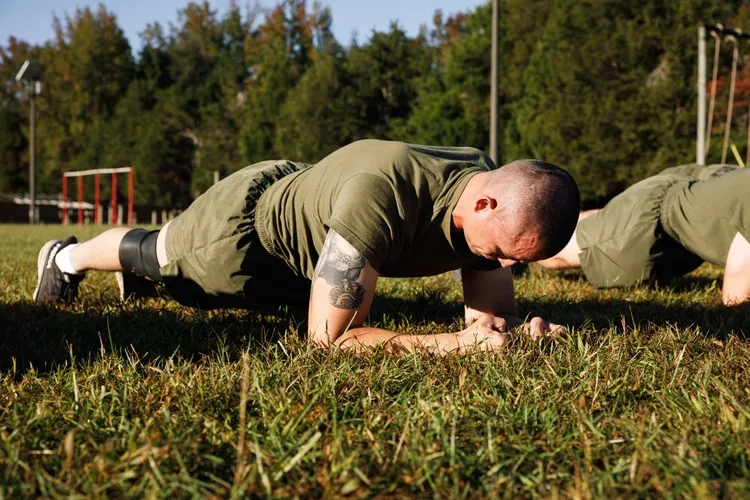
Set your forearms under your shoulders, squeeze your glutes, pull your ribs down, and brace as if you are about to take a punch. Hold the tension, not just the position. Train with sets of 10 to 30 seconds at maximum effort, and practice a full test-length hold once a week if your branch scores the plank.
2. Dead Bug
Lie on your back with arms reaching up and knees bent at 90 degrees. Slowly lower one arm and the opposite leg while keeping your lower back pressed into the floor. The dead bug teaches you to move your limbs without your spine moving with them, which is the core’s job in running, climbing, and fighting.
3. Ab Wheel Rollout
From your knees, roll the wheel forward while keeping your hips and ribs locked, then pull back. Stop before your lower back sags. Electromyography research has ranked rollouts among the highest-activation abdominal exercises tested, so treat this as an advanced strength move with low reps.
4. Bird Dog
On hands and knees, extend one arm and the opposite leg until both are level with your torso, hold two to three seconds, and return. The bird dog trains your spinal erectors and multifidus with very little spinal load, which is why it sits in McGill’s well-known “Big 3” for back resilience.
5. Pallof Press
Stand side-on to a cable or band anchored at chest height. Press the handle straight out, hold two to three seconds, and return without letting your torso rotate toward the anchor. One-sided loads (a weapon, a door, a patient, a single jerry can) all try to twist you. The Pallof press trains you to refuse.
6. Side Plank
Stack your feet, set your elbow under your shoulder, and lift your hips into a straight line. This loads the obliques and quadratus lumborum, the muscles that keep your spine from collapsing sideways. Short, hard holds of 10 to 20 seconds per side build more than long sagging ones.
7. Suitcase Carry
Hold one heavy dumbbell or kettlebell at your side and walk tall without leaning. McGill’s strongman research found one-handed carries place a high demand on the lateral trunk muscles. It is the most direct core exercise for rucking, carrying gear, and moving equipment.
Rotation: Where Does the Bicycle Crunch Fit?
Rotation exercises train the trunk to create twisting force, which you need for throwing, striking, and changing direction. Most ab and core exercises for men overload flexion and skip rotation entirely, so one rotational move per session closes the gap.
8. Bicycle Crunch
Lie on your back, hands lightly behind your head, and bring one elbow toward the opposite knee while extending the other leg. Move slowly and rotate from the ribcage, not the neck. The bicycle crunch combines rotation and flexion, so it works the obliques hard. Keep the tempo controlled: fast reps turn it into a hip flexor exercise.
Flexion: Are Sit-Ups Still Worth Doing?
Sit-ups are still worth doing in small doses if your test or job requires them, but they are no longer the backbone of core training. Research from McGill’s lab found that sit-ups placed among the highest compressive loads on the lower spine of the abdominal exercises studied.
9. Sit-Up
Anchor your feet, cross your arms or place hands at your ears, and curl up until your elbows reach your thighs. Control the descent. A large cluster-randomized trial in U.S. Army soldiers found that replacing sit-ups with core stabilization exercises did not reduce sit-up test performance, and injury rates were similar between groups.
The takeaway: if a police academy or other entry test scores sit-ups, practice them specifically in the weeks before. Otherwise, build your trunk with stability work and treat sit-ups as test-specific skill practice.
What Are the Best Lower Core Exercises for Men?
The best lower core exercises for men are the reverse crunch, hanging knee raise, and lying leg raise, because each one trains you to control your pelvis. The rectus abdominis is a single muscle, so you cannot isolate “lower abs.” These moves emphasize the lower fibers and posterior pelvic tilt.
10. Reverse Crunch
Lie on your back, knees bent, and curl your hips off the floor toward your ribs. Lower slowly. The movement starts at the pelvis, not the legs, which makes it the best entry point for lower-core work.
11. Hanging Knee Raise
Hang from a bar, brace, and pull your knees toward your chest while tilting your pelvis up. Avoid swinging. Research has shown hanging knee raises produce strong abdominal activation, and the dead hang builds the grip you need for climbing and carries.
12. Lying Leg Raise
Lie flat, hands under your hips, and raise straight legs to vertical, then lower until just before your lower back lifts. Your hip flexors attach to the lumbar spine and will pull it into an arch if your abs lose the fight. Stop the range where control ends.
Core Exercises for Men at Home (No Equipment Needed)
You can train every core function at home without equipment. At home core exercises for men cover everything except heavy loading:
Anti-extension: front plank, dead bug, hollow body hold
Anti-rotation: bird dog, plank shoulder taps
Anti-lateral flexion: side plank, suitcase carry with a loaded backpack
Rotation: bicycle crunch
Lower core: reverse crunch, lying leg raise
Without equipment, progress by slowing the tempo, adding pauses, lengthening the lever (arms overhead in a dead bug), or reducing contact points (lifting one foot in a plank). A resistance band adds Pallof presses for the cost of a few dollars. Core exercises for men without equipment get hard fast when you stop treating reps as the goal and start treating tension as the goal.
Weighted Core Exercises for Men at the Gym
Weighted core exercises for men build strength faster than bodyweight work because load forces the trunk to stiffen harder. Add weight once you can hold clean positions for the bodyweight version.
The best gym options:
Weighted plank: a plate on the upper back, held 10 to 20 seconds
Cable Pallof press: progress the weight stack
Cable woodchop: controlled rotation under load, high to low or low to high
Heavy suitcase and farmer’s carries: the closest gym match to load carriage
Hanging knee raise with a dumbbell held between the feet
Ab wheel rollout from standing for advanced athletes
Core exercises with weights are accessories, not the main event. Squats, deadlifts, and overhead presses demand heavy bracing every rep, so they build the core alongside everything else. Program core accessories after the main lifts in a strength workout for athletes like a strength workout for athletes, not before, so a fatigued trunk never limits your heavy sets.
Core Exercises for Men Over 40 and 50
Core exercises for men over 40 and over 50 should prioritize stability, control, and spinal tolerance over high-rep flexion. Discs and connective tissue recover more slowly with age, and repeated loaded flexion is the pattern most likely to aggravate them.
Swap high-rep sit-ups for bird dogs and dead bugs: lower spinal compression.
Swap fast bicycle crunches for slow-tempo reps or Pallof presses: control over momentum.
Swap straight-leg raises for reverse crunches: less lumbar pull from the hip flexors.
Swap long plank holds for repeated 10-second holds: quality tension, less fatigue.
Swap ballistic rotation for cable woodchops: load you can control.
Warm up the trunk before heavy lifting, and run McGill’s Big 3 (curl-up, side plank, bird dog) as a daily low-dose routine if your back is sensitive. Carries become more valuable with age because they train grip, posture, and the trunk together. ACSM guidelines recommend resistance training on at least two days per week for older adults, and core strengthening exercises for men over 50 fit inside that.
A Sample Core Workout for Men (Sets, Reps, and Frequency)
A complete core workout for men uses one exercise from each function and takes 15 minutes. Run this after your main training two to three times per week.
A1. Dead bug: 3 x 8 per side (anti-extension)
A2. Pallof press: 3 x 10 per side, 2-second hold (anti-rotation)
B1. Ab wheel rollout: 3 x 6 to 10 (anti-extension)
B2. Side plank: 3 x 20 seconds per side (anti-lateral flexion)
C. Suitcase carry: 3 x 40 meters per side (anti-lateral flexion)
D. Hanging knee raise: 3 x 8 to 12 (lower core)
How to program core exercises for men:
Train core two to four times a week. Stability work recovers quickly, so frequency beats volume.
Pick three to five exercises per session, each from a different function.
Use sets of 6 to 12 reps or 10 to 30 seconds. Stop when form breaks.
Progress load or difficulty, not duration. A harder 20-second hold beats a sloppy 2-minute one.
Add daily core exercises for men only at low intensity, such as a five-minute Big 3 routine.
Practice test events specifically in the four to six weeks before a scored test.
Frequently Asked Questions
What are the best core exercises for men?
The best core exercises for men are the front plank, dead bug, Pallof press, side plank, suitcase carry, and hanging knee raise. Together they train anti-extension, anti-rotation, anti-lateral flexion, and lower-core control, which are the functions that protect your spine and transfer force under load.
What is the difference between core and ab training?
Ab training targets the rectus abdominis, usually through crunches and sit-ups. Core training works every muscle around the trunk, including the obliques, transverse abdominis, spinal erectors, and glutes, and focuses on resisting movement. Ab training shapes one muscle. Core training builds a stable, force-transferring trunk.
Can you train your core at home with no equipment?
Yes. Planks, side planks, dead bugs, bird dogs, reverse crunches, and bicycle crunches cover every core function except heavy loading. Progress by slowing tempo, adding pauses, and lengthening levers. A loaded backpack turns into a suitcase carry, and a cheap resistance band adds the Pallof press.
How often should men train their core?
Men should train their core two to four times a week with three to five exercises per session. Stability work recovers fast, so frequent short sessions outperform one long one. Low-intensity work like McGill’s Big 3 can be done daily, especially for men managing back sensitivity.
What are good core exercises for men over 40 or 50?
Good core exercises for men over 40 or 50 are the bird dog, dead bug, side plank, Pallof press, reverse crunch, and suitcase carry. They build stability with less spinal compression than sit-ups or fast crunches. Short, high-quality holds and loaded carries give the best return for the least joint stress.
Should you add weight to core exercises?
Yes, once you can hold perfect form with bodyweight. Weighted planks, cable Pallof presses, woodchops, and heavy carries build trunk strength faster than endless bodyweight reps. Add load in small steps, keep reps moderate, and remember that heavy squats and deadlifts already load the core significantly.
How many core exercises should a workout have?
A core workout should have three to five exercises, each covering a different function. More than five usually means repeating the same pattern. Ten to 20 minutes of focused work after your main session is enough for most tactical athletes.
Core exercises for men work best when you train the trunk the way your job loads it: resisting extension, rotation, and side bending first, then adding rotation, flexion, and lower-core control in smaller doses. Pick one move from each function, load it as you get stronger, and keep it short and frequent. If you want trunk work built into a full plan with strength, conditioning, and test prep already sequenced, start with a Combat Fitness program and train for the demand, not the mirror.
References:
Kibler WB, Press J, Sciascia A. The role of core stability in athletic function. Sports Medicine. 2006;36(3):189-198.
Hibbs AE, Thompson KG, French D, Wrigley A, Spears I. Optimizing performance by improving core stability and core strength. Sports Medicine. 2008;38(12):995-1008.
Behm DG, Drinkwater EJ, Willardson JM, Cowley PM. Canadian Society for Exercise Physiology position stand: the use of instability to train the core in athletic and nonathletic conditioning. Applied Physiology, Nutrition, and Metabolism. 2010;35(1):109-112.
McGill SM. Low Back Disorders: Evidence-Based Prevention and Rehabilitation. 3rd ed. Human Kinetics; 2016.
Axler CT, McGill SM. Low back loads over a variety of abdominal exercises: searching for the safest abdominal challenge. Medicine & Science in Sports & Exercise. 1997;29(6):804-811.
McGill SM, Karpowicz A. Exercises for spine stabilization: motion/motor patterns, stability progressions, and clinical technique. Archives of Physical Medicine and Rehabilitation. 2009;90(1):118-126.
McGill SM, McDermott A, Fenwick CM. Comparison of different strongman events: trunk muscle activation and lumbar spine motion, load, and stiffness. Journal of Strength and Conditioning Research. 2009;23(4):1148-1161.
Lee BC, McGill SM. Effect of long-term isometric training on core/torso stiffness. Journal of Strength and Conditioning Research. 2015;29(6):1515-1522.
Escamilla RF, Babb E, DeWitt R, et al. Electromyographic analysis of traditional and nontraditional abdominal exercises: implications for rehabilitation and training. Physical Therapy. 2006;86(5):656-671.
Vera-Garcia FJ, Grenier SG, McGill SM. Abdominal muscle response during curl-ups on both stable and labile surfaces. Physical Therapy. 2000;80(6):564-569.
Childs JD, Teyhen DS, Casey PR, et al. Effects of traditional sit-up training versus core stabilization exercises on short-term musculoskeletal injuries in US Army soldiers: a cluster randomized trial. Physical Therapy. 2010;90(10):1404-1412.
Knapik JJ, Reynolds KL, Harman E. Soldier load carriage: historical, physiological, biomechanical, and medical aspects. Military Medicine. 2004;169(1):45-56.
Huxel Bliven KC, Anderson BE. Core stability training for injury prevention. Sports Health. 2013;5(6):514-522.
Hayden JA, Ellis J, Ogilvie R, Malmivaara A, van Tulder MW. Exercise therapy for chronic low back pain. Cochrane Database of Systematic Reviews. 2021;9:CD009790.
American College of Sports Medicine. ACSM’s Guidelines for Exercise Testing and Prescription. 11th ed. Wolters Kluwer; 2021.
Headquarters, Department of the Army. FM 7-22, Holistic Health and Fitness. 2020.
U.S. Army. Army Fitness Test (AFT) event standards, effective June 2025. army.mil.
U.S. Marine Corps. Physical Fitness Test and Combat Fitness Test policy, MCO 6100.13A with changes (plank replaces crunches).
U.S. Navy. Physical Readiness Program guidance, Physical Readiness Test forearm plank event.
Disclaimer: This article is for educational purposes only and is not medical advice. Consult a qualified healthcare provider before starting a new exercise program, especially if you have a history of back pain, spinal injury, or other medical conditions. Individual results vary, and no exercise program guarantees a specific performance outcome or prevents all injuries.


