
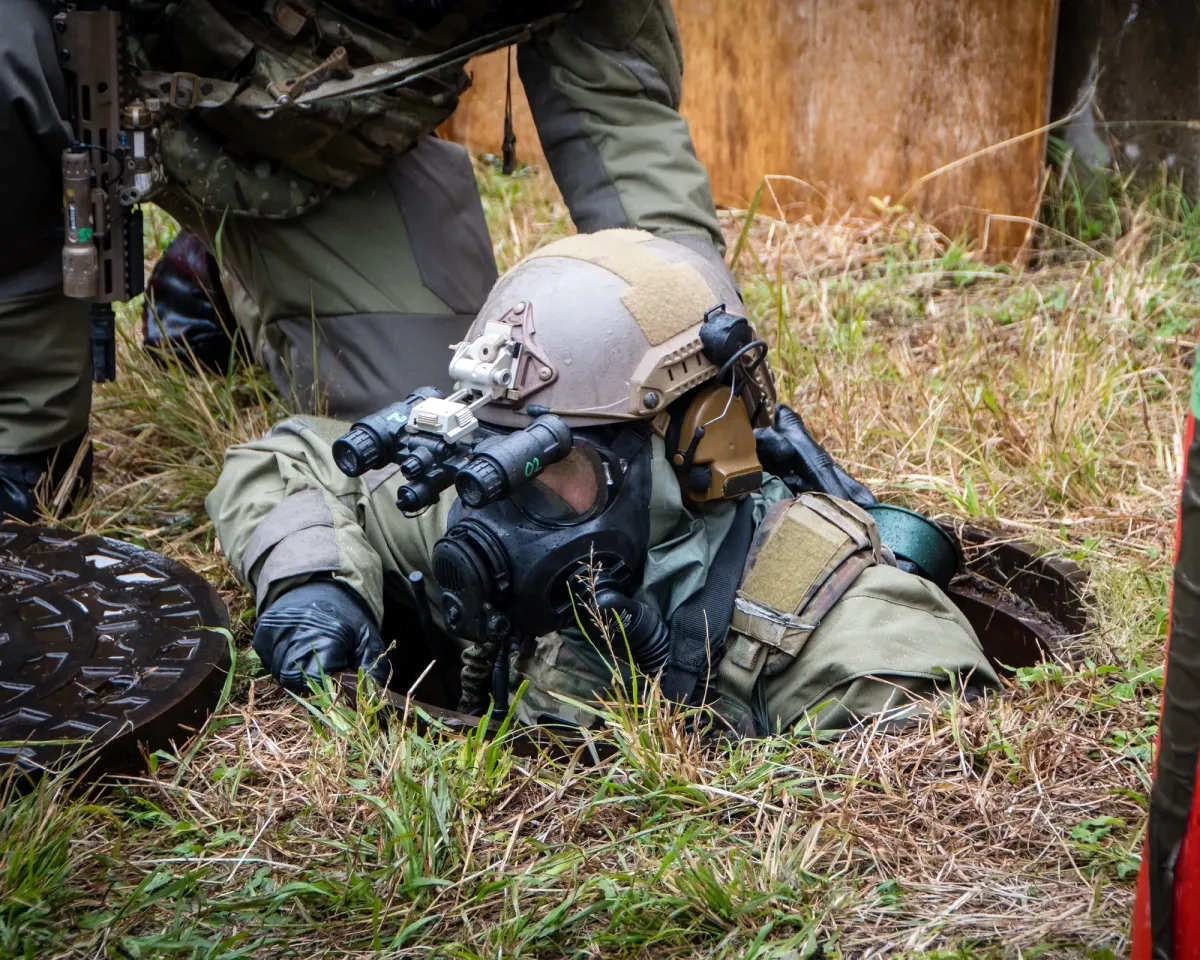
Heart Rate Control Under Stress: Override the Kill Switch
How to Hack Your Heart Rate When the World Is Burning
Heart rate control under stress is the trainable skill that separates operators who stay functional from those who freeze. When stress hits hard, the body doesn’t ask permission, heart rate spikes, breathing goes shallow, vision narrows, and fine motor control slips. In a fight, a raid, or any real-world emergency, that physiological response decides whether you act with precision or fall apart. The good news: it can be trained.
This is the “kill switch” moment, when physiology hijacks decision-making before conscious thought catches up. Controlling heart rate under stress is not a mental trick or a matter of willpower. It is a measurable physiological capability you build the same way you build strength or aerobic capacity: through deliberate, repeated training.
This article breaks down what's actually happening inside the body under extreme stress, why heart rate control matters, and how to train it in a way that transfers to real-world performance. Athletes who want a training program structured around developing exactly this physiological resilience can find one through CF ONE training programs.
What Happens to Your Heart Rate When Stress Takes Over
Under acute stress, the sympathetic nervous system dominates. Adrenaline surges. Heart rate accelerates. Blood flow shifts away from fine motor control toward large muscle groups. This response is useful for survival, but destructive for precision, judgment, and coordination.
As heart rate climbs:
Cognitive processing slows
Auditory exclusion increases
Tunnel vision sets in
Breathing becomes inefficient
Reaction time degrades
These thresholds are well documented. The performance model developed by Bruce Siddle and popularized in Dave Grossman’s On Combat maps the cost directly to heart rate: around 115 BPM, fine motor skills like writing or working a safety begin to degrade; 115–145 BPM is the optimal “combat” window where complex motor skills, reaction time, and decision-making peak; from 145–175 BPM complex skills break down and tunnel vision, auditory exclusion, and loss of depth perception set in; above 175 BPM, cognitive processing collapses and only gross motor actions remain. Critically, this curve describes fear-driven sympathetic arousal, not the heart rate you hit sprinting, which carries none of the same cognitive penalty.
The practical takeaway is blunt: anything requiring decision-making, accuracy, or fine coordination falls apart fast once fear pushes you past that optimal window. The goal is not to eliminate the stress response, that is impossible. The goal is to keep your heart rate inside the band where you can still think and shoot straight, and to claw it back down when it climbs too high. For athletes evaluating which tactical fitness program best fits their goals and conditioning background, the tactical fitness program buying guide walks through exactly how to choose the right option.
Heart Rate as a Performance Lever
Heart rate is not just a cardiovascular metric. It is a direct indicator of nervous system state.
A heart rate that spikes uncontrollably reflects:
Poor autonomic regulation
Inadequate exposure to stress during training
Limited aerobic and respiratory efficiency
Underdeveloped recovery capacity
Controlling heart rate allows you to:
Maintain cognitive clarity
Preserve motor control
Extend work output under pressure
Recover faster between efforts
This is why wearables that track heart rate variability (HRV) have become standard kit for serious tactical athletes: HRV is a direct readout of how much parasympathetic “brake” you have available on a given day. A nervous system with deep reserves drops back into the optimal window quickly after a spike; a depleted one stays redlined. The difference is not genetic, it is the cumulative product of aerobic base, sleep, and how often you have rehearsed staying composed while your pulse is hammering.
This is why elite performers don’t just train skills, they train physiology under stress. For athletes with specific questions about tactical fitness program structure and what to look for in a system built around durability and stress adaptation, the tactical fitness program FAQ covers the most common questions in one place.
Tactical Breathing Is the Fastest Override
Breathing is the most direct way to influence heart rate in real time. Slow, controlled breathing increases parasympathetic activity, helping bring heart rate down and restore clarity.
Key principles:
Longer exhales slow heart rate
Nasal breathing improves oxygen efficiency
Controlled breathing stabilizes perception under stress
The best-known protocol is tactical breathing, also called combat or box breathing, taught across military and law enforcement pipelines: inhale for a four-count, hold for four, exhale for four, hold for four, and repeat three to four cycles. The mechanism is not mystical. A long, controlled exhale stimulates the vagus nerve, which raises parasympathetic tone and physically pulls heart rate down within seconds. That is why a shooter can run a stage, pause, cycle two breaths, and drop back into the optimal window before the next engagement.
This isn’t meditation, it’s tactical physiology. Breathing techniques are effective because they mechanically influence the nervous system, not because they “calm the mind” in an abstract way. Understanding the role of the nervous system in performance explains the physiological mechanism behind why sympathetic dominance produces these specific performance failures, and why training the nervous system directly is what changes the outcome.
Why Fitness Alone Isn’t Enough
Many people assume being “fit” means they’ll handle stress better. That’s not always true.
Someone with strong cardio but no exposure to high-stress conditioning may still panic when intensity spikes. Conversely, someone with poor aerobic capacity may struggle to recover heart rate between repeated efforts.
Heart rate control under stress requires:
Aerobic base
CO₂ tolerance
Exposure to controlled stress
Recovery efficiency
Picture two operators. One runs sub-three-hour marathons but trains in a calm, predictable rhythm; the other does less mileage but regularly conditions under noise, fatigue, and decision pressure. Drop both into a high-arousal scenario and the marathoner’s raw engine does not save him, his system has never learned to stay regulated when the threat signal fires. CO₂ tolerance is the hidden variable: athletes who can sit with the discomfort of rising carbon dioxide breathe slower and panic later, while those who bolt at the first air hunger spiral fast.
This is where conditioning, not just cardio, matters. Understanding aerobic vs anaerobic adaptations explains exactly why aerobic development produces the specific autonomic regulation improvements that make heart rate recovery faster, while anaerobic stress without aerobic base produces the opposite effect.
Training the Kill Switch On Purpose
Heart rate control is best trained under conditions that resemble stress, not in isolation.
Effective methods include:
Interval conditioning with incomplete rest
Breathing-restricted aerobic work
Mixed-modality circuits that elevate heart rate quickly
Decision-making tasks layered into conditioning
Exposure to controlled discomfort
A simple session makes this concrete: row or assault-bike for 60 seconds hard to drive heart rate above 160, then immediately perform a fine-motor task, thread a carabiner, hold a tight dry-fire sight picture, or write a legible grid coordinate, before recovering for 30 seconds and repeating. The drill forces your nervous system to execute precision work while redlined, which is exactly the demand of a real call. Over weeks, the same heart rate that once wrecked your hands becomes a number you can work through calmly. The goal is to teach the body that elevated heart rate does not equal danger, and that recovery is possible without full shutdown.
Recovery Is Part of Control
Heart rate control isn’t just about preventing spikes, it’s about how fast you come back down. Faster recovery reflects:
Strong parasympathetic response
Better aerobic efficiency
Improved stress tolerance
Heart rate recovery (HRR) is one of the few stress metrics you can measure without a lab. After a hard effort, count how far your pulse drops in the first 60 seconds: a well-conditioned tactical athlete typically sheds 30 or more beats, while a poorly recovered one barely moves. That number is a direct proxy for parasympathetic strength, and it improves predictably with aerobic volume. It is also why repeat-effort conditioning, many bouts with partial rest, builds composure under stress far better than a single all-out grinder.
Training that emphasizes repeatability, multiple efforts with partial recovery, builds this capacity far better than single, maximal efforts. This is why sustainable conditioning programs outperform "go hard once" workouts. Understanding how Zone 2 training works explains the physiological mechanism behind why low-intensity aerobic development is the most direct way to build the parasympathetic efficiency that drives faster heart rate recovery between efforts.
Why This Matters Beyond Training
Heart rate control affects:
Tactical decision-making
Communication under pressure
Injury risk
Emotional regulation
Long-term resilience
The application is the same whether you wear a badge, a uniform, or a fire helmet. A patrol officer making a use-of-force decision, a soldier clearing a room, and a paramedic running a pediatric code are all performing complex cognitive and motor tasks with their heart rate elevated by fear, not exercise. The professionals who perform are not the ones who feel no stress, they are the ones who have trained the recovery curve so thoroughly that an arousal spike becomes information, not a hijacking.
Whether you’re in law enforcement, military, emergency response, or high-pressure civilian roles, the ability to control physiological arousal is a performance multiplier. You can't think your way out of a physiological response. You have to train your way through it. Understanding what is training readiness gives this principle its full professional definition, explaining what readiness actually means when physiological control under stress is the performance standard rather than a fitness test score.
The Big Picture
The kill switch doesn’t need to be removed, it needs to be controlled. Heart rate spikes are inevitable. Losing control is not.
Strip it all back and the message is simple: you cannot think your way out of a sympathetic surge, but you can train your body to ride it. Conditioning builds the engine, breathing buys you the override, and repeat-effort recovery teaches your nervous system that a spike is survivable. That is the whole game, and it is entirely trainable.
With the right conditioning, breathing strategies, and exposure to stress, heart rate becomes a tool, not a liability. That’s what allows performance to stay sharp when everything else is trying to pull you off center. Understanding what is recovery gives every athlete reading this post the foundational definition of what the body is doing when it comes back down from a stress spike, and why recovery is a trainable quality rather than a fixed biological trait. And the specific question of whether Zone 2 training is enough for tactical performance addresses the natural follow-up for athletes who want to know exactly how much aerobic base development they need before adding higher-intensity stress exposure.


