
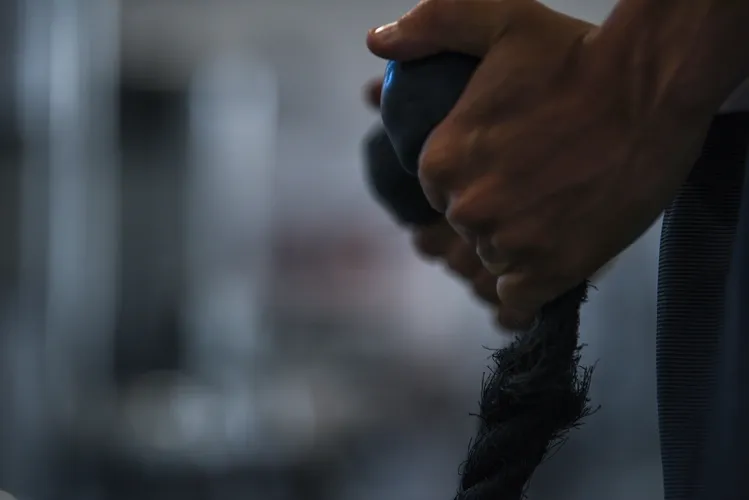
Cable Wrist Curl Guide for Forearm & Grip | Combat Fitness
Cable Wrist Curls: How to Build Forearm & Grip Strength
The cable wrist curl is wrist flexion against a low pulley, and it is one of the most direct ways to build the forearm and grip strength that tactical work demands. Your grip usually gives out before your legs or back do on a casualty drag, an ammo-can carry, or a rope climb, and that ends the rep. If you want forearm work built into a complete plan instead of tacked on at the end, our tactical fitness programs program it for you.
This guide covers what the movement trains, why it matters for tactical athletes, how to set it up, the reverse version that protects your elbows, the variations worth using, and how to dose it.
What Is a Cable Wrist Curl?
A cable wrist curl is an isolation exercise. You flex the wrist against resistance from a low cable pulley, curling the hand up toward the forearm while the forearm stays braced and still. The cable keeps tension on the forearm flexors through the full range, including the stretched bottom position, where a dumbbell loses most of its load.
Cable wrist curls, cable forearm curls, forearm cable curls, and wrist curls with a cable are all names for the same movement. The only real difference from the barbell or dumbbell version is the resistance curve. A free weight pulls straight down, so the load on your wrist changes as the joint angle changes. A cable pulls along its own line, so you can position your body to keep tension where you want it. That makes the cable wrist curl easier to control at higher reps, and higher reps are where forearm work produces the most results.
What Muscles Do Cable Wrist Curls Work?
Cable wrist curls work the forearm flexors, a group of muscles on the palm side of the forearm that bend the wrist and close the hand. The reverse version shifts the work to the extensors on the back of the forearm.
The standard, palms-up cable wrist curl trains:
Flexor carpi radialis and flexor carpi ulnaris: the main wrist flexors, which also steady the wrist from side to side.
Palmaris longus: a small wrist flexor that some people don’t have at all.
Flexor digitorum superficialis and profundus: the finger flexors. These do most of the gripping, and they are heavily involved when you let the bar roll down to your fingertips.
The wrist flexors share a common tendon that attaches at the inside of the elbow (the medial epicondyle). The extensors attach at the outside of the elbow (the lateral epicondyle). Those attachment points are why forearm training affects elbow health, a point we come back to in the reverse section.
Why Forearm and Grip Strength Matters for Tactical Athletes
Grip is the link between your body and every external load you handle at work. Several current occupational fitness tests are built around exactly that:
The Army’s sprint-drag-carry event includes a sled drag and a kettlebell carry with one kettlebell in each hand.
The Marine Corps Maneuver Under Fire event includes a casualty drag and an ammunition-can carry.
The Candidate Physical Ability Test (CPAT) for firefighters includes a hose drag, an equipment carry, and a rescue drag with a 165-pound mannequin.
Rope climbs and obstacle courses add hanging and pulling work under fatigue, and weapon handling and retention depend on hand and forearm strength that holds up when you are tired and stressed.
Grip strength also reflects overall strength. Handgrip dynamometry is consistently associated with whole-body strength and with long-term health outcomes, which is why researchers use it as a broad marker of physical capacity. A strong grip also helps the shoulder: research shows that gripping hard increases rotator cuff activity. That partly explains why a firm grip makes heavy pulls and carries feel more stable.
Durability is the other reason to train the forearms. Forearm tendons take repeated loading from every pull, carry, and weapon manipulation. Training the flexors and extensors directly builds their tolerance to that load, which is a core part of functional strength for military performance. Your forearms have to last a whole career, not one test.
How to Do a Cable Wrist Curl With Proper Form
Good form comes down to one rule: only the wrist moves. Brace your forearm, take the wrist through its full range, and control the cable on the way down so it never jerks your wrist back.
Seated Cable Wrist Curl
Attach a straight bar or a single handle to the low pulley. Sit on a bench facing the weight stack.
Rest your forearms on your thighs or on the bench with your palms up and your wrists just past the edge.
Let the bar roll slowly toward your fingertips to stretch the flexors under load.
Close your fingers around the bar, then curl the wrist up as far as it goes without lifting your forearms.
Hold for one second at the top. Lower over two to three seconds back to the full stretch.
Standing Cable Wrist Curl
Stand facing the stack with your elbows bent to about 90 degrees and pinned to your sides, palms up. Curl only at the wrist. The standing version is quicker to set up between sets of other cable work, but your forearms are harder to keep still, so start lighter than you would seated.
Common Mistakes
Lifting the forearms: this turns the movement into a partial biceps curl and takes load off the wrist.
Loading too heavy: a weight you can only bounce costs you range of motion and stresses the tendons.
Dropping the eccentric: if the cable snaps your wrist into extension at the bottom, you lose the most productive part of each rep.
Cutting the range short: use the full stretch and the full curl. The forearms respond to range of motion.
Reverse Cable Wrist Curl: Training the Extensors
The reverse cable wrist curl uses an overhand, palms-down grip and raises the back of the hand toward the forearm. It trains the wrist extensors: extensor carpi radialis longus and brevis, and extensor carpi ulnaris.
This version matters because most tactical work is flexor-dominant. You grip, pull, carry, and squeeze all day, and your extensors rarely get matched work. Training them balances the forearm. Controlled, eccentric-focused wrist extensor exercise is also a well-supported part of rehab for lateral elbow pain (tennis elbow), which suggests that a stronger extensor tendon handles load better.
Set up the same way as the seated version, with your palms facing down. Use noticeably less weight, because the extensors are smaller than the flexors. Lift to full extension and lower over three seconds. The standing cable reverse wrist curl works too: elbows pinned, overhand grip on a straight bar, wrists only.
Cable Wrist Curl Variations
Each variation changes the angle or the setup, not the job. Pick one or two and rotate them over a training block.
Single-arm cable wrist curl: use a D-handle. Training one side at a time exposes left-right differences and lets you focus on each hand.
Behind-the-back cable wrist curl: stand facing away from the low pulley, bar behind your thighs, palms facing back, arms straight. The fixed shoulder position lets you load the finger flexors heavier.
High cable or overhead cable wrist curl: set the pulley high and extend your arm. The changed line of pull loads the flexors at a different wrist angle and is easier on the elbows for some athletes.
Straight-bar cable wrist curl: the default for two-handed work. Both hands move together, which makes heavier loads easier to manage.
How to Program Cable Wrist Curls
Forearms recover quickly and respond well to volume, so cable wrist curls work best with moderate loads, high reps, and frequent sessions. For most athletes, 2 to 3 sets of 12 to 20 reps, two or three times per week, is enough. Hypertrophy research shows that lighter loads taken close to failure build muscle about as well as heavy loads, and that total weekly volume drives most of the result.
Place wrist curls at the end of a pull or arm day, after your heavy deadlifts, rows, and pull-ups. If your grip is already fatigued when you start heavy pulling, your forearms limit the main lifts and you lose training quality. Pair the curl work with loaded carries and dead hangs: the isolation work builds the tissue, and the carries teach your grip to hold under whole-body fatigue. For where this fits in a full week, see our guide to a strength workout for athletes.
Accessory work only helps if the plan around it is sound. If you are still deciding how to structure your week, our guide to choosing a strength & endurance program explains what to look for.
Rope Hammer Curls: The Neutral-Grip Partner
Rope hammer curls train the forearm from a neutral grip, with the thumbs up. That position loads the brachioradialis and the elbow flexors, while the wrist curl isolates the wrist. Together they cover the forearm from two angles. Hammer curls build the neutral-grip strength used for jerry cans, stretcher handles, and ammo-can carries, and wrist curls build the wrist flexion that keeps the load from slipping out of your hand.
Where Cable Wrist Curls Fit in Cable Arm Workouts
Cable arm workouts usually pair a biceps movement, a triceps movement, and a forearm finisher. The cable wrist curl is the finisher. Because a cable station lets you switch movements in seconds, you can superset wrist curls with reverse wrist curls and finish both forearm compartments in under ten minutes, without leaving the station.
Frequently Asked Questions
What muscles do cable wrist curls work?
Cable wrist curls work the forearm flexors: flexor carpi radialis, flexor carpi ulnaris, palmaris longus, and the finger flexors (flexor digitorum superficialis and profundus). The finger flexors work harder when you let the bar roll to your fingertips. The reverse, palms-down version trains the wrist extensors on the back of the forearm.
What is the difference between a wrist curl and a reverse wrist curl?
A wrist curl uses a palms-up grip and flexes the wrist, which trains the flexors on the palm side of the forearm. A reverse wrist curl uses a palms-down grip and extends the wrist, which trains the extensors on the back of the forearm. The extensors are weaker, so the reverse version needs a lighter load.
Do cable wrist curls build grip strength?
Yes. Cable wrist curls build grip strength, especially when you let the bar roll to your fingertips and close the hand before each curl, because that trains the finger flexors that do the gripping. Grip also has to hold up under whole-body load, so pair wrist curls with carries and dead hangs to transfer that strength to the job.
Should you do wrist curls seated or standing?
Seated wrist curls are better for strict isolation, because the bench or your thighs lock the forearms in place and only the wrist moves. Standing curls are faster to set up and fit easily into cable supersets. Start with the seated version to learn the movement, then add the standing version for variety.
How many reps of cable wrist curls should you do?
Most athletes do best with 2 to 3 sets of 12 to 20 reps, two or three times per week. Forearms recover quickly and respond well to high-rep work taken close to failure. Control the lowering phase over two to three seconds, and only add load once you can complete the top of your rep range with full range of motion.
Can cable wrist curls help prevent elbow pain?
Cable wrist curls can build tendon tolerance at the elbow, but no exercise guarantees you won’t get elbow pain. The wrist flexors attach at the inside of the elbow and the extensors attach at the outside. Training both sides, with an emphasis on slow eccentrics, is a reasonable durability strategy. See a clinician for persistent pain.
The cable wrist curl is a small exercise that makes a real difference: it builds the forearm and grip strength that keeps you holding on through drags, carries, climbs, and weapon handling, and it toughens the tendons that make all of that possible. Train both the flexors and the extensors, keep the reps high and controlled, and put the work after your heavy pulling. When you’re ready for forearm work programmed as part of a full tactical plan, start a CF ONE free trial and train with a plan built for the job.
References:
Bohannon RW. Muscle strength: clinical and prognostic value of hand-grip dynamometry. Current Opinion in Clinical Nutrition and Metabolic Care. 2015;18(5):465-470.
Bohannon RW. Grip strength: an indispensable biomarker for older adults. Clinical Interventions in Aging. 2019;14:1681-1691.
Wind AE, Takken T, Helders PJ, Engelbert RH. Is grip strength a predictor for total muscle strength in healthy children, adolescents, and young adults? European Journal of Pediatrics. 2010;169(3):281-287.
Cronin J, Lawton T, Harris N, Kilding A, McMaster DT. A brief review of handgrip strength and sport performance. Journal of Strength and Conditioning Research. 2017;31(11):3187-3217.
Sporrong H, Palmerud G, Herberts P. Hand grip increases shoulder muscle activity: an EMG analysis with static hand contractions in 9 subjects. Acta Orthopaedica Scandinavica. 1996;67(5):485-490.
Tyler TF, Thomas GC, Nicholas SJ, McHugh MP. Addition of isolated wrist extensor eccentric exercise to standard treatment for chronic lateral epicondylosis: a prospective randomized trial. Journal of Shoulder and Elbow Surgery. 2010;19(6):917-922.
Cullinane FL, Boocock MG, Trevelyan FC. Is eccentric exercise an effective treatment for lateral epicondylitis? A systematic review. Clinical Rehabilitation. 2014;28(1):3-19.
Schoenfeld BJ, Grgic J, Ogborn D, Krieger JW. Strength and hypertrophy adaptations between low- vs. high-load resistance training: a systematic review and meta-analysis. Journal of Strength and Conditioning Research. 2017;31(12):3508-3523.
Schoenfeld BJ, Ogborn D, Krieger JW. Dose-response relationship between weekly resistance training volume and increases in muscle mass: a systematic review and meta-analysis. Journal of Sports Sciences. 2017;35(11):1073-1082.
Pedrosa GF, Lima FV, Schoenfeld BJ, et al. Partial range of motion training elicits favorable improvements in muscular adaptations when carried out at long muscle lengths. European Journal of Sport Science. 2022;22(8):1250-1260.
U.S. Department of the Army. Army Fitness Test (AFT) event standards and scoring.
U.S. Marine Corps. Combat Fitness Test (CFT), MCO 6100.13A, Marine Corps Physical Fitness and Combat Fitness Tests.
International Association of Fire Fighters / International Association of Fire Chiefs. Candidate Physical Ability Test (CPAT) program overview.
Disclaimer: This article is for educational purposes only and is not medical advice. Consult a qualified healthcare provider before starting a new exercise program, especially if you have existing wrist, elbow, or forearm pain. Individual results vary.


