
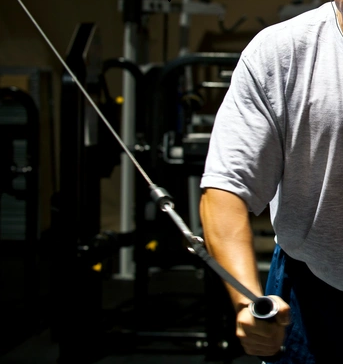
Cable Machine Abs: 5 Best Exercises | Combat Fitness
Cable Machine Abs: How to Load Your Core for Real Strength
Cable machine abs training lets you load your core the way you load every other muscle: with weight you can add in small steps and tension that stays on through the whole rep. The five best cable ab and core exercises are the kneeling cable crunch, the cable woodchop, the cable leg raise, the standing cable oblique crunch, and the Pallof press.
We program cable core work for soldiers, operators, and first responders because a trunk that braces under load protects the back through rucks, deadlifts, and carries. Our military fitness programs build it into the strength block. Below: why the cable stack beats bodyweight for core loading, how to do each move, which cable exercise hits lower, upper, and side abs, and a printable cable ab workout.
Key Takeaways:
The cable stack lets you add load to ab work in small steps, which bodyweight crunches cannot do.
Cable resistance pulls along the line of the cable, so tension stays on at the top of the rep and on the return.
The kneeling cable crunch is the hero move for loaded flexion. It is not the whole core.
Pair flexion work with anti-rotation and anti-extension (Pallof press, woodchop, plank) for a functional trunk.
Why Train Abs on the Cable Machine?
Training abs on the cable machine solves the problem with most ab work: no way to progress. Bodyweight crunches get easier until you are doing sets of 50 for endurance, not strength. On a cable stack you add one plate, keep the reps clean, and the muscle keeps adapting.
That is progressive overload, the principle behind every strength gain you have ever made (Kraemer and Ratamess, 2004; American College of Sports Medicine, 2009). Muscle growth also tracks training volume (Schoenfeld et al., 2017), and a loaded movement lets you build volume in the 8 to 15 rep range instead of chasing burnout sets.
Constant Tension Through the Full Range
A free weight only resists straight down, so a plate held during a sit-up loses its pull near the top. A cable pulls along its own line, so with the pulley set right, resistance stays on at peak contraction and on the way back, the part most people rush (Haff and Triplett, 2016).
Why a Loaded Core Matters on the Job
Low back pain is one of the most common reasons service members seek care and lose duty time (Cohen et al., 2012), and musculoskeletal injuries are among the largest drains on Army readiness (Molloy et al., 2020). The core’s job is to stiffen the spine and pass force between the legs and arms (Kibler et al., 2006; McGill, 2010). Army Holistic Health and Fitness doctrine treats trunk strength as a foundation of physical readiness (Department of the Army, 2020). A trunk trained under load holds position when a ruck, a casualty, or a bar tries to bend it. Our breakdown of functional strength for military performance explains why that capacity counts more than a visible six-pack.
The 5 Best Cable Ab and Core Exercises
These five cover every job the trunk does: flexing under load, rotating, bending to the side, and resisting rotation. Each gets a short how-to.
One cue runs through all of them: brace first, then move. Take a breath, tighten your midsection as if about to take a punch, and exhale through the hardest part of the rep. Use a two-second squeeze and a three-second return. If the stack slams between reps, the weight is too heavy.
1. Kneeling Cable Crunch (The Hero Move)
The kneeling cable crunch is the best loaded ab exercise on the machine and the one to learn first.
Attach a rope to a high pulley. Kneel facing the stack, about two feet away.
Hold the rope ends beside your head or temples, hips stacked over knees.
Brace, then curl your ribs down toward your pelvis, rounding the spine. Your hips stay still.
Pause with your elbows near your thighs, then return over three seconds until your abs are long.
The common mistake is sitting back into the heels and pulling with the arms, which turns the rep into a hip hinge. Lock the hips and think “ribs to belt buckle.” A full guide to this move, with every setup and the standing version, is on the way.
2. Cable Woodchop
Set the pulley high, stand side-on, and pull the handle down and across to the opposite hip while pivoting the back foot. The woodchop trains your trunk to produce rotation and brake it on the return. We break down every version, direction, and position in our full guide to the wood chop.
3. Cable Leg Raise (Lying Reverse Crunch)
The cable leg raise is the lower-ab entry. Attach ankle cuffs to a low pulley and lie face up with your feet toward the stack. With knees bent, curl your knees toward your chest until your hips lift slightly off the floor, then lower over three seconds. The hip curl at the top is what loads the abs. Raising the legs alone mostly trains the hip flexors (Axler and McGill, 1997).
4. Standing Cable Oblique Crunch
Stand side-on to a low pulley with a D-handle in the near hand. Let the cable pull you into a slight side bend, then crunch up and away until your shoulders level, pause, and return slowly. This loads the obliques and quadratus lumborum, the muscles that keep you upright under a one-sided load such as a water can or a slung rifle.
5. Pallof Press (Anti-Rotation)
Set the pulley at chest height. Stand or half-kneel side-on, hold the handle at your sternum, and press it straight out. Hold two seconds without letting the cable turn you. That is anti-rotation, the bracing you use when a load pulls you to one side. Our roundup of landmine core exercises loads the same anti-rotation pattern with a barbell.
If you would rather follow a structured plan than assemble one, our guide to choosing a strength & endurance program covers what to look for.
Which Cable Exercises Hit Lower, Upper, and Side Abs?
The kneeling cable crunch emphasizes the upper abs, the cable leg raise and reverse crunch emphasize the lower abs, and the oblique crunch and woodchop target the side abs. The rectus abdominis is one long muscle, so you never fully isolate a region. You shift the emphasis.
Some research shows the lower rectus abdominis works harder when the pelvis curls toward the ribs (Sarti et al., 1996). Other work finds upper and lower differences are small, and the obliques vary more between exercises (Lehman and McGill, 2001). Train all three regions and you cover it.
Lower Abs on the Cable Machine
For lower abs, curl the pelvis toward the ribs with the cable leg raise. A lower ab cable workout puts it first, while you are fresh enough to control the hip curl.
Upper Abs: The Machine Cable Crunch
For upper abs, the kneeling crunch curls the ribcage down toward a fixed pelvis. Keep the hips locked so the spine does the work.
Side Abs and Obliques on the Cable Machine
For side abs, use the oblique crunch for side bending and the woodchop for rotation. The obliques do both jobs, so program one of each.
No cable exercise burns fat off your stomach. Six weeks of ab training did not reduce abdominal fat in a controlled trial (Vispute et al., 2011). Abs get stronger from loading. They become visible through body composition.
A Cable Machine Abs Workout You Can Run Twice a Week
This cable core workout takes about 15 minutes. Run it two times a week, after your main lifts or on a conditioning day. Put the lower-ab work first, because it takes the most control.
Cable leg raise (reverse crunch): 3 sets of 10 to 12, three-second lowering.
Kneeling cable crunch: 3 sets of 10 to 12, two-second squeeze, three-second return.
Standing cable oblique crunch: 3 sets of 10 per side.
Half-kneeling Pallof press: 3 sets of 8 per side with a two-second hold.
Cable woodchop, high to low: 2 sets of 8 per side.
Superset moves 2 and 3, then 4 and 5, resting 45 to 60 seconds between rounds. When every set hits the top of the rep range with clean form, add the smallest plate.
Where Cable Ab Work Fits in Your Week
Treat this as a finisher, not its own session. It slots onto the end of a strength workout for athletes without adding a training day. Never run it before heavy squats or deadlifts: a tired trunk braces worse under the bar.
Pair Flexion With Anti-Rotation and Anti-Extension
Loaded flexion builds strength and endurance, and it earns its place in the program (Contreras and Schoenfeld, 2011). But the trunk spends most of the job resisting motion, not creating it (McGill, 2010; Willardson, 2007). Isolated core work also shows limited transfer to performance unless it is integrated with how you move (Reed et al., 2012). That is why the circuit includes the Pallof press and woodchop, and why the plank belongs in your week, especially as a scored event on the Army Fitness Test (Department of the Army, 2025).
Frequently Asked Questions
What are the best cable machine ab exercises?
The best cable machine ab exercises are the kneeling cable crunch, cable woodchop, cable leg raise, standing cable oblique crunch, and Pallof press. Together they train flexion, rotation, side bending, and anti-rotation, which covers every job your core does under load.
Why train abs with a cable machine?
Training abs with a cable machine lets you add weight in small steps, which is progressive overload for your core. The cable also keeps tension on through the full range, including the slow return.
How do you do a cable crunch?
Kneel facing a high pulley, hold a rope beside your head, and brace. Curl your ribs down toward your pelvis while your hips stay still, pause near your thighs, and return over three seconds. Do not sit back into your heels or pull with your arms.
What cable exercise hits the lower abs?
The cable leg raise, done as a lying reverse crunch with ankle cuffs on a low pulley, hits the lower abs best. Curl your knees toward your chest until your hips lift. Raising your legs without that pelvic curl mostly works the hip flexors.
How do you train obliques on the cable machine?
Train obliques on the cable machine with the standing oblique crunch for side bending, the woodchop for rotation, and the Pallof press to resist rotation. Use 8 to 12 controlled reps per side.
Can you build a full core workout on the cable machine?
You can build a full core workout on the cable machine, because it loads flexion, rotation, side bending, and anti-rotation from one stack. It trains anti-extension less well, so add planks or rollouts to cover every direction the trunk has to control.
Are cable crunches enough for a strong core?
Cable crunches alone are not enough for a strong core. They build flexion strength, but the trunk’s main job is resisting motion under load. Pair them with the Pallof press, woodchops, and planks so your core can brace against rotation and extension, not just curl.
Cable machine abs work gives your core what bodyweight training cannot: load you can progress, tension through the full rep, and every direction the trunk has to control, from one stack. Lead with the kneeling cable crunch, balance it with the Pallof press and woodchop, and add weight only when every rep is clean. Grab the free printable cable ab workout and run it twice a week.
References:
American College of Sports Medicine. Progression models in resistance training for healthy adults. Medicine and Science in Sports and Exercise. 2009;41(3):687-708.
Axler CT, McGill SM. Low back loads over a variety of abdominal exercises: searching for the safest abdominal challenge. Medicine and Science in Sports and Exercise. 1997;29(6):804-811.
Cohen SP, Gallagher RM, Davis SA, Griffith SR, Carragee EJ. Spine-area pain in military personnel: a review of epidemiology, etiology, diagnosis, and treatment. The Spine Journal. 2012;12(9):833-842.
Contreras B, Schoenfeld B. To crunch or not to crunch: an evidence-based examination of spinal flexion exercises, their potential risks, and their applicability to program design. Strength and Conditioning Journal. 2011;33(4):8-18.
Department of the Army. FM 7-22: Holistic Health and Fitness. Washington, DC: Headquarters, Department of the Army; 2020.
Department of the Army. Army Fitness Test (AFT). U.S. Army; 2025.
Haff GG, Triplett NT, eds. Essentials of Strength Training and Conditioning. 4th ed. Champaign, IL: Human Kinetics; 2016.
Kibler WB, Press J, Sciascia A. The role of core stability in athletic function. Sports Medicine. 2006;36(3):189-198.
Kraemer WJ, Ratamess NA. Fundamentals of resistance training: progression and exercise prescription. Medicine and Science in Sports and Exercise. 2004;36(4):674-688.
Lehman GJ, McGill SM. Quantification of the differences in electromyographic activity magnitude between the upper and lower portions of the rectus abdominis muscle during selected trunk exercises. Physical Therapy. 2001;81(5):1096-1101.
McGill S. Core training: evidence translating to better performance and injury prevention. Strength and Conditioning Journal. 2010;32(3):33-46.
Molloy JM, Pendergrass TL, Lee IE, et al. Musculoskeletal injuries and United States Army readiness part I: overview of injuries and their strategic impact. Military Medicine. 2020;185(9-10):e1461-e1471.
Reed CA, Ford KR, Myer GD, Hewett TE. The effects of isolated and integrated core stability training on athletic performance measures: a systematic review. Sports Medicine. 2012;42(8):697-706.
Sarti MA, Monfort M, Fuster MA, Villaplana LA. Muscle activity in upper and lower rectus abdominus during abdominal exercises. Archives of Physical Medicine and Rehabilitation. 1996;77(12):1293-1297.
Schoenfeld BJ, Ogborn D, Krieger JW. Dose-response relationship between weekly resistance training volume and increases in muscle mass: a systematic review and meta-analysis. Journal of Sports Sciences. 2017;35(11):1073-1082.
Vispute SS, Smith JD, LeCheminant JD, Hurley KS. The effect of abdominal exercise on abdominal fat. Journal of Strength and Conditioning Research. 2011;25(9):2559-2564.
Willardson JM. Core stability training: applications to sports conditioning programs. Journal of Strength and Conditioning Research. 2007;21(3):979-985.
Disclaimer: This article is for educational purposes and is not medical advice. If you have back pain, a disc injury, or a diagnosed condition, get cleared by a qualified medical provider before starting a new exercise program. Stop any exercise that causes sharp or worsening pain.


