
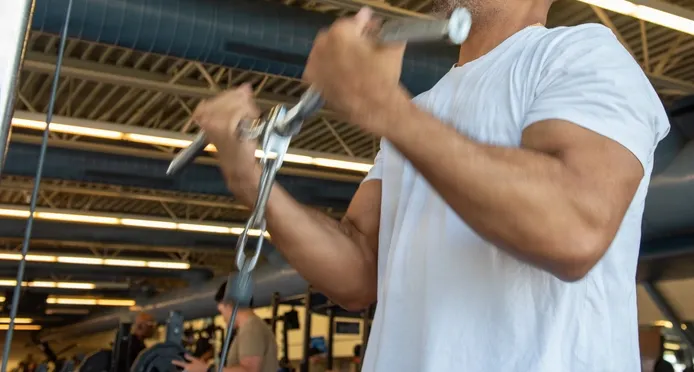
Cable Bicep Exercises: 6 Best Cable Moves | Combat Fitness
Cable Bicep Exercises: The Best Cable-Machine Moves for Biceps
Cable bicep exercises keep tension on the elbow flexors through the entire curl, including the bottom range where a dumbbell goes slack. That makes them one of the most efficient accessory tools in the gym. In the military fitness programs we build, cable curls are not the main event. They sit behind the pulls, carries, and climbs that move you through a job or a selection course, and they earn their place by adding arm volume without beating up your elbows.
This guide covers why cables work so well for biceps, the six best cable bicep exercises with short how-to cues, how cable angle biases the long head versus the short head, single-arm variations, a complete cable biceps workout, and how to program it as a finisher or a short arm day.
Key Takeaways:
Cables keep resistance on the biceps through the full range of motion, so the stretched position at the bottom of the curl is loaded instead of wasted.
Cable angle decides which head you bias. Arm behind the body stretches the long head; arm high and in front shifts emphasis to the short head.
The six best cable bicep exercises are the straight-bar curl, rope curl, Bayesian curl, high cable curl, cable crossover curl, and rope hammer curl.
For tactical athletes, cable biceps are accessory work: 2 to 3 sets as a finisher after pulling, or a short session on an arm day.
Most lifters grow well on 8 to 15 reps taken within 1 to 2 reps of failure, with enough rest to repeat the rep target.
Why Train Biceps with Cables?
Cables train the biceps with near-constant tension from full stretch to full contraction, because the pulley redirects resistance along the cable line instead of straight down like gravity. That loads the bottom of the curl, where dumbbells go easy, and lets you change the angle to bias each head of the biceps.
Constant Tension Through the Full Range
With a dumbbell, the torque at your elbow depends on how far the weight sits horizontally from the joint. At the bottom of a standing curl your forearm hangs vertical, so the load is close to zero. At the top it drops off again. Only the middle third does real work.
A cable pulls along its own line. Set the pulley low and slightly behind you, and the bottom of the curl becomes one of the hardest positions in the rep. That matters because the evidence on range of motion favors training muscles at longer lengths. A 2020 systematic review by Schoenfeld and Grgic found full range of motion generally outperforms partial range for hypertrophy, and later work on the elbow flexors by Pedrosa and colleagues found training in the initial (lengthened) range produced greater adaptations than training in the final range. Bicep cable exercises load that lengthened position by design.
Joint-Friendly Loading
A straight barbell locks your wrists into full supination, and some lifters’ wrists and elbows do not tolerate that under heavy load. Cable machine bicep exercises let you swap to a rope, single handles, or an EZ bar so the joint finds its natural line. The resistance is smooth, and there is no momentum to borrow from your hips.
That matters more than it sounds for a tactical athlete. Arms rarely limit performance outright, but undertrained elbow flexors show up on rope climbs, pull-up standards, casualty drags, and loaded carries, and connective tissue that never sees direct work is less prepared for those demands. Military physiology research consistently ties upper-body strength to task performance (Friedl et al., 2015). That is why we treat cable bicep workouts as targeted accessory work that supports functional strength for military performance, not a replacement for it.
If you are still deciding how arm work fits into a bigger plan that includes running and rucking, start with choosing a strength & endurance program that balances lifting with conditioning. Cable exercises for biceps work best once that foundation is set.
What Are the Best Cable Bicep Exercises?
The best cable bicep exercises are the straight-bar cable curl, the rope cable curl, the Bayesian (behind-body) curl, the high cable curl, the cable crossover curl, and the rope hammer curl. Together they cover both biceps heads, the brachialis, and the brachioradialis from every useful cable angle.
1. Straight-Bar Cable Curl
This is your heavy anchor. Attach a straight bar or EZ bar to the low pulley, take a shoulder-width underhand grip, and stand a half step back so the cable runs at a slight angle. Pin your elbows to your sides, curl until your forearms are just short of vertical, and lower over 2 to 3 seconds.
Why it works: the biceps is a forearm supinator as well as an elbow flexor, so a fully supinated grip lets it contribute the most. Electromyography research by Kleiber and colleagues (2015) shows hand position shifts the work between the biceps and brachioradialis. Use the EZ bar if a straight bar bothers your wrists.
2. Rope Cable Curl
Clip a rope to the low pulley, start with palms facing each other, and rotate your pinkies up as you curl. Pull the rope ends apart at the top. Cable rope bicep exercises start in a neutral grip, which loads the brachialis and brachioradialis, then finish in supination for a hard biceps contraction.
3. Bayesian Curl (Behind-the-Body Cable Curl)
Named after Menno Henselmans’ Bayesian Bodybuilding, this is the best long-head stretch on the list. Face away from a low pulley, take a single handle, and step forward until your working arm trails behind your torso. Curl without letting the elbow drift forward, and lower until you feel the stretch at the front of the shoulder.
4. High Cable Curl
Set a pulley at shoulder height, stand side-on, and hold the handle with your arm extended out to the side. Curl the handle toward your ear while your upper arm stays level. The shoulder is flexed and abducted, which shortens the long head and shifts relative emphasis to the short head for a strong peak contraction.
5. Cable Crossover Curl
Stand in the middle of a crossover station with both high pulleys set at shoulder height and a handle in each hand. Curl both handles toward your head at once. This is the double bicep cable curl, and it is the fastest way to train both arms evenly from the high angle. It also fits any cable pull bicep exercise slot when time is short.
6. Rope Hammer Curl
Keep a neutral grip on a rope from the low pulley through the whole rep. Rope hammer curls shift load to the brachialis and brachioradialis, which builds arm thickness and the grip and forearm capacity that rope climbs and drags demand. The movement deserves its own breakdown, so we keep to the essentials here: elbows still, wrists neutral, no swing.
How Do You Target the Long Head vs. Short Head with Cables?
Cable angle targets the biceps heads by changing shoulder position. The long head crosses the shoulder joint, so setups that pull your arm behind your body stretch it and bias the long head. High, in-front setups shorten the long head and shift relative emphasis to the short head.
Why Shoulder Position Changes the Muscle
The long head originates on the supraglenoid tubercle above the shoulder socket, while the short head starts on the coracoid process. Both insert on the radius (Landin et al., 2017). Because only the long head spans the shoulder, moving your upper arm behind you lengthens it before the curl even starts. Oliveira and colleagues (2009) found that shoulder position measurably changes biceps activation patterns across different curl variations.
Long Head Bicep Cable Exercises
Bayesian curl, arm trailing behind the torso
Low-pulley cable curl from a half step forward of the stack
Behind the back cable bicep curl, single arm
Short Head Bicep Cable Exercises
High cable curl, single arm at shoulder height
Cable crossover curl, both arms
Kneeling face-the-stack cable curl with elbows held forward
Be honest about what this does. You cannot isolate one head; both work in every curl. Cable angle changes emphasis, not exclusivity. Train both angles every week and you cover the muscle completely, which is the point competitors usually skip.
Single-Arm and Unilateral Cable Curls
A single arm cable bicep curl fixes side-to-side gaps that bilateral work hides, because your stronger arm cannot carry the weaker one. It also lets your wrist rotate freely for a full supination at the top. Here is how to do it:
Set a single handle on the low pulley and stand facing the stack, feet hip-width.
Brace your trunk so the cable does not rotate your torso.
Curl with the elbow fixed at your side, turning your palm up through the last third.
Squeeze for one second at the top, then lower over 3 seconds to a full stretch.
Finish all reps on your weaker arm first, then match that number on the stronger side.
The double bicep cable curl trains both arms at once and saves time, while unilateral cable curls give you cleaner feedback and an anti-rotation demand on your core. Use the behind the back cable bicep curl as your unilateral long-head option. Most athletes do best with one bilateral and one unilateral movement per session.
A Cable Bicep Workout You Can Run on Any Cable Machine
A complete cable bicep workout uses 3 to 4 exercises from different angles: one long-head stretch, one heavy bilateral curl, one short-head peak movement, and one neutral-grip finisher. That structure covers both biceps heads and the brachialis in about 20 minutes on a single cable station.
Run it in this order:
Bayesian curl: 3 sets of 10 to 12 per arm. Start with the stretch while you are fresh.
Straight-bar cable curl: 3 sets of 8 to 12. Your heaviest loading of the session.
Cable crossover curl or high cable curl: 2 to 3 sets of 12 to 15. Peak contraction.
Rope hammer curl: 2 sets of 12 to 15. Brachialis and grip.
Take each set within 1 to 2 reps of failure and rest 60 to 120 seconds. If you only have a single-stack machine, swap the crossover curl for the single-arm high cable curl. This biceps workout on cable machine setups works in a hotel gym, a station gym, or a base facility, which is why we program it for deployed and on-shift athletes.
How to Program Cable Biceps: Finisher or Arm Day
Program cable biceps by where they help most. As a finisher, add 2 to 3 sets of one or two cable curls after a pull day. On a dedicated arm day, run the full four-exercise session above. Either way, it should sit on top of a solid strength base, not compete with it.
Volume, Frequency, and Reps
A 2017 meta-analysis by Schoenfeld, Ogborn, and Krieger found a graded relationship between weekly sets and muscle growth, and a 2019 review found that training a muscle at least twice per week is a reasonable default. Rows and pull-ups already train the biceps, so 6 to 10 direct sets per week split across two sessions covers most athletes.
Rep range is flexible. Schoenfeld and colleagues (2017) showed low and high loads produce similar hypertrophy when sets are taken close to failure, and Refalo and colleagues (2023) found proximity to failure matters for growth. For cable bicep exercises for mass, work mostly in 8 to 15 reps and add load in small jumps. Cable stacks jump in large increments, so add a rep before you add a plate. A review by Grgic and colleagues (2017) supports resting long enough to keep performance high rather than chasing short rest.
Where It Fits in a Tactical Week
Put this cable bicep finisher after pulling work, never before a pull-up test, rope climb, or a session that depends on grip. Build it on top of a strength workout for athletes that already covers squats, hinges, presses, and pulls. When running and rucking volume climbs during selection prep, arm accessories are the first thing to cut. The Army’s FM 7-22 frames strength as one component of a balanced readiness system, and accessory work follows the same logic: it supports the mission, it never drives it.
How Do Cable Biceps Fit Into a Full Cable Arm Workout?
Cable biceps pair cleanly with cable triceps work in a full cable arm workout. Supersetting a curl with a pushdown or overhead extension lets one muscle rest while the other works, so you finish the same volume in less time.
Research by Robbins and colleagues (2010) found agonist-antagonist paired sets maintained volume load while cutting session time. On a single cable station, alternate a Bayesian curl with an overhead rope extension, then a bar curl with a straight-bar pushdown. A complete cable arm session runs both halves in about 30 minutes, and our tricep cable work follows the same angle-based logic covered here for the biceps.
FAQ: Frequently Asked Questions
What are the best cable bicep exercises?
The best cable bicep exercises are the straight-bar cable curl, rope cable curl, Bayesian curl, high cable curl, cable crossover curl, and rope hammer curl. Pick one long-head movement, one heavy bilateral curl, and one short-head or neutral-grip movement for a complete session. That combination covers both heads of the biceps plus the brachialis.
Why are cables good for training biceps?
Cables are good for training biceps because they keep near-constant tension through the full curl, including the stretched bottom position where dumbbells go slack. They also let you change the pulley angle to bias the long or short head, and the smooth resistance is easier on wrists and elbows than a heavy fixed barbell.
How do you target the long head vs. short head of the biceps with cables?
Target the long head by setting the cable so your arm sits behind your body, as in the Bayesian curl. Target the short head with high, in-front setups like the high cable curl or crossover curl. The long head crosses the shoulder, so shoulder position changes its length. Both heads work in every curl; angle shifts emphasis.
Cable curl vs. dumbbell curl: which is better?
The cable curl is better for loading the stretched bottom position and holding steady tension, while the dumbbell curl is better for portability, heavier loading progression, and free wrist rotation. Neither is superior overall. Most athletes do best with a cable movement and a free-weight curl in the same week.
How many cable bicep exercises should a workout have?
A cable bicep workout should have 2 to 4 exercises. Use 1 to 2 as a finisher after a pull day and 3 to 4 on a dedicated arm day. More movements add little once you cover the long-head, short-head, and neutral-grip angles, so spend extra effort on sets taken close to failure instead.
How do you do a single-arm cable curl?
To do a single-arm cable curl, set a handle on the low pulley, brace your trunk, and curl with your elbow fixed at your side while turning your palm up. Squeeze for one second at the top, lower over three seconds, and start every set with your weaker arm.
Cable bicep exercises give you what free weights cannot: steady tension through the full range and the ability to aim the load at the long or short head by changing the angle. Used as accessory work, they build arm strength and elbow resilience that carry into climbs, drags, and carries without stealing recovery from the training that matters most.
Start with the four-exercise workout above twice a week, log your loads, and add a rep before you add a plate. When you want this slotted into a full plan with your strength, running, and rucking already balanced, the CF ONE library linked at the top of this guide does that work for you.
References:
Landin D, Thompson M, Jackson MR. Actions of the biceps brachii at the shoulder: a review. J Clin Med Res. 2017;9(8):667-670.
Oliveira LF, Matta TT, Alves DS, Garcia MAC, Vieira TMM. Effect of the shoulder position on the biceps brachii EMG in different dumbbell curls. J Sports Sci Med. 2009;8(1):24-29.
Kleiber T, Kunz L, Disselhorst-Klug C. Muscular coordination of biceps brachii and brachioradialis in elbow flexion with respect to hand position. Front Physiol. 2015;6:215.
Schoenfeld BJ, Grgic J. Effects of range of motion on muscle development during resistance training interventions: a systematic review. SAGE Open Med. 2020;8:2050312120901559.
Wolf M, Androulakis-Korakakis P, Fisher J, Schoenfeld B, Steele J. Partial vs full range of motion resistance training: a systematic review and meta-analysis. Int J Strength Cond. 2023;3(1).
Pedrosa GF, et al. Training in the initial range of motion promotes greater muscle adaptations than at final in the arm flexors: a randomized controlled trial. Front Physiol. 2023.
Schoenfeld BJ, Grgic J, Ogborn D, Krieger JW. Strength and hypertrophy adaptations between low- vs. high-load resistance training: a systematic review and meta-analysis. J Strength Cond Res. 2017;31(12):3508-3523.
Schoenfeld BJ, Ogborn D, Krieger JW. Dose-response relationship between weekly resistance training volume and increases in muscle mass: a systematic review and meta-analysis. J Sports Sci. 2017;35(11):1073-1082.
Schoenfeld BJ, Grgic J, Krieger J. How many times per week should a muscle be trained to maximize muscle hypertrophy? A systematic review and meta-analysis of studies examining the effects of resistance training frequency. J Sports Sci. 2019;37(11):1286-1295.
Refalo MC, Helms ER, Trexler ET, Hamilton DL, Fyfe JJ. Influence of resistance training proximity-to-failure on skeletal muscle hypertrophy: a systematic review with meta-analysis. Sports Med. 2023;53(3):649-665.
Grgic J, Lazinica B, Mikulic P, Krieger JW, Schoenfeld BJ. The effects of short versus long inter-set rest intervals in resistance training on measures of muscle hypertrophy: a systematic review. Eur J Sport Sci. 2017;17(8):983-993.
Robbins DW, Young WB, Behm DG, Payne WR. The effect of an upper-body agonist-antagonist resistance training protocol on volume load and efficacy. J Strength Cond Res. 2010;24(10):2632-2640.
American College of Sports Medicine. Progression models in resistance training for healthy adults. Med Sci Sports Exerc. 2009;41(3):687-708.
Kraemer WJ, Ratamess NA. Fundamentals of resistance training: progression and exercise prescription. Med Sci Sports Exerc. 2004;36(4):674-688.
Friedl KE, Knapik JJ, Häkkinen K, et al. Perspectives on aerobic and strength influences on military physical readiness: report of an international military physiology roundtable. J Strength Cond Res. 2015;29(Suppl 11):S10-S23.
Headquarters, Department of the Army. FM 7-22: Holistic Health and Fitness. Washington, DC: Department of the Army; 2020.
Standring S, ed. Gray’s Anatomy: The Anatomical Basis of Clinical Practice. 42nd ed. London: Elsevier; 2020.
Disclaimer: This article is for educational purposes only and is not medical advice. Consult a qualified healthcare provider before starting a new training program, especially if you have an existing elbow, wrist, or shoulder injury. Individual results vary, and no specific outcome is guaranteed.


