
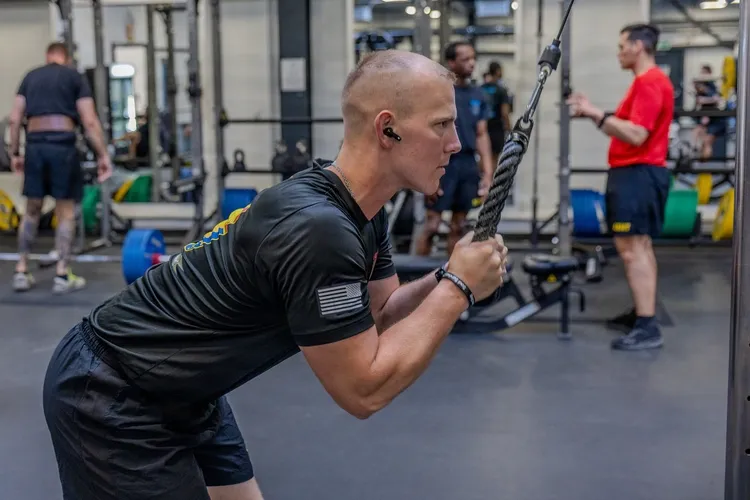
Cable Back Exercises: 10 Best Moves | Combat Fitness
Cable Back Exercises: The Best Moves for a Stronger Back
Cable back exercises are the most efficient way to load every region of your back (lats, upper back, mid back, and lower back) from one station, with tension that stays on through the full range of motion. That matters for anyone who carries weight for a living. A back that can’t hold position under a pack gives out first, usually at the shoulders and the spine. Our military fitness programs build this pulling work into structured plans for service members, police officers, and first responders.
Below you’ll find the 10 best back exercises using a cable machine, grouped by the region each one trains, plus a sample cable-only back workout and the sets, reps, and weekly volume to run it. Start with why the cable earns its place.
Key Takeaways:
Cables keep tension on the back through the full range and let you change the line of pull by moving one pin, which free weights can’t do.
Organize cable back work by region: vertical pulls for the lats, horizontal rows for the mid back, high rows and face pulls for the upper back, and hip hinges for the lower back.
Back and pulling strength help resist the forward-rounded posture that heavy packs and ruck loads force on you.
Most athletes progress well on 10 or more hard sets for the back per week, split across at least two sessions.
Cables complement barbell rows, deadlifts, and pull-ups. They don’t replace them.
Why Train Your Back with Cable Back Exercises?
Cable back exercises keep resistance on the muscle through the entire range of motion, including the stretched and fully shortened positions where dumbbells often go slack. The pulley also lets you set the angle of pull to match the fibers you want to train, and you change load by moving a pin instead of stripping plates.
Those three traits explain why cable machine back exercises show up in almost every serious program:
Consistent tension. A dumbbell row is heavy at the top and nearly weightless at the bottom. A cable pulls along the line of the cable the whole time, so the lats and rhomboids work in the stretched position too.
Adjustable angle. Raise or lower the pulley and the same handle trains a different region. A high anchor biases the lats and upper back; a low anchor shifts work to the mid back and hips.
Easy to scale. Small weight jumps make cables ideal for high-rep accessory work, technique practice, and training around a beat-up shoulder or back.
The trade-off is absolute load. You will never pull as much on a cable as you deadlift, so the cable is a tool for volume, positioning, and weak-point work, not your main strength driver.
Why Does Back Strength Matter for Tactical Athletes?
Back strength matters for tactical athletes because carrying load pulls the trunk and shoulders forward. Research on soldiers shows that heavier packs increase forward trunk lean and change gait, and back problems are a recognized load-carriage injury. Strong upper- and mid-back muscles hold the shoulder blades and spine in position against that pull.
Knapik and colleagues’ review of soldier load carriage identifies back injuries among the problems tied to heavy loads, and Attwells and colleagues measured more forward lean as pack weight climbed. Body armor, a plate carrier, or a duty belt does the same thing over a long shift. The muscles that resist it are the lats, rhomboids, middle and lower trapezius, rear delts, and spinal erectors: the exact targets of the best cable back exercises.
Be honest about scale here. A cable row won’t carry your ruck for you. What it does is let you add quality pulling volume without more spinal loading, which keeps the posture muscles strong while your heavy lifts and road work handle the rest. That’s the principle behind functional strength for military performance: strength that shows up in how you hold position and do the job, not only on a training log.
The 10 Best Cable Back Exercises
The best back exercises with cable cover four patterns: vertical pulls, horizontal rows, high rows, and hip hinges. This list includes standing, seated, and rope cable back exercises so you can train the whole back from one station.
1. Lat Pulldown
Sit with thighs locked under the pad, take a pronated grip just outside shoulder width, and pull the bar to your upper chest while driving the elbows down and back. Pull in front of the head. Electromyography research found front pulldowns produced more lat activity than behind-the-neck versions, and a pronated grip beat a supinated one. Grip width mattered less than people assume.
2. Seated Cable Row
Brace your feet, sit tall, and row the V-handle to your lower ribs. Let the shoulder blades travel forward on the return, then pull them back before the arms bend. That full scapular range is the point. It trains the rhomboids and mid traps that hold your posture under load.
3. Straight-Arm Pulldown
Stand facing a high pulley, arms nearly straight, and sweep the bar or rope down to your thighs. With the elbows locked, the biceps can’t help, so the lats do the work. This is also the cable pullover pattern, and it teaches you to feel the lats before heavier pulls.
4. Single-Arm Cable Row
Stand in a split stance, row one handle to your hip, and refuse to let the torso rotate. Fenwick and colleagues found standing cable rows placed less load on the lumbar spine than bent-over barbell rows while still demanding trunk stability. You get back work and anti-rotation core work in one movement.
5. Cable Face Pull
Set a rope at face height, pull the ends toward your ears, and finish with the hands wide and the knuckles pointing back. The face pull trains the rear delts, mid traps, and external rotators that balance out pressing and forward-rounded posture. Cable face pulls deserve their own full breakdown on setup, grip, and load, so treat this as the short version.
6. Rope High Row
Anchor the rope just above chest height and row toward your collarbones with the elbows flared to about 45 degrees. The upward angle shifts work from the lats to the upper traps, rhomboids, and rear delts.
7. Half-Kneeling Single-Arm Pulldown
Kneel beside a high pulley and pull one handle down to your side, letting the arm stretch fully overhead on each rep. Training one side at a time exposes left-to-right gaps and gives the lat a longer stretch than a bar allows.
8. Wide-Grip Seated Row
Use a long bar and pull to the bottom of the chest with the elbows out. The wider grip moves the emphasis to the rhomboids, mid traps, and rear delts. A study comparing row and pulldown grips found that hand position changed which back muscles worked hardest, so rotate grips across the week.
9. Cable Rear-Delt Fly
Stand between two cable towers set at shoulder height, cross the cables, and pull your arms out wide with a slight elbow bend. Light weight and strict reps keep the load on the rear delts and upper back instead of the traps.
10. Cable Pull-Through
Face away from a low pulley with the rope between your legs, hinge at the hips with a flat back, then drive the hips forward to stand tall. This is a hip hinge that loads the glutes, hamstrings, and spinal erectors with little compression on the spine.
What Are the Best Cable Exercises for the Upper Back?
The best upper back cable exercises are the face pull, the rope high row, and the cable rear-delt fly. All three pull at or above chest height with the elbows out, which shifts work to the rear delts, rhomboids, and middle trapezius instead of the lats.
These are the muscles that keep the shoulders from rolling forward under a plate carrier. Research on scapular muscle balance shows that exercises with the arm moving horizontally away from the body, combined with external rotation, favor the middle and lower trapezius over the upper traps. That’s the face pull in one sentence. Run these cable exercises for the upper back in the 12 to 20 rep range, because the muscles involved respond well to volume and the movements break down fast when they’re loaded heavy.
What Are the Best Cable Exercises for the Lats?
The lat pulldown, straight-arm pulldown, and half-kneeling single-arm pulldown are the best cable exercises for the lats. Each one pulls from overhead toward the hip, which matches the lat’s main job: drawing the upper arm down and back toward the body.
Use the pulldown as your heavy lat movement in the 6 to 10 rep range. The straight-arm pulldown goes early in a session as a primer or late as a finisher, since it isolates the lats without tiring the biceps. The single-arm version builds even strength side to side, which carries straight over to climbing, pull-ups, and dragging a casualty.
What Are the Best Cable Exercises for the Mid Back?
The best mid back cable exercises are the seated cable row, the wide-grip seated row, and the single-arm cable row. Horizontal rows put the rhomboids and middle trapezius in the best position to work, pulling the shoulder blades together against resistance.
Change grip to change emphasis. A close neutral grip lets the lats join in and lets you move more load. A wide overhand grip puts more of the effort on the middle back and rear delts. The single-arm row adds an anti-rotation demand that seated rows can’t. Hold each rep for a one-second squeeze at the finish; that pause keeps the mid back muscles doing the work instead of momentum.
What Are the Best Cable Exercises for the Lower Back?
The cable pull-through is the best lower back cable exercise for most athletes, followed by the cable good morning and the cable back extension. All three train the spinal erectors and hips through a hinge, and the cable keeps load light enough to hold a neutral spine.
Be conservative. The spinal erectors’ job in the field is mostly to resist bending, not to produce big movements, which is why spine researcher Stuart McGill emphasizes endurance and a neutral position over heavy loaded flexion. For a cable good morning, hold a rope at your upper chest with the cable running from a low pulley, push the hips back to a flat-backed hinge, and stand up. For a cable back extension, set up on a 45-degree bench with a low cable running to your chest. Keep all three in the 10 to 15 rep range and stop any set the moment your lower back rounds. If you have current back pain, get cleared by a clinician first.
A Sample Cable Back Workout
This cable back workout trains every region in about 50 minutes, working from the heaviest, most demanding movements down to lighter accessory work. It’s built as a stand-alone back day or as the pulling half of an upper-body session.
Lat pulldown: 4 x 6-10, rest 2 min
Single-arm cable row: 3 x 8-12 per side, rest 90 sec
Wide-grip seated row: 3 x 10-12, rest 90 sec
Straight-arm pulldown: 3 x 12-15, rest 60 sec
Cable face pull: 3 x 15-20, rest 60 sec
Cable pull-through: 3 x 10-12, rest 90 sec
The order is deliberate. Heavy vertical and horizontal pulls come first, when you’re fresh enough to load them. Isolation work for the lats and upper back follows, and the hinge goes last so the lower back isn’t fatigued before you need it to brace for rows. Finish each set one or two reps short of failure. If you want to see how a back day like this fits inside a full week alongside squats, presses, and conditioning, use it as one session in a strength workout for athletes.
How to Program Cable Back Exercises: Sets, Reps, and Frequency
Program cable back exercises twice per week, for roughly 10 to 20 hard sets total across the back, using 6 to 12 reps on compound pulls and 12 to 20 on isolation work. Meta-analyses show higher weekly volume and twice-weekly training produce more muscle growth than lower doses.
Here’s how to set it up:
Anchor the week with heavy pulls. Keep pull-ups, barbell or dumbbell rows, and deadlifts as your main strength work. Cables fill in the volume around them.
Split the volume. Run two back sessions per week, or put three to four cable movements at the end of two upper-body days.
Cover every region weekly. At minimum, include one vertical pull, one horizontal row, one face pull or high row, and one hinge.
Progress reps, then load. When you hit the top of the rep range on every set, add a pin.
Manage fatigue around rucks and runs. Put lower back and hinge work away from long ruck days, since both tax the same muscles.
How much cable work you can absorb depends on everything else you’re training. If you’re balancing lifting with running, rucking, and test prep, our guide to choosing a strength & endurance program explains how to weigh the options.
Frequently Asked Questions
What are the best cable exercises for your back?
The best cable exercises for your back are the lat pulldown, seated cable row, single-arm cable row, straight-arm pulldown, face pull, and cable pull-through. Together they cover vertical pulling, horizontal rowing, upper-back work, and a hip hinge, which trains the lats, mid back, upper back, and lower back.
Can you train your whole back on just a cable machine?
Yes, a cable machine can train every region of the back with enough variety for steady progress. The limit is absolute load. Cables can’t match a deadlift or heavy row for overall strength, so cable-only training works best for a phase or when equipment is limited.
What cable exercises hit the upper back vs the lats?
The pull angle decides it. Pulling down from overhead toward your hips (pulldowns, straight-arm pulldowns) targets the lats. Pulling toward your face or chest with the elbows high and wide (face pulls, high rows, rear-delt flies) targets the upper back and rear delts.
What are good cable exercises for the lower back?
Good cable exercises for the lower back are the cable pull-through, cable good morning, and cable back extension. Keep the load moderate, the spine neutral, and the reps between 10 and 15. Anyone with current back pain should get medical clearance before loading these movements.
Standing or seated cable back exercises: which is better?
Neither is better; they do different jobs. Seated exercises stabilize the body so you can load the back heavier. Standing cable back exercises add a trunk-stability demand, which builds the braced posture you use under a pack. Use both in a week.
How many cable back exercises should a workout have?
Four to six cable back exercises is enough for a full back session, or two to three when cables are accessory work after heavy pulls. Pick one movement per region and stop adding exercises once your total reaches roughly 10 to 16 hard sets for that session.
Are cable rows as good as barbell rows for the back?
Cable rows build the back as well as barbell rows when sets are taken close to failure, and they put less load on the lower back. Barbell rows allow heavier loading and train the hinge position. Most athletes do best with both in the program.
Cable back exercises give you a way to train the lats, upper back, mid back, and lower back with consistent tension and low spinal cost, which is exactly the pulling volume a load-carrying athlete needs to hold posture over a long day. Pick one movement per region, run the sample session twice a week, and add reps before you add weight. If you’d rather have that back work periodized around your rucks, runs, and test dates instead of building it yourself, start with CF ONE and train it on a plan.
References:
Knapik JJ, Reynolds KL, Harman E. Soldier load carriage: historical, physiological, biomechanical, and medical aspects. Military Medicine. 2004;169(1):45-56.
Attwells RL, Birrell SA, Hooper RH, Mansfield NJ. Influence of carrying heavy loads on soldiers’ posture, movements and gait. Ergonomics. 2006;49(14):1527-1537.
Lusk SJ, Hale BD, Russell DM. Grip width and forearm orientation effects on muscle activity during the lat pull-down. Journal of Strength and Conditioning Research. 2010;24(7):1895-1900.
Signorile JF, Zink AJ, Szwed SP. A comparative electromyographical investigation of muscle utilization patterns using various hand positions during the lat pull-down. Journal of Strength and Conditioning Research. 2002;16(4):539-546.
Fenwick CMJ, Brown SHM, McGill SM. Comparison of different rowing exercises: trunk muscle activation and lumbar spine motion, load, and stiffness. Journal of Strength and Conditioning Research. 2009;23(5):1408-1417.
Lehman GJ, Buchan DD, Lundy A, Myers N, Nalborczyk A. Variations in muscle activation levels during traditional latissimus dorsi weight training exercises: an experimental study. Dynamic Medicine. 2004;3:4.
Cools AM, Dewitte V, Lanszweert F, et al. Rehabilitation of scapular muscle balance: which exercises to prescribe? American Journal of Sports Medicine. 2007;35(10):1744-1751.
McGill SM. Core training: evidence translating to better performance and injury prevention. Strength and Conditioning Journal. 2010;32(3):33-46.
Schoenfeld BJ, Ogborn D, Krieger JW. Dose-response relationship between weekly resistance training volume and increases in muscle mass: a systematic review and meta-analysis. Journal of Sports Sciences. 2017;35(11):1073-1082.
Schoenfeld BJ, Ogborn D, Krieger JW. Effects of resistance training frequency on measures of muscle hypertrophy: a systematic review and meta-analysis. Sports Medicine. 2016;46(11):1689-1697.
American College of Sports Medicine. Progression models in resistance training for healthy adults. Medicine and Science in Sports and Exercise. 2009;41(3):687-708.
Kraemer WJ, Ratamess NA. Fundamentals of resistance training: progression and exercise prescription. Medicine and Science in Sports and Exercise. 2004;36(4):674-688.
Haff GG, Triplett NT, eds. Essentials of Strength Training and Conditioning. 4th ed. National Strength and Conditioning Association. Human Kinetics; 2016.
Headquarters, Department of the Army. FM 7-22: Holistic Health and Fitness. 2020.
Disclaimer: This article is for educational purposes only and is not medical advice. Consult a qualified healthcare provider before starting a new training program, especially if you have current or past back or shoulder injuries. Results vary by individual, and no training approach guarantees a specific outcome.


