
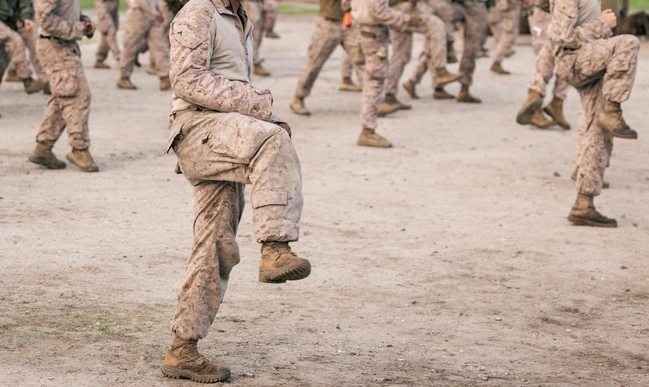
Butt Kicks: How to Do the Running Drill | Combat Fitness
Butt Kicks: How to Do the Drill and Why It Belongs in Your Warm-Up
Butt kicks are a dynamic running drill: you jog in place or move forward while snapping each heel up toward your glutes with quick, alternating turnover. The drill warms the hamstrings, rehearses fast heel recovery, and raises your heart rate in under a minute. That is why it opens the run and ruck sessions in our military fitness programs.
Most people treat the butt kick exercise as filler cardio. Done with the right cues and in the right order, they prepare the exact muscles that take the most strain when you start running fast. Below: how to do them, what they work, the variations, and where they fit in a real warm-up.
How Do You Do Butt Kicks?
To do butt kicks, stand tall, jog lightly on the balls of your feet, and pull one heel up toward your glute, then the other, as fast as you can while staying relaxed. Keep the torso upright, swing the arms in opposition, and let the knees point down or slightly forward.
Stand tall. Feet hip-width apart, ribs stacked over hips, eyes forward.
Get on the balls of your feet. Light contact, no heel slapping the ground.
Pull the heel up. Bend the knee and bring the heel toward the glute. The hamstring does the pulling.
Switch fast. Quick turnover beats big height. Think “up, down” off the ground, not “kick, kick.”
Swing the arms. Elbows near 90 degrees, hands relaxed, moving opposite the legs like you are running.
Set the volume. Work 15 to 20 seconds in place or 20 to 30 meters moving, for 2 rounds.
The cue that fixes most reps is stay tall, quick turnover, heel to glute. The usual faults are tipping forward, arching back to reach the heel, and landing heavy. If any show up, slow down until the posture holds.
In Place vs. Moving
In-place butt kicks need no space and let you focus on posture and rhythm. Moving butt kicks drift forward, tying heel recovery into a real running pattern. As a running drill, let the knee come slightly forward so the heel travels up under the hip instead of straight back. As a dynamic quad stretch, keep the thighs vertical and the knees pointing at the ground.
What Muscles Do Butt Kicks Work, and What Are the Benefits?
Butt kicks work the hamstrings as the prime mover, since they bend the knee to pull the heel up. The front of the thigh gets a dynamic stretch at the top of each rep, and the calves keep you on the balls of your feet.
Muscles Worked
Hamstrings: flex the knee and drive the heel toward the glute.
Quadriceps and rectus femoris: lengthened under motion at the top of each kick.
Calves: absorb each light landing and keep you off your heels.
Hip flexors: stretched as the thigh stays vertical in the quad-stretch version.
Shoulders and trunk: coordinate the arm swing and hold posture.
Benefits of Butt Kicks
The first benefit is temperature. A warmer muscle contracts faster and with more force, and a meta-analysis of 32 high-quality studies found active warm-ups improved performance in most outcomes tested.
The second is hamstring preparation. Biomechanics research shows the hamstrings hit peak stretch and load in late swing, just before the foot strikes, which is where most running hamstring strains happen. Butt kicks put the hamstrings through fast cycles of contraction before you ask them to handle that load at speed.
The third is mechanics. Quick heel recovery shortens the leg’s lever as it swings forward, which helps you turn the leg over faster. Research on step rate found that a 5 to 10 percent increase in cadence lowered the load on the knee and hip during running. The drill rehearses that rhythm.
That last point matters for anyone in uniform. Lower-extremity overuse injuries are the leading driver of lost duty time in Army data, and running sits among the most common activities behind them. Preparation is part of the fix, and so is the strength that sits under it, which is the case behind our approach to functional strength for military performance.
Butt Kick Variations
Once you own the basic in-place version, these butt kick variations change the demand without changing the core pattern.
Moving or Running Butt Kicks
Drift forward 20 to 30 meters with the same fast turnover. Use this version before a run because it links the drill to forward travel.
Butt Kick Jumps (Double-Leg)
Jump straight up off both feet, pull both heels to the glutes at the top, and land softly with bent knees. This is a plyometric drill: it uses the stretch-shortening cycle and trains fast force production. Keep sets to 5 to 8 reps and stop when landings get loud.
Single-Leg Butt Kicks
Hop lightly on one foot while the opposite heel pulls up to the glute, 10 to 15 reps per side. Use a wall for balance at first. The single-leg version exposes left-to-right differences in hamstring speed and calf control that the alternating drill hides.
High-Knee and A-Skip Combo
Pair butt kicks with high knees and A-skips in a short series. High knees drive the thigh up in front, butt kicks pull the heel up behind, and A-skips combine both into a rhythmic skip with an active foot strike. Together they cover the whole running cycle.
Where Do Butt Kicks Fit in a Warm-Up?
Butt kicks fit in the middle of a dynamic warm-up, after a few minutes of easy movement raises body temperature and before strides. Run them cold and you cannot turn over fast safely; run them last and the hamstring prep comes too late.
Here is the sequence we use before a run or ruck:
Easy jog or brisk walk, 3 to 5 minutes.
Leg swings, front-to-back and side-to-side, 10 per leg.
High knees, 2 rounds of 20 meters.
Butt kicks, 2 rounds of 20 meters.
A-skips, 2 rounds of 20 meters.
Strides at 70 to 80 percent effort, 2 to 3 rounds of 60 to 80 meters.
The whole series takes 8 to 10 minutes. Dynamic work like this supports speed and power better than long static holds, which can blunt force output for a short time afterward when used alone. Before a ruck, do the drills with the pack off, then step off at an easy pace for the first few minutes.
The run you warm up for matters as much as the warm-up. Most of your running volume should build the aerobic base, the low-intensity conditioning that carries you through long rucks and timed runs, with harder sessions layered on top. Strength work belongs in the same week, so slot it into a strength workout for athletes that covers your hinge, squat, and upper-body lifts. If you would rather follow a plan that already balances both, start with choosing a strength & endurance program.
FAQ: Frequently Asked Questions
What is a butt kick?
A butt kick is a dynamic running drill: you jog in place or move forward while pulling each heel toward your glutes with quick, alternating turnover. It warms the hamstrings, stretches the quads, raises heart rate, and rehearses heel recovery.
How do you do butt kicks?
Stand tall on the balls of your feet and jog lightly, pulling one heel toward your glute, then the other. Keep the torso upright, swing the arms, and favor fast turnover over kick height. Do 2 rounds of 20 to 30 meters.
What muscles do butt kicks work?
Butt kicks work the hamstrings as the prime mover, since they flex the knee to bring the heel up. The quadriceps and hip flexors get a dynamic stretch, the calves control each landing, and glute involvement is light.
What are the benefits of butt kicks?
Butt kicks raise muscle temperature and heart rate, prepare the hamstrings for the high load they take in late swing, and rehearse quick heel recovery for efficient running. They need no equipment, so they work before any run, ruck, or leg session.
Are butt kicks a warm-up or a workout?
Butt kicks are primarily a warm-up drill. They prepare the hamstrings but carry too little load to build strength and too little sustained intensity to replace conditioning. For a butt kick workout, use butt kick jumps as a short plyometric block inside a session.
What is the difference between butt kicks and high knees?
High knees drive the thigh up in front of the body and emphasize hip flexion and front-side mechanics. Butt kicks pull the heel up behind the body and emphasize knee flexion and heel recovery. Each covers one half of the running cycle, so use both in the same warm-up.
Are butt kick jumps a plyometric exercise?
Yes. Butt kick jumps are plyometric because each rep uses a quick stretch and rebound off the ground to produce force fast. Take off from both feet, pull both heels to the glutes in the air, and land softly with low volume.
Butt kicks earn their place when you treat them as running preparation, not filler: stay tall, keep the turnover quick, and pull the heel to the glute in the middle of a structured warm-up. Run the series before every run and ruck so the hamstrings are ready before the pace picks up. Grab our free dynamic warm-up routine and start every session prepared.
References:
Fradkin AJ, Zazryn TR, Smoliga JM. Effects of warming-up on physical performance: a systematic review with meta-analysis. Journal of Strength and Conditioning Research. 2010;24(1):140-148.
Bishop D. Warm up I: potential mechanisms and the effects of passive warm up on exercise performance. Sports Medicine. 2003;33(6):439-454.
Bishop D. Warm up II: performance changes following active warm up and how to structure the warm up. Sports Medicine. 2003;33(7):483-498.
McGowan CJ, Pyne DB, Thompson KG, Rattray B. Warm-up strategies for sport and exercise: mechanisms and applications. Sports Medicine. 2015;45(11):1523-1546.
Behm DG, Chaouachi A. A review of the acute effects of static and dynamic stretching on performance. European Journal of Applied Physiology. 2011;111(11):2633-2651.
Little T, Williams AG. Effects of differential stretching protocols during warm-ups on high-speed motor capacities in professional soccer players. Journal of Strength and Conditioning Research. 2006;20(1):203-207.
Herman K, Barton C, Malliaras P, Morrissey D. The effectiveness of neuromuscular warm-up strategies, that require no additional equipment, for preventing lower limb injuries during sports participation: a systematic review. BMC Medicine. 2012;10:75.
Soligard T, Myklebust G, Steffen K, et al. Comprehensive warm-up programme to prevent injuries in young female footballers: cluster randomised controlled trial. BMJ. 2008;337:a2469.
Chumanov ES, Heiderscheit BC, Thelen DG. Hamstring musculotendon dynamics during stance and swing phases of high-speed running. Medicine and Science in Sports and Exercise. 2011;43(3):525-532.
Schache AG, Dorn TW, Blanch PD, Brown NA, Pandy MG. Mechanics of the human hamstring muscles during sprinting. Medicine and Science in Sports and Exercise. 2012;44(4):647-658.
Heiderscheit BC, Chumanov ES, Michalski MP, Wille CM, Ryan MB. Effects of step rate manipulation on joint mechanics during running. Medicine and Science in Sports and Exercise. 2011;43(2):296-302.
Novacheck TF. The biomechanics of running. Gait and Posture. 1998;7(1):77-95.
Markovic G. Does plyometric training improve vertical jump height? A meta-analytical review. British Journal of Sports Medicine. 2007;41(6):349-355.
Molloy JM, Pendergrass TL, Lee IE, et al. Musculoskeletal injuries and United States Army readiness part I: overview of injuries and their strategic impact. Military Medicine. 2020;185(9-10):e1461-e1471.
Knapik JJ, Sharp MA, Canham-Chervak M, Hauret K, Patton JF, Jones BH. Risk factors for training-related injuries among men and women in basic combat training. Medicine and Science in Sports and Exercise. 2001;33(6):946-954.
Headquarters, Department of the Army. FM 7-22, Holistic Health and Fitness. Washington, DC; 2020.
Disclaimer: This article is for educational purposes and is not medical advice. Consult a qualified healthcare provider before starting a new exercise program, especially if you have a hamstring, knee, or ankle injury. Stop any exercise that causes sharp or worsening pain.


