
Barbell Push Press: Form, Cues & Mistakes | Combat Fitness
Barbell Push Press: How to Build Explosive Overhead Power
The barbell push press is a standing overhead press that starts with a short dip and drive from the legs, then finishes with the arms. That leg drive lets you move more weight overhead than a strict press and trains the hip-to-bar power transfer you use to put a sandbag, a gear bag, or a heavy load above your head. It is a staple in the military fitness programs we build for tactical athletes because it trains strength and power in the same rep.
Below you’ll find the muscles it works, the setup and cues, how it compares to the military press, the variations worth using, the mistakes that cost you load, and how to program it. Start with the five cues:
Rack the bar on your front delts with a grip just outside shoulder width.
Brace and dip straight down a few inches, torso vertical.
Drive hard through the floor and extend the hips and knees.
Press as the bar leaves your shoulders, moving your head out of the bar path.
Lock out with the bar stacked over mid-foot, then lower under control.
Key Takeaways:
The push press is a strength-speed lift: the legs start the bar and the arms finish it.
Research places peak push press power at roughly 65 to 75 percent of a push press 1RM.
Use the strict press for pure shoulder strength and the push press for heavier overhead loading and power.
Keep the dip short and vertical. A deep or forward dip leaks the power the lift exists to train.
What Muscles Does the Barbell Push Press Work?
The barbell push press works the deltoids, triceps, upper chest, and upper back as the pressing muscles, while the quadriceps, glutes, and calves generate the drive. Your core and spinal erectors keep the torso rigid so force from the legs reaches the bar instead of leaking through a soft midsection.
That division of labor is the point of the lift. The dip and drive use the same explosive extension of the hips, knees, and ankles you use to jump. Research comparing the push press to the loaded jump squat found similar peak power and impulse between the two, with the push press producing higher mean power across loads. You get lower-body power training with an overhead finish and far less landing impact than a jump.
For tactical athletes, the carryover is practical. Soldier loads have climbed steadily over the past two centuries, and the job still asks you to lift heavy, awkward objects to shoulder height and above: gear onto a truck bed, a sandbag onto a wall, equipment passed up to a teammate. Army doctrine in FM 7-22 treats strength and power as core components of physical readiness for that reason.
Where the push press sits in your week depends on how you balance heavy lifting against running and rucking. If you are still working out how those pieces fit together, our guide to choosing a strength & endurance program breaks down the trade-offs between program styles.
The lift itself is a direct expression of functional strength for military performance. You generate force from the ground, transfer it through a braced trunk, and deliver it to a load overhead. That sequence is the job, compressed into one rep.
How to Do the Barbell Push Press (Setup, Dip, Drive, Press)
Standing is the default way to train it, because the lift depends on leg drive and a braced trunk. Coaches break the standing barbell push press into three phases: the dip, the drive, and the press to lockout. Get the setup right and each phase feeds the next.
Setup and Rack Position
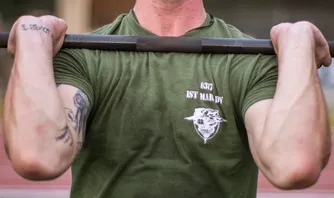
Set the bar in a rack at upper-chest height. Take a grip just outside shoulder width, step under, and let the bar rest on your front delts and collarbones rather than in your hands. Elbows sit slightly in front of the bar. Feet go about hip width, roughly where you would stand to jump. Take a full breath into your belly, brace, and squeeze your glutes before you move.
The Dip
The dip is short and vertical: a quick bend of the knees, a few inches deep, with the torso upright and your weight balanced across the whole foot. Think of it as the loading phase of a jump, not a squat. You want just enough stretch in the legs to rebound hard.
The Drive
Reverse the dip without pausing. Push the floor away and extend the hips and knees aggressively, letting the heels rise slightly at the finish. The legs alone should launch the bar off your shoulders. If the drive is working, the bar feels noticeably lighter at the moment your arms take over.
The Press and Lockout
As the bar leaves your shoulders, press straight up and pull your head back just enough to clear the bar path. Once the bar passes your forehead, push your head through so the bar finishes over mid-foot. Lock the elbows and shrug up into the bar. A bent-arm finish is a missed rep.
The Reset
Lower the bar under control to the rack position, absorbing it with a slight knee bend rather than catching it on locked legs. Re-brace before every rep. On heavy sets, reset your breath at the shoulders so the next dip starts from a stable position.
Barbell Push Press vs. Military Press: What’s the Difference?
The barbell push press uses a dip and leg drive to start the bar moving, while the military press (also called the strict or overhead press) keeps the legs locked and relies on the shoulders and triceps alone. The push press moves more weight and trains power. The strict press builds pure pressing strength.
Research on weightlifting overhead pressing derivatives confirms what coaches see in the gym: the variation you choose changes how much you can lift, with leg-driven versions outperforming the strict press on one-rep max. The key differences:
Load: the push press handles more weight because the legs start the bar.
Quality trained: the push press builds power and rate of force development; the strict press builds maximal shoulder strength.
Weak points: the strict press exposes lockout and shoulder weakness; the push press can mask them.
Best use: the push press for power blocks and heavy overhead loading; the strict press for building the base.
In the push press vs. strict press debate, the honest answer is that you need both, and the same holds for the push press vs. overhead press question, since those are two names for the same strict lift. Strict pressing sets your ceiling. The push press teaches you to express that strength faster and under heavier loads. A lifter with a weak strict press hits a wall on the push press quickly, because the arms still have to finish what the legs start.
Barbell Push Press Variations
The standard standing version covers most needs. Each variation below changes one variable and has a specific job.
Single-Arm Barbell Push Press
Holding a barbell in one hand turns the lift into an anti-rotation and grip drill. The long bar wants to tip, so your forearm, shoulder stabilizers, and obliques work hard to keep it level. Use light loads and a centered grip, and treat it as accessory work.
Seated Barbell Push Press
Sitting removes the dip and drive, which turns a seated barbell push press into a seated strict press. Research comparing seated and standing presses shows the seated position shifts demand away from the trunk and legs. It builds shoulder strength, but don’t count it as power work.
Barbell Front Squat to Push Press
The barbell front squat to push press (a barbell squat push press, or thruster) replaces the short dip with a full front squat, so you drive out of the bottom and press in one motion. The deep squat slows the transition, which makes it a work-capacity tool more than a power lift. End the set when the press turns into a grind.
Barbell Push Press Behind the Neck
Pressing from behind the neck puts the shoulder in an extreme abducted, externally rotated position. Clinical guidance on avoiding shoulder injury in resistance training advises against behind-the-neck pressing for anyone with shoulder instability. Use it only with good mobility and a healthy shoulder history, and keep loads moderate.
Barbell Push Press With Dumbbells
Searches for a barbell push press with dumbbells usually mean the dumbbell push press. Dumbbells let each arm find its own path, which suits shoulders that dislike a fixed bar, and they expose side-to-side imbalances. The dip and drive stay identical; expect lighter loads and more stabilizer demand.
Common Barbell Push Press Mistakes
Most faults start in the dip, and most cost you load before anything else. Fix them with these cues:
Pressing before the drive. The elbows bend early and the legs contribute little. Cue: “Legs, then arms.”
Dipping into a quarter squat. A deep dip kills the rebound. Cue: “Short and sharp.”
Dipping forward. The chest drops, the hips shift back, and the bar travels forward with them. Cue: “Chest tall, weight mid-foot.”
Soft lockout. Unlocked elbows leave the load on unstable joints. Cue: “Punch and shrug.”
Bar drifting forward. The bar finishes in front of your face. Cue: “Head through.”
How to Program the Barbell Push Press
The push press is a strength-speed exercise, so it fits in both strength and power blocks. The load decides which quality you train.
Programming for Power
Research mapping push press power across loads found peak power maximized near 75 percent of push press 1RM and mean power near 65 percent. A separate study found the push press, squat jump, and mid-thigh power clean produced similar peak power at 50 to 70 percent of 1RM, so the three can rotate through a power block. Use 3 to 5 sets of 2 to 4 fast reps in that range and stop before bar speed drops. Rest 2 to 3 minutes between sets.
Programming for Strength
Heavier sets of 3 to 5 reps, finishing with one or two clean reps in reserve, train lockout strength under loads your strict press can’t handle. Keep the strict press in the plan on a separate day so the base keeps rising.
Where It Fits in Your Week
Program it early in the session, after the warm-up, when you are fresh. One or two exposures a week covers most tactical athletes running concurrent endurance work. To see where it sits inside a full training day, use a strength workout for athletes as your session template. Sequence it across the year like other weightlifting derivatives: heavier strength work early, lighter and faster power work as a key event approaches. Once your push press is fast and consistent, the push jerk is the logical next step.
Frequently Asked Questions
What is a barbell push press?
A barbell push press is a standing overhead lift where you dip a few inches at the knees, drive hard with the legs, and use that momentum to help press the bar from your shoulders to lockout. It combines lower-body power and upper-body pressing strength in one rep.
What muscles does the barbell push press work?
The deltoids, triceps, upper chest, and upper back do the pressing. The quads, glutes, and calves produce the drive, and the core and spinal erectors hold the torso rigid so leg force reaches the bar. It is a full-body lift with an overhead finish.
Push press vs. military (strict) press: what is the difference?
The military press keeps the legs locked and uses only the shoulders and arms. The push press adds a dip and leg drive, which lets you lift more weight and train power. Use the strict press to build shoulder strength and the push press for heavier overhead loading.
Is the push press better than the strict press for building power?
Yes, for power specifically. The leg drive moves heavier loads faster, and research shows push press power output is comparable to loaded jumping. The strict press is the better pure strength builder, so most athletes get the best results programming both.
Can you do a push press seated or single-arm?
Single-arm, yes: a one-arm barbell push press adds anti-rotation and grip demand, so keep loads light. Seated, not in any real sense. Sitting removes the dip and drive, which turns the lift into a seated strict press that builds shoulder strength but not leg-driven power.
How much weight should you push press?
Most lifters push press noticeably more than they strict press because the legs start the bar. Begin with your strict press working weight, own the timing, then add small jumps. For power, train around 50 to 75 percent of your push press max.
How do you program the push press?
Program it early in the session, one to two times a week. For power, use 3 to 5 sets of 2 to 4 fast reps at moderate loads with full rest. For strength, use heavier sets of 3 to 5 and keep strict pressing on another day.
The barbell push press earns its place because it trains the exact quality tactical work demands: force from the ground, through a braced trunk, into a load overhead. Keep the dip short, drive before you press, and finish every rep locked out. Program it alongside your strict press and it moves your overhead strength and your power in the same block. If you want it built into a structured progression rather than pieced together session by session, start with the CF ONE training library and let the program handle the progression.
References:
Lake JP, Mundy PD, Comfort P. Power and impulse applied during push press exercise. Journal of Strength and Conditioning Research. 2014;28(9):2552-2559.
Comfort P, Mundy PD, Graham-Smith P, Jones PA, Smith LC, Lake JP. Comparison of peak power output during exercises with similar lower-limb kinematics. Journal of Trainology. 2016;5(1):1-5.
Bishop C, Chavda S, Turner A. Exercise technique: the push press. Strength and Conditioning Journal. 2018;40(3):104-108.
Soriano MA, Suchomel TJ, Comfort P. Weightlifting overhead pressing derivatives: a review of the literature. Sports Medicine. 2019;49(6):867-885.
Soriano MA, García-Ramos A, Torres-González A, Castillo-Palencia J, Marín PJ, Sainz de Baranda P, Comfort P. Comparison of 1-repetition-maximum performance across 3 weightlifting overhead pressing exercises and sport groups. International Journal of Sports Physiology and Performance. 2020;15(6):862-867.
Soriano MA, Jiménez-Ormeño E, Lake JP, McMahon JJ, Gallo-Salazar C, Mundy P, Comfort P. Kinetics and kinematics of the push press, push jerk, and split jerk. Journal of Strength and Conditioning Research. 2024;38.
Saeterbakken AH, Fimland MS. Effects of body position and loading modality on muscle activity and strength in shoulder presses. Journal of Strength and Conditioning Research. 2013;27(7):1824-1831.
Suchomel TJ, Comfort P, Lake JP. Enhancing the force-velocity profile of athletes using weightlifting derivatives. Strength and Conditioning Journal. 2017;39(1):10-20.
Durall CJ, Manske RC, Davies GJ. Avoiding shoulder injury from resistance training. Strength and Conditioning Journal. 2001;23(5):10-18.
Ronai P. The push press exercise. ACSM’s Health & Fitness Journal. 2022;26(4):33-38.
Knapik JJ, Reynolds KL, Harman E. Soldier load carriage: historical, physiological, biomechanical, and medical aspects. Military Medicine. 2004;169(1):45-56.
Headquarters, Department of the Army. FM 7-22: Holistic Health and Fitness. October 2020.
American College of Sports Medicine. Progression models in resistance training for healthy adults. Medicine & Science in Sports & Exercise. 2009;41(3):687-708.
American College of Sports Medicine. Resistance training prescription for muscle function, hypertrophy, and physical performance in healthy adults: an overview of reviews. Medicine & Science in Sports & Exercise. 2026.
Disclaimer: This article is for educational purposes only and is not medical advice. Consult a qualified healthcare professional before starting a new training program, especially if you have a history of shoulder, neck, or lower-back injury. Overhead lifting carries inherent risk; use loads you can control with proper technique.


