
Assisted Pull-Ups: Which Method Works Best | Combat Fitness
Assisted Pull-Ups: The Best Method to Build Your First Real Rep
Assisted pull-ups let you train the full pull-up pattern while lifting less than your bodyweight, using a band, an assist machine, your feet on a box, or a partner. They work, but the method decides how much of that strength shows up on a strict rep. Some methods take the load off in the wrong place.
We use assisted work inside our military fitness programs because the pull-up is the tactical benchmark. Per MCO 6100.13A, pull-ups are the only upper-body event that can earn the full 100 points on the Marine Corps PFT, and the Navy SEAL PST scores strict reps too. Below: every assist method, an honest ranking, the muscles worked, how it compares to the lat pulldown, and how to get off the assist entirely.
Key Takeaways:
Assisted pull-ups for beginners work when the assist matches where you fail, not just how much you weigh.
Feet-assisted reps and slow negatives transfer best to a strict pull-up. Bands come next. The machine comes last.
Bands help most at the bottom and least at the top, which is backward for most athletes.
The goal of any assist is to remove it. Cut the assistance in small steps and test a strict rep every two weeks.
What Are the Assisted Pull-Up Methods (and Their Tradeoffs)?
Every assisted pull-up method removes part of your bodyweight from the bar. The difference is where in the rep the help arrives and how much stabilizing work it leaves you. Those two details decide whether the strength carries over to a dead-hang rep on test day.
Band-Assisted Pull-Ups
Loop a resistance band over the bar and put a foot or knee in it. A band’s tension rises as it stretches, so it delivers the most help at the bottom of the rep and the least near the top (McMaster et al., 2010). That is the opposite of where most people stall, which is the last few inches before the chin clears the bar. Bands also let you bounce out of the bottom, which hides a weak start. They remain portable and easy to scale.
Assisted Pull-Up Machine
The counterweight machine has you kneel on a pad that pushes you up with a set load. The assist is constant and adjusts in exact increments, so progress is easy to track. The tradeoff is the pad: it locks your lower body in place, so your trunk stops working to keep you still. A strict pull-up demands that bracing, and less stable conditions demand more trunk muscle activity (Behm and Anderson, 2006). The machine trains your back. It does not train the full skill.
Feet-Assisted, Chair, Box, or Bench Pull-Ups
Set a box, bench, or sturdy chair under the bar, hang with straight arms and your feet on it, and push through your legs only as much as you need. You control the assist rep by rep and can push harder exactly where you stall, while your body stays free in space. The downside: the assist is hard to measure, so be honest about leg drive. Leg-assisted pull-ups on a low bar work the same way.
Negatives (Eccentric Pull-Ups)
Jump or step to the top position with your chin over the bar, then lower yourself over three to five seconds. You are stronger lowering a load than lifting it, so negatives let you train with full bodyweight before you can pull it. Eccentric training builds strength at least as well as concentric training (Roig et al., 2009). They are taxing, though, and soreness runs high if you add volume too fast (Hody et al., 2019).
Partner-Assisted Pull-Ups
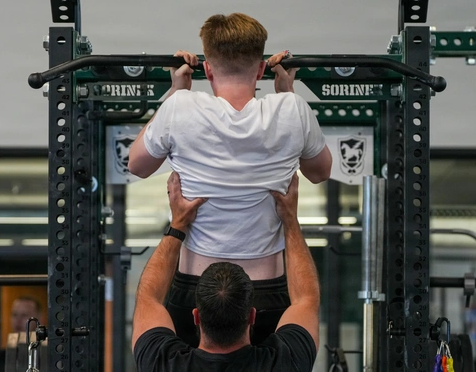
A partner lifts at your ankles or waist and gives only the help you need, right where you slow down. The help changes from rep to rep, so it works best as a finisher.
Which Assisted Pull-Up Method Is Best?
Feet-assisted pull-ups and negatives transfer best to a strict pull-up, because both keep you hanging free and load the top of the rep, where most athletes fail. Band-assisted reps rank next. The assisted pull-up machine ranks last for transfer, though it remains a solid back-strength tool.
Our ranking, best to worst for earning a strict rep:
Negatives. Full bodyweight, full range, and the hardest part of the rep trained under control.
Feet-assisted (box, bench, or chair). Free body position, and the assist goes exactly where you need it.
Partner-assisted. Adaptive help, but inconsistent and hard to track.
Band-assisted. Real carryover, but the help sits at the bottom, not the top.
Assisted pull-up machine. Measurable and safe, but it removes the bracing a strict rep needs.
Band versus machine: bands transfer better because you hang free and control your body, while the machine is better for exact loads and high-rep back work. On grip, train the one you will be tested on; extra-wide grips add difficulty without adding benefit (Andersen et al., 2014).
If you would rather have the whole decision made for you, our guide to choosing a strength & endurance program shows how to judge a plan before you commit to it.
Do Assisted Pull-Ups Work?
Assisted pull-ups work when they train the same pattern, through the same range, with a load you reduce over time. They fail when athletes stay on the same assist for months or pick a method that skips the range where they stall.
The muscles worked match a strict pull-up. The latissimus dorsi drives the pull, with the biceps, brachialis, lower and middle trapezius, rhomboids, rear delts, and forearm flexors sharing the work (Youdas et al., 2010; Dickie et al., 2017). The difference is load, not muscle selection.
Pulling your own bodyweight is a job skill: walls, obstacles, and vehicles all demand it. That ties straight into functional strength for military performance, where relative strength matters more than absolute numbers.
Assisted Pull-Ups vs. Lat Pulldown: Which Is Better?
For earning a strict pull-up, assisted pull-ups beat the lat pulldown, because your body moves to the bar and your trunk has to stabilize you. The lat pulldown is better for adding back volume and loading the pattern heavier than you can on the bar. Most programs use both.
Studies comparing the two find similar prime movers but different joint motion and stabilizer demand (Doma et al., 2013). Pulldown strength is also an imperfect predictor of pull-up performance (Johnson et al., 2009). With your thighs anchored under a pad, the core has little to do, so treat the pulldown as a supporting lift, not a substitute. The lat pulldown muscles worked breakdown covers that lift in detail.
Run assisted pull-ups first while you are fresh, then use the pulldown for extra sets once pull-up quality drops. If your pulling sits inside a strength workout for athletes, both count toward weekly pulling volume.
How to Progress From Assisted Pull-Ups to Unassisted
Progress off assisted pull-ups by reducing the help in small steps once you own your sets, adding negatives, and testing a strict rep every two weeks. The assist is a bridge. If you are not using less of it each month, the bridge has turned into a crutch.
Use this sequence:
Set the baseline. Find the assist that lets you complete 3 sets of 5 to 8 clean reps, chin over the bar, arms straight at the bottom.
Earn the cut. When you hit 3 sets of 8 with that assist, drop to a thinner band, lower the counterweight by one step, or use less leg drive.
Shift the assist on a box. Move from two feet to one foot, then to toes only, then to a light tap at the sticking point.
Add negatives twice a week. Three to five reps, each lowered over three to five seconds, after your assisted sets.
Keep the hang. Finish sessions with a dead hang and scapular pulls so grip and shoulder position never limit you.
Test on a fresh day. Try a strict rep every two weeks. One clean rep means you graduate to the full plan.
Train this two to three times a week with at least 48 hours between hard sessions, in line with ACSM guidance for resistance-training frequency (ACSM, 2009). Stop each set a rep or two short of failure so your form holds.
Once you have that first rep, the pull-up progression plan takes you from one rep to double digits, using frequent submaximal practice and barbell pull-ups to add reps.
Frequently Asked Questions
What are assisted pull-ups?
Assisted pull-ups are pull-ups performed with part of your bodyweight removed, using a resistance band, a counterweight machine, your feet on a box, or a partner. They let you train the full pull-up pattern before you can lift your whole body, so you build the strength for an unassisted rep.
Do assisted pull-ups build real pull-ups?
Assisted pull-ups build real pull-ups when you pick a method that loads the top of the rep and you reduce the assist over time. Feet-assisted reps and negatives transfer best. Athletes who stay on the same band or machine setting for months tend to stall.
Band vs. machine vs. feet-assisted: which is best?
Of the three, feet-assisted pull-ups transfer best, because you hang free and apply help exactly where you stall. Bands rank second but help most at the bottom, where you need it least. The assisted pull-up machine ranks last for transfer because the pad removes the trunk bracing a strict rep needs.
Are assisted pull-ups good for beginners?
Assisted pull-ups are good for beginners when paired with dead hangs and negatives. Start with an assist that allows 3 sets of 5 clean, full-range reps. Once you own one strict rep, shift most of your time to negatives and strict singles.
What muscles do assisted pull-ups work?
Assisted pull-ups work the same muscles as a strict pull-up: the lats, biceps, brachialis, lower and middle traps, rhomboids, rear delts, and forearms. Band and feet-assisted versions also train trunk stability. The machine version reduces that core demand because your lower body is braced on a pad.
How do you progress from assisted to unassisted pull-ups?
Progress from assisted to unassisted pull-ups by cutting the assist once you hit 3 sets of 8, adding negatives twice a week, and testing a strict rep every two weeks. Move from two feet to one foot to toes on a box, or step down band thickness, until no help remains.
Assisted pull-ups are a tool for getting off assistance, not a place to live. Pick the method that loads the top of the rep, cut the help in small steps, and add negatives until the box or band stops doing any work. Run the sequence above for the next four weeks, test a strict rep on a fresh day, and download the free pull-up progression plan to take that first rep to double digits.
References:
American College of Sports Medicine. (2009). Progression models in resistance training for healthy adults. Medicine and Science in Sports and Exercise, 41(3), 687-708.
Andersen, V., Fimland, M. S., Wiik, E., Skoglund, A., and Saeterbakken, A. H. (2014). Effects of grip width on muscle strength and activation in the lat pull-down. Journal of Strength and Conditioning Research, 28(4), 1135-1142.
Behm, D. G., and Anderson, K. G. (2006). The role of instability with resistance training. Journal of Strength and Conditioning Research, 20(3), 716-722.
Dickie, J. A., Faulkner, J. A., Barnes, M. J., and Lark, S. D. (2017). Electromyographic analysis of muscle activation during pull-up variations. Journal of Electromyography and Kinesiology, 32, 30-36.
Doma, K., Deakin, G. B., and Ness, K. F. (2013). Kinematic and electromyographic comparisons between chin-ups and lat-pull down exercises. Sports Biomechanics, 12(3), 302-313.
Hody, S., Croisier, J. L., Bury, T., Rogister, B., and Leprince, P. (2019). Eccentric muscle contractions: risks and benefits. Frontiers in Physiology, 10, 536.
Johnson, D., Lynch, J., Nash, K., Cygan, J., and Mayhew, J. L. (2009). Relationship of lat-pull repetitions and pull-ups to maximal lat-pull and pull-up strength in men and women. Journal of Strength and Conditioning Research, 23(3), 1022-1028.
McMaster, D. T., Cronin, J., and McGuigan, M. R. (2010). Quantification of rubber and chain-based resistance modes. Journal of Strength and Conditioning Research, 24(8), 2056-2064.
Roig, M., O’Brien, K., Kirk, G., Murray, R., McKinnon, P., Shadgan, B., and Reid, W. D. (2009). The effects of eccentric versus concentric resistance training on muscle strength and mass in healthy adults: a systematic review with meta-analysis. British Journal of Sports Medicine, 43(8), 556-568.
Youdas, J. W., Amundson, C. L., Cicero, K. S., Hahn, J. J., Harezlak, D. T., and Hollman, J. H. (2010). Surface electromyographic activation patterns and elbow joint motion during a pull-up, chin-up, or perfect-pullup rotational exercise. Journal of Strength and Conditioning Research, 24(12), 3404-3414.
United States Marine Corps. MCO 6100.13A (with changes): Marine Corps Physical Fitness and Combat Fitness Tests.
Naval Special Warfare. Physical Screening Test (PST).
Disclaimer: This article is for educational purposes and is not medical advice. Consult a qualified healthcare provider before starting a new training program, especially if you have a shoulder, elbow, or back injury. Standards cited here can change; confirm current requirements with your branch or unit before testing. Combat Fitness does not sell or endorse any fitness equipment mentioned in this article.


