
Are Squats Cardio? The Honest Answer | Combat Fitness
Are Squats Cardio? The Honest Answer for Strength and Conditioning
Are squats cardio? No. Squats are a strength exercise first, because the main stimulus is force production against load, not sustained aerobic work. Program them for high reps, in circuits, or with short rest, and your heart rate climbs high enough to build real conditioning. That is why the squat sits on a continuum between strength and cardio, and why our tactical fitness programs use it both ways.
We program for service members tested on both qualities, often in the same week. Below: where squats sit on the spectrum, the protocols that turn them into conditioning, and how to program them without skipping the aerobic base they cannot replace.
Are Squats Strength or Cardio?
Squats are a strength exercise. Cardio, or aerobic exercise, is rhythmic, sustained work with large muscle groups that keeps your heart rate up for minutes at a time (Garber et al., 2011). A heavy set of five lasts under 30 seconds and runs mostly on anaerobic energy, so it trains force, not your aerobic engine.
Whether you ask "is squatting cardio" or "is squats cardio," two variables decide it: load relative to your max, and how long the effort runs without a break. Heavy, low-rep squats with long rest build force and muscle (American College of Sports Medicine, 2009; Schoenfeld et al., 2017).
Heart rate does rise during a heavy set, and blood pressure spikes hard during straining reps (MacDougall et al., 1985). That is a pressure load, not an aerobic stimulus, and the long rest lets heart rate fall back.
The Strength to Cardio Continuum
The same movement lands in a different place depending on how you dose it:
Heavy squats (1 to 5 reps, long rest): strength. Minimal aerobic stimulus.
Moderate squats (6 to 12 reps): strength and muscle growth, with a brief heart-rate spike each set.
Light squats (15 to 30 reps, short rest): muscular endurance with a meaningful cardiovascular demand.
Bodyweight squats in continuous circuits: conditioning. Here, squats behave like cardio.
When Are Squats Cardio? High Reps, Circuits, and Short Rest
Squats become cardio when you remove the rest. High-rep sets, air squat circuits, EMOMs, and short-rest intervals keep large leg muscles working continuously, which holds heart rate in the moderate to vigorous range. ACSM places that range at roughly 64 to 95 percent of maximum heart rate (Garber et al., 2011).
The research backs the effect. Circuit-style resistance training improves VO2max, with larger gains in less-trained people (Muñoz-Martínez et al., 2017; Ozaki et al., 2013). In one study, four-minute bodyweight intervals that included squat jumps improved aerobic fitness about as much as treadmill running (McRae et al., 2012).
Squat Conditioning Protocols That Work
These are the formats we use to turn a strength movement into a conditioning stimulus:
Air squat EMOM: 12 minutes, 15 to 20 air squats at the top of every minute.
Run and squat couplet: 5 rounds of a 400-meter run plus 25 air squats at a steady, repeatable pace.
Goblet squat circuit: 4 rounds of 15 goblet squats, 10 push-ups, and a 250-meter row, with 60 seconds of rest between rounds.
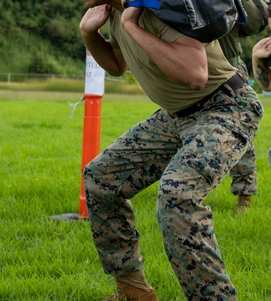
Sandbag carry into squats: carry 40 meters, do 10 sandbag front squats, carry back. Repeat for 5 rounds.
Air squat intervals: 8 rounds of 20 seconds on, 10 seconds off. Mostly anaerobic, so use it as a finisher.
If you would rather run a plan that already balances lifting and conditioning, our guide to choosing a strength & endurance program covers what to look for.
The Tactical Take: Work Capacity Over Labels
"Strength or cardio" is a gym question. On the job, the question is work capacity: how much useful work you can do under load, and how many times you can repeat it. A casualty drag or a stairwell climb in full kit demands strength and an engine at the same moment.
Military research agrees: soldiers need both aerobic and strength qualities for occupational tasks (Friedl et al., 2015; Kraemer & Szivak, 2012), and Army doctrine trains them together (Department of the Army, 2020).
That is the logic behind GPP. Once you understand what GPP (general physical preparedness) is, a broad base built before any specialization, the squat's dual role makes sense. In the field, squat strength shows up as standing from a kneel with a loaded pack, the quality we break down in functional strength for military performance.
Loaded vs. Light: Same Movement, Different Job
Loaded: heavy back squats, front squats, or trap-bar work for low reps build the force you need to move a body or a pack.
Light: air squats or light goblet squats for high reps build the repeatability to keep moving when your legs are already tired.
How to Program Squats (and Why You Still Need Real Cardio)
Put heavy squats early in a strength session, when you are fresh: 3 to 5 sets of 3 to 6 reps with two to three minutes of rest. Put light, high-rep squats in conditioning circuits at the end of a session or on mixed days. Do not let squat circuits become your only cardio.
The strength side follows the loading and progression rules in a strength workout for athletes.
Squat circuits raise your heart rate, but they are not a replacement for real aerobic conditioning. Your legs fatigue before your cardiovascular system reaches its limit, so you cannot sustain the effort long enough to build a deep base. VO2max gains from resistance circuits are modest compared with endurance training (Ozaki et al., 2013).
That is the job of building an aerobic base: high volumes of steady, low-intensity running, rucking, and rowing (Seiler, 2010). Sequence it with care. High-volume endurance work can blunt strength and power gains when the two compete (Wilson et al., 2012), so separate heavy squat days from long runs by several hours or a full day when you can.
A Sample Week
Monday: heavy squat strength session.
Tuesday: easy run, 40 to 60 minutes.
Wednesday: upper-body strength plus a squat conditioning finisher.
Thursday: ruck at a sustainable pace.
Friday: full-body strength with moderate-rep squats.
Saturday: long, easy aerobic session.
Sunday: rest or mobility.
Frequently Asked Questions
Are squats cardio or strength?
Squats are a strength exercise. Heavy and moderate sets build force and muscle with little aerobic stimulus. High-rep squats done in circuits or with short rest raise your heart rate enough to train conditioning, so they can serve both roles.
Do squats raise your heart rate?
Yes. Any squat set raises heart rate, and heavy sets spike blood pressure as well. High-rep or continuous squats hold heart rate in the moderate to vigorous range for minutes at a time, which produces the conditioning effect.
Can squats replace cardio?
No. Squat circuits build conditioning and work capacity, but your legs fatigue before your heart and lungs reach their limit, so the aerobic stimulus stays modest. You still need steady running, rucking, or rowing to build the aerobic base behind long efforts and recovery.
How many squats count as a cardio workout?
No fixed number makes squats cardio. What counts is continuous effort that keeps your heart rate in the moderate range or higher. Current federal guidelines count aerobic activity of any bout length toward weekly totals (U.S. Department of Health and Human Services, 2018), so 10 to 20 minutes of nonstop squat circuits qualifies.
Are high-rep squats good for conditioning?
Yes. High-rep squats build muscular endurance in the legs and, with short rest, a real cardiovascular demand. They work best inside circuits with running, rowing, or carries. Stop a set when depth or knee position starts to slip.
Do bodyweight (air) squats count as cardio?
Air squats count as cardio when you do them continuously or in short-rest intervals, because they keep large muscles working and your heart rate up. A single set of 20 does not. Twelve minutes of air squat EMOMs or squat and run rounds does, especially for less-trained athletes.
Should you do squats on cardio days or strength days?
Do heavy squats on strength days, early in the session. Use light, high-rep squats on conditioning or mixed days as circuit work or finishers. Avoid hard squat conditioning right before a long run, because leg fatigue degrades both sessions.
Are squats cardio? Not by definition, but the answer depends on how you program them. Load them heavy to build force, cycle them light and fast to build work capacity, and keep running and rucking to build the aerobic base squats cannot. Start a Combat Fitness program that sequences strength, conditioning, and aerobic work for the job you are training for.
References:
American College of Sports Medicine. Progression models in resistance training for healthy adults. Medicine and Science in Sports and Exercise. 2009;41(3):687-708.
Department of the Army. FM 7-22, Holistic Health and Fitness. Washington, DC: Headquarters, Department of the Army; 2020.
Friedl KE, Knapik JJ, Häkkinen K, et al. Perspectives on aerobic and strength influences on military physical readiness: report of an international military physiology roundtable. Journal of Strength and Conditioning Research. 2015;29(Suppl 11):S10-S23.
Garber CE, Blissmer B, Deschenes MR, et al. Quantity and quality of exercise for developing and maintaining cardiorespiratory, musculoskeletal, and neuromotor fitness in apparently healthy adults. Medicine and Science in Sports and Exercise. 2011;43(7):1334-1359.
Haff GG, Triplett NT, eds. Essentials of Strength Training and Conditioning. 4th ed. Champaign, IL: Human Kinetics; 2016.
Kraemer WJ, Szivak TK. Strength training for the warfighter. Journal of Strength and Conditioning Research. 2012;26(Suppl 2):S107-S118.
MacDougall JD, Tuxen D, Sale DG, Moroz JR, Sutton JR. Arterial blood pressure response to heavy resistance exercise. Journal of Applied Physiology. 1985;58(3):785-790.
McRae G, Payne A, Zelt JG, et al. Extremely low volume, whole-body aerobic-resistance training improves aerobic fitness and muscular endurance in females. Applied Physiology, Nutrition, and Metabolism. 2012;37(6):1124-1131.
Muñoz-Martínez FA, Rubio-Arias JA, Ramos-Campo DJ, Alcaraz PE. Effectiveness of resistance circuit-based training for maximum oxygen uptake and upper-body one-repetition maximum improvements: a systematic review and meta-analysis. Sports Medicine. 2017;47(12):2553-2568.
Ozaki H, Loenneke JP, Thiebaud RS, Abe T. Resistance training induced increase in VO2max in young and older subjects. European Review of Aging and Physical Activity. 2013;10(2):107-116.
Schoenfeld BJ, Grgic J, Ogborn D, Krieger JW. Strength and hypertrophy adaptations between low- vs. high-load resistance training: a systematic review and meta-analysis. Journal of Strength and Conditioning Research. 2017;31(12):3508-3523.
Seiler S. What is best practice for training intensity and duration distribution in endurance athletes? International Journal of Sports Physiology and Performance. 2010;5(3):276-291.
Steele J, Fisher J, McGuff D, Bruce-Low S, Smith D. Resistance training to momentary muscular failure improves cardiovascular fitness in humans: a review of acute physiological responses and chronic physiological adaptations. Journal of Exercise Physiology Online. 2012;15(3):53-80.
U.S. Department of Health and Human Services. Physical Activity Guidelines for Americans. 2nd ed. Washington, DC: HHS; 2018.
Wilson JM, Marin PJ, Rhea MR, et al. Concurrent training: a meta-analysis examining interference of aerobic and resistance exercises. Journal of Strength and Conditioning Research. 2012;26(8):2293-2307.
Disclaimer: This article is for educational purposes and is not medical advice. If you have an injury, pain, or a diagnosed condition, get cleared by a qualified medical provider before starting a new exercise program. Stop any exercise that causes sharp or worsening pain.


