
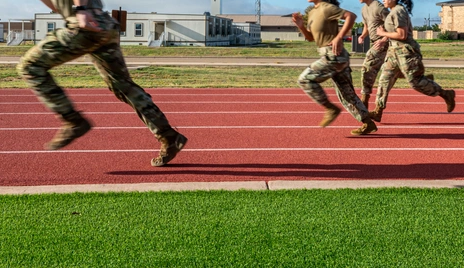
100m Sprint Training: How to Run Faster | Combat Fitness
100m Sprint Training: How to Train for a Faster 100-Meter Dash
100m sprint training works best when you train the race in phases: the drive out of the start, the acceleration that follows, and the top speed you hold to the line. Each phase has its own mechanics and its own drills. The strength behind all of them is the same quality our tactical fitness programs build: the ability to put big force into the ground fast.
We coach athletes who need speed on the job, not just on a track. Below: how to train for the 100 meter sprint phase by phase, the drills, the strength and plyometric support, the tactical transfer, and a sample week.
What Are the Phases of the 100m Sprint?
The 100m sprint breaks into four phases: the drive (roughly the first 10 meters), acceleration (10 to 30 meters), maximum velocity (30 to 60 meters), and speed maintenance to the finish. Each asks for different body angles and force direction, so each needs its own training.
Drive phase (0 to 10 meters): a strong forward lean and long pushes that send force backward into the ground.
Acceleration (10 to 30 meters): your torso rises gradually with each step, and stride length and stride frequency both climb (Mero et al., 1992; Hunter et al., 2004).
Maximum velocity (30 to 60 meters): you run tall, with short ground contacts and force aimed down into the track. Most trained non-elite athletes hit their top speed somewhere in this window, while world-class sprinters keep accelerating deeper into the race (Haugen et al., 2019; Maćkała & Mero, 2013).
Speed maintenance (60 to 100 meters): everyone slows down. The winner slows down least, thanks to relaxed mechanics and a high top speed to start from.
The physics is simple. The best accelerators aim more of their force horizontally (Morin et al., 2011; Rabita et al., 2015). At top speed, faster sprinters do not move their legs faster. They hit the ground harder in less time (Weyand et al., 2000). Train the force and its direction.
The Key Sprint Drills for the 100m
The best exercises for 100m sprinters are drills that reinforce the position and force direction of one phase at a time: acceleration drills for the drive, top-speed drills for upright running, and mechanics drills for the pattern. Do them fresh, early in the session.
For general sprint conditioning (repeat efforts, intervals, and shuttles), our sprint workouts guide covers that ground. This section stays on the event-specific drills.
Acceleration Drills
Wall drives: lean into a wall at about 45 degrees and drive one knee at a time, ankle to head in a straight line.
Resisted sled sprints: 10 to 20 meters with a sled or harness. Resisted sprinting reliably improves acceleration, especially with loads that slow you meaningfully (Petrakos et al., 2016; Morin et al., 2017).
Hill sprints: 10 to 30 meters on a moderate grade. The slope forces the drive-phase lean.
Starts: 10 to 20 meter efforts from a three-point, two-point, or block start. Rest fully between reps.
Max Velocity Drills
Flying sprints: build up over 20 to 30 meters, then sprint 10 to 30 meters at max effort. This isolates top speed.
Wicket runs: mini hurdles spaced evenly to cue a tall posture, front-side mechanics, and consistent stride length.
Sprint-float-sprint: alternate 20 meters of hard sprinting with 20 meters of relaxed, near-top-speed running, which trains the relaxation you need late in the race.
Mechanics Drills
A-march and A-skip: knee up, toe up, foot striking under the hips. These rehearse the front-side pattern.
B-skip: adds the leg extension and the pawing strike back under the body.
Straight-leg bounds: short, stiff ground contacts off the ball of the foot.
Strength and Plyometric Training for the 100m Sprint
Strength and plyometric training make you faster because sprint speed is limited by how much force you produce in a short ground contact. Squats, Olympic lift variations, and hinges raise your force ceiling. Bounds and hops teach you to apply it in the fraction of a second a stride allows.
The research is consistent. Gains in lower-body strength transfer to faster sprint times (Seitz et al., 2014). Plyometric training improves sprint performance, with the biggest effects in short sprints and in athletes who already have a base (de Villarreal et al., 2012). Strength work alone does not finish the job: it has to be paired with sprinting so the new force shows up in the stride (Delecluse, 1997). Part of the gain is neural: better motor unit recruitment and rate of force development (Ross et al., 2001; Cormie et al., 2011).
The Lifts That Matter
Squats (back or front): the base of lower-body force. Work in the 3 to 6 rep range.
Cleans and pulls from the hang: high-velocity triple extension, close to the joint action of the drive.
Hinges (Romanian deadlifts, trap-bar deadlifts): posterior chain strength for the push and for hamstring resilience.
Nordic hamstring curls: hamstrings take a heavy eccentric load at top speed, and Nordics reduce hamstring injury rates (van der Horst et al., 2015).
The loading, set, and progression rules for these lifts are laid out in a strength workout for athletes, so this post does not repeat them.
The Plyometrics That Matter
Broad jumps and bounds: horizontal force, matched to the drive and acceleration.
Single-leg hops: every sprint stride is one leg at a time.
Pogo jumps and hurdle hops: short, stiff contacts that train the ankle for top speed.
Keep volume low. Ten good contacts beat fifty sloppy ones.
The Tactical Transfer: Why Acceleration Matters on the Job
Acceleration matters for tactical athletes because almost nothing on the job is a full 100 meters. A foot pursuit, a sprint to cover, or a dash across a danger area lasts seconds and is decided in the first steps. That makes the drive and acceleration phases the qualities you use most.
The sprint-drag-carry on the Army's fitness test rewards the same first-step quickness. Repeat-sprint ability, the capacity to produce near-max sprints with short rest, depends on the same top-end speed plus a recovery system built for it (Girard et al., 2011; Bishop et al., 2011).
We frame 100m training as building the ability to produce force fast. That force base is what functional strength for military performance develops: strength that carries into first-step quickness under kit, not just numbers on a bar.
How to Train for the 100m Dash: A Sample Week
The way to train for the 100m dash is two or three sprint sessions per week, two strength sessions, low-volume plyometrics paired with the sprint work, and real recovery between hard days. Speed work only builds speed when you are fresh, so the week is built around quality, not volume (Haugen et al., 2019).
Monday, acceleration and lower strength: warm-up, A-skips, wall drives, 6 to 8 x 10 to 20 meter starts or sled sprints, broad jumps, then squats and Romanian deadlifts.
Tuesday, recovery: easy aerobic work for 20 to 30 minutes, plus mobility.
Wednesday, max velocity: warm-up, B-skips and wickets, 4 to 6 x 20 to 30 meter flying sprints, pogo jumps and hurdle hops.
Thursday, upper body and core strength: no sprinting.
Friday, speed endurance and power: 3 to 4 x 60 to 80 meter runs at 90 to 95 percent, single-leg hops, then hang cleans and Nordic curls.
Saturday, easy aerobic work or a ruck.
Sunday, rest.
Rest fully between sprint reps. A common coaching rule is about a minute of rest per 10 meters sprinted. When times drop or mechanics fall apart, end the set.
If you are fitting speed work into a plan that also has to cover strength, rucking, and endurance, our guide to choosing a strength & endurance program explains what a balanced plan should include.
An Honest Note on Genetics
Genetics set your ceiling. Genes such as ACTN3 are linked to elite sprint performance (Yang et al., 2003), and no plan turns everyone into a 10-second sprinter. Your floor is different: better mechanics and more force make almost every athlete faster.
Frequently Asked Questions
How do you train for a 100-meter sprint?
Train each phase separately: starts and sled sprints for the drive and pickup, flying sprints for top speed. Support that with two strength sessions, low-volume plyometrics, and full rest between reps. Two or three quality sprint days a week is enough for most athletes.
What exercises improve 100m sprint speed?
Squats, cleans, and hinges raise the force you can produce. Bounds, hops, and broad jumps teach you to apply it quickly. Add sled sprints for acceleration and Nordic curls for durability. Sprinting is still the most specific exercise. Lifting supports it and never replaces it.
How long does it take to get faster at the 100m?
Most athletes see measurable gains within 6 to 12 weeks of consistent sprint, strength, and plyometric work, which is the length of most training studies (Petrakos et al., 2016; de Villarreal et al., 2012). Beginners improve fastest. Trained sprinters gain in smaller amounts over seasons.
Should sprinters lift weights?
Yes. Lower-body strength gains transfer to faster sprint times, especially over short distances (Seitz et al., 2014). Lifting raises your force ceiling and makes hamstrings and tendons more resilient. Keep reps low, move the bar with intent, and lift after sprinting or on separate days.
What drills improve acceleration off the start?
Wall drives, sled sprints, hill sprints, and 10 to 20 meter starts all build acceleration. Each reinforces a forward lean and pushes that send force backward into the ground. Rest fully between reps so every start is a full-intent effort.
How many days a week should you train for the 100m?
Sprint two or three days a week, with an easy day between hard sessions. Add two strength days and pair plyometrics with sprint days. More sprint days rarely help, because speed work depends on a fresh nervous system.
Do plyometrics make you a faster sprinter?
Yes. A meta-analysis found plyometric training improves sprint performance, with the largest effects over short distances (de Villarreal et al., 2012). Bounds, hops, and jumps train short, stiff ground contacts. Keep volume low and stop a set when contacts get slow.
100m sprint training comes down to three jobs: drive hard out of the start, accelerate with good angles, and reach a high top speed you can hold. Train each phase with the right drills, back it with strength and plyometrics, and protect quality with full rest. Start a Combat Fitness program that builds speed and strength into one plan for the job you are training for.
References:
Bishop D, Girard O, Mendez-Villanueva A. Repeated-sprint ability part II: recommendations for training. Sports Medicine. 2011;41(9):741-756.
Cormie P, McGuigan MR, Newton RU. Developing maximal neuromuscular power: part 1, biological basis of maximal power production. Sports Medicine. 2011;41(1):17-38.
de Villarreal ES, Requena B, Cronin JB. The effects of plyometric training on sprint performance: a meta-analysis. Journal of Strength and Conditioning Research. 2012;26(2):575-584.
Delecluse C. Influence of strength training on sprint running performance: current findings and implications for training. Sports Medicine. 1997;24(3):147-156.
Department of the Army. FM 7-22, Holistic Health and Fitness. Washington, DC: Headquarters, Department of the Army; 2020.
Girard O, Mendez-Villanueva A, Bishop D. Repeated-sprint ability part I: factors contributing to fatigue. Sports Medicine. 2011;41(8):673-694.
Haff GG, Triplett NT, eds. Essentials of Strength Training and Conditioning. 4th ed. Champaign, IL: Human Kinetics; 2016.
Haugen T, Seiler S, Sandbakk Ø, Tønnessen E. The training and development of elite sprint performance: an integration of scientific and best practice literature. Sports Medicine Open. 2019;5(1):44.
Hunter JP, Marshall RN, McNair PJ. Interaction of step length and step rate during sprint running. Medicine and Science in Sports and Exercise. 2004;36(2):261-271.
Maćkała K, Mero A. A kinematics analysis of three best 100 m performances ever. Journal of Human Kinetics. 2013;36:149-160.
Mero A, Komi PV, Gregor RJ. Biomechanics of sprint running: a review. Sports Medicine. 1992;13(6):376-392.
Morin JB, Edouard P, Samozino P. Technical ability of force application as a determinant factor of sprint performance. Medicine and Science in Sports and Exercise. 2011;43(9):1680-1688.
Morin JB, Petrakos G, Jiménez-Reyes P, et al. Very-heavy sled training for improving horizontal-force output in soccer players. International Journal of Sports Physiology and Performance. 2017;12(6):840-844.
Petrakos G, Morin JB, Egan B. Resisted sled sprint training to improve sprint performance: a systematic review. Sports Medicine. 2016;46(3):381-400.
Rabita G, Dorel S, Slawinski J, et al. Sprint mechanics in world-class athletes: a new insight into the limits of human locomotion. Scandinavian Journal of Medicine and Science in Sports. 2015;25(5):583-594.
Ross A, Leveritt M, Riek S. Neural influences on sprint running: training adaptations and acute responses. Sports Medicine. 2001;31(6):409-425.
Seitz LB, Reyes A, Tran TT, Saez de Villarreal E, Haff GG. Increases in lower-body strength transfer positively to sprint performance: a systematic review with meta-analysis. Sports Medicine. 2014;44(12):1693-1702.
van der Horst N, Smits DW, Petersen J, Goedhart EA, Backx FJ. The preventive effect of the Nordic hamstring exercise on hamstring injuries in amateur soccer players: a randomized controlled trial. American Journal of Sports Medicine. 2015;43(6):1316-1323.
Weyand PG, Sternlight DB, Bellizzi MJ, Wright S. Faster top running speeds are achieved with greater ground forces not more rapid leg movements. Journal of Applied Physiology. 2000;89(5):1991-1999.
Yang N, MacArthur DG, Gulbin JP, et al. ACTN3 genotype is associated with human elite athletic performance. American Journal of Human Genetics. 2003;73(3):627-631.
Disclaimer: This article is for educational purposes and is not medical advice. Max-effort sprinting carries a real risk of hamstring and calf strains. Warm up thoroughly, build sprint volume gradually, and get cleared by a qualified medical provider before training if you have an injury, pain, or a diagnosed condition. Stop any exercise that causes sharp or worsening pain.


