
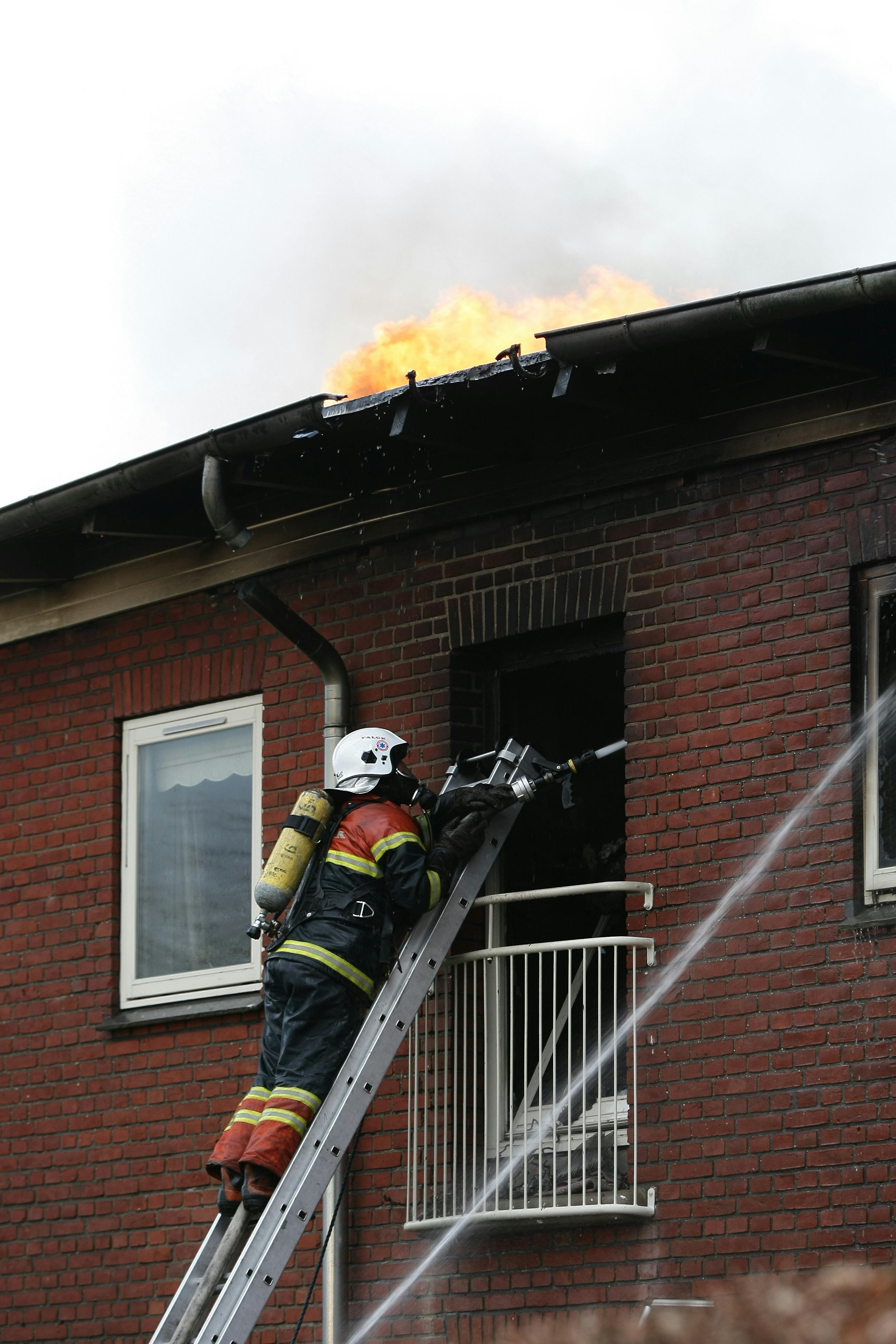
Firefighter Work Capacity: Fireground Physical Demands
Firefighting is not a single-effort job. It is a profession built around repeated high-intensity tasks performed under fatigue, heat, and psychological stress, and the physical quality that decides whether a firefighter holds up across all of them is work capacity.
Research on the physical demands of firefighting found that the most demanding fireground operations drive firefighters to roughly 85% of maximum aerobic capacity (Gledhill & Jamnik, 1992), and that effort has to be repeated, call after call, with little predictable rest. That is why work capacity, not a single max lift or a fast mile, is the truest measure of a firefighter's readiness for the job.
Firefighters must:
Carry heavy equipment
Climb stairs
Drag hoses
Break through barriers
Rescue casualties
Work in extreme heat
Repeat these tasks multiple times during a single incident
Because of this, traditional fitness metrics like a single strength test or a timed run only tell part of the story. What truly determines performance on the fireground is work capacity. Programs structured around work capacity development, not just isolated fitness testing, are what CF ONE training programs are designed to deliver.
What the Fireground Actually Demands, Measured
The foundational task analysis of firefighting quantified the job rather than describing it. These are the numbers.
Figure 1.1 - Seven measured fireground demands, all verified verbatim against Gledhill and Jamnik's 1992 task analysis: oxygen cost of 41.5 ml/kg/min at the peak and 23 ml/kg/min across 90 percent of demanding operations, peak blood lactate of 6 to 13.2 mM, lifting to 80 lb, pulling to 135 lb, working in front of the body to 125 lb, and a recommended minimum VO2max of 45. Two updates: the current consensus minimum is 42 ml/kg/min or 12 METs across a range of 39 to 45, so 45 is the top of the band rather than its centre; and the 85 and 50 percent figures are computed against the study's own subjects, not against 45. Three demands the table omits - heart rate at 84 to 100 percent of maximum, oxygen uptake still elevated more than 30 minutes after work stops, and roughly 70 lb of gear before any load is picked up. Sources: Canadian Journal of Sport Sciences 17(3) 1992, NSCA tactical physiological demands review, NFPA 1580.
Two of those numbers need reading together carefully. The 41.5 ml/kg/min figure describes the actual oxygen cost of the hardest fireground work, and it represented 85% of the tested firefighters' maximum. The 45 ml/kg/min figure is a separate recommendation: the minimum aerobic capacity an applicant should bring to the job. They are not the same quantity and they are not meant to divide into each other.
The practical implication is the one that matters. If the hardest work on the fireground costs roughly 41.5 ml/kg/min, then a firefighter sitting at the 45 minimum is working at over 90% of maximum during it. A firefighter with a VO2max of 55 is working at around 75%. Same task, radically different sustainability, and radically different recovery between calls. The minimum is a floor to clear, not a standard to train to.
The Entry Standard: What CPAT Actually Tests
For most US departments, the physical entry requirement is the Candidate Physical Ability Test. It is worth knowing what it measures, because it is a work capacity test in everything but name: eight tasks, back to back, on one clock, in a weighted vest.
The format: a 50-pound weighted vest worn throughout, an additional 25 pounds (12.5 per shoulder) for the stair climb, 85 feet of walking between events, and a total time limit of 10 minutes and 20 seconds for all eight.
The eight events, in order:
Stair Climb.Climbing with an additional 25 lbs of equipment
Hose Drag.Stretching uncharged lines and advancing them
Equipment Carry. Removing and carrying equipment from apparatus to fireground
Ladder Raise and Extension. Placing a ground ladder and extending it to a roof or window
Forcible Entry.Penetrating a locked door, breaching a wall
Search.Crawling through dark, unpredictable spaces
Rescue.Removing a victim or partner from a structure
Ceiling Breach and Pull. Pulling down a ceiling to check for fire extension
Notice what the test is really assessing. No single event is beyond an averagely fit adult. Eight of them consecutively, in a 50-pound vest, inside eleven minutes, is a work capacity problem. Candidates who fail rarely fail on the first two events.
That is the entry standard. The job itself is harder, because the job does not stop at 10:20 and does not let you take the vest off afterward.
What Work Capacity Means for Firefighters
Work capacity refers to the ability to perform repeated physical efforts, recover between tasks, and sustain performance over time.
For firefighters, this means:
Performing multiple tasks in sequence
Working at high heart rates
Carrying external loads
Operating in hot, stressful environments
Recovering quickly between efforts
Unlike many sports, firefighting does not provide predictable work-to-rest cycles. Incidents can last minutes, hours, or entire shifts.
This makes work capacity one of the most critical physical qualities for operational success. For firefighters and tactical athletes evaluating which program best fits their work capacity development goals, the tactical fitness program buying guide walks through exactly how to choose the right option.
The Physical Demands of Fireground Tasks
Common fireground tasks include stair climbs with equipment, hose drags and pulls, forcible entry, victim rescues, ladder raises, and equipment carries.
What makes them physiologically taxing is not any single task in isolation but the requirement to perform them at near-maximal intensity, back to back, under heat and gear, with no scheduled recovery in between. Nine out of ten of the demanding operations measured in the task analysis averaged around 50% of maximum aerobic capacity. It is the remaining ten percent, the spikes to 85%, that decide who is still effective on the second rescue.
The lactate data tells the same story from a different angle. Peak concentrations of 6 to 13.2 mM put the hardest fireground work firmly in anaerobic territory, and lactate at that level does not clear quickly without a strong aerobic system underneath it.
These tasks require a blend of strength, strength endurance, aerobic capacity, and anaerobic power. But more importantly, they require the ability to repeat these efforts under fatigue. A firefighter who performs one victim rescue excellently but degrades significantly on the second is not adequately prepared for the demands of the job.
For firefighters with specific questions about tactical fitness program structure and what to look for in a system built around occupational performance, the tactical fitness program FAQ covers the most common questions in one place.
Why Work Capacity Matters More Than Peak Fitness
A firefighter might lift very heavy weights, run a fast mile, or score high on fitness tests. But if they cannot sustain effort across multiple tasks, recover between bouts of work, and maintain output under fatigue, their real-world performance will suffer.
High work capacity allows firefighters to maintain performance across long incidents, recover faster between tasks, reduce fatigue accumulation, lower injury risk, and stay operational for the duration of the call. In many cases, the firefighter who lasts the longest is more valuable than the one who peaks the highest.
This is the distinction between general fitness and occupational readiness. Understanding what is work capacity gives this concept its full physiological definition, explaining exactly what the body is doing when work capacity is expressed or limited, and why it is the performance quality that ties strength and endurance together into real-world output.
The Role of the Aerobic System
One of the biggest contributors to work capacity is the aerobic system. The task analysis recommended a minimum VO2max of roughly 45 ml/kg/min for firefighter applicants (Gledhill & Jamnik, 1992), not because every call is maximal, but because a deep aerobic base is what lets a firefighter recover between the moments that are.
A strong aerobic base:
Improves recovery between high-intensity efforts
Reduces heart rate during submaximal tasks
Delays fatigue
Supports longer work durations
On the fireground, this means:
Faster recovery between tasks
Better tolerance to heat and stress
Sustained performance over time
Firefighters with higher aerobic fitness often:
Perform tasks more efficiently
Experience less fatigue
Show better overall job performance
Firefighters with higher aerobic fitness often perform tasks more efficiently, experience less fatigue, and show better overall job performance.
The specific aerobic demands of firefighting operations are covered in aerobic capacity for firefighting operations, which addresses the cardiovascular demands of the fireground specifically and how to develop the aerobic base that makes sustained operational performance possible.
The Role of Strength and Strength Endurance
While aerobic fitness is essential, firefighters also need high levels of absolute strength and the ability to repeat forceful efforts.
Strength helps firefighters move heavy equipment, break through obstacles, and perform rescues. The task analysis put real numbers on that: lifting and carrying up to 80 lbs, pulling up to 135 lbs, and working with objects in front of the body up to 125 lbs. Those are not maximal lifts for a trained adult. They become maximal when they are the fourth one, in gear, at 85% of VO2max.
Strength endurance allows firefighters to repeat these tasks, maintain force output across multiple efforts, and resist muscular fatigue as the incident extends.
Together, these qualities support overall work capacity. Strength without endurance means early degradation on repeated tasks. Endurance without strength means insufficient force production when it matters. The firefighter who combines both, and who has the aerobic base to recover between demands, is the one whose performance holds up when the incident is at its most demanding.
The specific strength-endurance demands of fireground tasks are covered in strength-endurance for fireground tasks, which connects the physical qualities described here to the operational scenarios firefighters face and the training approaches that prepare for them directly.
Environmental and Operational Stress
Firefighting is not performed in ideal conditions.
Firefighters must operate:
In heavy protective gear
Under extreme heat
With restricted airflow
In unpredictable environments
Under psychological stress
These factors increase heart rate, accelerate fatigue, and reduce performance capacity.
Insulated turnout gear and self-contained breathing apparatus (SCBA) trap heat and add resistance to every movement, so the same task that costs a firefighter little in the gym costs far more on the fireground. Heart rate climbs faster, core temperature rises, and the margin for recovery shrinks. Without a deep work-capacity base, fatigue accumulates rapidly, and a firefighter who is gassed is a firefighter who gets hurt or has to be pulled from the line.
Heat tolerance is trainable, and most firefighters never train it. Repeated deliberate exposure to heat stress produces measurable adaptation: plasma volume expands, sweating begins earlier and at a higher rate, core temperature rises more slowly for the same work, and heart rate at a given output drops. Those adaptations arrive faster than most fitness adaptations and they fade quickly without maintenance.
The practical version is not complicated. Some conditioning done in warm conditions, in gear where it is safe and supervised to do so, produces adaptations that a purely air-conditioned training program never will. This is one of the few areas where training specificity is directly protective rather than just performance-enhancing.
The Risk This Article Has Been Describing
Everything above describes near-maximal cardiovascular effort, repeated, under heat load, in a sealed breathing apparatus, with no predictable recovery. It is worth being direct about what that means, because the fitness conversation in the fire service often stops short of it.
Sudden cardiac events are the leading cause of firefighter line-of-duty death, and have been for years. In 2022, NFPA recorded 96 on-duty firefighter deaths in the United States. Thirty-five were sudden cardiac incidents or cardiac-related. Just over half of all on-duty deaths that year, 49 of 96, fell under overexertion and stress, the category that contains them.
Building work capacity is genuinely protective here. Higher aerobic fitness lowers the relative strain of every fireground task, which is the whole argument of this article and the evidence supports it.
But fitness training is not a substitute for medical screening, and it can mask the need for it. A firefighter who trains hard, feels strong, and pushes through symptoms is not thereby low-risk. The physiological profile described in this article, high-intensity effort under heat and equipment load with abrupt onset and no warm-up, is specifically the profile associated with cardiac events in this population.
So, plainly:
Get the medical evaluation. NFPA 1582 exists as the medical standard for fire department members, and departments with a functioning occupational health program are giving you something worth using. If yours does not offer one, get it independently
Chest discomfort, unusual breathlessness, palpitations, light-headedness on exertion, or unexplained drops in exercise tolerance are medical questions, not training questions. Do not program around them. See a physician, and tell them what the job actually involves, because the exertional profile matters to their assessment
Know your family history and your risk factors. Blood pressure, lipids, glucose and smoking status all sit alongside fitness rather than being replaced by it
This is more important, not less, for the fittest people in the station. Fitness reduces risk. It does not eliminate it, and it can make symptoms easier to dismiss
None of this is a reason to train less. It is a reason to make sure that the training is happening on top of a known baseline rather than instead of one.
Signs of Poor Work Capacity in Firefighters
Low work capacity rarely shows up on the first task of a call. It shows up on the third, the fourth, and the climb back up after. The firefighter who looked strong dragging the first charged line is the same one who cannot raise the ladder twenty minutes later. These are the operational tells of an underdeveloped engine.
Firefighters with low work capacity may:
Fatigue quickly during calls
Struggle with repeated tasks
Need longer recovery between efforts
Experience more injuries
Have difficulty maintaining performance over a shift
These are often signs of low aerobic fitness, poor strength endurance, or insufficient conditioning.
One caution on reading that list. A sudden change in exercise tolerance, as opposed to a longstanding lack of conditioning, is not a training signal. See the section above.
How Firefighters Build Work Capacity
Effective work capacity training for firefighters integrates three components that work together.
Aerobic base development. Zone 2 work, meaning roughly 60 to 70% of maximum heart rate at a pace where you can hold a full conversation, through running, cycling, rowing, or stair work. Two to three sessions per week, 30 to 60 minutes each. This builds the recovery engine that supports repeated high-intensity efforts. Without it, all other conditioning is less effective because the body cannot recover adequately between efforts within a session or between sessions. Given the 45 ml/kg/min applicant floor, this is also the work that moves the number that matters most.
Strength training. Compound lifts, loaded carries, sled pushes, and sandbag work. Two to three sessions per week. The target is not a competition total. It is making the job's loads, 80 lbs carried, 135 lbs pulled, 125 lbs worked in front of the body, a smaller fraction of what you can do. Every pound added to your maximum makes those numbers cheaper. That also builds the structural durability that protects joints and connective tissue under repeated load carriage.
Strength endurance and conditioning. Circuits, task-based intervals, and repeated-effort training. One to two sessions per week. Work-to-rest around 1:1 to 1:2, moderate loads, deliberately incomplete recovery. This is the bridge between gym fitness and fireground performance, and it is where the CPAT-style sequencing gets rehearsed.
The structural framework for balancing these three components across a training cycle is covered in a framework for strength-endurance balance, which maps exactly how to sequence and progress strength and endurance development without one undermining the other.
The Durability Factor
High work capacity also improves durability. Firefighters with strong work capacity:
Tolerate higher workloads
Recover more effectively
Experience fewer overuse injuries
Maintain performance over longer careers
The mechanism behind why conditioning specifically improves durability, rather than just fitness, is explained in why conditioning improves durability, which gives firefighters the physiological understanding of why structured conditioning reduces breakdown rather than simply adding more stress to an already demanding job.
The Key Takeaway
Firefighting is not about a single maximal effort. It is about sustained performance across repeated high-intensity tasks.
Work capacity determines how long a firefighter can perform, how well they recover between efforts, how effectively they handle stress, and how durable they are over time.
Strength and endurance both matter. But work capacity is what ties them together into real-world performance.
Understanding what is aerobic capacity gives every firefighter and tactical athlete reading this post the foundational physiological definition of the aerobic quality that underpins work capacity development, explaining what limits it, what improves it, and why it is the engine behind everything this post has described.
Frequently Asked Questions
What are the physical requirements to be a firefighter?
For most US departments, the standardized entry requirement is the CPAT: eight fireground-simulation events completed consecutively in a 50-pound weighted vest, within 10 minutes and 20 seconds. Beyond that, the research-backed physiological benchmark is a minimum VO2max of roughly 45 ml/kg/min, because the hardest fireground work costs about 41.5 ml/kg/min and anyone at the floor is working near their ceiling to do it.
What VO2max do firefighters need?
Forty-five ml/kg/min is the recommended minimum for applicants. That is a floor, not a target. A firefighter at 45 works at over 90% of maximum during demanding operations. One at 55 works at around 75%, and recovers far faster between calls.
How hard is firefighting physically?
The most demanding operations measured in the foundational task analysis reached 85% of maximum aerobic capacity, with peak blood lactate between 6 and 13.2 mM. That is comparable to competitive middle-distance running, except performed in insulated gear, under heat, wearing SCBA, and repeated without a scheduled finish line.
Is cardio or strength more important for firefighters?
Neither alone. The job demands both and then demands that you repeat them. If you have to prioritize, build the aerobic base first, because it is the aerobic system that runs your recovery between the high-force efforts, and because it is the quality most directly linked to the leading occupational health risk in the fire service.
Why do firefighters need such high work capacity?
Because incidents do not schedule rest. Nine out of ten demanding operations sit around 50% of VO2max, but the spikes hit 85%, they arrive without warning, and they repeat. The firefighter who is still effective on the third task is more useful than the one who was strongest on the first.
What is the leading cause of firefighter line-of-duty deaths?
Sudden cardiac events. In 2022, NFPA recorded 96 on-duty deaths, of which 35 were cardiac-related and 49 fell under overexertion and stress. Fitness is genuinely protective, and it is not a substitute for medical screening.
How do you train for the CPAT?
Rehearse the pattern rather than the individual events. No single CPAT task is difficult in isolation. Eight of them consecutively, in a 50-pound vest, on one clock, is a work capacity test. Weighted stair work, loaded carries, sled and rope pulls, and circuits that chain those together with incomplete rest are the specific preparation. Do some of it wearing weight.
References
Gledhill, N., & Jamnik, V. K. (1992). Characterization of the physical demands of firefighting. Canadian Journal of Sport Sciences, 17(3), 207-213.
National Fire Protection Association. Firefighter fatalities in the United States. NFPA Fire Statistical Reports.
International Association of Fire Fighters & International Association of Fire Chiefs. Candidate Physical Ability Test (CPAT).


