
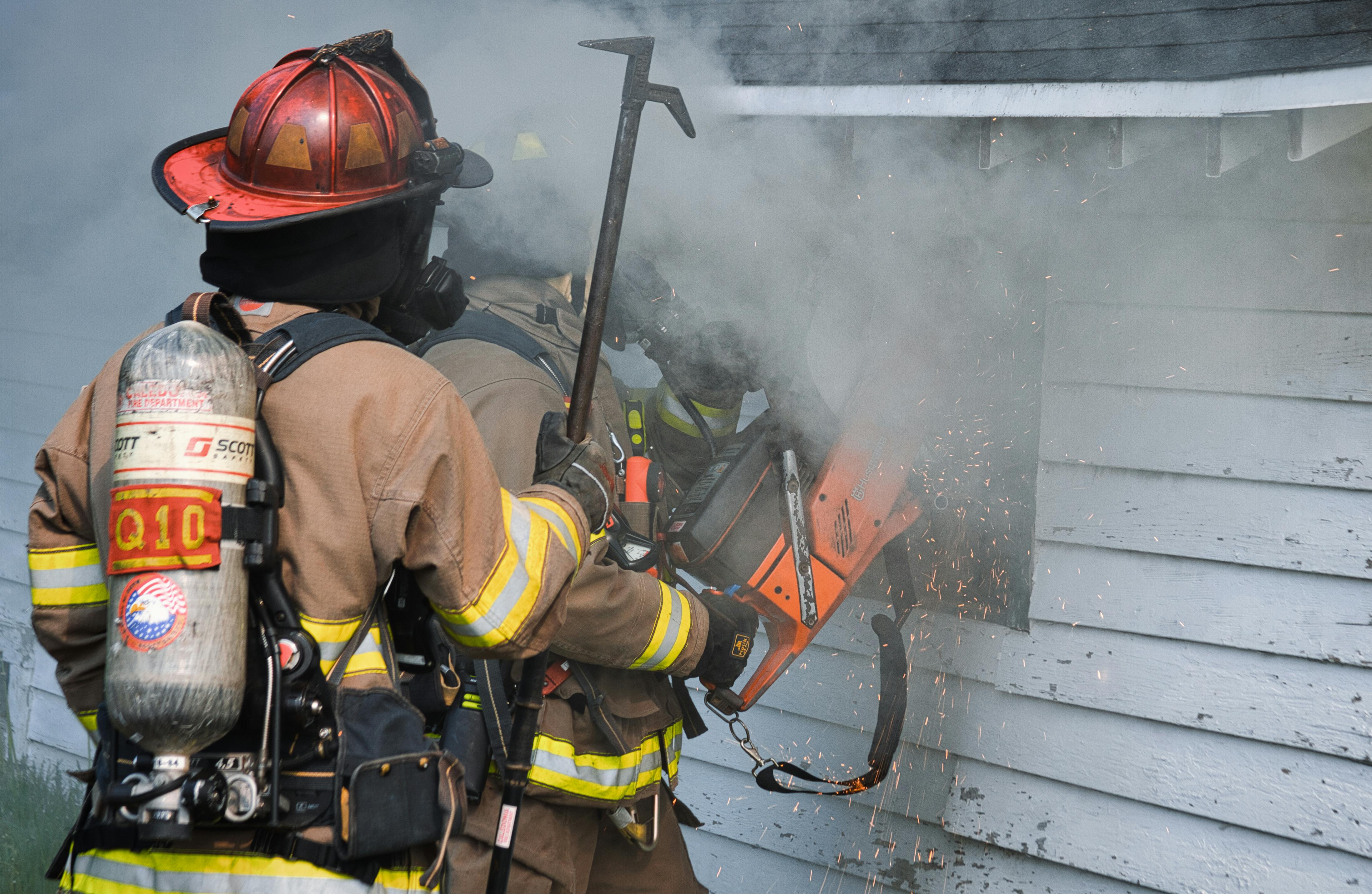
Strength Endurance for Firefighters: Fireground Training
Strength endurance for firefighters is the quality that decides whether you're still effective on the last task of a call or running on empty. Fireground work is rarely a single maximal effort, it's a chain of demanding tasks performed under load, in heat, and under time pressure. In one incident you might carry equipment up several flights of stairs, advance a charged hose line, force entry, and then drag a victim clear, with no rest in between.
Those tasks don't just demand strength, they demand the ability to apply strength repeatedly as fatigue sets in. That capacity is strength endurance, and for firefighters it's one of the most decisive physical qualities on the job. Developing that capacity reliably comes down to structured programming rather than guesswork, which is exactly what a purpose-built tactical training program is built to deliver.
What Strength Endurance Means for Firefighters
For a firefighter, strength endurance is the ability to:
Produce force repeatedly
Sustain muscular effort over time
Maintain output under fatigue
Perform physically demanding tasks for extended periods
It sits between:
Maximal strength (single heavy efforts)
Aerobic endurance (long, low-intensity efforts)
Fireground tasks usually fall in this middle zone. If you are still deciding how to train, a tactical fitness program buying guide lays out what separates a serious program from a generic workout plan.
Examples include:
Carrying tools or equipment
Advancing hose lines
Repeated ladder raises
Forcible entry
Victim drags or carries
Extended stair climbs
Research into the physiological cost of firefighting has consistently found that fireground tasks place high simultaneous demands on muscular strength and endurance, demands that climb sharply once you add full turnout gear and an SCBA (Bilzon et al., 2001). For the practical questions that come up before committing, a tactical fitness program FAQ covers the essentials.
Why Strength Endurance Matters on the Fireground
What makes the fireground so taxing isn't any single task, it's the combination. Many of them are:
Repetitive
Load-bearing
Performed in awkward positions
Done under fatigue
Performed in high-heat environments
Without adequate strength endurance, firefighters may experience:
Rapid fatigue
Slower task completion
Poor movement quality
Increased injury risk
Studies on firefighter job-task performance consistently link higher physical fitness, strength and endurance in particular, to faster, safer task completion. That combined load is also why the work capacity demands of firefighters climb so fast once heat and gear enter the picture. In practical terms, building strength endurance directly improves your operational effectiveness on scene.
The Fireground Tasks That Demand Strength Endurance
The case for strength endurance gets clearer when you break the fireground down task by task. Almost every core firefighting job is a repeated, loaded effort, not a single max lift, which is exactly why this quality matters so much. Hose advancement is the clearest example. Moving a charged line means driving force into the floor over and over while the hose fights back, often around corners and up stairs. It's a sustained, full-body effort that punishes anyone who can pull hard once but fades fast.
Ladder raises and carries combine awkward load with repeated effort. Throwing a ground ladder, then repositioning it, then climbing it with tools demands shoulders, grip, and a braced core that hold up across multiple attempts, not just the first one. Forcible entry is strength endurance under a stopwatch. Swinging an axe or driving the irons is explosive, but rarely one swing, it's repeated impacts while your heart rate is already high and your grip is fading inside gloves.
Victim drags and rescues are where everything compounds. Moving a downed adult, sometimes in zero visibility and through tight spaces, requires producing force from poor positions while already fatigued from the work that came before. There's no fresh set of muscles waiting for the rescue. Stair climbs with a high-rise pack or equipment turn legs and lungs into the limiting factor. Carrying load up several flights, then arriving with enough left to actually work, is a textbook strength-endurance demand.
Look at that list and the pattern is obvious: none of these are isolated maximal efforts. They're repeated, loaded, fatiguing tasks stacked back-to-back. Train each underlying quality, base strength, repeatable muscular output, and the aerobic engine that ties them together, and every one of these jobs gets easier to perform and easier to repeat when the call drags on.
How Strength Endurance Differs from Max Strength
Max strength is the ability to produce peak force in one all-out effort. Strength endurance is the ability to produce moderate-to-high force again and again, rep after rep, without that output collapsing. Strength endurance is the ability to produce moderate-to-high force again and again, rep after rep, without that output collapsing.
For example:
A heavy deadlift is max strength.
Repeated hose drags are strength endurance.
Fireground tasks are rarely one-and-done efforts. They often require:
Sustained output
Multiple efforts
Continuous movement under load
Train only for maximal strength and you leave a gap exactly where the fireground lives, in the repeated, sustained efforts that decide how a long incident ends.
Core Components of Fireground Strength Endurance
Strength endurance isn't one trait you train in isolation, it's built from several overlapping qualities that have to be developed together. That blend of overlapping qualities is really a picture of the concept of work capacity, the total amount of useful work you can produce and then repeat.
1) Base Strength
Strength endurance begins with strength.
Stronger muscles:
Fatigue more slowly
Handle loads more efficiently
Reduce stress on joints
Key areas to develop:
Lower-body strength
Upper-body pushing and pulling
Core stability
Grip strength
For firefighters, that translates into heavy compound work: trap-bar or conventional deadlifts, squats, overhead and bench pressing, weighted pull-ups, and loaded carries. Build the base in lower rep ranges first, because strong tissue is what lets you repeat hard efforts later without breaking down.
2) Muscular Endurance
Muscular endurance allows firefighters to:
Repeat movements over time
Sustain effort during long operations
Maintain performance across multiple tasks
This is typically trained with:
Moderate loads
Higher repetitions
Short rest intervals
In practice that means circuits built from movements that mirror the job: sled pushes and drags, sandbag cleans and carries, weighted step-ups, and high-rep kettlebell work. The goal isn't to crush yourself, it's to keep quality output high across repeated rounds, the way you would across a long incident.
3) Aerobic Support
Even though tasks are muscular in nature, the aerobic system plays a major role.
Aerobic fitness helps:
Recover between efforts
Sustain long operations
Reduce overall fatigue
Research on firefighting tasks indicates that stronger aerobic fitness both improves performance and reduces the physiological strain of working in heat and heavy gear (Sothmann et al., 2004). For most firefighters, two or three steady, conversational-pace aerobic sessions a week are enough to support this, on top of the conditioning already built into their strength-endurance circuits.
Common Training Mistakes
Only Training Max Strength
Heavy lifting alone does not prepare firefighters for:
Repeated efforts
Long operations
Sustained work under load
Only Doing Cardio
Cardio-only programs:
Do not build sufficient force production
Fail to prepare firefighters for load-bearing tasks
Increase injury risk during heavy operations
Random High-Intensity Circuits
Unstructured circuits without progression:
Limit long-term gains
Increase fatigue
Do not build true capacity
Strength endurance is built on purpose, through planned progression, not by accident in a random sweat session.
What Strength-Endurance Training Looks Like for Firefighters
Building strength endurance for firefighters isn't about bolting random "firefighter workouts" onto your week. It's about structuring three things, base strength, repeatable muscular output, and aerobic support, so they reinforce each other instead of competing for your recovery. Getting that balance right is far easier with a clear framework for strength-endurance balance to guide hoe much you weight each quality.
A simple training week might look like this:
Two strength days: heavy compound lifts in lower rep ranges to build and maintain the base.
One to two strength-endurance days: job-specific circuits at moderate load and higher reps, with short rest.
Two aerobic days: steady, low-intensity work that helps you recover between the hard sessions.
A sample strength-endurance circuit might pair a loaded carry, a sled drag, weighted step-ups, and a hose-pull or sled push, performed for several rounds with controlled rest. The point is to rehearse exactly what the fireground asks for: producing force, moving load, and recovering just enough to do it again, round after round.
Progress it the way you'd progress any quality, gradually. Add load, rounds, or density over weeks rather than all at once, and keep technique clean as fatigue climbs. Sloppy reps under fatigue are how training injuries happen, and an injured firefighter helps no one.
How Often Should Firefighters Train Strength Endurance?
For most firefighters, two dedicated strength-endurance sessions a week is enough to build the quality without cutting into strength work or recovery. If you're early in your training, start with one and add the second once you're recovering well between sessions. Firefighters working 24- or 48-hour rotations should anchor these sessions to their days off and treat on-shift physical activity as part of the total training load, not extra work to grind through. Strength endurance compounds slowly, so the aim is consistent, repeatable training over months. The firefighters who keep showing up are the ones who still have something left late in a long call.
Practical Takeaways
To build strength endurance for fireground tasks:
Develop a solid strength foundation
Include strength endurance circuits weekly
Maintain aerobic conditioning
Use integrated, job-specific sessions
Progress loads gradually over time
Fireground work is never about one maximal effort. It's about staying effective through repeated, physically demanding tasks long after fatigue sets in. That's exactly what strength endurance for firefighters delivers, the capacity to keep performing when the incident runs longer than anyone expected.
References
Bilzon, J. L. J., et al. (2001). Energy cost and physiological strain of firefighting tasks.
Knapik, J. J., et al. (2004). Soldier load carriage: physiological, biomechanical, and medical aspects.
Sothmann, M. S., et al. (2004). Advancing age and the cardiorespiratory stress of firefighting.


