Upper Body Workout Machines: 7 That Matter | Combat Fitness
Upper-Body Workout Machines: The Push & Pull Map and a Machine Day
Upper body workout machines do one of two jobs. Some push (chest press, shoulder press, pec deck, assisted dip) and some pull (lat pulldown, seated row, assisted pull-up). Machines move the weight on a fixed path, so you can take them close to failure safely and add load in small jumps. We use them for volume, not as the foundation. Every one of our military fitness programs builds upper-body strength on barbell and bodyweight presses and pulls first, then adds machine work where it earns its place.
Below: the push and pull map, what each machine trains, the honest machines-versus-free-weights take, and a done-for-you machine upper-body day. Machine names vary by gym and manufacturer, so match the movement, not the label.
What Are the Best Upper Body Workout Machines for Pushing?
The best upper body workout machines for pushing are the chest press, shoulder press, pec deck, and assisted dip. Together they cover the horizontal press, the vertical press, chest isolation, and a triceps-heavy bodyweight press, which is every pushing pattern your upper body uses.
Chest Press Machine
The chest press trains the pecs, front delts, and triceps in the same pattern as a bench press. The fixed path removes most of the balance demand, and EMG work shows less stabilizer activity on a machine press than on a barbell or dumbbell press (Saeterbakken et al., 2011). That trade lets you push the last reps without a spotter. Set the handles at mid-chest height.
Shoulder Press Machine
The machine shoulder press trains the front and side delts plus the triceps overhead. It adds overhead volume at low risk when your shoulders are already loaded from rucking or a heavy barbell day. Keep the handles slightly in front of your ears.
Pec Deck
The pec deck isolates the chest through horizontal adduction, the arm-across-the-body action the pecs exist to produce. With the triceps out of it, your chest ends the set. Use it late, for 12 to 15 reps.
Assisted Dip Machine
The assisted dip uses a counterweight to offset part of your bodyweight, so you can train the dip for triceps, lower chest, and front delts before you own clean bodyweight reps. Progress by removing counterweight.
Incline, decline, and converging chest machines get their own breakdown in our chest-machines guide.
Which Upper-Body Pull Machines Are Worth Using?
The upper-body pull machines worth using are the lat pulldown, the seated row, and the assisted pull-up. The pulldown and pull-up train the vertical pull, the row trains the horizontal pull, and together they balance every press in the session. Train the pull at least as hard as the push, because your back carries the ruck, the plate carrier, and the casualty drag.
Lat Pulldown
The lat pulldown trains the lats, teres major, rear delts, and biceps. In one EMG comparison, a wide overhand grip pulled to the front of the chest produced more lat activity than behind-the-neck or close-grip versions (Signorile et al., 2002). Drive your elbows toward your hips and do not lean back into a row. We cover grip choices and the full lat pulldown muscles worked in a dedicated guide.
Seated Row
The seated row trains the mid-back (rhomboids and middle traps), lats, and rear delts in the horizontal pull. It is the direct counter to the chest press, which is why we pair them. Pull to your lower ribs and pause one count.
Assisted Pull-Up Machine
The assisted pull-up works the same muscles as a pull-up with a counterweight under your knees or feet. It is the fastest bridge to bodyweight reps because it trains the exact pattern. The Marine Corps PFT scores pull-ups directly (U.S. Marine Corps, MCO 6100.13A), so treat this machine as a stepping stone, not a destination.
Sit facing the pad on the pec deck and it becomes a reverse pec deck for the rear delts, a useful counter to heavy pressing volume.
Where Does the Cable Column Fit in an Upper-Body Machine Day?
The cable column covers both sides of the map: flyes and presses for the push, face pulls and single-arm rows for the pull. We cover the full upper body cable workout in its own guide. Here it earns one job: filling a slot when a machine is taken.
Are Machines as Good as Free Weights for the Upper Body?
Machines build muscle about as well as free weights, but strength carries over best to the tool you trained with. A 2023 meta-analysis found similar hypertrophy from free-weight and machine training, with strength gains specific to the equipment used in testing (Haugen et al., 2023). For a tactical athlete, that specificity settles the question.
Where Machines Win
An eight-week trial comparing the two approaches found similar gains in muscle thickness between the free-weight and machine groups (Schwanbeck et al., 2020). Machines also make hard sets safer. Training close to failure is an effective hypertrophy stimulus (Refalo et al., 2023), and a machine lets you get there without a spotter or a failed rep pinning you. Most weight-training injuries seen in U.S. emergency departments involve free weights (Kerr et al., 2010). For beginners, the American College of Sports Medicine recommends both machines and free weights while technique is built, shifting toward free weights as training age grows (ACSM, 2009).
Where Free Weights Win
The job does not come on a fixed path. Lifting a litter, pulling yourself over a wall, or fighting for position on a door asks your shoulders to produce force and stabilize at the same time. That is the case for functional strength for military performance, and it is why the barbell bench press, overhead press, weighted pull-up, and push-up stay the base. The Army Fitness Test still scores the hand-release push-up, not a machine press (U.S. Army, 2025). Our bench press pillar guide covers that lift.
The honest verdict: build strength with the barbell and your bodyweight, then use machines to add volume you could not safely get from free weights alone. If you are weighing a machine-heavy plan against a barbell plan or a hybrid of both, our guide to choosing a strength & endurance program lays out the trade-offs.
A Machine-Only Upper-Body Workout You Can Run This Week
A good machine upper-body day pairs every push with a pull: chest press with seated row, shoulder press with lat pulldown, assisted dip with assisted pull-up, then a pec deck or reverse pec deck finisher. Run it twice a week for 8 to 12 reps per set, stopping one to two reps short of failure.
The Session
Chest press: 3 sets of 8 to 10, paired with seated row: 3 sets of 8 to 10.
Shoulder press: 3 sets of 8 to 12, paired with lat pulldown: 3 sets of 8 to 12.
Assisted dip: 2 sets of 6 to 10, paired with assisted pull-up: 2 sets of 6 to 10.
Pec deck or reverse pec deck: 2 sets of 12 to 15.
Optional arm finisher: one biceps curl machine and one triceps extension machine, 2 sets of 12 to 15 each.
Rest 90 seconds between each set in a pair. This is a paired-set session, not a machine circuit. Alternating a push and a pull with full rest gives every set your best effort instead of racing through stations with your loads dropping. Our arm-machines guide covers the curl and extension options in detail.
That is 10 to 11 hard sets per side each session. Run twice a week, it puts most upper-body muscles past the 10 weekly sets that research links to greater hypertrophy (Schoenfeld et al., 2017), and training a muscle twice a week outperforms once a week for growth (Schoenfeld et al., 2016). On weeks you also lift with a barbell, run this as your second upper-body day alongside a strength workout for athletes built on the big lifts.
New to machines? Run 2 sets per pair for two weeks, three reps short of failure.
How to Progress It
Use double progression, the simplest form of progressive overload (Kraemer and Ratamess, 2004):
Pick a load you can lift for the bottom of the rep range.
Add reps each session until every set hits the top of the range.
Move the pin one plate heavier and start again at the bottom.
On assisted machines, remove one plate of counterweight instead of adding load.
Log your seat settings. One notch off changes the leverage and last week’s numbers stop meaning anything.
Frequently Asked Questions
What machines work the upper body at the gym?
The machines that work the upper body are the push machines (chest press, shoulder press, pec deck, assisted dip) and the pull machines (lat pulldown, seated row, assisted pull-up). The cable column covers both. One of each pattern trains every major upper-body muscle.
Can you build the upper body with only machines?
You can build muscle in the upper body with only machines, because hypertrophy from machines matches free weights in the research. What you will not fully build is free-weight strength and the shoulder stability your job and fitness test demand. Use machine-only blocks when traveling or limited by equipment.
What are the best upper-body pull machines?
The best upper-body pull machines are the lat pulldown, the seated row, and the assisted pull-up. The pulldown and assisted pull-up build the vertical pull your pull-up depends on, and the row builds the mid-back that balances your pressing. The reverse pec deck is a strong fourth for the rear delts.
Are machines as good as free weights for the upper body?
Machines are as good as free weights for building muscle, but not for building free-weight strength. Strength gains stay specific to the equipment you trained on. For a tactical athlete, barbell and bodyweight work stays the base and machines add volume around it.
What is a good machine-only upper-body routine?
A good machine-only upper-body routine pairs pushes with pulls: chest press with seated row, shoulder press with lat pulldown, and assisted dip with assisted pull-up, then a pec deck finisher. Do 2 to 3 sets of 8 to 12 reps, rest 90 seconds, and add load once every set reaches the top of the range.
What upper-body machines are good for beginners?
The best upper-body machines for beginners are the chest press, seated row, lat pulldown, and assisted pull-up. Each has a guided path and small load jumps. The same machines work for women and men; set the seat to your own frame and progress the same way. Start with 2 sets and stop a few reps short of failure.
What upper-body machines does a big-box gym usually have?
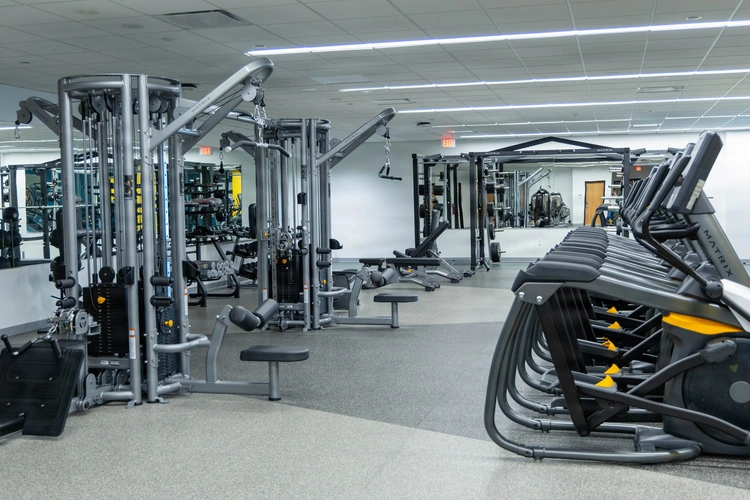
Most big-box gyms, including chains like Planet Fitness, carry a chest press, shoulder press, lat pulldown, seated row, pec deck that doubles as a reverse fly, assisted dip and pull-up station, and a cable column. Look for the movement, not the brand name.
The upper body workout machines worth your time come down to seven: four that push and three that pull, plus the cable column when one is free. Use them for safe, measurable volume close to failure. Keep the barbell press, pull-up, and push-up as your base, because those are what your test and your job grade. Start the machine day this week, pair every push with a pull, and log every set so you know when to add the next plate.
References:
American College of Sports Medicine. (2009). Progression models in resistance training for healthy adults. Medicine & Science in Sports & Exercise, 41(3), 687-708.
Haugen, M. E., Vårvik, F. T., Larsen, S., Haugen, A. S., van den Tillaar, R., & Bjørnsen, T. (2023). Effect of free-weight vs. machine-based strength training on maximal strength, hypertrophy and jump performance: a systematic review and meta-analysis. BMC Sports Science, Medicine and Rehabilitation, 15, 103.
Kerr, Z. Y., Collins, C. L., & Comstock, R. D. (2010). Epidemiology of weight training-related injuries presenting to United States emergency departments, 1990 to 2007. American Journal of Sports Medicine, 38(4), 765-771.
Kraemer, W. J., & Ratamess, N. A. (2004). Fundamentals of resistance training: progression and exercise prescription. Medicine & Science in Sports & Exercise, 36(4), 674-688.
Refalo, M. C., Helms, E. R., Trexler, E. T., Hamilton, D. L., & Fyfe, J. J. (2023). Influence of resistance training proximity-to-failure on skeletal muscle hypertrophy: a systematic review with meta-analysis. Sports Medicine, 53(3), 649-665.
Saeterbakken, A. H., van den Tillaar, R., & Fimland, M. S. (2011). A comparison of muscle activity and 1-RM strength of three chest-press exercises with different stability requirements. Journal of Sports Sciences, 29(5), 533-538.
Schoenfeld, B. J., Ogborn, D., & Krieger, J. W. (2016). Effects of resistance training frequency on measures of muscle hypertrophy: a systematic review and meta-analysis. Sports Medicine, 46(11), 1689-1697.
Schoenfeld, B. J., Ogborn, D., & Krieger, J. W. (2017). Dose-response relationship between weekly resistance training volume and increases in muscle mass: a systematic review and meta-analysis. Journal of Sports Sciences, 35(11), 1073-1082.
Schwanbeck, S. R., Cornish, S. M., Barss, T., & Chilibeck, P. D. (2020). Effects of training with free weights versus machines on muscle mass, strength, free testosterone, and free cortisol levels. Journal of Strength and Conditioning Research, 34(7), 1851-1859.
Signorile, J. F., Zink, A. J., & Szwed, S. P. (2002). A comparative electromyographical investigation of muscle utilization patterns using various hand positions during the lat pull-down. Journal of Strength and Conditioning Research, 16(4), 539-546.
Haff, G. G. (2000). Roundtable discussion: machines versus free weights. Strength and Conditioning Journal, 22(6), 18-30.
Haff, G. G., & Triplett, N. T. (Eds.). (2016). Essentials of Strength Training and Conditioning (4th ed.). National Strength and Conditioning Association. Human Kinetics.
Headquarters, Department of the Army. (2020). FM 7-22, Holistic Health and Fitness.
U.S. Army. (2025). Army Fitness Test (AFT) event standards.
U.S. Marine Corps. Marine Corps Order 6100.13A, Marine Corps Physical Fitness and Combat Fitness Tests.
Disclaimer: This article is for educational purposes and is not medical advice. Consult a qualified healthcare provider before starting a new training program, especially if you have a current injury or medical condition. Individual results vary with training history, recovery, and consistency.


