
Underdeveloped Upper Chest: Causes and Fix | Combat Fitness
Underdeveloped Upper Chest? Why It Lags and How to Fix It
An underdeveloped upper chest almost always comes from one training pattern: too much flat pressing and not enough incline work. The fix is to press and fly on a 30 to 45 degree incline, put that work early in the session, and give it a real share of your weekly chest volume. We program pressing for service members and selection candidates inside our military fitness programs, and this is one of the most common imbalances we see in athletes who built their press on the flat bench and dip bars.
It is a training-balance gap, not a genetics problem. Below: how to tell if yours lags, why it happens, and how to fix and program it.
How Can You Tell If You Have an Underdeveloped Upper Chest?
An underdeveloped upper chest looks flat or hollow just below the collarbones, with most of the chest mass sitting low and toward the breastbone. A developed upper chest shows fullness from the collarbone down into the mid-chest, so from the side the chest reads as one continuous shelf instead of a ledge at the bottom.
What an Underdeveloped Upper Chest Looks Like vs a Developed One
Take a side-view photo in even lighting and check these cues:
Profile line: underdeveloped chests drop straight down from the collarbone, then bulge near the nipple line. Developed chests slope out gradually from the collarbone.
Collarbone gap: a visible hollow between the collarbone and the top of the pec points to a lagging clavicular head.
Front delt dominance: if the front of your shoulder looks fuller than the top of your chest, your pressing is likely shoulder-heavy at the top and flat-heavy everywhere else.
The Strength Check
In one study of 30 trained adults, the average 30-degree incline max was about 78 percent of the flat bench max. If your incline sits well below that, the upper chest is likely undertrained. Treat it as a rough marker, not a standard.
Why Does the Upper Chest Lag?
The upper chest lags because most pressing is horizontal. The flat bench, push-ups, and dips bias the larger sternocostal portion of the pec, which covers the mid and lower chest. The clavicular head, which runs from the collarbone and helps raise the arm forward, gets its best stimulus when the press angles upward.
The clavicular head starts on the inner half of the collarbone; the much larger sternocostal head starts on the breastbone and upper ribs. The clavicular head also assists shoulder flexion, raising the arm forward and up. A flat bench path barely asks for that motion, so the mid-chest does most of the work.
EMG studies show clavicular activity rising as the bench tilts upward, peaking at 30 degrees in one study. Older studies found smaller differences, and activity is not growth. The best training data: in an eight-week trial, the incline-only group gained the most upper-chest thickness, while strength gains matched across groups.
Why a Balanced Chest Matters for Tactical Athletes
Your job does not happen on a flat bench. Pushing a load onto a vehicle or pressing gear overhead happens between horizontal and vertical, and a chest trained only flat leaves that range weak. Incline work rounds out your pressing and supports stronger incline and overhead positions. It fits the logic of functional strength for military performance: train the angles the job demands, not just the easiest lift to test.
The Fix: Which Exercises Build the Upper Chest?
The best upper-chest exercises put the press or fly on an upward path: the incline barbell or dumbbell press, incline dumbbell fly, low-to-high cable fly, and reverse-grip bench press. Use a 30 to 45 degree bench. Steeper angles shift more of the work to the front delts.
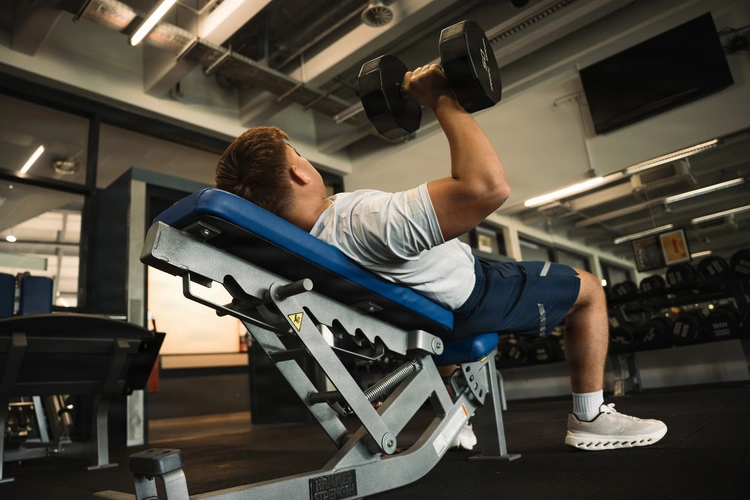
Incline Barbell or Dumbbell Press
This is the main lift; progress it hardest. The barbell loads heavier, dumbbells give a deeper stretch. Expect roughly 20 percent less weight than your flat bench at 30 degrees. We cover setup and bar path in full in our guide on how to do the incline bench press.
Incline Dumbbell Fly
The fly loads the pec in a stretched position without the triceps taking over. Keep a soft elbow bend and use it after presses, for higher reps.
Low-to-High Cable Fly
Sweep the handles from low to eye level. That arc matches the clavicular fibers, and the cable keeps tension through the whole rep. You will find this movement programmed inside a full cable chest workout.
Reverse-Grip Bench Press
An underhand grip on a flat bench raised clavicular activity in EMG testing, and later work found the same effect for supinated grips at 30 degrees. Start light and use a spotter; the grip feels unstable at first.
The Shoulder-Friendly Incline Angle
Keep the bench at 30 to 45 degrees. Inclines above 45 degrees sharply raise front delt activation and reduce pec output, turning chest day into a shoulder press. If your shoulders complain, lower the angle and tuck your elbows slightly before dropping the exercise.
How Should You Program Upper Chest Training?
Put an incline press first in one or two sessions per week and keep flat pressing in the plan. For most lifters, 6 to 10 hard upper-chest sets per week inside 10 to 20 total chest sets is a practical starting point, split across two sessions.
Meta-analyses show 10 or more weekly sets per muscle produce more growth than lower volumes, and twice-weekly training beats once-weekly. Order matters too: the first lift gets your best effort, so a lagging upper chest should lead at least one session.
If you would rather follow a done-for-you plan than build one, our guide to choosing a strength & endurance program shows what to look for. For how chest work fits inside a full week of lifting, see a strength workout for athletes.
Sample Upper Chest Routine
Run these sessions at least 48 hours apart, with each set 1 to 2 reps short of failure. Add reps first, then load.
Session A (incline focus):
Incline barbell press, 30 degrees: 4 sets of 5 to 8
Flat dumbbell press: 3 sets of 8 to 10
Low-to-high cable fly: 2 sets of 12 to 15
Session B (flat focus, upper-chest support):
Flat barbell bench press: 3 sets of 5 to 8
Incline dumbbell press, 45 degrees: 2 sets of 8 to 12
Reverse-grip bench press: 2 sets of 6 to 10
That is 16 weekly chest sets, 10 of them upper-chest biased.
Frequently Asked Questions
How can you tell if your upper chest is underdeveloped?
Check your chest from the side. An underdeveloped upper chest drops straight down from the collarbone, shows a hollow below it, and carries its mass low. A developed one slopes out gradually from the collarbone. An incline press far weaker than your flat bench is a second sign.
How do you build your upper chest?
Press and fly on a 30 to 45 degree incline, put that work first in at least one session per week, and progress it steadily. Aim for 6 to 10 hard upper-chest sets per week across two sessions, and give it 8 to 12 weeks before judging results.
What is the best exercise for the upper chest?
The incline press, barbell or dumbbell, is the best single upper-chest exercise because it loads the clavicular head heavily and is easy to progress. Pair it with a low-to-high cable fly or incline dumbbell fly for a stretch-focused second movement.
What incline angle targets the upper chest?
A 30 to 45 degree incline targets the upper chest best. EMG research found peak upper-chest activity at 30 degrees, while angles above 45 degrees hand most of the work to the front delts. Start at 30 degrees and adjust within that range for shoulder comfort.
How much incline vs flat pressing should you do?
If your upper chest lags, put roughly half or more of your weekly chest sets on an incline and lead at least one session with an incline press. Keep the flat bench: it still builds the mid-chest and overall pressing strength.
How long does it take to develop the upper chest?
Expect visible change in roughly 8 to 12 weeks of consistent incline training. Studies detect muscle growth within a few weeks, and an eight-week incline program produced measurable upper-chest thickness gains in untrained men. Trained lifters progress more slowly.
An underdeveloped upper chest is a training-balance problem with a clear fix: stop pressing only flat. Lead your week with an incline press, add an upward-angle fly, keep the bench at 30 to 45 degrees, and progress it for 8 to 12 weeks. The payoff is a fuller chest and a stronger press at every angle the job demands. Start with the two sessions above, or grab our free upper-chest routine to run the full progression.
References:
Rodríguez-Ridao D, Antequera-Vique JA, Martín-Fuentes I, Muyor JM. Effect of five bench inclinations on the electromyographic activity of the pectoralis major, anterior deltoid, and triceps brachii during the bench press exercise. Int J Environ Res Public Health. 2020;17(19):7339.
Chaves SFN, Rocha-Júnior VA, Encarnação IGA, et al. Effects of horizontal and incline bench press on neuromuscular adaptations in untrained young men. Int J Exerc Sci. 2020;13(6):859-872.
Trebs AA, Brandenburg JP, Pitney WA. An electromyography analysis of 3 muscles surrounding the shoulder joint during the performance of a chest press exercise at several angles. J Strength Cond Res. 2010;24(7):1925-1930.
Lauver JD, Cayot TE, Scheuermann BW. Influence of bench angle on upper extremity muscular activation during bench press exercise. Eur J Sport Sci. 2016;16(3):309-316.
Barnett C, Kippers V, Turner P. Effects of variations of the bench press exercise on the EMG activity of five shoulder muscles. J Strength Cond Res. 1995;9(4):222-227.
Glass SC, Armstrong T. Electromyographical activity of the pectoralis muscle during incline and decline bench presses. J Strength Cond Res. 1997;11(3):163-167.
Lehman GJ. The influence of grip width and forearm pronation/supination on upper-body myoelectric activity during the flat bench press. J Strength Cond Res. 2005;19(3):587-591.
Arseneault K, Roy X, Sercia P. The effect of 12 variations of the bench press exercise on the EMG activity of three heads of the pectoralis major. Int J Strength Cond. 2021.
Saeterbakken AH, Mo DA, Scott S, Andersen V. The effects of bench press variations in competitive athletes on muscle activity and performance. J Hum Kinet. 2017;57:61-71.
Solari F, Burns B. Anatomy, Thorax, Pectoralis Major Muscle. StatPearls. Treasure Island (FL): StatPearls Publishing; updated periodically.
Schoenfeld BJ, Ogborn D, Krieger JW. Dose-response relationship between weekly resistance training volume and increases in muscle mass: a systematic review and meta-analysis. J Sports Sci. 2017;35(11):1073-1082.
Schoenfeld BJ, Ogborn D, Krieger JW. Effects of resistance training frequency on measures of muscle hypertrophy: a systematic review and meta-analysis. Sports Med. 2016;46(11):1689-1697.
Seynnes OR, de Boer M, Narici MV. Early skeletal muscle hypertrophy and architectural changes in response to high-intensity resistance training. J Appl Physiol. 2007;102(1):368-373.
Damas F, Phillips SM, Libardi CA, et al. Resistance training-induced changes in integrated myofibrillar protein synthesis are related to hypertrophy only after attenuation of muscle damage. J Physiol. 2016;594(18):5209-5222.
Disclaimer: This article is for educational purposes and does not replace advice from a physician or physical therapist. Stop any exercise that causes sharp or lasting shoulder pain, and get cleared by a qualified provider before training through an existing injury. Individual results vary with training history, recovery, nutrition, and genetics.


