
T-Bar Row Muscles Worked and How to Do It | Combat Fitness
T-Bar Row Muscles Worked, Form Cues, and Grip Variations
The T-bar row muscles worked are the lats, middle and lower traps, rhomboids, rear delts, and spinal erectors, with the biceps, brachialis, and forearms finishing every rep. It is a heavy, braced horizontal pull that builds a thick, durable mid-back. Our military fitness programs treat that kind of back as non-negotiable for anyone who carries load for a living.
The reason is occupational. A ruck, a plate carrier, and a fighting load all drag your shoulders forward and pull your torso into flexion for hours at a time (Knapik et al., 2004). Your upper back is what holds posture against that pull. Below, we break down what the lift trains, how to set it up, how grip and machine choice shift the emphasis, how it compares to the barbell row, and how to program it.
T-Bar Row Muscles Worked: Primary and Secondary Movers
The T-bar row primarily works the latissimus dorsi, middle and lower trapezius, rhomboids, and posterior deltoids, which pull the arm back and retract the shoulder blades. The spinal erectors, glutes, and hamstrings hold the hinge isometrically. The biceps, brachialis, brachioradialis, and grip muscles flex the elbow and hold the handle.
Primary target muscles
Latissimus dorsi: extends the shoulder, driving the elbow back toward the hip. Close, neutral grips load it most.
Middle and lower trapezius: retract and depress the shoulder blades at the top of each rep.
Rhomboids: pull the shoulder blades together and hold them there under load.
Posterior deltoids: draw the upper arm back and out, especially on wider grips with the elbows flared.
Teres major and rotator cuff (infraspinatus, teres minor): assist the lats and keep the shoulder joint centered (Neumann, 2017).
Secondary and stabilizing muscles
Spinal erectors: hold the spine neutral against a load that wants to round you forward.
Glutes and hamstrings: keep the hip hinge locked in place.
Biceps, brachialis, and brachioradialis: flex the elbow through every pull.
Forearm flexors: hold the handle, and that grip carries straight into ruck straps, litter carries, and drags.
Deep trunk muscles: brace the torso so force moves from the floor to the handle.
That combination is why the T-bar row earns a permanent slot in functional strength for military performance. A strong upper back does two jobs under a pack. It keeps the shoulder blades from drifting forward under the straps, and it gives the spine a stiff, stable column to work from (Cholewicki & McGill, 1996). Back and shoulder complaints are among the most common load-carriage injuries reported in soldiers (Orr et al., 2014). The muscles this lift builds are the ones that resist that strain.
How to Do a T-Bar Row With Good Form
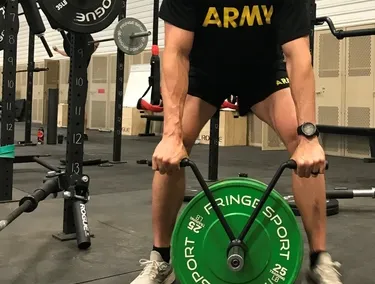
A T-bar row starts with you straddling a loaded bar and hinging until your torso sits at roughly 45 degrees. Brace a neutral spine and pull the handle to your lower ribs. Pause with the shoulder blades squeezed, then lower under control to a full reach. Every rep starts from a brace, not from momentum.
Set the bar. Anchor one end of an Olympic bar in a landmine or a corner, or use a plate-loaded T-bar station. Load the free end.
Set your feet. Straddle the bar with your feet hip- to shoulder-width apart, close enough that the plates sit under your chest when you hinge.
Take the handle. Hook a V-handle under the bar just behind the plates, or take the machine handles.
Hinge. Push your hips back with soft knees until your torso is about 45 degrees or a little lower. Keep your chest proud and your neck neutral.
Brace. Take a full breath into your belly, lock your ribs down, and stiffen your trunk before the bar moves.
Row. Drive your elbows back toward your hips and bring the handle to your lower ribs or upper abdomen. Hold the top for one second with the shoulder blades pinched together and down.
Lower. Take two to three seconds on the way down and let your arms reach fully while your spine stays still.
T-bar row form cues
“Elbows to back pockets” keeps the pull on the lats instead of the arms.
“Chest stays down” stops you from standing up to finish the rep.
“Shoulders away from ears” keeps the upper traps from taking over.
“Reach long at the bottom” earns the full stretch and the full range.
Grip and Variation Differences: Close, Wide, Machine, and Chest-Supported
Grip changes where the T-bar row load lands. A close neutral grip keeps the elbows tucked and biases the lats. A wide overhand grip flares the elbows and shifts work to the rear delts, rhomboids, and upper traps. Research on grip in pulling exercises shows these shifts are real but modest (Lehman et al., 2004; Andersen et al., 2014).
Close-grip (V-handle) T-bar row
The close grip T-bar row muscles worked lean toward the lats and the inner mid-back. A neutral grip with tucked elbows makes the movement mostly shoulder extension, which is the lat’s main job. This is the default version for most athletes, and it lets you handle the most weight.
Wide-grip T-bar row
Wide grip T-bar row muscles worked shift toward the rear delts, rhomboids, and middle traps. Flaring the elbows toward 60 to 90 degrees turns the pull into horizontal abduction. Expect to use less load. Use this version when the goal is upper-back thickness and shoulder balance.
T-bar row machine (standing and seated)
T-bar row machine muscles worked match the free version, but the fixed path and handles remove some of the stabilizing demand. The seated version and the standing platform version both load the same mid-back muscles. Machines are useful for higher-rep work late in a session, when your setup tends to drift.
Chest-supported and lying T-bar row
Chest supported T-bar row muscles worked include the full upper back with almost no erector demand. The pad holds your torso in place, so you can’t cheat with your hips. The lying T-bar row is the same idea on a flat or inclined bench. We program this version during heavy ruck blocks, when the lower back is already absorbing hours of load.
T-Bar Row vs. Barbell Row (and the Landmine Version)
The T-bar row and the barbell row train the same back muscles. The T-bar’s anchored arc, neutral grip, and bar-between-the-legs position remove the balance demand and the knee-clearance problem. Most lifters can handle more load on it at a lower technique cost. The barbell row asks for more trunk control and lets you change grip freely.
Here is how they compare on the factors that matter:
Bar path: the T-bar travels in a fixed arc around its anchor. A barbell row has to be steered in a straight line around your knees.
Grip: the T-bar usually runs neutral with a V-handle. The barbell row runs pronated or supinated at whatever width you choose.
Spinal demand: both lifts load the lower back. Fenwick and colleagues (2009) found that the bent-over barbell row placed some of the highest loads on the lumbar spine of the rowing variations they tested. The T-bar’s support and arc tend to make a consistent hinge easier to hold.
Load: the T-bar usually takes more weight for the same reps because it needs less balance.
Equipment: the barbell row needs only a bar. The T-bar needs a machine or a landmine anchor.
T-bar bent over row muscles worked are no different from those of a barbell bent-over row. The difference is how much stability you have to supply yourself. Rotate both lifts through a training year.
The landmine T-bar row (no machine needed)
Landmine T-bar row muscles worked are identical to the machine version. Wedge one end of a bar into a landmine sleeve or a padded corner, load the far end, and hook a close-grip handle under the bar behind the plates. Use 10- or 25-pound plates rather than 45s. Smaller plates sit higher off the floor, which gives you a longer range of motion before they hit your chest.
T-bar row alternatives
With no bar to anchor, use a chest-supported dumbbell row, a seal row, a single-arm dumbbell row, or a seated cable row. Unilateral rows add an anti-rotation demand on the trunk (Saeterbakken et al., 2015), which carries over well to asymmetric loads like a weapon or a single-strap bag.
Common T-Bar Row Mistakes and How to Program It
Most T-bar row problems come from ego loading. Too much weight leads to hip drive, a shorter range, and a rounding spine. Each of these moves the work off the back and onto the joints you are trying to protect.
T-bar row mistakes to fix
Jerking the weight. If your hips snap up to start each rep, the load is too heavy. Reset your brace and lighten the bar until the torso stays still.
Rounding the lower back. Flexion under load is the pattern you are training against. Shorten the hinge or switch to the chest-supported version.
Cutting the range. Half reps leave the stretch and the squeeze on the table. Use smaller plates and reach fully at the bottom.
Standing up to finish. Raising your chest at the top turns the row into a shrug. Hold your torso angle for the whole set.
Shrugging to the ears. Upper-trap dominance crowds the shoulder. Pull the shoulder blades down as well as back.
T-bar row sets, reps, and placement
For strength, use 3 to 5 sets of 5 to 8 reps. For muscle and work capacity, use 3 to 4 sets of 8 to 12. Stop most sets with one to three reps left in reserve (Helms et al., 2016). Both heavy and moderate loads build muscle when the effort is high (Schoenfeld et al., 2017b). Aim for roughly 10 or more hard sets per week for the back across all your pulling (Schoenfeld et al., 2017a).
Place the T-bar row as the main horizontal pull on an upper day, or right after your hinge on a full-body day. Pair it with a vertical pull such as pull-ups so the lats get trained from both angles. If you want to see how a row fits into a complete session, a strength workout for athletes lays out the structure. If you are still deciding how to balance lifting against running and rucking, start with choosing a strength & endurance program before you commit to a plan.
FAQ: Frequently Asked Questions
What muscles does the T-bar row work?
The T-bar row works the lats, middle and lower traps, rhomboids, and rear delts as primary movers. The teres major and rotator cuff assist. The spinal erectors, glutes, and hamstrings hold the hinge, while the biceps, brachialis, brachioradialis, and forearm flexors handle elbow flexion and grip. The result is a full mid-back and posterior-chain stimulus from one lift.
How do you do a T-bar row with good form?
Straddle the bar, hinge to about 45 degrees, and brace a neutral spine. Pull the handle to your lower ribs by driving your elbows toward your hips. Pause for one second at the top, then lower over two to three seconds to a full reach. Your torso angle should not change during the set.
Does grip change the muscles worked on a T-bar row?
Yes, but less than most people assume. A close neutral grip with tucked elbows biases the lats. A wide overhand grip with flared elbows shifts emphasis toward the rear delts, rhomboids, and middle traps. Every grip still trains the whole upper back, so choose based on your goal and rotate grips across training blocks.
What is the difference between a T-bar row and a barbell row?
Both train the same muscles. The T-bar row follows a fixed arc around an anchor point and usually uses a neutral grip, so it needs less balance and often takes more load. The barbell row is free-moving, needs to clear the knees, and demands more trunk control. Rotating both builds a more complete pulling base.
Can you do a T-bar row with a landmine?
Yes. Anchor one end of an Olympic bar in a landmine or a padded corner, load the opposite end, and hook a V-handle under the bar behind the plates. Smaller-diameter plates give you a longer range of motion. The muscles worked are the same as on a dedicated T-bar machine.
How do you program the T-bar row?
Use 3 to 5 sets of 5 to 8 reps for strength or 3 to 4 sets of 8 to 12 for muscle, with one to three reps in reserve. Make it the main horizontal pull on an upper day and pair it with a vertical pull. During heavy rucking blocks, swap in the chest-supported version to spare your lower back.
The T-bar row muscles worked, from the lats and mid-traps down through the erectors and grip, are the same ones that keep you upright under a pack late in a long movement. Learn the brace, earn the full range, and rotate grips and variations with purpose. Once the movement is solid, place it inside a program that balances it against your running, rucking, and lower-body work. Build that back now, before the load test finds the weak link for you.
References:
Andersen V, Fimland MS, Wiik E, Skoglund A, Saeterbakken AH. Effects of grip width on muscle strength and activation in the lat pull-down. Journal of Strength and Conditioning Research. 2014;28(4):1135-1142.
American College of Sports Medicine. Progression models in resistance training for healthy adults. Medicine & Science in Sports & Exercise. 2009;41(3):687-708.
Cholewicki J, McGill SM. Mechanical stability of the in vivo lumbar spine: implications for injury and chronic low back pain. Clinical Biomechanics. 1996;11(1):1-15.
Fenwick CMJ, Brown SHM, McGill SM. Comparison of different rowing exercises: trunk muscle activation and lumbar spine motion, load, and stiffness. Journal of Strength and Conditioning Research. 2009;23(5):1408-1417.
Haff GG, Triplett NT, editors. Essentials of Strength Training and Conditioning. 4th ed. National Strength and Conditioning Association. Human Kinetics; 2016.
Headquarters, Department of the Army. FM 7-22: Holistic Health and Fitness. October 2020.
Helms ER, Cronin J, Storey A, Zourdos MC. Application of the repetitions in reserve-based rating of perceived exertion scale for resistance training. Strength and Conditioning Journal. 2016;38(4):42-49.
Knapik JJ, Reynolds KL, Harman E. Soldier load carriage: historical, physiological, biomechanical, and medical aspects. Military Medicine. 2004;169(1):45-56.
Kraemer WJ, Ratamess NA. Fundamentals of resistance training: progression and exercise prescription. Medicine & Science in Sports & Exercise. 2004;36(4):674-688.
Lehman GJ, Buchan DD, Lundy A, Myers N, Nalborczyk A. Variations in muscle activation levels during traditional latissimus dorsi weight training exercises: an experimental study. Dynamic Medicine. 2004;3:4.
McGill SM. Low Back Disorders: Evidence-Based Prevention and Rehabilitation. 3rd ed. Human Kinetics; 2016.
Neumann DA. Kinesiology of the Musculoskeletal System: Foundations for Rehabilitation. 3rd ed. Elsevier; 2017.
Orr RM, Pope R, Johnston V, Coyle J. Soldier occupational load carriage: a narrative review of associated injuries. International Journal of Injury Control and Safety Promotion. 2014;21(4):388-396.
Saeterbakken AH, Andersen V, Brudeseth A, Lund H, Fimland MS. The effect of performing bi- and unilateral row exercises on core muscle activation. International Journal of Sports Medicine. 2015;36(11):900-905.
Schoenfeld BJ. The mechanisms of muscle hypertrophy and their application to resistance training. Journal of Strength and Conditioning Research. 2010;24(10):2857-2872.
Schoenfeld BJ, Ogborn D, Krieger JW. Dose-response relationship between weekly resistance training volume and increases in muscle mass: a systematic review and meta-analysis. Journal of Sports Sciences. 2017a;35(11):1073-1082.
Schoenfeld BJ, Grgic J, Ogborn D, Krieger JW. Strength and hypertrophy adaptations between low- vs. high-load resistance training: a systematic review and meta-analysis. Journal of Strength and Conditioning Research. 2017b;31(12):3508-3523.
Disclaimer: This article is for educational purposes only and is not medical advice. Consult a qualified healthcare provider before starting a new training program, especially if you have a history of back, shoulder, or other injuries. Stop any exercise that causes pain and seek professional guidance. Individual results vary.


