
Standing Arnold Shoulder Press: Form Guide | Combat Fitness
The Standing Arnold Press: How to Do It, Muscles Worked, and Why Stand
The standing Arnold shoulder press is a dumbbell overhead press that starts with your palms facing you at chin height and rotates to palms forward as you press, finishing with your arms locked out overhead. The rotation takes your delts through a longer path than a straight press, and doing it on your feet forces your trunk to brace against the load. If you want overhead work like this built into a complete plan, our tactical fitness programs program it for you.
We coach it to service members who lift gear overhead on their feet, not from a bench. Below: technique, muscles, standing versus seated, programming, and a free overhead-press plan.
How to Do the Standing Arnold Shoulder Press
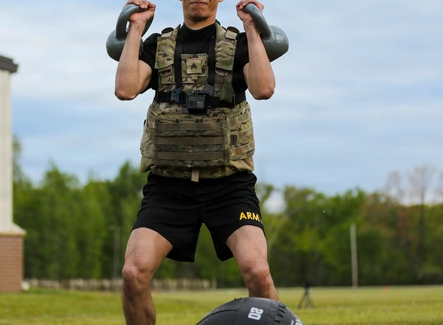
To do the standing Arnold shoulder press, hold two dumbbells at chin height with palms facing you, brace, then press up while rotating your palms to face forward at lockout. Reverse the rotation on the way down.
Set your stance. Feet hip width, knees soft, glutes squeezed so your lower back does not arch as the bells climb.
Take the start position. Dumbbells at chin height, palms facing you, elbows tucked in front of your ribs.
Brace. Breathe into your belly, tighten your abs as if bracing for a punch, and pull your ribs down.
Press and rotate. Drive up while opening your elbows to the sides and turning your palms forward. Finish the rotation by forehead height.
Lock out. Biceps beside your ears, bells stacked over your shoulders.
Lower with control. Take 2 to 3 seconds and reverse the rotation back to palms-in.
The Rotation Cue: Open the Doors
Picture your forearms as two closed doors in front of your face. As you press, swing the doors open until your palms face forward. The rotation happens at the shoulder, with your upper arms moving from in front of you out to your sides. If your elbows stay pinned forward and only your wrists turn, you lose the range that makes the lift worth doing.
Three faults to watch: leaning back with flared ribs (now it is an incline press loading your lower back), dipping the knees (now it is a push press), and spinning the bells at the bottom instead of rotating smoothly.
What Muscles Does the Arnold Press Work?
The Arnold press works the front and side deltoids as prime movers, with the triceps finishing lockout and the trapezius and serratus anterior rotating your shoulder blades. Standing, your abs and obliques keep your ribs and pelvis stacked.
Anterior deltoid: drives the press, especially at the bottom where your arms start in front of you.
Lateral deltoid: takes over as your elbows open to the sides.
Triceps: finish the lockout.
Upper trapezius and serratus anterior: rotate the shoulder blade so your arm reaches overhead cleanly (Ludewig and Reynolds, 2009).
Rectus abdominis and obliques: stop your torso arching back when you stand.
Raizada and Bagchi (2017) tested ten trained men and found the Arnold press produced higher front and side deltoid activity than a standard dumbbell press, which fits work showing a longer range of motion raises deltoid activity (Paoli and colleagues, 2010). Ten lifters and an EMG reading do not prove more growth, so treat it as a strong variation, not a replacement.
One correction to a common claim: the Arnold press is not a rear-delt exercise. The lift is driven by the front and side heads, so keep your face pulls and reverse flies.
Not sure how much shoulder work your week needs? Our guide to choosing a strength & endurance program covers what a balanced plan includes.
Standing vs. Seated Arnold Press: Which Should You Use?
Use the standing Arnold press for overhead strength that transfers to your feet and more trunk work. Use the seated version to isolate the shoulders and handle more load. Standing costs you some weight. Seated costs you the bracing.
Saeterbakken and Fimland (2013) found standing shoulder presses produced lower one-rep maxes than seated, yet the standing dumbbell press drew the highest deltoid activity of the four versions tested. Their companion study found rectus abdominis activity about 81 percent lower in the seated dumbbell press than standing, with similar erector spinae activity (Saeterbakken and Fimland, 2012). Standing makes the press an anti-extension drill for your abs.
Choose standing for job carryover, built-in trunk work, and exposing a weak side. Choose seated for maximum shoulder isolation, for training around a low-back flare-up, or when you catch yourself using leg drive, since an upright bench takes the legs out of the lift.
This is where the tactical case lives. Loading a ruck into a truck bed or pushing through a hatch happens on your feet, with your trunk holding a stiff column under load. Ground-based free-weight lifts are one of the most practical ways to train the trunk alongside the limbs (Behm and colleagues, 2010), which is the core of functional strength for military performance.
Benefits and How to Program the Standing Arnold Press
Program the standing Arnold press as a moderate-load accessory: 3 to 4 sets of 8 to 12 reps, one or two times a week, after your main overhead lift. Drop one or two dumbbell sizes from your straight press. The rotation is the point, not the weight.
The benefits: more range and time under tension per rep, a palms-in start many lifters find comfortable, trunk work a seated press does not give you, and side-to-side honesty because each arm moves its own dumbbell. The 8 to 12 range fits the ACSM (2009) loading guidance for muscle growth, and it adds to the weekly set volume linked to greater hypertrophy (Schoenfeld and colleagues, 2017).
A Shoulder-Friendly Note
Some lifters feel a pinch mid-rotation as the upper arm sweeps out to the side. If you do, shorten the turn: start palms facing each other and keep your elbows slightly forward of your torso. Poorly positioned overhead pressing is a common source of shoulder complaints in lifters (Kolber and colleagues, 2010; Durall and colleagues, 2001). Pain is a stop sign.
Arnold Press vs. the Barbell Shoulder Press
The barbell shoulder press is the parent lift: heavier, simpler to track, and your main overhead movement. The standing Arnold press is the accessory that adds range, trunk demand, and independent arms. It slots into a strength workout for athletes as the second press of the day.
Free Standing Overhead-Press Plan
Run this twice a week for six weeks, 72 hours apart.
Day A:
Standing barbell or dumbbell shoulder press: 4 sets of 5.
Standing Arnold press: 3 sets of 10, 3-second lowering.
Half-kneeling single-arm press: 3 sets of 8 per side.
Face pull: 3 sets of 15.
Day B:
Standing Arnold press: 4 sets of 8.
Dumbbell lateral raise: 3 sets of 12 to 15.
Single-arm overhead carry: 3 trips of 30 yards per side.
Dead bug: 3 sets of 8 per side.
When every Arnold press set hits 12 clean reps, go up one dumbbell size and drop back to 8.
Frequently Asked Questions
What is a standing Arnold press?
The standing Arnold press is a dumbbell shoulder press done on your feet, starting palms-in at chin height and rotating to palms forward at lockout. Standing adds a trunk-bracing demand to the longer range.
How do you do the standing Arnold press?
Hold dumbbells at chin height, palms facing you, and brace your abs and glutes. Press up while opening your elbows and turning your palms forward, finishing the turn by forehead height. Reverse it on the way down.
What muscles does the Arnold press work?
The Arnold press works the anterior and lateral deltoids, with the triceps finishing lockout and the trapezius and serratus anterior rotating your shoulder blades. Standing, your abdominals and obliques keep your torso from arching.
Standing vs. seated Arnold press: which is better?
Neither wins across the board. The standing Arnold press builds overhead strength on your feet and adds ab work, but invites leg drive. The seated version isolates the shoulders and allows more load. Use standing for carryover, seated for isolation.
Is the Arnold press better than a regular shoulder press?
The Arnold press is different, not better. A small EMG study found higher front and side delt activity than a standard dumbbell press, likely from the longer range. The regular press loads heavier, so keep it as your main lift and use the Arnold press as an accessory.
How heavy should you go on the Arnold press?
Go one or two dumbbell sizes lighter than your straight dumbbell press. Pick a weight you can rotate smoothly for 8 to 12 reps with no back lean or knee dip. A rushed turn means it is too heavy.
Is the Arnold press bad for your shoulders?
The Arnold press is safe for most healthy shoulders at moderate loads with a smooth rotation. If you feel a pinch mid-turn, start palms-neutral, keep your elbows slightly forward, or switch to a neutral-grip press. Get persistent shoulder pain checked by a clinician.
The standing Arnold shoulder press gives you more shoulder range per rep and a trunk-bracing drill in the same set, which earns it a spot behind your main overhead lift. Start palms-in, open the doors, keep your ribs down, and pick a weight you can rotate cleanly. Run the plan for six weeks, then retest your strict press.
References:
Raizada S, Bagchi A. Comparison among the EMG activity of the anterior deltoid and medial deltoid during two variations of dumbbell shoulder press exercise. Indian Journal of Public Health Research & Development. 2017;8(4):653-656.
Saeterbakken AH, Fimland MS. Effects of body position and loading modality on muscle activity and strength in shoulder presses. Journal of Strength and Conditioning Research. 2013;27(7):1824-1831.
Saeterbakken AH, Fimland MS. Muscle activity of the core during bilateral, unilateral, seated and standing resistance exercise. European Journal of Applied Physiology. 2012;112(5):1671-1678.
Paoli A, Marcolin G, Petrone N. Influence of different ranges of motion on selective recruitment of shoulder muscles in the sitting military press: an electromyographic study. Journal of Strength and Conditioning Research. 2010;24(6):1578-1583.
Kohler JM, Flanagan SP, Whiting WC. Muscle activation patterns while lifting stable and unstable loads on stable and unstable surfaces. Journal of Strength and Conditioning Research. 2010;24(2):313-321.
Behm DG, Drinkwater EJ, Willardson JM, Cowley PM. The use of instability to train the core musculature. Applied Physiology, Nutrition, and Metabolism. 2010;35(1):91-108.
Coratella G, Tornatore G, Longo S, et al. Front vs back and barbell vs machine overhead press: an electromyographic analysis and implications for resistance training. Frontiers in Physiology. 2022;13:825880.
Sweeney S. Electromyographic analysis of the deltoid muscle during various shoulder exercises. Master’s thesis, University of Wisconsin-La Crosse; 2014.
Ludewig PM, Reynolds JF. The association of scapular kinematics and glenohumeral joint pathologies. Journal of Orthopaedic & Sports Physical Therapy. 2009;39(2):90-104.
Kolber MJ, Beekhuizen KS, Cheng MS, Hellman MA. Shoulder injuries attributed to resistance training: a brief review. Journal of Strength and Conditioning Research. 2010;24(6):1696-1704.
Durall CJ, Manske RC, Davies GJ. Avoiding shoulder injury from resistance training. Strength and Conditioning Journal. 2001;23(5):10-18.
American College of Sports Medicine. Position stand: progression models in resistance training for healthy adults. Medicine & Science in Sports & Exercise. 2009;41(3):687-708.
Schoenfeld BJ, Ogborn D, Krieger JW. Dose-response relationship between weekly resistance training volume and increases in muscle mass: a systematic review and meta-analysis. Journal of Sports Sciences. 2017;35(11):1073-1082.
Haff GG, Triplett NT, eds. Essentials of Strength Training and Conditioning. 4th ed. National Strength and Conditioning Association. Champaign, IL: Human Kinetics; 2016.
Headquarters, Department of the Army. FM 7-22: Holistic Health and Fitness. Washington, DC; 2020.
Disclaimer: This article is for educational purposes and is not medical advice. If you have current shoulder pain, a rotator cuff injury, or a history of impingement or dislocation, get cleared by a qualified clinician before loading overhead pressing. Results vary by individual, and no exercise program guarantees injury prevention.


