Rope Hammer Curls: Form, Muscles Worked | Combat Fitness
Rope Hammer Curls: How to Do Them, Muscles Worked & Form
Rope hammer curls are a cable curl done with a rope attachment and a neutral, palms-facing grip, and they train the brachialis, brachioradialis, and grip more directly than a standard biceps curl. That gives them a clear job inside tactical fitness programs: building forearms and hands that keep holding kettlebells, litter handles, ropes, and gear after the rest of you is tired.
We program this lift as accessory work, not a centerpiece. Below you’ll get what the movement is, which muscles it hits, how it compares with the dumbbell version, a step-by-step form breakdown, and rep schemes built for forearm and grip durability.
What Are Rope Hammer Curls?
Rope hammer curls, also called cable rope hammer curls or hammer curls with rope, are elbow flexion performed at a low cable pulley using a rope attachment. Your palms face each other for the entire rep, which shifts work toward the brachialis and brachioradialis and away from the biceps’ role as a forearm supinator.
That neutral grip is the whole point. The biceps flexes the elbow and also rotates the palm up, so a standard underhand curl lets it dominate. Lock the palms in a neutral position and the muscles that flex the elbow without rotating it take a bigger share of the load.
This is a variation of the hammer curl, so we won’t re-teach the base movement here. Our guide to the hammer curl covers the fundamentals and the dumbbell version. Programs and gym boards also list this lift as hammer rope curls, rope cable hammer curls, or cable hammer curls rope. It is the same exercise under every name.
What Muscles Do Rope Hammer Curls Work?
Rope hammer curls work the brachialis and brachioradialis as the primary movers, with the biceps brachii assisting. The forearm and finger flexors work isometrically to hold the rope, so the lift trains grip on every rep. The neutral hand position is what drives that emphasis.
Here is how the load breaks down:
Brachialis. It sits under the biceps and attaches to the ulna, so it flexes the elbow in every forearm position. A stronger brachialis adds elbow flexion strength and upper-arm thickness.
Brachioradialis. This forearm muscle is a strong elbow flexor when the hand is neutral. EMG research shows its contribution rises as the forearm turns from palm-up toward neutral, while biceps contribution falls.
Biceps brachii. It still assists, but with supination removed, it does less of the work than in a standard curl.
Forearm and grip flexors. These hold the rope under continuous cable tension for the full set, which builds grip endurance.
That last point is why the lift earns space in a tactical program. Grip strength tracks closely with overall strength and with performance across many sports, and it is often the first thing to fail during carries. The kettlebell carry inside the Army Fitness Test’s sprint-drag-carry, ruck straps, rope climbs, and casualty drags all ask your hands to keep working under fatigue. Rope hammer curls won’t replace heavy carries, but they give your forearms dedicated volume without loading your spine.
Rope vs. Dumbbell Hammer Curls: Which Is Better?
Rope hammer curls and dumbbell hammer curls each win on different points. The cable keeps tension on the muscle through the full range because it pulls along a fixed line, while a dumbbell loads hardest only near the middle of the rep. Choose the rope for constant tension and control, and dumbbells for heavier loading.
Most people asking about rope curls vs hammer curls mean this exact comparison. Here is how the two stack up:
Tension profile. With a dumbbell, gravity pulls straight down, so resistance peaks when your forearm is parallel to the floor and drops near the top and bottom. The cable keeps the muscle loaded at both ends.
Load. Dumbbells usually allow heavier absolute loads and smaller, more precise jumps at home. Cable stacks vary by machine.
Grip demand. The rope lets your hands separate slightly at the top for a harder squeeze, and holding it under constant tension challenges the grip throughout.
Equipment. Dumbbells travel and work in a garage gym. The rope needs a cable station.
Unilateral work. Both allow single-arm sets, but dumbbells let you train both arms independently at the same time.
Are rope hammer curls better than dumbbell? For a forearm and grip goal with strict form, the rope has the edge. For progressive loading with minimal equipment, the dumbbell wins. Rotating both across a training block covers the gaps.
Where either variation fits matters more than which one you pick. If you’re still deciding how accessory work slots into your overall plan, our guide to choosing a strength & endurance program walks through what to look for.
How to Do Rope Hammer Curls With Proper Form
Standing cable rope hammer curls are the default setup. Follow these steps:
Set the pulley to its lowest position and attach a rope.
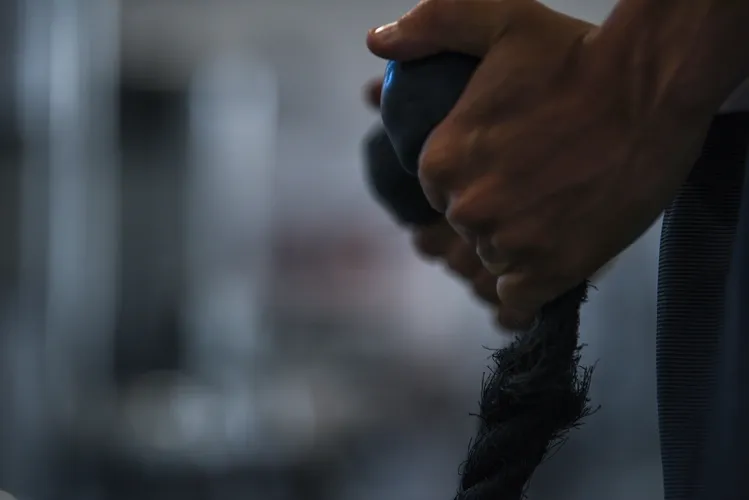
Grab the rope with palms facing each other, hands just above the knobs.
Stand tall one to two feet from the stack, knees soft, ribs down.
Pin your elbows to your sides and keep them there for the whole set.
Curl until your forearms are near vertical, pulling the rope ends slightly apart at the top, and squeeze for one second.
Lower under control over two to three seconds to full elbow extension, without letting the stack touch down.
The controlled lowering keeps the muscle loaded through the part of the rep most people waste. Strength-training guidelines favor controlled tempos for accessory and hypertrophy work for that reason.
Common Rope Hammer Curl Mistakes
Elbows drifting forward. This turns the curl into a front raise and moves load to the shoulders.
Swinging the hips. Momentum takes work off the target muscles. If you need to swing, the weight is too heavy.
Cutting the bottom short. Stopping before full extension removes the stretched position.
Cocking the wrists. Keep wrists neutral so the forearm muscles, not the wrist joint, control the rope.
Crashing the stack. A stack that slams between reps means you lost tension and control.
Programming Rope Hammer Curls: Reps, Sets, and Variations
Rope hammer curls are effective as accessory work for forearm, brachialis, and grip development. Program 2 to 4 sets of 10 to 15 reps, one to three times per week, after your main pulling work. Take sets close to failure while form stays clean.
That rep range is deliberate. Research shows muscle growth occurs across a wide range of loads when sets are taken near failure, and higher reps also build local muscular endurance, which is what a grip needs late in a carry. Dose-response data supports roughly 10 or more hard weekly sets per muscle group for growth, so count rope hammer curls toward your arm and forearm totals.
Place them at the end of a pull day, behind rows, pull-ups, and deadlifts. Training grip to failure before a heavy hinge only weakens the lift that matters more. They work well as the closing accessory in a strength workout for athletes, where compound lifts lead and isolation fills gaps.
Useful variations:
Single-arm cable rope hammer curls. Hold one end of the rope in one hand to expose and correct side-to-side imbalances.
Standing rope hammer curls. The default version, with the most stable stance for strict reps.
Isometric holds. Pause at 90 degrees of elbow flexion for 20 to 30 seconds to build grip endurance without extra reps.
Frequently Asked Questions
What muscles do rope hammer curls work?
Rope hammer curls work the brachialis and brachioradialis as the primary movers, with the biceps assisting. The forearm and finger flexors hold the rope under constant tension, so grip trains on every rep. The neutral grip reduces the biceps’ supinating role, which shifts more of the work to the brachialis and forearm.
Are rope hammer curls better than dumbbell hammer curls?
Rope hammer curls are better for constant tension and strict, controlled reps, because the cable loads the muscle at the top and bottom of the movement. Dumbbell hammer curls are better for heavy loading and training without a cable station. Most athletes benefit from rotating both across training blocks.
How do you do rope hammer curls with proper form?
Set a low pulley with a rope, hold it with palms facing each other, and pin your elbows to your sides. Curl until your forearms are near vertical, pull the rope ends apart slightly, and squeeze. Lower over two to three seconds to full extension without letting the stack touch down.
Are rope hammer curls effective for the forearms?
Rope hammer curls are effective for the forearms because the neutral grip increases brachioradialis involvement and the rope demands continuous grip under cable tension. They build forearm size and grip endurance with low spinal load, which makes them a good complement to heavy carries rather than a replacement for them.
Can you do rope hammer curls single-arm?
Single-arm rope hammer curls work well. Hold one end of the rope, or both ends in one hand, and curl with the same elbow-pinned form. Single-arm sets expose strength differences between sides and let you add extra volume to the weaker arm. Brace your free hand on the machine for stability.
How many reps of rope hammer curls should you do?
Most athletes should do 2 to 4 sets of 10 to 15 reps of rope hammer curls, one to three times per week. Higher reps suit the grip and forearm endurance goal. Take each set close to failure with clean form, and program them after your main pulling lifts.
Rope hammer curls earn their place by building the brachialis, forearms, and grip that fail first during carries, climbs, and drags. Train them with strict form, controlled lowering, and moderate-to-high reps at the end of your pull days, and your hands will hold out longer when the work gets long. Get them programmed into a full plan built around your test, selection, or job, and train with a structure that tells you exactly when they fit.
References:
Kleiber T, Kunz L, Disselhorst-Klug C. Muscular coordination of biceps brachii and brachioradialis in elbow flexion with respect to hand position. Frontiers in Physiology. 2015;6:215.
Boland MR, Spigelman T, Uhl TL. The function of brachioradialis. Journal of Hand Surgery (American Volume). 2008;33(10):1853-1859.
StatPearls. Anatomy, Shoulder and Upper Limb, Brachialis Muscle. Treasure Island (FL): StatPearls Publishing.
Cronin J, Lawton T, Harris N, Kilding A, McMaster DT. A brief review of handgrip strength and sport performance. Journal of Strength and Conditioning Research. 2017;31(11):3187-3217.
Bohannon RW. Muscle strength: clinical and prognostic value of hand-grip dynamometry. Current Opinion in Clinical Nutrition and Metabolic Care. 2015;18(5):465-470.
Knapik JJ, Reynolds KL, Harman E. Soldier load carriage: historical, physiological, biomechanical, and medical aspects. Military Medicine. 2004;169(1):45-56.
U.S. Army. Army Fitness Test (AFT) events and scoring standards.
Headquarters, Department of the Army. FM 7-22, Holistic Health and Fitness. October 2020.
Schoenfeld BJ, Grgic J, Van Every DW, Plotkin DL. Loading recommendations for muscle strength, hypertrophy, and local endurance: a re-examination of the repetition continuum. Sports. 2021;9(2):32.
Schoenfeld BJ, Ogborn D, Krieger JW. Dose-response relationship between weekly resistance training volume and increases in muscle mass: a systematic review and meta-analysis. Journal of Sports Sciences. 2017;35(11):1073-1082.
American College of Sports Medicine. Progression models in resistance training for healthy adults. Medicine and Science in Sports and Exercise. 2009;41(3):687-708.
Disclaimer: This article is for educational purposes only and is not medical advice. Consult a qualified healthcare provider before starting a new training program, especially if you have an elbow, wrist, or shoulder injury. Individual results vary with training history, recovery, and consistency.


