
Rear Delt Fly: Form, Muscles & 4 Variations | Combat Fitness
Rear Delt Fly: How to Do It, Muscles Worked & Every Variation
The rear delt fly is a horizontal abduction exercise that trains the back of your shoulder: the posterior deltoid, plus the rhomboids and middle traps that hold your shoulder blades in place. It is one of the cheapest insurance policies in strength training, and it belongs in any serious set of tactical fitness programs.
Most tactical athletes press far more than they pull horizontally, and then spend hours under ruck straps that drag the shoulders forward. The rear delts are the muscles that push back. This guide covers what the movement is, which muscles it works, how to do it with clean form, and how the cable, dumbbell, machine, and banded variations compare. You will also see how it differs from the face pull and how to program it so it builds durability instead of just burning.
Key Takeaways:
The rear delt fly isolates the posterior deltoid, with the rhomboids, middle traps, and infraspinatus assisting.
Its job for a tactical athlete is durability: it balances heavy pressing and counters the rounded posture that load carriage encourages.
Form beats load. Keep a soft, fixed elbow, sweep wide, and stop before your traps take over.
Cable, dumbbell, machine, and banded versions all work. Choose by the tension profile and setup you can repeat consistently.
Program it light and high-rep: 2 to 4 sets of 12 to 20, two or three times per week, near the end of a session.
What Is a Rear Delt Fly?
A rear delt fly is an isolation exercise where you move your arms out and back in a wide arc, with elbows slightly bent and locked at a fixed angle, to train the rear shoulder. You will also see it called a reverse fly, back delt fly, or rear delt flye. Rear delt flys, flies, and flyes all describe the same movement; the spelling changes, the exercise does not.
The defining feature is the path. Your arm travels in the horizontal plane, from in front of your chest to roughly in line with your torso. That motion is called horizontal abduction, and the posterior deltoid is its prime mover (Neumann, 2017). Because the elbow angle never changes, the biceps and lats contribute little. That is what separates a fly from a row.
What Muscles Does the Rear Delt Fly Work?
The rear delt fly primarily works the posterior deltoid. The rhomboids and middle trapezius assist by pulling the shoulder blades together, and the infraspinatus and teres minor contribute as secondary horizontal abductors and external rotators. Together, these form the back-of-shoulder unit most programs underserve.
Posterior deltoid: the prime mover (horizontal abduction). It balances the front delt and stabilizes the humeral head.
Rhomboids: retract the shoulder blades and hold scapular position under load.
Middle trapezius: retracts and stabilizes the scapula, supporting upright posture under a ruck.
Infraspinatus and teres minor: assist abduction and external rotation, supporting rotator cuff health and joint centering.
Lower trapezius: stabilizes the scapula and controls the shoulder blade during overhead work.
Electromyography research on scapular exercises consistently shows that prone and bent-over horizontal abduction drives high middle trap and lower trap activity relative to the upper traps (Ekstrom et al., 2003; Cools et al., 2007). That ratio matters. A good rear delts exercise strengthens the stabilizers without feeding the upper traps, which most lifters already overuse.
Why Do Rear Delts Matter for Tactical Athletes?
Rear delts matter because they protect the shoulder you depend on for work, not because they look good in a T-shirt. Bench press, push-ups, overhead press, and carrying a weapon at the ready all train the front of the shoulder. Without equal pulling work at the back, the joint drifts forward and the stabilizers lose ground.
Load carriage compounds the problem. Ruck straps sit on the front of the shoulders and pull them down and forward for hours, and long-duration carriage is associated with shoulder and upper-extremity complaints, including rucksack palsy in severe cases (Knapik, Reynolds, & Harman, 2004). Musculoskeletal injuries remain one of the largest causes of lost duty time across the services (Hauret et al., 2010). Rear delt and mid-back strength will not eliminate that risk, but it gives your shoulder blades the muscle to hold position when the pack wants to fold you over.
The research on posture backs this up. An exercise program built around strengthening the scapular retractors and posterior shoulder reduced forward-shoulder posture in elite swimmers, another population that lives in a rounded position (Lynch et al., 2010). Scapular control is also a recurring theme in shoulder injury literature (Kibler et al., 2013), and resistance-trained lifters who neglect posterior work show more impingement-type complaints (Kolber et al., 2010, 2014).
So, are rear delt flys good? For a tactical athlete, they are one of the most efficient accessory movements available. They are low-skill, low-fatigue, and easy to recover from, which means they fit into any training week without stealing from your main lifts or your rucks. If you are building a full plan around this kind of balance, our guide to choosing a strength & endurance program shows what a well-built program should include.
How to Do a Rear Delt Fly With Proper Form
Proper rear delt fly form comes down to four things: a stable torso, a fixed soft elbow, a wide arc, and a controlled return. The weight should feel lighter than you expect. If you can move heavy dumbbells, other muscles are doing the work.
Set the torso. Hinge to roughly 45 degrees or lower, or lie chest-down on an incline bench. Brace your trunk so your back stays flat.
Lock the elbow angle. Keep a slight bend in the elbows and do not let it change. Bending and straightening turns the fly into a row.
Lead with the elbows. Sweep your arms out and back in a wide arc, as if pushing your hands toward opposite walls.
Stop at torso line. Finish when your arms are roughly level with your body. Going farther pulls the shoulder blades hard together and shifts load to the rhomboids and traps.
Control the return. Lower over two to three seconds. The eccentric is where the rear delt does much of its work.
Keep the shoulders down. If your shoulders creep toward your ears, the upper traps have taken over. Reset and go lighter.
Common rear delt fly errors:
Shrugging, which turns the movement into an upper trap exercise
Swinging the torso to generate momentum
Pulling the hands straight back like a row instead of out in an arc
Squeezing the shoulder blades together at the end of every rep when the goal is rear delt isolation
Using a load you cannot hold for a one-second pause at the top
A note on the squeeze: allowing some shoulder blade retraction trains the mid-back. Limiting it keeps the work on the posterior deltoid. Both are valid. Decide which target you want for that set, and focus on the muscle you intend to train, since attentional focus measurably shifts muscle activation at light to moderate loads (Calatayud et al., 2016; Snyder & Fry, 2012).
Cable Rear Delt Fly
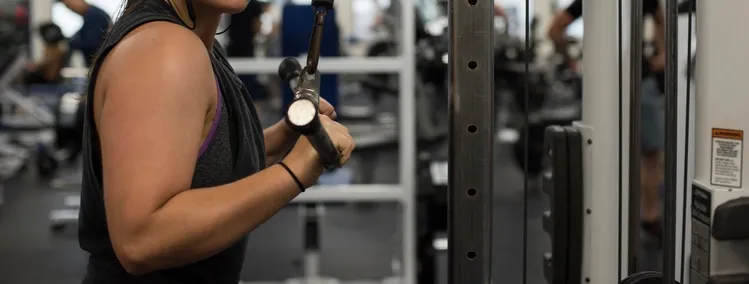
The cable rear delt fly gives you something dumbbells cannot: constant tension through the full range. With a dumbbell, resistance drops off at the start of the arc because gravity pulls straight down. A cable pulls along its own line, so the rear delt stays loaded from the first inch to the last.
How to set up a rear delt cable fly
Set two pulleys at shoulder height. Stand centered, grab the left cable with your right hand and the right cable with your left hand, so the cables cross in front of you. Start with arms extended forward at chest height, then sweep both arms out and back to torso line.
Single-arm cable rear delt fly
A single cable works well if your gym has only one functional machine. Stand side-on, reach across your body to grab the handle, and sweep the arm out and back. Training one side at a time lets you correct asymmetries, which are common in operators who carry a weapon or a load predominantly on one side.
Grip choice is simple. You can use the cable end with no handle, holding the ball stopper, which reduces grip demand and keeps the focus on the shoulder. For anyone asking which cable machine works for rear delts, any dual adjustable pulley does the job.
Dumbbell Rear Delt Fly (Bent-Over, Seated, Incline)
The dumbbell rear delt fly is the most accessible version and works anywhere you have a pair of light dumbbells, including a deployed gym. The trade-off is the resistance curve: tension is highest at the top of the movement and lowest at the bottom. That is fine, since the top is where the rear delt is shortest and hardest to recruit.
Bent-over rear delt fly
Stand with feet hip-width apart, hinge at the hips until your torso is roughly 45 degrees or lower, and let the dumbbells hang under your shoulders. Brace, keep a soft elbow, and sweep the weights out and up. The bent-over rear delt fly demands lower back endurance, which is a bonus for a ruck athlete but a limiter if you are fatigued from deadlifts.
Seated rear delt fly
Sit on the edge of a bench, fold your chest toward your thighs, and perform the same arc. Seated takes the lower back out of the equation and reduces momentum, so it is a good choice late in a session.
Incline chest-supported rear delt fly
Lie chest-down on a bench set to 30 to 45 degrees. The bench removes nearly all cheating. This is the version we default to for dumbbell work, because it isolates the rear delt with the fewest compensation patterns. It mirrors the prone horizontal abduction position that research identifies as effective for the middle and lower traps (Ekstrom et al., 2003).
If you want a full dumbbell session built for the rear delts, these three variations rotated across the week cover it.
Machine Rear Delt Fly (Reverse Pec Deck)
The rear delt fly machine, usually the reverse pec deck, is the easiest variation to load and repeat. You sit facing the pad, set the handles so your arms start in front of you, and sweep back. The machine fixes the path, which removes the balance demand and lets you focus on the muscle.
Three setup points matter. Set the seat height so the handles sit at shoulder level. Use the neutral (vertical) grip or a pronated grip based on which one lets you feel the rear delt. Set the arms so you start with a small stretch, not with the stack already touching. Because the path is fixed and stable, rear delt flyes on the machine are a good choice for progressive overload: you can track small load jumps week to week without technique drifting.
Banded rear delt fly
The banded version, often called the band pull-apart, is the field option. A light resistance band fits in a ruck and requires no anchor. Tension increases as the band stretches, so the hardest point is at the end of the movement. High-rep band pull-aparts make a good warm-up before pressing and a reasonable daily maintenance dose when you cannot get to a gym.
Rear Delt Fly vs. Face Pull: What Is the Difference?
The rear delt fly and the face pull both train the rear delts, but they are different movements. The fly is pure horizontal abduction with a fixed elbow. The face pull combines a row, where the elbow bends, with external rotation of the shoulder, pulling the rope toward your face. That makes the face pull more of a rotator cuff and shoulder-health movement.
Main motion: the rear delt fly is horizontal abduction. The face pull is a row plus external rotation.
Elbow: the fly keeps a fixed, slight bend. The face pull bends the elbow during the pull.
Primary emphasis: the fly targets the posterior deltoid. The face pull spreads the work across the rear delt, external rotators, and mid-traps.
Equipment: the fly works with a cable, dumbbell, machine, or band. The face pull uses a cable with a rope (or a band).
Best use: the fly is for rear delt isolation and size. The face pull is for rotator cuff health and posture.
So, rear delt fly or face pull? Do both. They train overlapping muscles through different actions, and external rotation strength is its own requirement for shoulder health (Reinold et al., 2004). The face pull gets its own full breakdown in our cable face pull guide, so we will not re-teach it here.
How Many Rear Delt Flys Should You Do? (Sets and Reps)
Most athletes should do 2 to 4 sets of 12 to 20 rear delt flys, two or three times per week, stopping one to three reps short of failure. Light loads work well here because research shows lighter and heavier loads produce similar muscle growth when sets are taken close to failure (Schoenfeld et al., 2017a).
[Image: Tactical athlete performing a reverse pec deck rear delt fly on a machine during a pull session | rear-delt-machine-reverse-pec-deck.jpg]
Why high reps? The rear delt is a small muscle with a short range, and heavy loads almost always pull in the traps, lats, and lower back. Higher reps keep the tension on the target and add little systemic fatigue, which matters when you are also running, rucking, and lifting.
Where it fits in the week:
Pull day: after your main rows and pull-ups, as the first or second accessory
Shoulder or press day: at the end, to balance the pressing volume you just did
Warm-up: band pull-aparts before any pressing session
Spreading the volume across two or three sessions helps, since training a muscle at least twice per week tends to outperform a single weekly dose for growth (Schoenfeld, Grgic, & Krieger, 2019), and total weekly sets drive hypertrophy in a dose-response pattern (Schoenfeld, Ogborn, & Krieger, 2017b). If you want to see how accessories like this slot around compound lifts, the template in a strength workout for athletes shows the structure.
Rear delt work is one piece of a complete shoulder plan. It sits alongside overhead pressing, lateral raises, external rotation work, and scapular control drills, which together make up the best shoulder exercises for a tactical athlete.
FAQ: Frequently Asked Questions
What muscles does the rear delt fly work?
The rear delt fly works the posterior deltoid as the primary mover. The rhomboids and middle trapezius assist by retracting and stabilizing the shoulder blades, while the infraspinatus and teres minor support the movement as secondary abductors and external rotators. The lower traps also help control scapular position throughout the rep.
How do you do a rear delt fly with correct form?
Hinge or lie chest-down on an incline bench, keep a slight fixed bend in your elbows, and sweep your arms out and back in a wide arc until they reach torso line. Keep your shoulders down away from your ears, avoid swinging, and lower the weight under control over two to three seconds.
Cable, dumbbell, or machine rear delt fly: which is best?
No single version is best. The cable gives constant tension, the machine is the easiest to load and track, and the chest-supported dumbbell version is the most accessible with the least cheating. Use the variation you can perform consistently with clean form, and rotate two of them across the week.
What is the difference between a rear delt fly and a face pull?
The rear delt fly is horizontal abduction with a fixed elbow, which isolates the posterior deltoid. The face pull adds an elbow bend and external rotation, so it trains the rotator cuff and mid-back more heavily. Both are valuable, and most tactical athletes benefit from including each in a weekly plan.
Why can’t I feel my rear delts during rear delt flys?
You likely cannot feel your rear delts because the load is too heavy or your traps are taking over. Drop the weight, keep your shoulders down, sweep your arms wide instead of pulling them back, and stop at torso line instead of squeezing the shoulder blades together. A chest-supported setup also helps.
How many reps of rear delt flys should you do?
Aim for 12 to 20 reps per set across 2 to 4 sets, two or three times per week. Stop one to three reps short of failure. High reps keep tension on the rear delt and limit fatigue, so the work supports your main lifts and conditioning instead of competing with them.
The rear delt fly is a small exercise with an outsized job: it balances heavy pressing, keeps the shoulder blades stable under a ruck, and protects a joint you cannot afford to lose to an overuse injury. Choose a variation, keep the elbow fixed, sweep wide, and program it light and often.
Knowing the movement is the easy part. The value comes from placing it inside a plan that already accounts for your pressing volume, your ruck mileage, and your test date. Build your shoulder work into a structured program and train for the job, not just the mirror.
References:
Calatayud J, Vinstrup J, Jakobsen MD, et al. Importance of mind-muscle connection during progressive resistance training. European Journal of Applied Physiology. 2016;116(3):527-533.
Cools AM, Dewitte V, Lanszweert F, et al. Rehabilitation of scapular muscle balance: which exercises to prescribe? American Journal of Sports Medicine. 2007;35(10):1744-1751.
Ekstrom RA, Donatelli RA, Soderberg GL. Surface electromyographic analysis of exercises for the trapezius and serratus anterior muscles. Journal of Orthopaedic & Sports Physical Therapy. 2003;33(5):247-258.
Haff GG, Triplett NT, eds. Essentials of Strength Training and Conditioning. 4th ed. National Strength and Conditioning Association. Human Kinetics; 2016.
Hauret KG, Jones BH, Bullock SH, Canham-Chervak M, Canada S. Musculoskeletal injuries: description of an under-recognized injury problem among military personnel. American Journal of Preventive Medicine. 2010;38(1 Suppl):S61-S70.
Kibler WB, Ludewig PM, McClure PW, et al. Clinical implications of scapular dyskinesis in shoulder injury: the 2013 consensus statement from the “Scapular Summit.” British Journal of Sports Medicine. 2013;47(14):877-885.
Knapik JJ, Reynolds KL, Harman E. Soldier load carriage: historical, physiological, biomechanical, and medical aspects. Military Medicine. 2004;169(1):45-56.
Kolber MJ, Beekhuizen KS, Cheng MS, Hellman MA. Shoulder injuries attributed to resistance training: a brief review. Journal of Strength and Conditioning Research. 2010;24(6):1696-1704.
Kolber MJ, Cheatham SW, Salamh PA, Hanney WJ. Characteristics of shoulder impingement in the recreational weight-training population. Journal of Strength and Conditioning Research. 2014;28(4):1081-1089.
Lynch SS, Thigpen CA, Mihalik JP, Prentice WE, Padua D. The effects of an exercise intervention on forward head and rounded shoulder postures in elite swimmers. British Journal of Sports Medicine. 2010;44(5):376-381.
Neumann DA. Kinesiology of the Musculoskeletal System: Foundations for Rehabilitation. 3rd ed. Elsevier; 2017.
Reinold MM, Wilk KE, Fleisig GS, et al. Electromyographic analysis of the rotator cuff and deltoid musculature during common shoulder external rotation exercises. Journal of Orthopaedic & Sports Physical Therapy. 2004;34(7):385-394.
Schoenfeld BJ, Grgic J, Ogborn D, Krieger JW. Strength and hypertrophy adaptations between low- vs. high-load resistance training: a systematic review and meta-analysis. Journal of Strength and Conditioning Research. 2017;31(12):3508-3523. (2017a)
Schoenfeld BJ, Ogborn D, Krieger JW. Dose-response relationship between weekly resistance training volume and increases in muscle mass: a systematic review and meta-analysis. Journal of Sports Sciences. 2017;35(11):1073-1082. (2017b)
Schoenfeld BJ, Grgic J, Krieger J. How many times per week should a muscle be trained to maximize muscle hypertrophy? A systematic review and meta-analysis. Journal of Sports Sciences. 2019;37(11):1286-1295.
Snyder BJ, Fry WR. Effect of verbal instruction on muscle activity during the bench press exercise. Journal of Strength and Conditioning Research. 2012;26(9):2394-2400.
Headquarters, Department of the Army. FM 7-22: Holistic Health and Fitness. Washington, DC; 2020.
Disclaimer: This article is for educational purposes only and is not medical advice. Consult a qualified healthcare provider before starting a new exercise program, especially if you have a current or previous shoulder injury. Stop any exercise that causes sharp or worsening pain. Individual results vary.


