
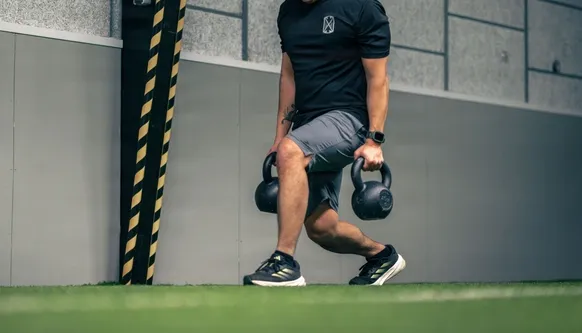
Lunge Alternatives: 8 Best Substitutes | Combat Fitness
Lunge Alternatives: The Best Substitute Exercises (Including Knee-Friendly Options)
The best lunge alternatives keep the single-leg strength, hip control, and knee durability that lunges build, while removing whatever makes lunges the wrong call for you right now. For most athletes the top pick is the step-up, followed closely by the static split squat. Both train the same muscles under the same one-leg demand, with less braking stress on the front knee. Every substitute below is one we use in our military fitness programs when an athlete can’t lunge, shouldn’t lunge this training block, or needs a different stimulus.
Load carriage, broken terrain, and stairwells under kit all happen one leg at a time, so we don’t drop single-leg work. We swap it. This guide covers the eight best substitutes, the knee-friendly options for bad knees, ankles, and hips, and specific replacements for walking, reverse, and lateral lunges. It closes with how to program the swap so you keep the training effect.
Why Look for a Lunge Alternative?
A lunge alternative is any exercise that keeps the lunge’s single-leg strength stimulus while removing the part that isn’t working for you: knee or joint pain, poor balance under load, no room to walk, or a stale training block. The right lunge substitute trains the same muscles through a pattern your joints tolerate today.
Lunges load one leg at a time through hip and knee extension. The quads, glutes, and adductors do most of the work while the hamstrings and lateral hip stabilize. Forward and walking versions add a braking demand: the front leg absorbs your body mass and the load on every step. That deceleration builds durability, and it is also the part that aggravates irritated knees.
Single-leg strength is central to functional strength for military performance because the job rarely happens on two feet. Rucking, climbing, stepping over obstacles, and dragging a casualty all put one leg in charge (Knapik et al., 2004). The Army’s own Preparation Drill includes both a rear lunge and a forward lunge for that reason (FM 7-22). Musculoskeletal injuries, concentrated in the lower body, are a leading driver of limited-duty days in the Army (Molloy et al., 2020). So we treat the single-leg pattern as non-negotiable and the specific exercise as interchangeable.
Our guide to lunges covers technique for every variation. This post covers the replacement exercise for lunges when the original is off the table.
The Best Lunge Alternatives
We chose these substitutes on three criteria. Each one keeps a single-leg or hip-and-knee-dominant stimulus, each can be loaded progressively, and each costs less than a lunge on at least one joint. If you’re weighing a full plan rather than one exercise, our guide to choosing a strength & endurance program covers what to look for.
1. Step-Up
How to do it: Place your whole foot on a box at or just below knee height. Drive through the working leg and stand tall without pushing off the trailing foot, then lower under control.
Why it works: The step-up trains the same hip and knee extension as a lunge with almost no braking on the front leg. Loaded step-up variations heavily recruit the quads and glutes (Simenz et al., 2012), and the pattern carries straight over to stairs and obstacles.
Verdict: the best all-around lunge substitute.
2. Static Split Squat
How to do it: Set a split stance, lower the back knee straight down toward the floor, and drive back up without moving your feet.
Why it works: This is the lunge position with the stepping removed. You train the bottom of the lunge without the impact of planting a loaded foot, which makes it the easiest swap for balance or joint issues.
Verdict: the closest match to a lunge.
3. Goblet Squat
How to do it: Hold a dumbbell or kettlebell at your chest, sit down between your hips, and keep your torso upright.
Why it works: You lose the single-leg balance demand, but the front-loaded position keeps the quads and glutes working with low spinal load. Single-leg squatting can match bilateral muscle activity at far less external load (DeForest et al., 2014), so treat this as a balance-friendly bridge, not a permanent replacement. Our goblet squat guide covers the setup in detail.
Verdict: best when balance is the limiter.
4. Single-Leg Leg Press
How to do it: Center one foot on the platform, lower to the depth where your pelvis stays flat, and press without slamming into lockout.
Why it works: The machine removes balance and stabilization, so you can load one leg hard. Knee stress in closed-chain pressing is managed through range of motion (Escamilla et al., 1998), which gives you a precise dial.
Verdict: best for heavy single-leg loading while an ankle or balance issue settles.
5. Single-Leg Romanian Deadlift
How to do it: Hinge on one leg with a soft knee, reach the free leg back, lower the weight along the shin, and stand by driving the hips forward.
Why it works: This is a hip-dominant single-leg lift with minimal knee bend. Single-limb deadlifts produce high gluteus maximus and medius activation (DiStefano et al., 2009). It does not replace quad work, so pair it with a knee-dominant option.
Verdict: the posterior-chain half of the lunge.
6. Hip Thrust
How to do it: Set your upper back on a bench with the bar over your hips. Drive to full hip extension, pause, and lower.
Why it works: The hip thrust produced higher glute activation than the back squat in direct comparison (Contreras et al., 2015), with little knee stress. Single-leg versions restore the unilateral element.
Verdict: glute strength with zero impact.
7. Bulgarian Split Squat
How to do it: Elevate the rear foot on a bench, keep most of your weight on the front leg, and lower until the back knee nears the floor.
Why it works: Rear-foot-elevated split squats are among the most demanding unilateral barbell lifts for the quads and glutes (Mausehund et al., 2019). Single-leg training builds strength and power on par with bilateral training (McCurdy et al., 2005; Speirs et al., 2016). If you tolerate the range, the bulgarian split squat is a harder lunge substitute, not an easier one.
Verdict: the progression, not the regression.
8. Sled Push
How to do it: Hands on the posts, body at a forward angle, drive the sled with short, hard steps.
Why it works: The sled push is concentric-only. There is no braking phase, which is why it rarely aggravates knees and leaves little soreness. It also conditions the same alternating leg drive as walking lunges.
Verdict: best for joint-friendly volume and conditioning.
If you need squat and lunge alternatives at the same time, build the session from the hip thrust, single-leg RDL, leg press, and sled push. Together they cover hip extension, the posterior chain, quad strength, and leg drive without deep loaded knee flexion under a bar.
Knee-Friendly Lunge Alternatives for Bad Knees and Joints
The best lunge alternatives for bad knees are the box step-up, static split squat, sled push, and hip thrust. Each one limits how far the knee travels forward, shifts more load to the hips, or removes the braking phase that drives pain in forward and walking lunges.
Why These Substitutes Cut Knee Stress
Three variables decide how much a single-leg exercise costs the knee:
Knee travel. Restricting how far the knee moves forward shifts torque from the knee to the hip (Fry et al., 2003). A box step-up with a near-vertical shin does this by design.
Braking demand. Patellofemoral joint force changes with knee angle, step length, and whether you step into the rep (Escamilla et al., 2008a). Stationary and concentric-only options remove the stepping.
Depth and tempo. A controlled tempo and a range you own keep load on muscle, not on an irritated joint. Work in the pain-free range, then expand it.
Clinical guidelines for patellofemoral pain recommend hip- and knee-targeted strengthening, not avoidance (Willy et al., 2019). That is the logic of a substitute: keep training the leg, change the stress.
Bad Hips, Ankles, and Toes
Lunge alternatives for bad hips: a long split stance and deep hip flexion can pinch. Shorten the stance, cap leg press depth, and lean on the hip thrust.
Lunge alternatives for bad ankles: limited ankle mobility pushes the heel up and the knee forward. Use a lower step-up box, elevate your heels on goblet squats, or use the leg press.
Lunge alternatives for bad toes: the back foot of a lunge forces the big toe into extension. Step-ups, the leg press, and the single-leg RDL keep the foot flat.
Sharp pain, pain that worsens session to session, or pain with swelling, locking, or instability needs a sports medicine physician or physical therapist, not an exercise swap. Substitutes manage training load. They don’t diagnose or treat injury.
Walking Lunge Alternatives: What to Do Instead
The best walking lunge alternative is the step-up for strength and the sled push for conditioning. Both replace the alternating leg drive of walking lunges without a long lane, and both cut the repeated impact of planting a loaded foot.
Alternatives to walking lunges make sense when you’re training in a cramped gym or a hotel room, when the repeated landings bother your knees, or when grip fails before your legs do. Good walking lunges substitutes include:
Alternating step-ups for straight strength work
Static split squats when space is tight
Reverse lunges in place to keep a lunge pattern without the travel
Sled pushes or forward sled drags for continuous, conditioning-style reps
For the loaded-locomotion carryover, run step-ups in a weighted vest or plate carrier. You keep the ruck-specific stimulus without the impact.
Reverse Lunge Alternatives: Do You Still Need One?
A reverse lunge is already the knee-friendlier lunge. Your front foot stays planted and you step behind you, so the front leg never brakes forward momentum. If you still need a substitute for reverse lunges, the static split squat is the direct swap, with the step-up and Bulgarian split squat as progressions.
For reverse lunge alternatives for bad knees, cut the range first. Place a pad or low box under the back knee during split squats to set a consistent depth. Use a lower step-up box, and add the single-leg RDL to keep hip loading high while the knee recovers.
Lateral and Side Lunge Alternatives
The best lateral lunge alternatives are the cossack squat, the lateral step-up, and direct adductor work. Each keeps the frontal-plane stimulus that forward-facing lunges miss: loading the inner thigh and lateral hip as the leg moves out to the side.
Cossack squat: shift deep onto one leg while the other stays straight, toes up. It demands hip mobility, so start with bodyweight or a light counterweight.
Lateral step-up: stand beside a box and step up sideways. Lateral step-ups drive meaningful glute medius activation (DiStefano et al., 2009).
Adductor work: the Copenhagen plank strengthens the groin directly, and an adductor program built around it reduced groin problems in football players (Harøy et al., 2019).
Lateral sled drag: frontal-plane conditioning with no braking load.
Side lunges load the knee in their own way, and stepping into the rep changes that load (Escamilla et al., 2008b). These side lunge alternatives keep the lateral stimulus for change of direction and groin durability without the impact.
How to Program the Swap
To replace lunges without losing the training effect, put the substitute in the same slot, match the reps per leg, and match the effort. Weekly hard sets per muscle drive adaptation (Schoenfeld et al., 2017), so the exercise can change while the dose stays the same.
Keep the slot. If lunges were the main single-leg lift in your session, the substitute goes there too. The structure of a strength workout for athletes doesn’t change because one exercise did.
Match reps per leg. 3 x 8 lunges per leg becomes 3 x 8 step-ups per leg.
Match effort, not load. A leg press takes far more weight than a step-up. Use reps in reserve, ending each set one to three reps short of failure.
Protect unilateral volume. If you swap to a bilateral lift like the goblet squat, add a single-leg accessory later in the session.
Ramp the first week. Start lighter than you think you need while you learn the new pattern.
Reintroduce the lunge in order. Once you’re pain-free, bring back the reverse lunge before the walking lunge.
Frequently Asked Questions
What is the best alternative to lunges?
The step-up is the best alternative to lunges for most athletes. It trains the same hip and knee extension on one leg, loads progressively, and removes most of the braking stress on the front knee. The static split squat is a close second when you want the exact lunge position without the stepping.
What are knee-friendly lunge alternatives for bad knees?
Box step-ups, static split squats, sled pushes, and hip thrusts are the most knee-friendly options. They limit forward knee travel, shift load to the hips, or remove the braking phase. Work in a pain-free range, and see a clinician if pain is sharp, worsening, or comes with swelling.
What can you do instead of walking lunges?
Step-ups and sled pushes are the best replacements for walking lunges. Step-ups cover the strength stimulus in a small space, and sled pushes cover the alternating leg drive for conditioning. Reverse lunges in place work when you want to keep the lunge pattern without the travel.
What are good reverse lunge alternatives?
The static split squat is the most direct reverse lunge alternative because it uses the same stance without the step. Step-ups and Bulgarian split squats work as progressions. For sore knees, limit split squat depth with a pad under the back knee and add single-leg RDLs.
What replaces a lateral or side lunge?
The cossack squat replaces the lateral lunge most closely, since it uses the same side-to-side shift. The lateral step-up and Copenhagen plank are lower-mobility options that still load the lateral hip and adductors. Lateral sled drags add frontal-plane work without impact.
Do the alternatives build the same muscles as lunges?
Yes, when you pick the right mix. Step-ups, split squats, and Bulgarian split squats train the quads, glutes, and adductors the way lunges do. Hip-dominant options like the single-leg RDL and hip thrust cover the glutes and hamstrings, so pair one of each to fully replace the lunge.
How do you swap lunges in a workout?
Put the substitute in the same slot, match the reps per leg, and match the effort level using reps in reserve. Loads will differ between exercises, so judge by effort rather than weight. If the substitute is bilateral, add a single-leg accessory to keep total unilateral volume intact.
Lunge alternatives exist so you never have to choose between single-leg strength and healthy knees. Identify your limiter, pick the substitute that removes it, and match the reps and effort so the training effect carries through. Durable legs come from consistent single-leg loading, not from any one exercise. If you want that loading programmed around your joints and your next standard, start a CF ONE free trial and train the swap inside a structured plan.
References:
Contreras B, Vigotsky AD, Schoenfeld BJ, Beardsley C, Cronin J. A comparison of gluteus maximus, biceps femoris, and vastus lateralis electromyographic activity in the back squat and barbell hip thrust exercises. Journal of Applied Biomechanics. 2015;31(6):452-458.
DeForest BA, Cantrell GS, Schilling BK. Muscle activity in single- vs. double-leg squats. International Journal of Exercise Science. 2014;7(4):302-310.
Department of the Army. FM 7-22, Holistic Health and Fitness. Washington, DC: Headquarters, Department of the Army; 2020.
DiStefano LJ, Blackburn JT, Marshall SW, Padua DA. Gluteal muscle activation during common therapeutic exercises. Journal of Orthopaedic & Sports Physical Therapy. 2009;39(7):532-540.
Escamilla RF, Fleisig GS, Zheng N, Barrentine SW, Wilk KE, Andrews JR. Biomechanics of the knee during closed kinetic chain and open kinetic chain exercises. Medicine & Science in Sports & Exercise. 1998;30(4):556-569.
Escamilla RF, Zheng N, MacLeod TD, et al. Patellofemoral joint force and stress between a short- and long-step forward lunge. Journal of Orthopaedic & Sports Physical Therapy. 2008;38(11):681-690. (2008a)
Escamilla RF, Zheng N, MacLeod TD, et al. Patellofemoral compressive force and stress during the forward and side lunges with and without a stride. Clinical Biomechanics. 2008;23(8):1026-1037. (2008b)
Fry AC, Smith JC, Schilling BK. Effect of knee position on hip and knee torques during the barbell squat. Journal of Strength and Conditioning Research. 2003;17(4):629-633.
Harøy J, Clarsen B, Wiger EG, et al. The Adductor Strengthening Programme prevents groin problems among male football players: a cluster-randomised controlled trial. British Journal of Sports Medicine. 2019;53(3):150-157.
Knapik JJ, Reynolds KL, Harman E. Soldier load carriage: historical, physiological, biomechanical, and medical aspects. Military Medicine. 2004;169(1):45-56.
Mausehund L, Skard AE, Krosshaug T. Muscle activation in unilateral barbell exercises: implications for strength training and rehabilitation. Journal of Strength and Conditioning Research. 2019;33(Suppl 1):S85-S94.
McCurdy KW, Langford GA, Doscher MW, Wiley LP, Mallard KG. The effects of short-term unilateral and bilateral lower-body resistance training on measures of strength and power. Journal of Strength and Conditioning Research. 2005;19(1):9-15.
Molloy JM, Pendergrass TL, Lee IE, et al. Musculoskeletal injuries and United States Army readiness part I: overview of injuries and their strategic impact. Military Medicine. 2020;185(9-10):e1461-e1471.
Schoenfeld BJ, Ogborn D, Krieger JW. Dose-response relationship between weekly resistance training volume and increases in muscle mass: a systematic review and meta-analysis. Journal of Sports Sciences. 2017;35(11):1073-1082.
Simenz CJ, Garceau LR, Lutsch BN, Suchomel TJ, Ebben WP. Electromyographical analysis of lower extremity muscle activation during variations of the loaded step-up exercise. Journal of Strength and Conditioning Research. 2012;26(12):3398-3405.
Speirs DE, Bennett MA, Finn CV, Turner AP. Unilateral vs. bilateral squat training for strength, sprints, and agility in academy rugby players. Journal of Strength and Conditioning Research. 2016;30(2):386-392.
Willy RW, Hoglund LT, Barton CJ, et al. Patellofemoral pain: clinical practice guidelines linked to the International Classification of Functioning, Disability and Health from the Academy of Orthopaedic Physical Therapy of the American Physical Therapy Association. Journal of Orthopaedic & Sports Physical Therapy. 2019;49(9):CPG1-CPG95.
Disclaimer: This article is for educational purposes only and is not medical advice. Consult a qualified healthcare provider before starting a new training program, especially if you have pain, a current injury, or a medical condition. Stop any exercise that causes sharp or worsening pain and seek professional evaluation.


