
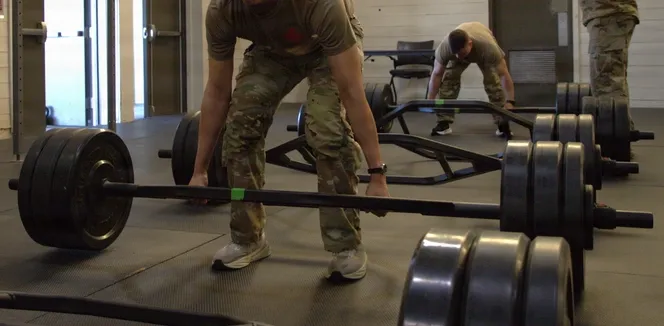
Lower Body Pull Exercises: 10 Best Moves | Combat Fitness
Lower Body Pull Exercises: The Best Hip-Hinge & Posterior-Chain Moves
Lower body pull exercises are hip-hinge and hamstring movements that train your posterior chain: the glutes, hamstrings, and spinal erectors that lift loads off the ground and drive you forward. Our tactical fitness programs build every lower-body block around this pattern, because the hinge carries more of the job than any other lift. Here are the best leg pull exercises for a tactical athlete:
Deadlift (conventional or hex bar)
Romanian deadlift
Single-leg Romanian deadlift
Hip thrust
Glute ham raise
Kettlebell swing
Nordic hamstring curl
Good morning
Back extension
Sled drag
Below you get the push-versus-pull split, a short how-to for each movement, bodyweight and dumbbell options, a sample session, and where lower body pulling exercises fit in your training split.
Key Takeaways:
Lower body pull exercises are hip-dominant hinges or knee-flexion hamstring movements. Lower body push exercises are squat, lunge, and step-up patterns.
The hinge is the lift you use to pick up a casualty, a sandbag, or a loaded ruck, and the Army still tests it with a hex bar deadlift.
Most athletes over-train the squat and under-train the hinge. Match your weekly pull volume to your push volume, at minimum.
Programs that include the Nordic hamstring curl cut hamstring injury rates roughly in half in research on athletes.
You can train the pattern with no equipment, a pair of dumbbells, or a full barbell setup.
Lower Body Push vs. Pull: What’s the Difference?
Lower body push exercises move the load by extending the knee and hip together, as in squats, lunges, and step-ups. Lower body pull exercises move the load mainly through the hip, as in deadlifts and hip thrusts, or by bending the knee against resistance, as in Nordic curls and leg curls.
Coaches also call this the knee-dominant versus hip-dominant split. Push work leans on the quads. Pull work leans on the glutes and hamstrings. Any list of lower body push and pull exercises needs both, because the squat builds the quads that absorb landings and climb stairs under load, while the hinge builds the posterior chain that produces force behind you.
Are Some Lower Body Pull Exercises Knee Dominant?
Yes. The hamstrings cross both the hip and the knee, so they extend the hip and flex the knee. A Nordic curl, glute ham raise, or slider leg curl is a knee-dominant pull: the knee is the moving joint, but the hamstrings still do the pulling. A complete program uses both, because different hamstring exercises load different regions of the muscle (Bourne et al., 2017).
Why Balance Push and Pull?
The squat is easy to measure, so it tends to get the volume, and the hinge gets whatever is left. That imbalance shows up as weak hip extension, sore low backs on long rucks, and hamstrings that strain at the first hard sprint. Pairing one push with one pull in every lower-body session keeps both sides of the hip in proportion.
What Are the Best Lower Body Pull Exercises?
The best lower body pull exercises for tactical athletes are the deadlift, Romanian deadlift, single-leg RDL, hip thrust, glute ham raise, kettlebell swing, Nordic curl, good morning, back extension, and sled drag. Together they cover heavy hinging, single-leg stability, power, and eccentric hamstring strength.
1. Deadlift (Conventional or Hex Bar)
The deadlift is the base strength lift for the pattern. Set your feet hip-width, push the hips back until your hands reach the bar, brace hard, and drive the floor away until you stand tall. The hex bar keeps the load in line with your center of mass and reduces lower-back demand compared with a straight bar (Swinton et al., 2011), which makes it a sound default for most tactical athletes and the version the Army tests.
2. Romanian Deadlift
The Romanian deadlift starts from the top. With soft knees, push the hips back and lower the bar along your thighs until you feel a hard stretch in the hamstrings, then drive the hips forward to stand. It loads the hamstrings through a long range, which makes it the primary accessory for the deadlift. Our full guide to the Romanian deadlift covers setup and loading in depth.
3. Single-Leg Romanian Deadlift
Same hinge, one leg. Hold a weight in the opposite hand, reach the free leg straight back, and keep your hips square to the floor. The single-leg Romanian deadlift builds hip stability and exposes left-to-right differences that two-leg lifts hide. Unilateral lower body pull exercises matter for anyone who runs, jumps, or moves over uneven ground, so program one at least once a week.
4. Hip Thrust
Rest your upper back on a bench, roll a barbell over your hips, and drive up until your torso and thighs form a straight line. The hip thrust produces high glute activation at full hip extension, the position where the squat produces the least (Contreras et al., 2015). Use it to build lockout strength and sprint drive with low spinal load.
5. Glute Ham Raise
Lock your feet into a GHR bench, start upright on your knees, lower your torso forward under control, then curl yourself back up with the hamstrings. The glute ham raise works the hamstrings at both the hip and the knee in a single rep, and it ranks among the highest-activation hamstring exercises measured (McAllister et al., 2014).
6. Kettlebell Swing
Hike the bell between your legs, then snap the hips forward so the bell floats to chest height. The swing is a ballistic hinge: it trains the pattern at speed, which is how you use it on the job. Swing training has improved both maximal and explosive strength in trained men (Lake & Lauder, 2012).
7. Nordic Hamstring Curl
Kneel with your heels anchored, hold a straight line from knee to head, and lower yourself toward the floor as slowly as you can. Catch yourself with your hands and push back up. The Nordic curl is an eccentric exercise, and injury-prevention programs that include it reduced hamstring injuries by about half across more than 8,000 athletes (van Dyk et al., 2019).
8. Good Morning
Set a bar on your upper back, unlock the knees, and hinge forward until your torso nears parallel, then stand. The load sits far from the hips, so the good morning trains the spinal erectors and hamstrings hard at modest weights. Keep it controlled. It builds the trunk strength that holds your back flat when the load is on your shoulders instead of in your hands.
9. Back Extension
On a 45-degree or horizontal bench, hinge over the pad and extend until your body forms a straight line. Squeeze the glutes to bias the hips, or keep a neutral spine to bias the erectors. Back extensions build low-back endurance at low load, a direct counter to long hours under body armor.
10. Sled Drag
Attach a strap to a belt or harness, face away from the sled, lean forward, and drive with hard, deliberate hip extension. The forward drag builds posterior-chain work capacity with almost no eccentric soreness, so you can train it on days when your legs are still recovering from heavy lifting.
You do not need all ten in every block. Pick one heavy hinge, one hamstring-focused accessory, and one power or capacity movement, then rotate every four to six weeks. If you are still working out how strength work fits with your running and rucking, our guide to choosing a strength & endurance program walks through what to look for.
Why the Lower-Body Pull Matters for Tactical Athletes
The lower-body pull matters because the hinge is how you lift, sprint, carry, and protect your back under load. Picking up a casualty, a sandbag, or a ruck is a deadlift. Sprinting to cover is driven by the glutes and hamstrings. Rucking for miles depends on posterior-chain endurance.
The sprint case is well documented. Hamstring strength is closely tied to horizontal force production during acceleration (Morin et al., 2015), and stronger athletes consistently perform better in sprinting, jumping, and change of direction (Suchomel et al., 2016). The hinge is where much of that strength is built.
The durability case matters as much. Military load carriage puts heavy, prolonged demand on the trunk and hips, and the lower back is a common site of injury and complaint among soldiers who carry it (Knapik et al., 2004; Orr et al., 2014). Musculoskeletal injuries are also a leading cause of lost readiness across the Army (Molloy et al., 2020). A strong posterior chain does not guarantee you stay healthy, but it gives the tissues that carry the load more capacity to spare.
The standard reflects this. The Army Fitness Test, which replaced the ACFT in 2025, keeps the three-repetition maximum hex bar deadlift as a scored event, a direct test of your hinge. That is the core argument behind functional strength for military performance: train the patterns the job uses, at the loads the job demands. For most athletes we coach, fixing the push-pull imbalance is the fastest lower-body improvement available.
Bodyweight Lower Body Pull Exercises at Home (No Equipment)
Bodyweight lower body pull exercises include the Nordic curl, single-leg RDL, glute bridge, slider leg curl, and prone back extension. You can do all of them at home with no equipment beyond a towel and something sturdy to anchor your heels.
Nordic curl: hook your heels under a loaded couch or have a partner hold your ankles. Three to five slow lowering reps is plenty.
Single-leg RDL: use a slow three-second lowering phase and a one-second pause at the bottom to make bodyweight count.
Single-leg glute bridge: drive through the heel and hold the top for two seconds.
Slider leg curl: lie on your back with heels on towels on a hard floor, bridge up, then curl the heels toward your hips.
Prone back extension: lie face down, hands by your ears, and lift your chest while squeezing the glutes.
Bodyweight work loses its training effect quickly for strong athletes, so progress by going single-leg, slowing the lowering phase, and adding pauses before adding reps. Our roundup of at-home hamstring exercises covers more no-equipment options.
Dumbbell Lower Body Pull Exercises
The best dumbbell lower body pull exercises are the dumbbell Romanian deadlift, dumbbell single-leg RDL, single-dumbbell swing, and goblet good morning. Two dumbbells cover the full hinge pattern in a garage, a hotel gym, or on deployment.
Dumbbell RDL: hold the dumbbells at your sides or in front of your thighs and hinge exactly as you would with a barbell.
Dumbbell single-leg RDL: hold one dumbbell in the hand opposite the working leg to challenge hip stability.
Single-dumbbell swing: grip one end of a heavy dumbbell with both hands and swing it like a kettlebell.
Goblet good morning: hug one dumbbell to your chest and hinge to near parallel.
Grip usually fails before your hamstrings do with dumbbells. Use lifting straps or higher rep ranges so the posterior chain, not your forearms, decides when the set ends.
A Sample Lower-Body Pull Workout
This hinge-focused session takes 45 to 60 minutes and works once or twice a week. Leave one to three reps in reserve on every working set.
Warm-up: five minutes of easy cardio, then two sets of 10 glute bridges and 10 bodyweight RDLs.
Hex bar deadlift: 4 sets of 4 to 6 reps, resting 2 to 3 minutes.
Romanian deadlift: 3 sets of 8 reps, resting 2 minutes.
Dumbbell single-leg RDL: 3 sets of 8 reps per leg.
Nordic hamstring curl: 3 sets of 3 to 5 slow reps.
Kettlebell swing: 5 sets of 10 reps, resting 60 seconds.
Back extension: 2 sets of 15 reps.
Short on time? Keep five lower body pull exercises: deadlift, RDL, single-leg RDL, Nordic curl, and swing. The heavy compound lift comes first, while you are fresh, and the high-rep endurance work comes last, which follows standard exercise-order principles (Haff & Triplett, 2016). This pull day slots straight into a strength workout for athletes as its posterior-chain session.
How to Program Lower Body Pull in a Push/Pull or Upper/Lower Split
In a push/pull split, lower body pull exercises go on pull day alongside rows and pull-ups. In an upper/lower split, pair one squat pattern with one hinge pattern on every lower day. Either way, keep weekly hinge volume at least equal to squat volume.
A four-day upper/lower split works well for most tactical athletes. Lower Day A leads with a heavy hinge and adds a lighter squat. Lower Day B leads with a heavy squat and adds an RDL or Nordic curl. Each pattern gets one heavy exposure and one lighter exposure per week, which supports strength gains without stacking fatigue. Our breakdown of workout splits compares the options in more detail.
Manage the overlap with your conditioning. Heavy deadlifts and long rucks both tax the posterior chain, so do not schedule a heavy hinge day the day before a long ruck or a test. Separate them by 48 to 72 hours where you can, a principle reflected in tactical strength and conditioning guidance (Alvar et al., 2017).
Frequently Asked Questions
What are lower body pull exercises?
Lower body pull exercises are movements that train the posterior chain by extending the hip or flexing the knee against resistance. The main examples are the deadlift, Romanian deadlift, hip thrust, kettlebell swing, glute ham raise, and Nordic curl. They work the glutes, hamstrings, and lower back, which drive lifting, sprinting, and load carriage.
What is the difference between a lower-body push and pull?
A lower-body push extends the knee and hip together to move a load, as in squats and lunges, and relies most on the quads. A lower-body pull moves the load mainly through the hip or by bending the knee, as in deadlifts and leg curls, and relies most on the glutes and hamstrings.
Can you do lower body pull exercises at home with no equipment?
Yes. Nordic curls, single-leg RDLs, single-leg glute bridges, slider leg curls, and prone back extensions all work at home with no equipment. Progress them by working one leg at a time, slowing the lowering phase, and adding pauses, because bodyweight alone stops challenging strong athletes quickly.
What are the best dumbbell lower body pull exercises?
The best dumbbell options are the dumbbell Romanian deadlift, the dumbbell single-leg RDL, the single-dumbbell swing, and the goblet good morning. Together they cover heavy hinging, single-leg stability, and hip power. Use lifting straps or higher reps when grip limits the load.
Why is the hip hinge important for athletes?
The hip hinge produces the hip extension behind sprinting, jumping, and lifting objects off the ground. For tactical athletes it also builds the posterior-chain and lower-back capacity that long load carriage demands. Hamstring strength from hinge and curl work is also linked to faster acceleration and fewer hamstring injuries.
How do you program lower body pull in a push/pull split?
Place your lower-body pull exercises on pull day with your upper-body rows and pull-ups. Lead with one heavy hinge, add a hamstring accessory such as a Nordic curl, and finish with swings or back extensions. Keep weekly hinge volume at least equal to your squat volume.
Lower body pull exercises build the strength you use every time you lift a load off the ground, sprint, or carry weight over distance, and they are the pattern most athletes neglect. Start by matching your hinge volume to your squat volume, use one heavy hinge and one hamstring accessory each week, and progress them as deliberately as you progress your squat. If you want that balance built into a structured plan with conditioning already scheduled around it, start a CF ONE free trial and run the lower-body block this week.
References:
Alvar BA, Sell K, Deuster PA, eds. NSCA’s Guide to Tactical Strength and Conditioning. Champaign, IL: Human Kinetics; 2017.
Bourne MN, Williams MD, Opar DA, et al. Impact of exercise selection on hamstring muscle activation. British Journal of Sports Medicine. 2017;51(13):1021-1028.
Contreras B, Vigotsky AD, Schoenfeld BJ, Beardsley C, Cronin J. A comparison of gluteus maximus, biceps femoris, and vastus lateralis electromyographic activity in the back squat and barbell hip thrust exercises. Journal of Applied Biomechanics. 2015;31(6):452-458.
Escamilla RF, Francisco AC, Fleisig GS, et al. A three-dimensional biomechanical analysis of sumo and conventional style deadlifts. Medicine & Science in Sports & Exercise. 2000;32(7):1265-1275.
Haff GG, Triplett NT, eds. Essentials of Strength Training and Conditioning. 4th ed. Champaign, IL: Human Kinetics; 2016.
Headquarters, Department of the Army. FM 7-22, Holistic Health and Fitness. Washington, DC; 2020.
Knapik JJ, Reynolds KL, Harman E. Soldier load carriage: historical, physiological, biomechanical, and medical aspects. Military Medicine. 2004;169(1):45-56.
Lake JP, Lauder MA. Kettlebell swing training improves maximal and explosive strength. Journal of Strength and Conditioning Research. 2012;26(8):2228-2233.
McAllister MJ, Hammond KG, Schilling BK, et al. Muscle activation during various hamstring exercises. Journal of Strength and Conditioning Research. 2014;28(6):1573-1580.
Molloy JM, Pendergrass TL, Lee IE, et al. Musculoskeletal injuries and United States Army readiness part I: overview of injuries and their strategic impact. Military Medicine. 2020;185(9-10):e1461-e1471.
Morin JB, Gimenez P, Edouard P, et al. Sprint acceleration mechanics: the major role of hamstrings in horizontal force production. Frontiers in Physiology. 2015;6:404.
Orr RM, Pope R, Johnston V, Coyle J. Soldier occupational load carriage: a narrative review of associated injuries. International Journal of Injury Control and Safety Promotion. 2014;21(4):388-396.
Otto WH, Coburn JW, Brown LE, Spiering BA. Effects of weightlifting vs. kettlebell training on vertical jump, strength, and body composition. Journal of Strength and Conditioning Research. 2012;26(5):1199-1202.
Petersen J, Thorborg K, Nielsen MB, Budtz-Jørgensen E, Hölmich P. Preventive effect of eccentric training on acute hamstring injuries in men’s soccer: a cluster-randomized controlled trial. American Journal of Sports Medicine. 2011;39(11):2296-2303.
Suchomel TJ, Nimphius S, Stone MH. The importance of muscular strength in athletic performance. Sports Medicine. 2016;46(10):1419-1449.
Swinton PA, Stewart A, Agouris I, Keogh JW, Lloyd R. A biomechanical analysis of straight and hexagonal barbell deadlifts using submaximal loads. Journal of Strength and Conditioning Research. 2011;25(7):2000-2009.
U.S. Army. Army Fitness Test (AFT) implementation guidance and event standards. 2025.
van Dyk N, Behan FP, Whiteley R. Including the Nordic hamstring exercise in injury prevention programmes halves the rate of hamstring injuries: a systematic review and meta-analysis of 8459 athletes. British Journal of Sports Medicine. 2019;53(21):1362-1370.
Disclaimer: This article is for educational purposes only and is not medical advice. Consult a qualified healthcare provider before starting a new training program, especially if you have a current injury, back pain, or a medical condition. Individual results vary, and no exercise program guarantees performance outcomes or injury prevention.


