
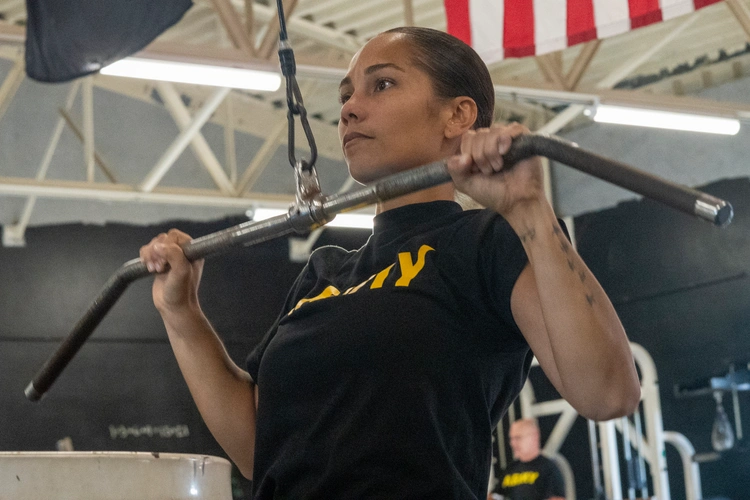
Lat Pulldown Muscles Worked, Grip by Grip | Combat Fitness
Lat Pulldown: Muscles Worked and How Each Grip Changes Them
The lat pulldown muscles worked start with the latissimus dorsi, the broad muscle that pulls your upper arm down and back. The rhomboids, middle and lower traps, rear delts, and teres major assist, along with the biceps, brachialis, and forearms. We use it in the pulling days of our military fitness programs because it lets you load the pull-up pattern at any strength level.
Below: every muscle the pulldown trains, how each grip shifts the emphasis, the form that keeps it a back exercise, and how to program it toward more pull-ups on test day.
What Muscles Does the Lat Pulldown Work?
The lat pulldown works the lats as the prime mover, with the teres major, rhomboids, middle and lower traps, and rear delts assisting at the shoulder and shoulder blade. The biceps, brachialis, and brachioradialis bend the elbow, and the forearm flexors hold the bar. Your abs brace to keep your torso still.
The Primary Muscle: Your Lats
The lats run from your lower spine, pelvis, and lower ribs up to the front of your upper arm. That attachment lets them pull the arm down from overhead (adduction and extension) and rotate it inward.
The Secondary Muscles
The teres major sits just above the lat and does the same job, so lifters call it the lat's little helper. The rhomboids and middle traps pull your shoulder blades together, and the lower traps pull them down. That downward rotation and depression of the shoulder blade is what lets the lats finish the rep. The rear delts assist shoulder extension, most of all with a closer grip.
The Arm, Grip, and Core Muscles
The biceps, brachialis, and brachioradialis flex the elbow on every rep, so the lat pulldown does work your arms. The forearm flexors squeeze the handle, which adds grip work that carries over to hanging and climbing. Your abs and spinal erectors keep the torso from rocking, a job that gets bigger in the standing and single-arm versions.
The pulldown is a vertical pull. Its horizontal partner is the row, and the barbell row benefits cover the same muscles from a different angle, with more upper-back thickness and grip. A complete back needs both. That pulling base is what lets you climb, haul a casualty, or drag gear, which is the core of functional strength for military performance.
How Does Each Grip Change the Lat Pulldown Muscles Worked?
Grip changes which helpers work hardest more than it changes the lats. Lusk and colleagues found an overhand grip produced more lat activity than an underhand grip, while grip width made little difference. Andersen and colleagues also found only modest differences across narrow, medium, and wide grips. Pick the grip for your weak point, not for gym myths.
Wide Overhand Grip
A wide overhand grip, just outside shoulder width, is the classic setup. It shortens the range of motion and puts the arms in a more side-to-side path, which most lifters feel in the upper and outer lats and upper back. Signorile and colleagues found the wide grip pulled to the front of the body produced high lat activity. Use it as your default and your heaviest version.
Close Grip and Neutral Grip (V-Bar)
A close grip or a neutral V-bar handle brings your elbows in front of your body and lengthens the range of motion. Lifters feel more of the lower lats, and the biceps and brachialis contribute more because the neutral grip puts the elbow flexors in a strong position. The neutral grip is also easier on cranky shoulders and elbows, which makes it a good high-volume choice.
Reverse Grip (Underhand)
The reverse-grip lat pulldown, palms facing you, loads the lats and the biceps hardest of any common grip. Lehman and colleagues found hand position changed biceps activity more than lat activity, and the underhand grip drives the biceps up. The movement mirrors the chin-up, so it builds the pattern for chin-up-heavy testing.
Straight-Arm Pulldown
The straight-arm pulldown keeps the elbows nearly locked and sweeps the bar from eye level to your thighs. With no elbow bend, the biceps drop out, and the lats, teres major, and long head of the triceps do the work. It isolates the lats, teaches you to feel them, and makes a strong warm-up or finisher.
Single-Arm Pulldown
The single-arm pulldown uses a D-handle on one side at a time. It allows a longer stretch at the top and a deeper contraction at the bottom, and it exposes a side-to-side imbalance that a bar hides. Your trunk also has to resist twisting, which adds core demand.
Standing Pulldown
The standing pulldown is done at a high cable with no thigh pad. Without the pad, your core and hips stabilize every rep, so the load is lighter and the bracing work is higher.
What Is the Right Lat Pulldown Form?
Correct lat pulldown form is pulling the bar to your upper chest with your elbows driving down and back, while your chest stays tall and your torso barely moves. Snyder and Leech found that cueing lifters to focus on the lats increased lat activity, so the cues below matter.
Set the thigh pad tight so your hips stay down when the weight wants to lift you.
Grip the bar and lean back slightly from the hips, chest up.
Start the rep by pulling your shoulder blades down, not by bending your elbows.
Drive your elbows toward your back pockets until the bar reaches your collarbone or upper chest.
Pause for a second, then let the bar rise under control until your arms are straight and your lats are stretched.
The most common fault is turning the pulldown into a biceps curl: hands lead, elbows stay forward, and the arms do the work. Think of your hands as hooks and pull with your elbows.
Pull to the front, not behind the neck. Sperandei and colleagues found the front pulldown produced more lat activity than the behind-the-neck version. Reviews of shoulder injuries in lifters list the behind-the-neck pulldown as a risk, because it forces the shoulder into extreme external rotation under load.
How Should You Program the Lat Pulldown?
Program the lat pulldown on your upper-body or pull days, two times a week, for 3 to 4 sets of 6 to 12 reps. Use the wide overhand grip for heavier sets, and a neutral, reverse, or single-arm variation for higher-rep work.
Sets, Reps, and Volume
Schoenfeld and colleagues found that strength and size can both build across a wide range of reps when sets are taken close to failure. Their volume meta-analysis also found more weekly sets produced more growth, with about 10 or more weekly sets per muscle at the top of the range.
Where It Fits in Your Week
Pair the pulldown with a press. A pull-up or pulldown for every overhead press, and a row for every bench set, keeps your shoulders balanced. If you need a full template, the structure in a strength workout for athletes shows where vertical pulling sits around your main lifts. Not sure whether your current plan balances push and pull, strength and endurance? Start with choosing a strength & endurance program.
Building Toward the Pull-Up
Pull-ups are a scored event on the Marine Corps PFT and the Navy SEAL PST, so the pulldown serves one goal: more strict reps. Johnson and colleagues found lat-pull strength relates to pull-up strength, but the transfer is not one-to-one. Doma and colleagues found the two lifts differ in body position and muscle activity. Use the pulldown to add volume, and keep pull-ups, negatives, or assisted pull-ups in the week as skill practice.
FAQ: Frequently Asked Questions
What muscles does the lat pulldown work?
The lat pulldown works the lats as the main muscle, with the teres major, rhomboids, middle and lower traps, and rear delts assisting. The biceps, brachialis, and brachioradialis bend the elbow, the forearms hold the bar, and the abs brace the torso. Grip choice shifts how hard each helper works.
Does the lat pulldown work your biceps?
Yes, the lat pulldown works your biceps, because they bend the elbow on every rep. The reverse grip loads them most, and the neutral grip brings in more of the brachialis and brachioradialis. If you want the biceps out of the movement, switch to the straight-arm pulldown, which keeps the elbows locked.
What grip works the lats the most?
A medium-to-wide overhand grip pulled to the front works the lats the most in most studies. Research found an overhand grip beat an underhand grip for lat activity, while width made only a small difference. In practice, the grip you can pull with the best form and range is the one that trains your lats hardest.
What does the reverse-grip lat pulldown work?
The reverse-grip lat pulldown works the lats and biceps, with more biceps demand than any overhand version. The underhand position puts the biceps in their strongest line of pull. It mirrors the chin-up, which makes it a direct builder for chin-up strength and a useful variation for lifters whose arms limit their pulling.
What does the straight-arm pulldown work?
The straight-arm pulldown works the lats, teres major, and long head of the triceps, with almost no biceps involvement. Keeping the elbows locked turns it into a shoulder extension movement, which isolates the lats. Use it to teach lat engagement before heavy pulls or to finish a back session.
Is the lat pulldown a good substitute for pull-ups?
The lat pulldown is a good training tool for pull-ups but not a full substitute. It trains the same muscles and lets you scale the load, which helps if you cannot yet do many strict reps. Pull-ups add body control and core demand the machine removes, so keep both in your week.
Should you pull to the chest or behind the neck?
Pull to your upper chest. The front pulldown produces equal or greater lat activity, and the behind-the-neck version forces your shoulder into extreme rotation under load, which reviews of lifting injuries flag as a risk.
The lat pulldown muscles worked come down to the lats first, with the upper back, rear delts, and arms in support, and your grip deciding which helper works hardest. Pull to the chest, drive the elbows down, and treat it as a back exercise, not a curl. Then put it to work on test day. Grab our free pull-strength plan, a back program built to add strict pull-ups and balance all the pressing in your week.
References:
Lusk SJ, Hale BD, Russell DM. Grip width and forearm orientation effects on muscle activity during the lat pull-down. Journal of Strength and Conditioning Research. 2010;24(7):1895-1900.
Andersen V, Fimland MS, Wiik E, Skoglund A, Saeterbakken AH. Effects of grip width on muscle strength and activation in the lat pull-down. Journal of Strength and Conditioning Research. 2014;28(4):1135-1142.
Signorile JF, Zink AJ, Szwed SP. A comparative electromyographical investigation of muscle utilization patterns using various hand positions during the lat pull-down. Journal of Strength and Conditioning Research. 2002;16(4):539-546.
Sperandei S, Barros MA, Silveira-Júnior PC, Oliveira CG. Electromyographic analysis of three different types of lat pull-down. Journal of Strength and Conditioning Research. 2009;23(7):2033-2038.
Snyder BJ, Leech JR. Voluntary increase in latissimus dorsi muscle activity during the lat pull-down following expert instruction. Journal of Strength and Conditioning Research. 2009;23(8):2204-2209.
Lehman GJ, Buchan DD, Lundy A, Myers N, Nalborczyk A. Variations in muscle activation levels during traditional latissimus dorsi weight training exercises: an experimental study. Dynamic Medicine. 2004;3:4.
Youdas JW, Amundson CL, Cicero KS, Hahn JJ, Harezlak DT, Hollman JH. Surface electromyographic activation patterns and elbow joint motion during a pull-up, chin-up, or perfect-pullup rotational exercise. Journal of Strength and Conditioning Research. 2010;24(12):3404-3414.
Doma K, Deakin GB, Ness KF. Kinematic and electromyographic comparisons between chin-ups and lat-pull down exercises. Sports Biomechanics. 2013;12(3):302-313.
Johnson D, Lynch J, Nash K, Cygan J, Mayhew JL. Relationship of lat-pull repetitions and pull-ups to maximal lat-pull and pull-up strength in men and women. Journal of Strength and Conditioning Research. 2009;23(3):1022-1028.
Kolber MJ, Beekhuizen KS, Cheng MS, Hellman MA. Shoulder injuries attributed to resistance training: a brief review. Journal of Strength and Conditioning Research. 2010;24(6):1696-1704.
Durall CJ, Manske RC, Davies GJ. Avoiding shoulder injury from resistance training. Strength and Conditioning Journal. 2001;23(5):10-18.
Schoenfeld BJ, Ogborn D, Krieger JW. Dose-response relationship between weekly resistance training volume and increases in muscle mass: a systematic review and meta-analysis. Journal of Sports Sciences. 2017;35(11):1073-1082.
Schoenfeld BJ, Grgic J, Van Every DW, Plotkin DL. Loading recommendations for muscle strength, hypertrophy, and local endurance: a re-examination of the repetition continuum. Sports. 2021;9(2):32.
American College of Sports Medicine. Progression models in resistance training for healthy adults. Medicine and Science in Sports and Exercise. 2009;41(3):687-708.
Neumann DA. Kinesiology of the Musculoskeletal System: Foundations for Rehabilitation. 3rd ed. Elsevier; 2017.
United States Marine Corps. MCO 6100.13A, Marine Corps Physical Fitness and Combat Fitness Tests.
Naval Special Warfare. SEAL Physical Screening Test.
Disclaimer: This article is for educational purposes only and is not medical advice. Consult a qualified healthcare provider before starting a new training program, especially if you have a shoulder, elbow, or back injury. Individual results vary.


