
Landmine Leg Exercises: 6 Best Moves | Combat Fitness
Landmine Leg Exercises: Joint-Friendly Lower-Body Strength
The best landmine leg exercises are the landmine goblet squat, landmine hack squat, landmine Romanian deadlift, single-leg landmine RDL, landmine reverse lunge, and landmine split squat. The anchored bar travels on a fixed arc, so you can load your legs hard with only a barbell and a corner, and your knees and lower back get an easier ride than they do under a straight bar.
We program landmine work for soldiers, operators, and first responders who need strong legs without losing training days to beat-up joints. Our military fitness programs build it into the lower-body block that supports rucking, stairs, and loaded carries. Below: why the landmine suits leg training, how to set up and perform each exercise, and a landmine leg workout you can run this week.
Why Train Legs With the Landmine?
Training legs with the landmine works because the anchor fixes the bar’s path and holds part of its weight. You can load squats, hinges, and lunges without a rack, a spotter, or a bar across your spine. The front-loaded position keeps your torso upright, and the guided path makes single-leg work safe to load.
Joint-Friendly by Design
Holding the load in front of your body keeps the torso more upright than a back squat, which shifts work toward the quads and reduces the forward lean that loads the lower back (Schoenfeld, 2010). Front-loaded squats also produce lower compressive forces at the knee than back squats at comparable effort (Gullett et al., 2009). Knee loads in a well-executed squat are well tolerated by healthy joints (Escamilla, 2001), and leaning into the bar lets you find a comfortable depth without balancing a free weight.
That matters on the job. Musculoskeletal injuries are one of the largest drains on Army readiness, and the lower body takes a large share of them (Molloy et al., 2020). Load carriage puts heavy, repeated demand on the legs (Knapik et al., 2004). Our breakdown of functional strength for military performance covers why durable leg strength carries straight into that work.
Built for Single-Leg Work
Unilateral training builds strength, sprint speed, and change of direction on par with bilateral squatting (Speirs et al., 2016; McCurdy et al., 2005). Large left-to-right strength gaps may also be associated with poorer performance (Bishop et al., 2018). The guided path steadies a lunge or split squat, so you can load one leg the way stairs load it under a pack. Start with the bodyweight split squat, covered in its own guide.
The Honest Trade-Off: The Arc Changes the Resistance Curve
The bar moves through an arc, so the load’s direction shifts during the rep, and the anchor holds part of the bar’s weight. How heavy it feels depends on how far you stand from the anchor. Landmine numbers do not translate to barbell numbers. Track progress against your own setup: same stance, same distance, same grip.
How to Set Up a Landmine for Leg Work
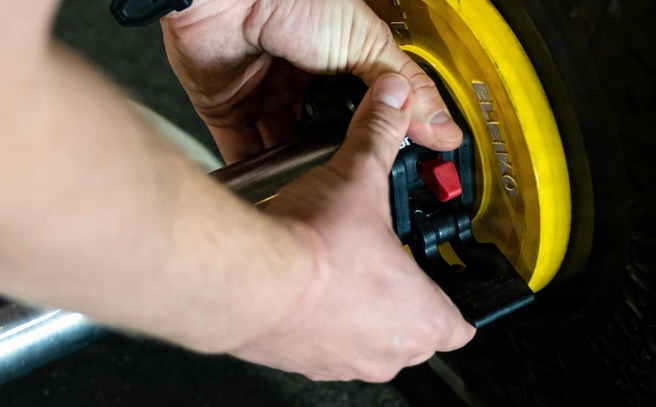
Wedge the empty end of the bar into a corner wrapped in a towel, or slot it into a landmine base or a heavy plate. Load and collar the free end. Before every set, plant your feet, brace, and confirm the anchor cannot slide; a shifting anchor is how most landmine sets go wrong.
The Best Landmine Leg Exercises
These six cover the squat, hinge, and single-leg patterns. Own each with an empty bar before adding plates.
1. Landmine Goblet Squat
Hold the end of the bar with both hands at your chest, elbows tucked.
Stand with feet shoulder-width, leaning slightly into the bar.
Sit down between your heels until your thighs reach parallel or just below.
Drive the floor away and stand tall without letting your chest drop.
This is the first landmine squat to learn, and a solid front squat substitute when your wrists or shoulders will not tolerate a front rack.
2. Landmine Hack Squat
Turn your back to the anchor and rest the end of the bar on the front of one shoulder, holding it with both hands. Lean back into the bar and squat, keeping your weight through mid-foot. The angle loads the quads hard with almost no lower-back demand. Switch shoulders each set.
3. Landmine Romanian Deadlift
Straddle the bar facing the anchor, or stand at its end, holding the sleeve with both hands at hip height. Push your hips back with soft knees until you feel a deep hamstring stretch, then drive the hips through to stand. The arc pulls the load into your body, so the hinge is easier to groove than with a free barbell.
4. Single-Leg Landmine RDL
Stand beside the bar and hold the sleeve in one hand. Hinge on the opposite leg, letting the free leg reach back, and return to standing. The bar acts as a guide rail, so you can load the hinge before balance runs out. It builds the hip and ankle stability uneven ground demands.
5. Landmine Reverse Lunge
Hold the bar at your chest as you would for the goblet squat. Step one foot back, lower the back knee toward the floor, and drive through the front foot to return. Stepping back keeps the shin more vertical than a forward lunge, which is easier on the front knee. Our guide to weighted lunges covers the free-weight versions.
6. Landmine Split Squat
Set a split stance and hold the bar at your chest or in the hand opposite the front leg. Lower straight down and stand back up without moving your feet. A fixed stance lets you load more than a lunge. If it bothers your knees, our split squat alternatives guide offers options.
What About the Landmine Leg Press?
The landmine leg press means lying under the bar and pressing the loaded end with your feet, and most versions need a foot-plate attachment. The hack squat trains the same muscles standing with no extra gear, so we rank the press last.
If you would rather follow a done-for-you plan than build one, our guide to choosing a strength & endurance program covers what to look for.
A Landmine Leg Workout You Can Run Twice a Week
Run this landmine leg workout two times a week as your main lower-body session or alongside barbell work. Bilateral moves go first while you are fresh; single-leg work follows (Haff and Triplett, 2016).
Landmine goblet squat: 4 sets of 8, 90 seconds rest.
Landmine Romanian deadlift: 3 sets of 8, 90 seconds rest.
Landmine reverse lunge: 3 sets of 8 per leg, 60 seconds rest.
Single-leg landmine RDL: 3 sets of 6 per leg, 60 seconds rest.
Landmine hack squat: 2 sets of 12, 60 seconds rest.
That is 15 hard sets in about 40 minutes; twice a week, the weekly volume sits in the range that drives strength and muscle gain (Schoenfeld et al., 2017).
How to Progress
Add reps to the top of each range, then add the smallest plate and drop back to the low end. Keep stance and distance identical. Finish with landmine core exercises on the same setup. To slot this into a full week, see a strength workout for athletes. Presses and rows belong to our general landmine exercises guide.
Frequently Asked Questions
What are the best landmine leg exercises?
The best landmine leg exercises are the goblet squat, hack squat, Romanian deadlift, single-leg RDL, reverse lunge, and split squat. They cover the squat, hinge, and single-leg patterns with one barbell and a corner.
Is the landmine good for building legs?
The landmine is good for building legs when you train it hard and progress the load. It cannot match a back squat for maximal loading, but it builds strength and muscle with less joint stress.
Why is the landmine easier on the knees and back?
The landmine is easier on the knees and back because the front-loaded position keeps your torso upright and the anchor guides the bar’s path. Less forward lean means less lower-back demand.
Can you do single-leg work with a landmine?
You can do single-leg work with a landmine, and it is one of its best uses. The reverse lunge, split squat, and single-leg RDL load well because the anchored bar steadies you, so balance stops limiting the weight.
What is a landmine leg press?
A landmine leg press is a variation where you lie under the bar and press the loaded end with your feet. Most versions need a foot-plate attachment, so the hack squat is the simpler standing option.
Do you need a landmine attachment or just a corner?
You need only a barbell and a corner. Wedge the empty end into the corner with a towel, or slot it into a heavy plate. A landmine base adds convenience but is not required for any exercise here.
How do you program a landmine leg workout?
Program a landmine leg workout with one squat, one hinge, and one or two single-leg moves, two times a week. Use 6 to 12 reps, add reps before load, and keep your stance and distance from the anchor constant.
Landmine leg exercises give you squat, hinge, and single-leg strength with a barbell, a corner, and far less wear on your knees and back. Learn the goblet squat and Romanian deadlift first, earn the single-leg work, and run the session twice a week. Grab the free printable landmine leg routine and put it on your training calendar this week.
References:
Bishop C, Turner A, Read P. Effects of inter-limb asymmetries on physical and sports performance: a systematic review. Journal of Sports Sciences. 2018;36(10):1135-1144.
Escamilla RF. Knee biomechanics of the dynamic squat exercise. Medicine and Science in Sports and Exercise. 2001;33(1):127-141.
Gullett JC, Tillman MD, Gutierrez GM, Chow JW. A biomechanical comparison of back and front squats in healthy trained individuals. Journal of Strength and Conditioning Research. 2009;23(1):284-292.
Haff GG, Triplett NT, eds. Essentials of Strength Training and Conditioning. 4th ed. Champaign, IL: Human Kinetics; 2016.
Knapik JJ, Reynolds KL, Harman E. Soldier load carriage: historical, physiological, biomechanical, and medical aspects. Military Medicine. 2004;169(1):45-56.
McCurdy KW, Langford GA, Doscher MW, Wiley LP, Mallard KG. The effects of short-term unilateral and bilateral lower-body resistance training on measures of strength and power. Journal of Strength and Conditioning Research. 2005;19(1):9-15.
Molloy JM, Pendergrass TL, Lee IE, et al. Musculoskeletal injuries and United States Army readiness part I: overview of injuries and their strategic impact. Military Medicine. 2020;185(9-10):e1461-e1471.
Schoenfeld BJ. Squatting kinematics and kinetics and their application to exercise performance. Journal of Strength and Conditioning Research. 2010;24(12):3497-3506.
Schoenfeld BJ, Ogborn D, Krieger JW. Dose-response relationship between weekly resistance training volume and increases in muscle mass: a systematic review and meta-analysis. Journal of Sports Sciences. 2017;35(11):1073-1082.
Speirs DE, Bennett MA, Finn CV, Turner AP. Unilateral vs. bilateral squat training for strength, sprints, and agility in academy rugby players. Journal of Strength and Conditioning Research. 2016;30(2):386-392.
Disclaimer: This article is for educational purposes and is not medical advice. If you have knee, hip, or back pain, or a diagnosed condition, get cleared by a qualified medical provider before starting a new exercise program. Stop any exercise that causes sharp or worsening pain.


