Good Mornings With Dumbbells: Form Guide | Combat Fitness
Good Mornings With Dumbbells: How to Hold the Weight and Hinge Safely
Yes, you can do good mornings with dumbbells, and for most tactical athletes training at home or in a garrison gym, the dumbbell version is the smarter choice. Hold one dumbbell vertically against your chest, or rest it across your upper back. Then push your hips back with soft knees and a flat back, and drive them forward to stand. That hinge is the pattern you use to pick up a ruck, a casualty, or a battering ram, which is why it shows up in our tactical fitness programs.
This guide covers where to hold the weight, the step-by-step hinge, the muscles worked, how the dumbbell good morning compares to the barbell version and the RDL, seated versus standing, and how to program it.
How Do You Do a Dumbbell Good Morning? (Step by Step)
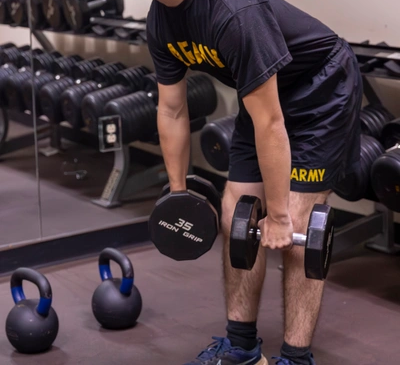
A dumbbell good morning is a hip hinge with the weight held on your torso instead of in your hands. You keep your knees slightly bent and your spine neutral, push your hips back until your hamstrings are fully stretched, then drive your hips forward to stand. The hold changes the difficulty. The hinge never changes.
Where to Hold the Dumbbell
Where you hold the dumbbell determines how hard the exercise is at a given weight. The farther the load sits from your hips, the longer the lever your back has to resist.
Goblet hold (at the chest): Cup one end of a single dumbbell with both hands and pin it against your sternum. It is the easiest position to brace, the most common, and the right starting point.
Behind-the-neck hold: Lay one dumbbell horizontally across your upper traps and grip both ends. It mimics the barbell lever, so it is harder at the same weight. Keep it on the meat of the traps, never on the bones of the neck.
Two dumbbells at the shoulders: Rest a dumbbell on each shoulder, elbows forward. It allows more total load once a single dumbbell gets light.
The Hinge, Step by Step
Stand with your feet hip-width apart and unlock your knees into an athletic stance.
Breathe into your belly and brace your trunk as if you were about to take a punch.
Push your hips straight back. Your torso tilts forward and your shins stay close to vertical.
Lower until you feel a strong hamstring stretch or your back starts to round, usually with your torso near or slightly above parallel.
Drive your hips forward and squeeze your glutes to stand tall. Do not lean back at the top.
Exhale, re-brace, and repeat.
Lower-Back Safety Note
The good morning is a load-sensitive lift. The weight sits on a long lever, so a small jump in load means a large jump in demand on your spinal erectors. Research on good morning loading found that as load increased, lifters bent their knees more and changed how they moved. In practice, heavier weight quietly turns the exercise into something else. Start light, end the set when your back position changes, and get cleared by a clinician before loading the movement if you have current low-back pain.
What Muscles Do Dumbbell Good Mornings Work?
Dumbbell good mornings primarily work the hamstrings, glutes, and spinal erectors, with the abdominals and upper back working hard to brace the trunk. The hamstrings and glutes move the hips. The erectors hold the spine still against the forward pull of the weight, which is the strength that protects your back under load.
Hamstrings: They lengthen under tension as your hips travel back, then contract to extend the hip. EMG research comparing hamstring exercises shows that hip-dominant lifts like the good morning and the RDL load the hamstrings heavily.
Glutes: They finish the hip extension at the top of each rep.
Spinal erectors: They work isometrically, resisting flexion for the whole set.
Trunk and upper back: The abs, obliques, lats, and upper back keep the dumbbell pinned and your torso rigid.
Those isometric erectors are the reason we program this lift for tactical athletes. Load carriage studies show that a heavy pack pulls the trunk into flexion and increases demand on the lower back over long distances. A back that is trained to hold position under a forward lever handles that demand better. The same posterior-chain case we make for Romanian deadlift benefits applies here, and it is a core piece of functional strength for military performance.
Dumbbell vs. Barbell Good Morning vs. RDL: What Is the Difference?
The dumbbell good morning, the barbell good morning, and the RDL all train the hip hinge, but they put the load in different places. The dumbbell version is lighter, needs no rack, and keeps a bar off your neck. The barbell version allows heavier loading. The RDL keeps the weight in your hands, so you can lift more and emphasize the hamstrings.
Dumbbell vs. Barbell Good Morning
The barbell good morning needs a rack and puts a loaded bar across your upper back, which many athletes with neck or shoulder issues tolerate poorly. The dumbbell version needs one dumbbell and a few feet of floor, which makes it practical in a barracks room, a hotel, or a station gym. The trade-off is the ceiling. Once your heaviest dumbbell feels easy, progress with slower lowering, pauses at the bottom, or more reps before moving to a barbell.
Good Morning vs. RDL (and the Deadlift)
In the Romanian deadlift, the weight hangs from your hands close to your legs, so the lever is shorter and you can handle much more load. The good morning puts the weight on your torso, which lengthens the lever and shifts more of the demand to your spinal erectors. A biomechanical comparison of deadlifts and good mornings found that the deadlift involves more knee movement, while the good morning concentrates the work at the hips and lower back.
The difference between good mornings and deadlifts with dumbbells comes down to purpose. Use the RDL or deadlift as your main hinge for building strength, and the good morning as an accessory for erector endurance and hinge control. If you want that sorted into a full plan, our guide to choosing a strength & endurance program explains what a sound program should include.
Seated vs. Standing Dumbbell Good Mornings: Which Should You Do?
Standing dumbbell good mornings should be your default, because they train the full hip hinge you use in the field. Seated dumbbell good mornings remove most of the hamstring stretch and focus the work on your spinal erectors and upper back. That makes them useful when a hamstring is irritated or when you want to isolate the back.
To do the seated version, sit on the end of a bench with your feet wide and flat. Hold the dumbbell at your chest and hinge forward from the hips with a flat back, then sit tall. Your legs cannot contribute much, so use a lighter weight than you would standing.
How to Program Dumbbell Good Mornings
Program dumbbell good mornings as an accessory after your main lower-body lift. Use 2 to 4 sets of 8 to 15 reps, one or two sessions per week, and stop each set with 2 to 3 good reps left. Moderate reps match the job of the exercise, which is building endurance and position control, not testing a max.
Some ways to fit the good morning workout with dumbbells into a training week:
Lower-body strength day: After squats or deadlifts, 3 sets of 10 with a 3-second lowering phase.
Pre-ruck primer: 2 light sets of 8 with a 2-second pause at the bottom to wake up the posterior chain.
Home or garrison day: Pair it with split squats and a plank variation for a dumbbell-only lower-body session.
For load, start with a dumbbell you could hinge for 15 clean reps. Add reps first, then slow the tempo, and only then add weight. The guidance is the same for women: the movement, sets, and reps do not change, and research shows women make comparable relative strength gains from resistance training. Scale the dumbbell to your strength, not your sex. For a complete session built around the hinge, see our guide to a strength workout for athletes.
Frequently Asked Questions
Can you do good mornings with dumbbells?
Yes. Hold one dumbbell at your chest or across your upper back and perform the same hip hinge as the barbell version. The dumbbell good morning works the same muscles, needs no rack, and keeps a bar off your neck, which makes it a practical option for home, garrison, or travel training.
Where do you hold the dumbbell for a good morning?
Hold it vertically against your chest in a goblet grip. This is the easiest position to brace and the best place to start. For a harder variation, rest one dumbbell horizontally across your upper traps, which lengthens the lever and mimics the barbell good morning at a lower load.
What muscles do dumbbell good mornings work?
Dumbbell good mornings work the hamstrings, glutes, and spinal erectors. Your hamstrings and glutes extend the hip, and your erectors hold your spine neutral against the weight. Your abs, obliques, lats, and upper back also work to keep your trunk rigid and the dumbbell in place.
What is the difference between dumbbell and barbell good mornings?
Both use the same hinge, but the barbell version puts a loaded bar across your back and allows much heavier weights. The dumbbell version is lighter, needs no rack, and is easier on the neck and shoulders. Most tactical athletes get what they need from dumbbells before a barbell is necessary.
Good morning vs. RDL: which should you do?
Do both, for different jobs. The RDL holds the weight in your hands on a shorter lever, so it is the better main lift for heavy hamstring and hip strength. The good morning loads your torso on a longer lever, which makes it a better accessory for spinal erector endurance and hinge control.
How much weight should you use for dumbbell good mornings?
Start with a dumbbell you can hinge for 15 clean reps with a flat back. Progress by adding reps, then slowing the lowering phase, then adding weight. The good morning is load-sensitive, so stop any set when your back starts to round or your knees begin to take over the movement.
Good mornings with dumbbells give you a hinge that builds the hamstrings, glutes, and spinal erectors without a rack or a bar across your neck. Hold the dumbbell at your chest, keep your knees soft and your back flat, and treat the lift as an accessory you progress slowly. Add it to your next lower-body session this week, then build it into a structured plan, so the back strength you develop carries over to every ruck, lift, and drag the job requires.
References:
Vigotsky AD, Harper EN, Ryan DR, Contreras B. Effects of load on good morning kinematics and EMG activity. PeerJ. 2015;3:e708.
Schellenberg F, Lindorfer J, List R, Taylor WR, Lorenzetti S. Kinetic and kinematic differences between deadlifts and goodmornings. BMC Sports Science, Medicine and Rehabilitation. 2013;5:27.
McAllister MJ, Hammond KG, Schilling BK, Ferreria LC, Reed JP, Weiss LW. Muscle activation during various hamstring exercises. Journal of Strength and Conditioning Research. 2014;28(6):1573-1580.
Knapik JJ, Reynolds KL, Harman E. Soldier load carriage: historical, physiological, biomechanical, and medical aspects. Military Medicine. 2004;169(1):45-56.
Nindl BC, Williams TJ, Deuster PA, Butler NL, Jones BH. Strategies for optimizing military physical readiness and preventing musculoskeletal injuries in the 21st century. US Army Medical Department Journal. 2013;Oct-Dec:5-23.
Headquarters, Department of the Army. FM 7-22, Holistic Health and Fitness. October 2020.
McGill SM. Low Back Disorders: Evidence-Based Prevention and Rehabilitation. 3rd ed. Champaign, IL: Human Kinetics; 2016.
Haff GG, Triplett NT, eds. Essentials of Strength Training and Conditioning. 4th ed. National Strength and Conditioning Association. Champaign, IL: Human Kinetics; 2016.
American College of Sports Medicine. Progression models in resistance training for healthy adults. Medicine and Science in Sports and Exercise. 2009;41(3):687-708.
Schoenfeld BJ, Ogborn D, Krieger JW. Dose-response relationship between weekly resistance training volume and increases in muscle mass: a systematic review and meta-analysis. Journal of Sports Sciences. 2017;35(11):1073-1082.
Helms ER, Cronin J, Storey A, Zourdos MC. Application of the repetitions in reserve-based rating of perceived exertion scale for resistance training. Strength and Conditioning Journal. 2016;38(4):42-49.
Roberts BM, Nuckols G, Krieger JW. Sex differences in resistance training: a systematic review and meta-analysis. Journal of Strength and Conditioning Research. 2020;34(5):1448-1460.
Disclaimer: This article is for educational purposes only and is not medical advice. Consult a qualified healthcare provider before starting a new exercise program, especially if you have a history of back, neck, or hamstring injury. Stop any exercise that causes pain and seek professional guidance.


