
Explosive Squats: How to Build Leg Power | Combat Fitness
Explosive Squats: Turn Leg Strength Into Usable Power
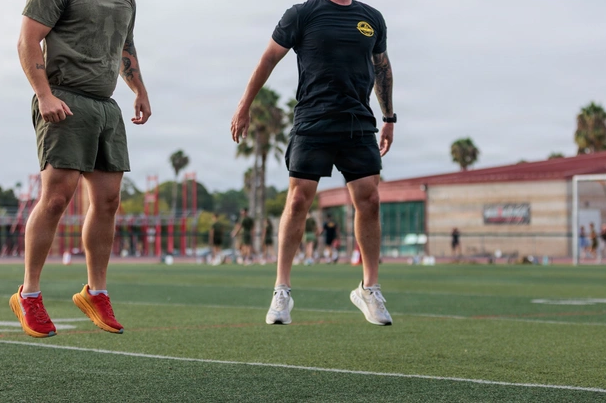
Explosive squats are squats performed with maximal speed on the way up, often finishing in a jump, to build power (force produced quickly) instead of strength alone. You lower under control, then drive out of the bottom as fast as you can on every rep. If you want this power work programmed around your strength, running, and rucking, our tactical fitness programs build it into one complete plan.
We program explosive squats for selection candidates because a strong squat only helps if you can express it fast. Below: the benefits, four variations, the muscles worked, and how to program them.
Benefits: Why Train Explosive Squats?
Explosive squats train rate of force development (RFD), the speed at which your muscles reach high force. Sprinting, jumping, and changing direction happen in roughly a quarter of a second or less, while reaching maximal force takes 300 milliseconds or longer (Aagaard et al., 2002; Maffiuletti et al., 2016). A heavy squat raises your ceiling. Explosive squats teach you to reach more of it in the time a real movement allows.
The benefits:
A higher vertical jump. Jump training reliably improves jump height (Markovic, 2007; de Villarreal et al., 2009).
Faster acceleration. Squat strength is strongly linked to short sprint times (Wisløff et al., 2004).
Tactical carryover. Sprinting to cover, clearing an obstacle, and getting up off the ground in kit all depend on fast force. Army doctrine treats power as its own fitness component (Department of the Army, 2020).
Low recovery cost. Power sets are short, so your legs are still fresh for tomorrow's ruck.
Do Squats Make You More Explosive?
Heavy squats make you more explosive up to a point. A weaker athlete gets more explosive from strength work alone (Suchomel et al., 2016), and stronger athletes respond better once they add power training (Cormie et al., 2010).
That is the Combat Fitness position: explosive squats are the bridge from max strength to tactical power. Pair heavy strength work with explosive squats. Do not replace one with the other. Treating power as tactical capacity is the core idea behind functional strength for military performance.
The Explosive Squat Variations
Each variation trains a different part of the force-velocity curve. Pick the one that matches what you need and what you have.
Jump Squats (Bodyweight Power)
Explosive jump squats are the entry point. Peak power in the jump squat often occurs at or near bodyweight (Cormie et al., 2007), and jump squats at about 30 percent of 1RM beat heavy squats and plyometrics for jump and sprint gains in an early study (Wilson et al., 1993).
How to do explosive squats correctly (jump squat):
Stand with feet hip to shoulder width.
Drop fast into a quarter to half squat, hips back, chest up.
Reverse instantly, driving through the whole foot and swinging your arms up.
Extend hips, knees, and ankles fully as you leave the floor.
Land softly, sink your hips back, reset, and repeat at max height.
Safety cue: land with your knees tracking over your toes. Knees caving inward on landing is a known risk pattern for knee injury (Hewett et al., 2005). If landings get loud or your knees collapse, end the set.
For explosive squats with weights, use light dumbbells or a trap bar at about 30 percent of your squat max or less. Jump height, not load, is the target.
Speed Squats (Dynamic Effort, Barbell)
Speed squats are explosive squats with a barbell at 50 to 60 percent of 1RM, moved as fast as possible for 2 to 3 reps (Zatsiorsky and Kraemer, 2006). Intent drives the adaptation, even when the load limits bar speed (Behm and Sale, 1993). Squatting at maximal intended velocity produced larger strength and jump gains than the same program done at half speed (Pareja-Blanco et al., 2014).
Box Squats (Reset and Explode)
Explosive box squats have you sit back to a box at parallel, pause briefly, then drive up hard. The pause removes the stretch reflex, so every rep starts from a dead stop and builds starting strength (Swinton et al., 2012). Stay tight on the box. Do not relax or rock.
Quarter Squats (Overload the Top)
Explosive quarter squats train the joint angles used in jumping and sprinting. In trained athletes, 16 weeks of quarter squats transferred to jump height and sprint speed better than half or full squats (Rhea et al., 2016), though another study found deep squats improved jumping more (Hartmann et al., 2012). Use them to supplement full-depth work, not replace it.
What Do Explosive Squats Work?
Explosive squats work the quadriceps, glutes, hamstrings, and calves, with the adductors and trunk stabilizing every rep. The quads and glutes drive extension, the calves finish the jump, and the trunk transfers force from the floor without leaking it.
The bigger training effect is neural. Intent to move fast recruits high-threshold, fast-twitch motor units and improves how quickly they fire (Aagaard et al., 2002; Cormie et al., 2011a). That is the quality that turns muscle into power.
How to Program Explosive Squats
Program explosive squats as power work: 3 to 5 reps per set, maximal intent, and 2 to 3 minutes of rest. Place them early in the session, after your warm-up and before heavy lifting, when your nervous system is fresh (Haff and Triplett, 2016; Haff and Nimphius, 2012). Train them one to three times per week.
These are a power tool. Keep reps low and quality high, and do not chase fatigue. Sets kept short of fatigue preserve speed and improve jumping better than sets taken to failure (Pareja-Blanco et al., 2017). End the set when a rep slows down. Fifty jump squats in a row is conditioning, not power.
Starting points:
Jump squats: 3 to 5 sets of 3 to 5 reps.
Speed squats: 6 to 10 sets of 2 to 3 reps at 50 to 60 percent of 1RM.
Box and quarter squats: 3 to 5 sets of 2 to 5 reps, always fast.
The Strength Pairing
Pair explosive squats with heavy squats in the same week or session. Day one: 4 sets of 3 jump squats, then heavy back squats. Day two: 8 sets of 2 speed squats, then single-leg work. The heavy half comes from a strength workout for athletes.
The leg blaster bodyweight complex and the medicine ball slam follow the same low-rep, max-intent rules for conditioning and upper-body power. To fit all of it around running and rucking, our guide to choosing a strength & endurance program shows where power work belongs.
Explosive Squats in Your Wider Power Training
Squats are one family of explosive exercises. Broad jumps, bounds, and kettlebell swings train the same quality from other angles. Make explosive squats your primary lower-body power lift.
Frequently Asked Questions
What are explosive squats?
Explosive squats are squats performed with maximal speed on the way up, often ending in a jump. You lower under control, then drive up as fast as possible. The goal is power, meaning force produced quickly, not just the ability to lift a heavy load slowly.
What are the benefits of explosive squats?
Explosive squats improve rate of force development, vertical jump, and sprint acceleration. For tactical athletes, that means faster first steps, quicker get-ups off the ground, and more power under load, at a low recovery cost.
Do squats make you more explosive?
Heavy squats make you more explosive, especially if you are not yet strong. Past a point, strength alone stops transferring, and you need speed work to use it. The best results come from pairing heavy squats with explosive squats, not choosing one over the other.
How do you do explosive squats correctly?
Drop fast into a quarter to half squat with hips back and chest up, then reverse instantly and drive through your whole foot to full extension. On jump variations, land softly with your knees tracking over your toes, then reset.
Are explosive squats good for your vertical jump?
Explosive squats are one of the best tools for your vertical jump. Jump training reliably improves jump height, and quarter squats train takeoff joint angles. Combine them with heavy full-depth squats to build both the strength and the speed behind the jump.
How many reps should you do for explosive squats?
Do 3 to 5 reps per set for jump squats and 2 to 3 reps per set for speed squats, with 2 to 3 minutes of rest. Stop each set as soon as a rep slows down. High-rep sets train conditioning, not power.
Should you do explosive squats with weights or bodyweight?
Start with bodyweight jump squats, since peak power often occurs near bodyweight. Add light dumbbells or a trap bar once your landings are clean, and use a barbell at 50 to 60 percent of 1RM for speed squats. Every rep must stay fast.
Explosive squats turn the strength you built under the bar into power you can use at selection or on the job. Keep reps low, rest fully, move every rep with maximal intent, and pair them with heavy squats. Add one variation to your next lower-body day, and download the free power and lower-body block to keep it in your plan.
References:
Aagaard P, Simonsen EB, Andersen JL, Magnusson P, Dyhre-Poulsen P. Increased rate of force development and neural drive of human skeletal muscle following resistance training. Journal of Applied Physiology. 2002;93(4):1318-1326.
Behm DG, Sale DG. Intended rather than actual movement velocity determines velocity-specific training response. Journal of Applied Physiology. 1993;74(1):359-368.
Cormie P, McCaulley GO, Triplett NT, McBride JM. Optimal loading for maximal power output during lower-body resistance exercises. Medicine & Science in Sports & Exercise. 2007;39(2):340-349.
Cormie P, McGuigan MR, Newton RU. Influence of strength on magnitude and mechanisms of adaptation to power training. Medicine & Science in Sports & Exercise. 2010;42(8):1566-1581.
Cormie P, McGuigan MR, Newton RU. Developing maximal neuromuscular power: part 1, biological basis of maximal power production. Sports Medicine. 2011;41(1):17-38.
Cormie P, McGuigan MR, Newton RU. Developing maximal neuromuscular power: part 2, training considerations for improving maximal power production. Sports Medicine. 2011;41(2):125-146.
de Villarreal ES, Kellis E, Kraemer WJ, Izquierdo M. Determining variables of plyometric training for improving vertical jump height performance: a meta-analysis. Journal of Strength and Conditioning Research. 2009;23(2):495-506.
Haff GG, Nimphius S. Training principles for power. Strength and Conditioning Journal. 2012;34(6):2-12.
Haff GG, Triplett NT, eds. Essentials of Strength Training and Conditioning. 4th ed. National Strength and Conditioning Association. Champaign, IL: Human Kinetics; 2016.
Hartmann H, Wirth K, Klusemann M, et al. Influence of squatting depth on jumping performance. Journal of Strength and Conditioning Research. 2012;26(12):3243-3261.
Headquarters, Department of the Army. FM 7-22: Holistic Health and Fitness. Washington, DC; 2020.
Hewett TE, Myer GD, Ford KR, et al. Biomechanical measures of neuromuscular control and valgus loading of the knee predict anterior cruciate ligament injury risk in female athletes. American Journal of Sports Medicine. 2005;33(4):492-501.
Maffiuletti NA, Aagaard P, Blazevich AJ, Folland J, Tillin N, Duchateau J. Rate of force development: physiological and methodological considerations. European Journal of Applied Physiology. 2016;116(6):1091-1116.
Markovic G. Does plyometric training improve vertical jump height? A meta-analytical review. British Journal of Sports Medicine. 2007;41(6):349-355.
Pareja-Blanco F, Rodriguez-Rosell D, Sanchez-Medina L, Gorostiaga EM, Gonzalez-Badillo JJ. Effect of movement velocity during resistance training on neuromuscular performance. International Journal of Sports Medicine. 2014;35(11):916-924.
Pareja-Blanco F, Rodriguez-Rosell D, Sanchez-Medina L, et al. Effects of velocity loss during resistance training on athletic performance, strength gains and muscle adaptations. Scandinavian Journal of Medicine & Science in Sports. 2017;27(7):724-735.
Rhea MR, Kenn JG, Peterson MD, et al. Joint-angle specific strength adaptations influence improvements in power in highly trained athletes. Human Movement. 2016;17(1):43-49.
Suchomel TJ, Nimphius S, Stone MH. The importance of muscular strength in athletic performance. Sports Medicine. 2016;46(10):1419-1449.
Swinton PA, Lloyd R, Keogh JW, Agouris I, Stewart AD. A biomechanical comparison of the traditional squat, powerlifting squat, and box squat. Journal of Strength and Conditioning Research. 2012;26(7):1805-1816.
Wilson GJ, Newton RU, Murphy AJ, Humphries BJ. The optimal training load for the development of dynamic athletic performance. Medicine & Science in Sports & Exercise. 1993;25(11):1279-1286.
Wisløff U, Castagna C, Helgerud J, Jones R, Hoff J. Strong correlation of maximal squat strength with sprint performance and vertical jump height in elite soccer players. British Journal of Sports Medicine. 2004;38(3):285-288.
Zatsiorsky VM, Kraemer WJ. Science and Practice of Strength Training. 2nd ed. Champaign, IL: Human Kinetics; 2006.
Disclaimer: This article is for educational purposes and is not medical advice. If you have knee, hip, or back pain, a past injury, or a diagnosed condition, get cleared by a qualified clinician before starting a new exercise program. Stop any exercise that causes sharp or worsening pain. Results vary by individual, and no program guarantees performance gains or injury prevention.


