
Dumbbell Thruster: Form, Muscles Worked | Combat Fitness
Dumbbell Thruster: How to Do It, Muscles Worked, and WOD Uses
A dumbbell thruster is a front squat that drives straight into an overhead press in one continuous rep, with a dumbbell racked on each shoulder. One movement trains your legs, hips, shoulders, and trunk together, then taxes your conditioning because no part of the rep gives you a break. That combination is why we use it inside our tactical fitness programs as a work-capacity builder, not a shoulder exercise.
Tactical work rarely isolates a muscle. Lifting a casualty, clearing a wall, or getting a load overhead all ask the legs to start the force and the arms to finish it. Below you get the muscles worked, the exact setup and cues, the single-arm version, how thrusters behave in a WOD, how dumbbells compare to the barbell, the mistakes that cost you reps, and how to program the lift.
The dumbbell thruster in four cues:
Rack the dumbbells on your shoulders, elbows forward, trunk braced.
Squat to full depth with your chest tall and heels down.
Stand hard and let your hips push the dumbbells upward.
Press to lockout as your legs finish, with no pause in between.
What Muscles Does the Dumbbell Thruster Work?
The dumbbell thruster works the quadriceps, glutes, and adductors through the squat, then the deltoids, triceps, and upper back through the press, while your trunk braces the entire rep. It is a full-body exercise because the lower body generates the force that the upper body finishes overhead.
Quadriceps and glutes: drive you out of the bottom of the front squat. Deeper squats place more demand on the glutes and quads through the hardest part of the range (Schoenfeld, 2010).
Adductors: help stabilize and extend the hip out of a full-depth squat.
Deltoids and triceps: press the dumbbells to lockout. Standing presses with dumbbells change shoulder and trunk muscle activity compared with seated or barbell pressing (Saeterbakken and Fimland, 2013).
Upper traps and serratus anterior: rotate the shoulder blades upward so your arms can finish directly overhead.
Core: holds the torso upright in the front rack and keeps your low back from arching at lockout.
What the thruster trains that a separate squat and press do not is timing. Your legs create momentum and your trunk transfers it to your arms, the same leg-drive principle that lets a push press move more load than a strict press (Lake, Mundy, and Comfort, 2014). That force transfer is what carries over to real tasks.
How to Do a Dumbbell Thruster
Dumbbell thruster technique comes down to one chain: rack, brace, squat, drive, press, return. Do it in this order:
Set the front rack. Clean or curl the dumbbells onto your shoulders, one head resting on each shoulder, elbows pointing forward and slightly up. Stand with feet about shoulder width apart, toes turned out a little.
Brace. Take a big breath into your belly and tighten your trunk as if you were about to take a punch.
Squat. Sit your hips back and down with your chest tall and knees tracking over your toes. Go to full depth, or as deep as you can while your torso stays upright.
Drive. Push through the whole foot and stand up fast. As your hips reach full extension, that upward momentum starts the dumbbells moving.
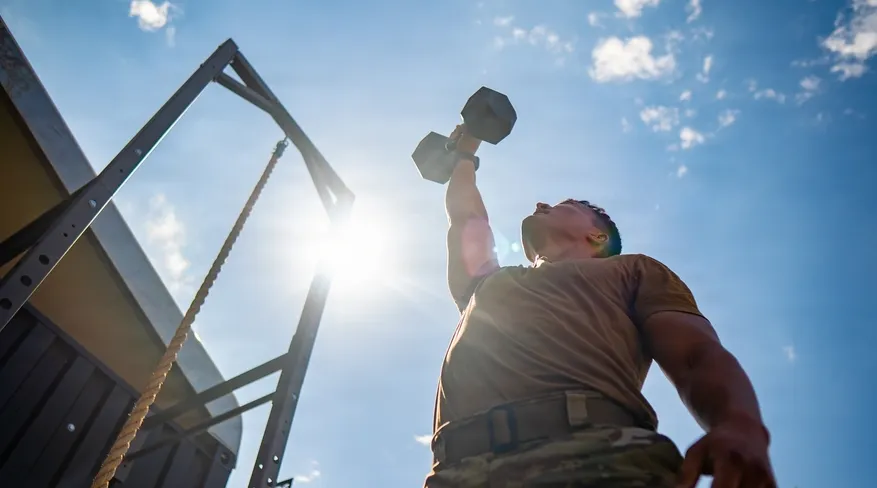
Press. Punch the dumbbells to lockout with your biceps beside your ears, ribs down, and the weight stacked over your midfoot.
Return. Lower the dumbbells to your shoulders under control and sink straight into the next squat.
The Cue That Matters Most: Stand, Then Press
Pressing before you stand turns a leg-driven lift into a weak shoulder press, and your delts fail long before your legs do. Hips lead, arms follow. Keep the trunk braced through the squat, then exhale at lockout and take a fresh breath at the top before the next rep. Holding your breath through short efforts raises intra-abdominal pressure and stiffens the spine, but extended breath-holding across many reps costs you oxygen you need (Hackett and Chow, 2013).
Dumbbell Squat Thruster and Goblet Thruster
A “dumbbell squat thruster” is the same lift under another name. The dumbbell goblet thruster uses one dumbbell held vertically at your chest by the head. You squat, then press it overhead with both hands. The counterweight in front keeps your torso upright, which makes the goblet version a good teaching tool for athletes still learning squat depth.
How Do You Do a Single-Arm Dumbbell Thruster?
A single-arm dumbbell thruster uses one dumbbell racked on one shoulder. You squat and press on that side while refusing to lean or twist toward the load. The movement pattern is identical to the two-dumbbell version, but the offset load turns your trunk into an anti-lateral-flexion and anti-rotation exercise.
Set up the same way: dumbbell on the shoulder, elbow forward, free arm held out to the side or resting on your hip. Keep your shoulders level through the squat and press. If your torso bends toward the dumbbell, the load is too heavy.
Carrying a load in one hand increases spinal loading and lateral trunk demand compared with splitting it across both hands (McGill, Marshall, and Andersen, 2013). That matters for tactical athletes, because real loads are rarely symmetrical: a ruck strap riding to one side, a shield on one arm, a casualty dragged by one handle. Start each set with your weaker side and match the reps on the stronger side. Choose a load well below what you would hold in each hand for the bilateral version.
Why Is the Thruster a WOD Staple, and Why Does It Gas You?
The thruster moves a large share of your muscle mass through a long range of motion on every rep, with almost no position to rest in. Heart rate and breathing climb fast, which is why metcon programming use it so often. The benchmark workout “Fran,” 21-15-9 barbell thrusters and pull-ups, built that reputation.
A few things make thrusters harder than the load suggests:
Your legs and shoulders work in the same rep, so local fatigue builds in two places at once.
The front rack and bracing restrict breathing between reps.
The only “rest” positions, the rack and lockout, still require you to hold the weight.
Pacing matters in a dumbbell thruster WOD or AMRAP. Pick a load you could move for 10 or more unbroken reps fresh, break sets before your form breaks, and breathe at the top of every rep. High-intensity functional training is not inherently riskier than other training in military populations, but technique under fatigue is where injuries happen (Poston et al., 2016).
That ability to produce force repeatedly while tired is the core of functional strength for military performance. A thruster set mimics the demand of a task that keeps going after you want it to stop.
Dumbbell vs. Barbell Thruster: Which Should You Use?
Use the barbell thruster when you want to move more load and develop power. Use the dumbbell thruster when you need to train anywhere, work one side at a time, or need a more forgiving front rack. Neither is better in general; they serve different goals.
Barbell thruster:
Allows heavier loads, since lifters press more with a barbell than dumbbells (Saeterbakken and Fimland, 2013).
Requires good wrist, lat, and thoracic mobility to hold a clean front rack.
Needs a bar, plates, and space.
Dumbbell thruster:
Lets each arm work independently, which exposes and corrects left-right imbalances.
Allows a neutral grip that is easier on many shoulders and wrists.
Works in a hotel gym, a garage, or a deployed setting with minimal equipment.
Adds stability demand, which raises trunk involvement but limits total load (Behm and Anderson, 2006).
What Are the Most Common Dumbbell Thruster Mistakes?
The most common dumbbell thruster mistake is pressing before your hips finish extending. Fix that one and most others shrink. Watch for these:
Pressing early: the arms start before the legs finish, so you lose leg drive.
Cutting the squat short: partial reps reduce the training effect and turn the lift into a push press.
Dropping the elbows: the dumbbells slide forward and pull your chest down in the squat.
Heels rising: weight shifts to the toes and the knees take the load. Widen the stance or work on ankle mobility.
Dumbbells drifting forward overhead: finish with the weight stacked over your midfoot, not in front of your face.
Arching to lock out: ribs flare and the low back takes the load. Keep the brace through the press.
Going too heavy in a metcon: a load you can only move in singles destroys pacing and form.
How Should You Program Dumbbell Thrusters?
Program dumbbell thrusters for strength and power with 4 to 5 sets of 5 to 8 reps at a moderate-to-heavy load and full rest. Program them for conditioning with lighter loads, 10 to 15 reps per set, inside circuits or intervals. Once or twice per week fits most plans.
Practical options:
Strength-power: 4 x 6, two to three minutes of rest, early in the session while you are fresh.
Interval: 6 to 8 reps every minute on the minute for 10 minutes.
Conditioning: rounds of thrusters paired with pull-ups, burpees, or a 200-meter run.
Progress by adding reps at a given load before adding weight, consistent with standard resistance-training progression models (American College of Sports Medicine, 2009; Kraemer and Ratamess, 2004). Treat the thruster as one piece of a week, not the whole plan. To see how it fits around squats, hinges, and pulls, start with a strength workout for athletes. If you are deciding between structured plans, our guide to choosing a strength & endurance program breaks down what to look for.
How Does the Thruster Relate to the Push Press, Hang Squat Clean, and Medicine Ball Thruster?
The Push Press
The barbell push press is the overhead half of the thruster. Instead of a full squat, you use a short dip and drive to launch the bar. If your thruster stalls at the press, push press work builds the leg-to-arm timing in isolation.
The Hang Squat Clean
The hang squat clean takes the bar from the hang into a full front squat. Chained with a thruster, it becomes a complex that trains the whole pull-catch-press sequence in one set.
The Medicine Ball Thruster
The medicine ball thruster uses the same squat-to-press pattern with a ball held at the chest. It is lighter and simpler to learn, which makes it a useful entry point before loading dumbbells.
FAQ: Frequently Asked Questions
What is a dumbbell thruster?
A dumbbell thruster is a compound exercise that combines a front squat and an overhead press into one continuous movement. You rack two dumbbells on your shoulders, squat to full depth, then stand explosively and use that momentum to press the dumbbells to lockout. It trains strength, power, and conditioning in a single rep.
What muscles does the dumbbell thruster work?
The dumbbell thruster works the quadriceps, glutes, and adductors during the squat, plus the deltoids, triceps, upper traps, and serratus anterior during the press. Your core braces the whole time to keep the torso upright and the low back neutral. It is a full-body movement because the legs drive the force the arms finish.
How do you do a dumbbell thruster with good form?
Good dumbbell thruster form starts with a braced front rack, elbows forward. Squat to full depth with heels down and chest tall. Stand hard and only begin pressing as your hips finish extending. Lock out with the dumbbells stacked over your midfoot, biceps by your ears, ribs down. Lower under control and repeat without pausing.
Dumbbell vs. barbell thruster: which is better?
Neither is better overall. The barbell thruster allows heavier loads and builds more absolute power. The dumbbell thruster works each side independently, is easier on many shoulders and wrists, and needs minimal equipment. Use the barbell for strength and power blocks, and dumbbells for unilateral work, travel, or limited-equipment training.
Why are thrusters so hard in a workout?
Thrusters are hard because each rep moves large muscle groups through a long range of motion, with no true rest position. The front rack and bracing restrict breathing, and both the legs and shoulders fatigue at once. That combination drives heart rate and breathing up quickly, which is why thruster-heavy metcons feel far harder than the load suggests.
How do you program dumbbell thrusters?
For strength and power, do 4 to 5 sets of 5 to 8 reps with a moderate-to-heavy load and full rest. For conditioning, use lighter dumbbells for 10 to 15 reps in circuits, EMOMs, or AMRAPs. Train them once or twice per week, and add reps before adding load as you progress.
The dumbbell thruster earns its place because one rep trains what tactical work demands: legs that produce force, a trunk that transfers it, and arms that finish the job, repeated under fatigue. Master the stand-then-press timing first, then decide whether a given day calls for strength sets or conditioning work. Build it into a structured plan, and the thruster stops being a workout you survive and becomes capacity you carry into the job.
References:
Schoenfeld BJ. Squatting kinematics and kinetics and their application to exercise performance. Journal of Strength and Conditioning Research. 2010;24(12):3497-3506.
Saeterbakken AH, Fimland MS. Effects of body position and loading modality on muscle activity and strength in shoulder presses. Journal of Strength and Conditioning Research. 2013;27(7):1824-1831.
Lake JP, Mundy PD, Comfort P. Power and impulse applied during push press exercise. Journal of Strength and Conditioning Research. 2014;28(9):2552-2559.
McGill SM, Marshall L, Andersen J. Low back loads while walking and carrying: comparing the load carried in one hand or in both hands. Ergonomics. 2013;56(2):293-302.
Behm DG, Anderson KG. The role of instability with resistance training. Journal of Strength and Conditioning Research. 2006;20(3):716-722.
Hackett DA, Chow CM. The Valsalva maneuver: its effect on intra-abdominal pressure and safety issues during resistance exercise. Journal of Strength and Conditioning Research. 2013;27(8):2338-2345.
American College of Sports Medicine. Position stand: Progression models in resistance training for healthy adults. Medicine and Science in Sports and Exercise. 2009;41(3):687-708.
Kraemer WJ, Ratamess NA. Fundamentals of resistance training: progression and exercise prescription. Medicine and Science in Sports and Exercise. 2004;36(4):674-688.
Poston WSC, Haddock CK, Heinrich KM, Jahnke SA, Jitnarin N, Batchelor DB. Is high-intensity functional training (HIFT)/CrossFit safe for military fitness training? Military Medicine. 2016;181(7):627-637.
Feito Y, Heinrich KM, Butcher SJ, Poston WSC. High-intensity functional training (HIFT): definition and research implications for improved fitness. Sports. 2018;6(3):76.
Haff GG, Triplett NT, eds. Essentials of Strength Training and Conditioning. 4th ed. National Strength and Conditioning Association. Human Kinetics; 2016.
McGill S. Low Back Disorders: Evidence-Based Prevention and Rehabilitation. 3rd ed. Human Kinetics; 2016.
Headquarters, Department of the Army. FM 7-22: Holistic Health and Fitness. October 2020.
Disclaimer: This article is for educational purposes only and is not medical advice. Consult a qualified healthcare provider before starting a new training program, especially if you have an injury or medical condition. Individual results vary with training history, recovery, and consistency.


