Dumbbell Goblet Squat: Form & Variations | Combat Fitness
Dumbbell Goblet Squat: How to Do It, Muscles Worked & Variations
The dumbbell goblet squat is a squat performed while holding one dumbbell vertically against your chest. It is the fastest way we know to build a clean, braced squat with a single weight. The front-loaded position makes your trunk stay upright and rigid, which is the same bracing you rely on under a ruck, during a casualty drag, or when you lift an awkward crate of gear. That is why it appears early in the military fitness programs we build for service members and first responders, and why it stays in the rotation long after the athlete can squat a barbell.
This guide covers the muscles it trains, how to pick up and hold the bell, the variations worth your time, how it compares to the dumbbell squat, front squat, and kettlebell version, and how heavy to go.
Key Takeaways:
The goblet squat loads the quads and glutes while the front-loaded dumbbell forces hard trunk and upper-back bracing.
The counterbalance of the bell lets most people squat deeper with a more upright torso than they can unloaded.
How you pick up and hold the dumbbell decides how heavy you can go. Cup the top head with both palms and keep the bell against your sternum.
Dumbbells progress in finer jumps than kettlebells, which makes them the better tool for steady loading.
Your arms and upper back usually limit the load before your legs do. When the heaviest bell gets easy, add tempo and pauses or move to a front squat.
What Is a Dumbbell Goblet Squat?
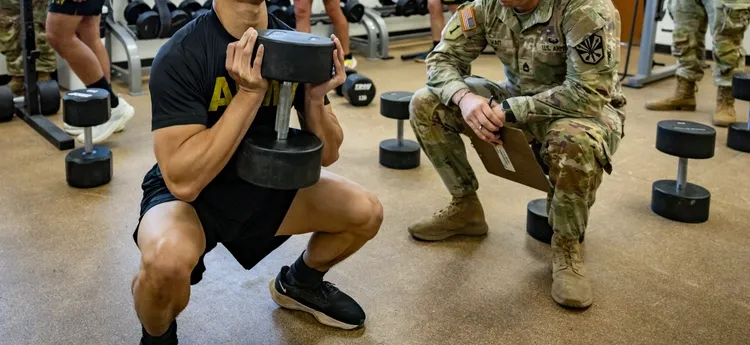
A dumbbell goblet squat is a bilateral squat in which you hold one dumbbell vertically at chest height, cupping the top head in both hands like a goblet. You squat between your knees to full depth while the bell stays against your sternum, then stand by driving through the whole foot.
Strength coach Dan John popularized the movement as a teaching tool. He found that a weight held in front of the body made people sit down between their hips instead of folding forward. The goblet squat with dumbbell and goblet squat dumbbell are the same lift under different names, and so is the goblet dumbbell squat. Some lifters call holding two bells at the shoulders a “double dumbbell goblet squat.” That position is closer to a dumbbell front squat, which we compare below.
What Muscles Does the Goblet Squat Work?
The dumbbell goblet squat trains the quadriceps and glutes as prime movers, with the adductors helping extend the hip at depth. The front load adds heavy isometric work for the abdominals, spinal erectors, and upper back, which must hold the torso rigid against a weight trying to pull it forward.
Here is how the work divides:
Quadriceps: The upright torso keeps the knees traveling forward, so the goblet squat is quad-dominant. This is where the “goblet squat dumbbell quad” reputation comes from.
Glutes: The glutes extend the hip out of the hole, and they work harder the deeper you go.
Adductors: The adductor magnus acts as a hip extensor at the bottom of a deep squat. Training to full depth has been shown to grow the glutes and adductors more than half squats (Kubo et al., 2019).
Trunk: The abdominals, obliques, and erectors brace to keep the spine neutral under an anterior load.
Upper back and arms: The thoracic extensors and the muscles between the shoulder blades keep the chest up, while the biceps and front delts hold the bell in place.
Why the Goblet Squat Is Built for Tactical Athletes
The dumbbell goblet squat benefits tactical athletes in three ways that a gym-floor bodybuilding squat does not.
It trains the brace you carry under load. Soldiers routinely move heavy external loads, and load carriage places sustained demand on the trunk and lower body (Knapik et al., 2004). Army doctrine frames strength training around the physical demands of combat tasks such as lifting, carrying, and moving loads (FM 7-22). The goblet position puts the load in front of you, so the trunk has to resist being pulled into flexion on every rep. That is the same anti-flexion bracing you need under a pack or when carrying something awkward in front of your body, and it is the core of functional strength for military performance.
It needs one dumbbell. Deployed gyms, station gyms, and home setups rarely have a free squat rack. A single dumbbell or kettlebell is enough to train a loaded squat pattern hard.
It teaches the squat. The counterweight in front lets you sit back and down without tipping, so most people find depth and an upright torso on the first set. Coaches use it to groove the pattern before adding a barbell. If you are deciding how a lift like this fits a broader plan, our guide to choosing a strength & endurance program walks through what a balanced program should include.
How to Do a Dumbbell Goblet Squat (Form & How to Hold the Dumbbell)
Correct dumbbell goblet squat form starts before the first rep. Most technique problems come from a bad pickup or a loose grip, so handle those first.
How to Pick Up the Dumbbell for a Goblet Squat
Light bells are easy: curl one up and set it at your chest. Heavy bells need a method that protects your lower back and wrists.
Stand the dumbbell on its end on the floor, between your feet.
Hinge or squat down and grip the top head with both hands.
Deadlift it to your hips with a neutral spine.
Pop it up with a short hip drive, catching it against your chest. If the bell sits on a bench or rack, stand it on end there and lift from that height instead.
Reverse the order to put it down. Never drop a heavy bell from chest height in a loaded squat stance.
How to Hold the Dumbbell
Turn the dumbbell vertical and cup the underside of the top head with both palms, thumbs wrapped around the handle or interlaced. The bell should touch your sternum, with elbows pointing down and tucked close to your ribs. Holding the bell away from your body turns it into a long lever, which tires the arms and pulls your torso forward.
Step-by-Step Goblet Squat Form
Set your stance. Feet about shoulder-width or slightly wider, toes turned out 15 to 30 degrees.
Brace. Take a breath into your belly and sides and tighten your trunk as if bracing for a punch.
Descend. Break at the hips and knees together. Sit down between your heels, letting your knees track in line with your toes.
Hit depth. Squat until your hip crease is below your knee or your elbows lightly reach the inside of your knees, as long as your back stays neutral.
Drive up. Push through the whole foot and stand tall, keeping the bell glued to your chest.
Reset. Exhale at the top, re-brace, and start the next rep.
Common Form Faults
Knees caving in: Push your knees out over your toes. The elbow-to-knee cue helps.
Heels lifting: Widen your stance slightly or elevate your heels (see the variations below).
Chest dropping: Usually a grip problem. Pull the bell back into your sternum.
Forcing knees behind toes: Letting the knees travel forward is normal. Restricting it shifts stress to the hips and lower back (Fry et al., 2003).
Goblet Squat Variations Worth Programming
Each dumbbell goblet squat variation changes stance or range of motion to shift the training effect. Keep the same pickup and hold for all of them.
Sumo or Wide-Stance Goblet Squat
Take a stance well outside shoulder-width with toes turned out further. Wider stances increase the demand on the adductors and glutes (Paoli et al., 2009). The dumbbell goblet sumo squat, the wide stance dumbbell goblet squat, and the plié squat are all versions of this setup.
Goblet Split Squat
Stagger your feet front to back and lower the back knee toward the floor. The dumbbell goblet split squat trains one leg at a time and exposes left-to-right strength gaps. It is a strong carryover to stepping over obstacles and climbing.
Goblet Cossack Squat
From a very wide stance, shift your weight to one side and squat deep on that leg while the other leg stays straight with the toes up. The dumbbell goblet cossack squat demands hip and ankle mobility and loads the adductors through a long range.
Goblet Lateral Squat
The dumbbell goblet lateral squat is a shorter-range cousin of the cossack. Step out to the side, sit back onto that leg, and push back to center. It trains frontal-plane strength, which matters for cutting and changing direction.
Elevated-Heel Goblet Squat
Place your heels on a small plate or wedge. The elevated dumbbell goblet squat lets your knees travel further forward and keeps the torso more upright, which increases quad emphasis and helps lifters with limited ankle mobility (Charlton et al., 2017; Sato et al., 2012).
Goblet Squat vs. Dumbbell Squat vs. Front Squat
The difference between a goblet squat and a dumbbell squat is where the load sits. The goblet holds one bell in front of the chest, which forces an upright torso and trunk bracing. A standard dumbbell squat holds two bells at your sides, which allows more total load but trains less anterior bracing.
Goblet squat
Load position: one bell at the sternum
Torso angle: most upright
Trunk bracing demand: high
Load ceiling: lowest (arms limit it)
Main limiter: arms and upper back
Best for: learning the squat, bracing, high reps
Dumbbell squat (bells at sides)
Load position: two bells hanging at your sides
Torso angle: more forward lean allowed
Trunk bracing demand: moderate
Load ceiling: highest (grip limits it)
Main limiter: grip
Best for: loading the legs heavier
Dumbbell front squat
Load position: two bells racked on the shoulders
Torso angle: upright
Trunk bracing demand: high
Load ceiling: moderate
Main limiter: shoulder and wrist position
Best for: advancing from the goblet
In the goblet squat vs dumbbell squat debate, choose by goal. Pick the goblet for bracing, depth, and technique, and the dumbbell squat when you need more load on the legs than your arms can hold in front of you. The dumbbell front squat vs goblet squat comparison is closer: both keep you upright, but the front squat spreads load across both shoulders, so you can handle more. A barbell front squat produces muscle activity similar to the back squat with lower compressive forces at the knee (Gullett et al., 2009), which makes it the natural next step once goblet loads run out.
Dumbbell or Kettlebell for Goblet Squats?
Either works. The dumbbell is better for progressive loading, and the kettlebell is more comfortable to hold at moderate weights.
With a kettlebell, you hold the horns with the bell resting against your chest, or flip it bottoms-up. The weight sits lower and closer to your body, which many lifters find easier on the wrists. With a dumbbell, you cup the top head, and the bell sits slightly higher.
The deciding factor is increments. Kettlebells are traditionally sized in jumps of about 4 kilograms, while most gyms rack dumbbells in 5-pound steps. Smaller jumps let you add load steadily without stalling. Gyms also tend to stock heavier dumbbells than kettlebells. For kettlebell vs dumbbell goblet squat work, use the kettlebell for warm-ups and moderate sets, and the dumbbell when you are pushing load.
How Heavy Should You Go, and How Do You Program It?
Choose a dumbbell goblet squat weight you can lift for the target reps while leaving two or three reps in reserve with perfect form. For most trained lifters, that bell is limited by how long the arms and upper back can hold it, not by leg strength.
Training to near failure across a wide range of loads builds muscle effectively (Schoenfeld et al., 2017b), so a heavy dumbbell goblet squat for sets of 8 to 15 is productive even if the absolute load looks modest. Weekly volume drives hypertrophy too, so more total hard sets tend to produce more growth (Schoenfeld et al., 2017a). Progress by adding reps first, then load, following the general overload principles in the ACSM position stand (ACSM, 2009).
When you can do clean sets of 12 with the heaviest bell available, stop chasing weight. Add a three-second lowering phase, a two-second pause at the bottom, or switch to a front squat.
Movement primer: 2 x 8 (light), 60 sec rest. Use as a warm-up before barbell work.
Strength-endurance: 3 x 15-20, 60-90 sec rest. Use in conditioning or home sessions.
Hypertrophy: 3-4 x 8-12, 90-120 sec rest. Use as the main lift on a lower-body day.
Heavy goblet work: 4 x 6-8 (tempo or pause), 2-3 min rest. Use when load maxes out.
A simple dumbbell goblet squat workout for a lower-body day looks like this:
Goblet squat: 4 x 8-10
Goblet split squat: 3 x 8 per leg
Single-arm dumbbell row: 3 x 10 per side
Farmer carry: 4 x 40 meters
For a full-session template that combines squatting with hinge, push, pull, and carry patterns, see a strength workout for athletes.
Where the Goblet Squat Fits With Your Other Lower-Body Moves
The goblet squat is the front-loaded, equipment-light entry point to squatting. It sits in a progression with other lower-body lifts, each of which trains something it does not.
Air Squats
The bodyweight air squat teaches the pattern with no load. Once you can do 20 smooth reps to depth, the goblet squat is the next step.
Lunges
Lunges add a single-leg, stepping component that the goblet squat lacks. They pair well on the same day, and the goblet hold works for walking or reverse lunges.
Zercher Squat
The Zercher squat holds a barbell in the crook of the elbows. It keeps the front-loaded bracing demand of the goblet but allows far more weight.
Single-Leg Romanian Deadlift
The single-leg RDL trains the hip hinge and balance on one leg. It covers the hamstrings and posterior chain that the squat-dominant goblet does not.
FAQ: Frequently Asked Questions
How do you do a dumbbell goblet squat with correct form?
Correct goblet squat form means holding the bell against your sternum, bracing your trunk, and sitting down between your heels with knees tracking over your toes. Squat until your hips pass your knees or your back starts to round, then drive up through the whole foot. Keep your elbows down and your chest tall throughout.
How do you hold and pick up the dumbbell for a goblet squat?
Stand the dumbbell on end, deadlift it to your hips, and pop it up to your chest with a short hip drive. Turn it vertical and cup the top head with both palms, thumbs around the handle. Keep it touching your sternum. A bell held away from the body tires the arms and pulls the torso forward.
What is the difference between a goblet squat and a dumbbell squat?
The goblet squat holds one dumbbell at the chest, which forces an upright torso and heavy trunk bracing. The dumbbell squat holds two bells at your sides, which allows more total load but less anterior bracing. Use the goblet for technique and bracing, and the dumbbell squat to load the legs heavier.
Dumbbell or kettlebell for goblet squats: which is better?
Dumbbells are better for steady progression because gyms stock them in smaller jumps and heavier sizes. Kettlebells are often more comfortable to hold because the bell rests lower against the chest. Both train the same pattern, so use what you have and switch to dumbbells when load becomes the limiting factor.
How heavy should your goblet squat be?
Pick a weight you can lift for your target reps with two or three reps left in reserve and no form breakdown. Most people’s arms and upper back cap the load before their legs do. Once you can do 12 clean reps with the heaviest bell available, add tempo or pauses, or progress to a front squat.
Is the goblet squat good for bad knees or beginners?
The goblet squat is one of the most beginner-friendly loaded squats because the front counterweight makes depth and an upright torso easier to find. For healthy knees, deep squatting with sound technique is not shown to be harmful (Hartmann et al., 2013). If you have a knee injury or pain, get cleared by a medical professional first.
The dumbbell goblet squat earns its place because it trains the brace you rely on under load, builds the quads and glutes through a full range, and needs nothing more than one dumbbell. Learn the pickup and the hold first, own the depth, then use the variations and tempo work to keep progressing when the rack runs out. The next step is putting it inside a structured plan, so load, volume, and progression move forward week to week instead of guessing session to session. Build it into your training this week and track the reps.
References:
American College of Sports Medicine. (2009). Progression models in resistance training for healthy adults. Medicine & Science in Sports & Exercise, 41(3), 687-708.
Charlton, J. M., Hammond, C. A., Cochrane, C. K., Hatfield, G. L., & Hunt, M. A. (2017). The effects of a heel wedge on hip, pelvis and trunk biomechanics during squatting in resistance trained individuals. Journal of Strength and Conditioning Research, 31(6), 1678-1687.
Contreras, B., Vigotsky, A. D., Schoenfeld, B. J., Beardsley, C., & Cronin, J. (2016). A comparison of gluteus maximus, biceps femoris, and vastus lateralis electromyography amplitude in the parallel, full, and front squat variations in resistance-trained females. Journal of Applied Biomechanics, 32(1), 16-22.
Escamilla, R. F. (2001). Knee biomechanics of the dynamic squat exercise. Medicine & Science in Sports & Exercise, 33(1), 127-141.
Fry, A. C., Smith, J. C., & Schilling, B. K. (2003). Effect of knee position on hip and knee torques during the barbell squat. Journal of Strength and Conditioning Research, 17(4), 629-633.
Gullett, J. C., Tillman, M. D., Gutierrez, G. M., & Chow, J. W. (2009). A biomechanical comparison of back and front squats in healthy trained individuals. Journal of Strength and Conditioning Research, 23(1), 284-292.
Haff, G. G., & Triplett, N. T. (Eds.). (2016). Essentials of Strength Training and Conditioning (4th ed.). National Strength and Conditioning Association. Human Kinetics.
Hartmann, H., Wirth, K., & Klusemann, M. (2013). Analysis of the load on the knee joint and vertebral column with changes in squatting depth and weight load. Sports Medicine, 43(10), 993-1008.
Headquarters, Department of the Army. (2020). FM 7-22: Holistic Health and Fitness.
John, D. (2013). Intervention: Course Corrections for the Athlete and Trainer. On Target Publications.
Knapik, J. J., Reynolds, K. L., & Harman, E. (2004). Soldier load carriage: historical, physiological, biomechanical, and medical aspects. Military Medicine, 169(1), 45-56.
Kubo, K., Ikebukuro, T., & Yata, H. (2019). Effects of squat training with different depths on lower limb muscle volumes. European Journal of Applied Physiology, 119(9), 1933-1942.
Lorenzetti, S., Ostermann, M., Zeidler, F., Zimmer, P., Jentsch, L., List, R., Taylor, W. R., & Schellenberg, F. (2018). How to squat? Effects of various stance widths, foot placement angles and level of experience on knee, hip and trunk motion and loading. BMC Sports Science, Medicine and Rehabilitation, 10, 14.
McGill, S. (2016). Low Back Disorders: Evidence-Based Prevention and Rehabilitation (3rd ed.). Human Kinetics.
Paoli, A., Marcolin, G., & Petrone, N. (2009). The effect of stance width on the electromyographical activity of eight superficial thigh muscles during back squat with different bar loads. Journal of Strength and Conditioning Research, 23(1), 246-250.
Sato, K., Fortenbaugh, D., & Hydock, D. S. (2012). Kinematic changes using weightlifting shoes on barbell back squat. Journal of Strength and Conditioning Research, 26(1), 28-33.
Schoenfeld, B. J. (2010). Squatting kinematics and kinetics and their application to exercise performance. Journal of Strength and Conditioning Research, 24(12), 3497-3506.
Schoenfeld, B. J., Ogborn, D., & Krieger, J. W. (2017a). Dose-response relationship between weekly resistance training volume and increases in muscle mass: A systematic review and meta-analysis. Journal of Sports Sciences, 35(11), 1073-1082.
Schoenfeld, B. J., Grgic, J., Ogborn, D., & Krieger, J. W. (2017b). Strength and hypertrophy adaptations between low- vs. high-load resistance training: A systematic review and meta-analysis. Journal of Strength and Conditioning Research, 31(12), 3508-3523.
Disclaimer: This article is for educational purposes only and is not medical advice. Consult a qualified healthcare provider before starting a new exercise program, especially if you have an injury, joint pain, or a medical condition. Individual results vary, and no specific performance outcome is guaranteed.


