
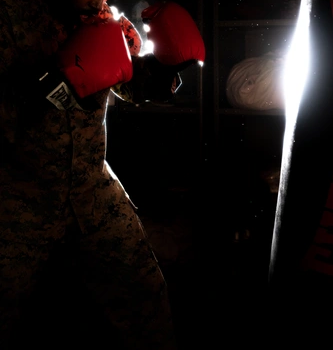
Do Heavy Bags Build Muscle? Honest Answer | Combat Fitness
Do Heavy Bags Build Muscle? What Bag Work Builds and What It Doesn’t
Do heavy bags build muscle? For most trained athletes, not much. Hitting a heavy bag builds muscular endurance, punching power, core and rotational strength, and serious conditioning, and a true beginner will add some muscle in the first few months. It is not a muscle-building tool, because growth depends on progressive mechanical tension that a bag cannot keep raising.
That is why our military fitness programs pair bag-style conditioning with progressive strength work instead of asking one tool to do both jobs. We program for tactical athletes who need to hit hard, carry heavy, and still have gas in the tank at the end of a long day. Whether you ask if a punching bag will build muscle or if punching a heavy bag helps build muscle, the answer is the same. Below is what the bag builds, why it falls short for size, how to slot it into your week, and what to do if muscle is the goal.
What Does Hitting a Heavy Bag Build?
Hitting a heavy bag builds power endurance, rotational core strength, grip and shoulder endurance, and cardiovascular conditioning. Each punch is a fast, full-body contraction that starts at the feet and finishes through the fist, repeated hundreds of times per session. That trains you to produce force again and again under fatigue, which is a different quality from size.
Power endurance. A good punch is a ground-up movement, and bag rounds train you to repeat it when you are tired. Research on punching mechanics shows that force comes from leg drive, hip and trunk rotation, and the transfer through a braced torso, not from the arm alone.
Core and rotational strength. Your obliques, deep abdominals, and spinal stabilizers fire on every rep to create rotation and then stop it. Thousands of reps build trunk endurance that carries over to grappling, carrying, and load-bearing work.
Grip, forearm, and shoulder endurance. You tighten the fist at impact and hold your hands up between combinations. Your delts and upper back stay under low-level tension.
Cardiovascular conditioning. Boxing-style work taxes both energy systems. Studies of amateur bouts show the aerobic system supplies most of the energy, with short anaerobic bursts layered on top. Three-minute rounds with short rest build exactly that profile.
Work under stress. Hitting with good mechanics while your heart rate is high and your lungs are burning is a trainable skill. The bag gives you a safe place to practice staying technical when you are spent.
Why Do Heavy Bags Build Muscle Less Than Lifting?
Heavy bags build less muscle than lifting because hypertrophy needs high mechanical tension, close to muscular failure, increased over weeks and months. A bag gives brief, ballistic contractions that end long before the muscle fails, and it offers no measured way to add load. Lifting does both on purpose, which is why it wins for size.
Three things drive muscle growth, per the hypertrophy research: mechanical tension, enough weekly volume, and a stimulus that keeps getting harder. Load itself matters less than once believed. Lighter weights build muscle as well as heavy ones when sets are taken close to failure. The catch is the word failure.
On the bag, you never get there. Each punch lasts a fraction of a second, the bag pushes back only as hard as you hit it, and your lungs and technique quit well before your shoulders or chest reach muscular failure. You can throw harder or faster, but you cannot add five pounds the way you can on a press. Without that dial, the muscle has no reason to keep growing.
Beginners are the exception, and it is a short one. An untrained body responds to almost any new stimulus, so a sedentary person who starts bag work often sees some early change in the shoulders, arms, and core. That effect fades within months, once the body adapts to a load it can already handle. So can punching bag training build muscle? A little, briefly. Can it carry a muscle-building plan? No.
How Should You Use the Heavy Bag in Your Training?
Use the heavy bag as a conditioning, power, and skill tool that sits alongside your lifting, not in place of it.
Conditioning rounds. Work 3-minute rounds with 1 minute of rest, the format used in amateur boxing. Start with 4 to 6 rounds at a steady, technical pace and build toward 8 to 10.
Power rounds. Throw 10 to 15 seconds of maximal-intent combinations, then rest 45 to 60 seconds. Once speed drops, the set is over.
Skill work. Spend easy rounds on footwork, defense, and clean combinations.
Smart scheduling. Put bag work after lifting or on separate days. Heavy conditioning before a strength session drains the quality of your lifts.
Hand protection. Wear wraps and bag gloves every session. Hand and wrist injuries are among the most common in boxing.
This split mirrors how we frame strength and conditioning for tactical work: two separate qualities, trained with the right tool for each. Our guide to functional strength for military performance breaks down why the job demands both. If you are deciding how to balance the two in one plan, our guide to choosing a strength & endurance program walks through what to look for.
What Should You Do If Your Goal Is Building Muscle?
If your goal is building muscle, lift with progressive resistance and treat the bag as your conditioning. Train each muscle group about twice a week, aim for at least 10 hard sets per muscle per week, take sets close to failure, and add load or reps over time. Eat enough protein to support the work.
The research is consistent on the basics. Higher weekly set volume produces more growth up to a point, training a muscle twice a week beats once at equal volume, and protein intake around 1.6 grams per kilogram of body weight per day covers most of the benefit. None of that is possible on a bag alone.
A practical week for the tactical athlete looks like this: three or four lifting sessions built around squats, hinges, presses, and pulls, plus two or three bag sessions for conditioning and power. If you need a starting template, use a strength workout for athletes as the base and add bag rounds on the off days.
FAQ: Frequently Asked Questions
What muscles does hitting a heavy bag work?
Hitting a heavy bag works the shoulders, chest, triceps, upper back, obliques, deep core, hips, and calves. Force starts in the legs, transfers through hip and trunk rotation, and finishes through the shoulder and arm. The delts and upper back also stay under tension holding your guard, which is why rounds burn so much in the shoulders.
Can you build muscle with just a punching bag?
You can build a small amount of muscle with just a punching bag if you are untrained, but the gains stall quickly. The bag cannot apply progressively heavier loads or take muscles close to failure, which is what sustained growth needs. For lasting size, add resistance training: barbells, dumbbells, kettlebells, or loaded bodyweight work.
Does the heavy bag build power or just conditioning?
The heavy bag builds both, depending on how you train it. Short, maximal-intent rounds with full rest develop punching power and rate of force development. Longer rounds at a steady pace build conditioning and power endurance. Most sessions should name one goal, because trying to do both in the same round dilutes each.
How should you combine bag work with lifting?
Lift first, then hit the bag, or put them on separate days. Strength work needs you fresh to move heavy loads with good form. Bag work tolerates fatigue better and makes an effective finisher. A sound week has three or four lifting days and two or three bag sessions, with your hardest bag day away from your heaviest leg day.
Is the heavy bag good for beginners?
The heavy bag is good for beginners who learn basic technique first and protect their hands. Wraps, bag gloves, and a few sessions on stance and straight punches prevent most wrist and knuckle problems. Start with short rounds at moderate effort. Beginners also tend to see the most early muscle change from bag work, though it levels off fast.
How often should you hit the heavy bag?
Two to three heavy bag sessions per week suits most tactical athletes who also lift. That is enough to build conditioning and skill without eating into recovery for strength work. Match frequency to your primary goal.
So, do heavy bags build muscle? Not in any meaningful way past the beginner stage. What they build is the engine and the power to keep hitting hard when you are tired, and for a tactical athlete that is worth the time. The complete package comes from pairing that work with progressive strength training, each tool doing its own job. Download our free combat-conditioning and strength plan to get both programmed into one week.
References:
Schoenfeld BJ. The mechanisms of muscle hypertrophy and their application to resistance training. Journal of Strength and Conditioning Research. 2010;24(10):2857-2872.
American College of Sports Medicine. Position stand: Progression models in resistance training for healthy adults. Medicine and Science in Sports and Exercise. 2009;41(3):687-708.
Schoenfeld BJ, Grgic J, Ogborn D, Krieger JW. Strength and hypertrophy adaptations between low- vs. high-load resistance training: a systematic review and meta-analysis. Journal of Strength and Conditioning Research. 2017;31(12):3508-3523.
Morton RW, Oikawa SY, Wavell CG, et al. Neither load nor systemic hormones determine resistance exercise-mediated hypertrophy or strength gains in resistance-trained young men. Journal of Applied Physiology. 2016;121(1):129-138.
Schoenfeld BJ, Ogborn D, Krieger JW. Dose-response relationship between weekly resistance training volume and increases in muscle mass: a systematic review and meta-analysis. Journal of Sports Sciences. 2017;35(11):1073-1082.
Schoenfeld BJ, Ogborn D, Krieger JW. Effects of resistance training frequency on measures of muscle hypertrophy: a systematic review and meta-analysis. Sports Medicine. 2016;46(11):1689-1697.
Morton RW, Murphy KT, McKellar SR, et al. A systematic review, meta-analysis and meta-regression of the effect of protein supplementation on resistance training-induced gains in muscle mass and strength in healthy adults. British Journal of Sports Medicine. 2018;52(6):376-384.
Lenetsky S, Harris N, Brughelli M. Assessment and contributors of punching forces in combat sports athletes: implications for strength and conditioning. Strength and Conditioning Journal. 2013;35(2):1-7.
Turner A, Baker ED, Miller S. Increasing the impact force of the rear hand punch. Strength and Conditioning Journal. 2011;33(6):2-9.
Chaabène H, Tabben M, Mkaouer B, et al. Amateur boxing: physical and physiological attributes. Sports Medicine. 2015;45(3):337-352.
Davis P, Leithäuser RM, Beneke R. The energetics of semicontact 3 x 2-min amateur boxing. International Journal of Sports Physiology and Performance. 2014;9(2):233-239.
Loosemore M, Lightfoot J, Palmer-Green D, et al. Boxing injury epidemiology in the Great Britain team: a 5-year surveillance study of medically diagnosed injury incidence and outcome. British Journal of Sports Medicine. 2015;49(17):1100-1107.
Wilson JM, Marin PJ, Rhea MR, et al. Concurrent training: a meta-analysis examining interference of aerobic and resistance exercises. Journal of Strength and Conditioning Research. 2012;26(8):2293-2307.
Haff GG, Triplett NT, eds. Essentials of Strength Training and Conditioning. 4th ed. Champaign, IL: Human Kinetics; 2016.
U.S. Department of Health and Human Services. Physical Activity Guidelines for Americans, 2nd edition. 2018.
Department of the Army. FM 7-22: Holistic Health and Fitness. 2020.
Disclaimer: This article is for educational purposes only and is not medical advice. Consult a qualified healthcare provider before starting a new training program, especially if you have an existing injury or medical condition. Individual results vary.


