
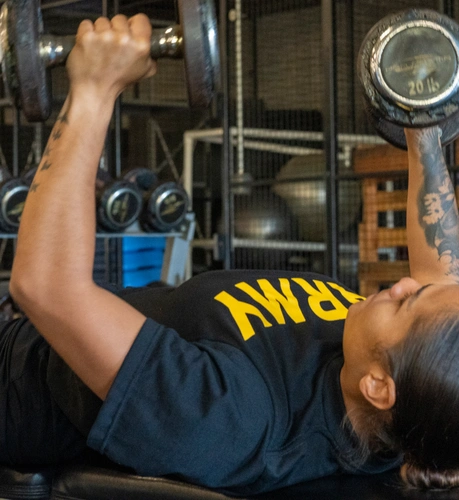
Do Bench Presses Work Shoulders? The Front Delt Answer
Do Bench Presses Work Your Shoulders? What the Bench Trains and What It Misses
Do bench presses work shoulders? Yes, but only one part of them. The bench press trains the anterior (front) deltoid as a secondary mover, while the pectoralis major and triceps do most of the work. The side and rear delts get almost nothing. Lifters who only bench tend to end up with a strong chest and weak overhead strength.
We program pressing for service members, operators, and first responders, and our military fitness programs build horizontal and vertical pressing into the same plan for this reason. Below: the anatomy, the bench press vs. shoulder press difference, and how to build shoulders that hold up under load.
Key Takeaways:
The bench works the front delts as a secondary mover behind the chest and triceps.
The side and rear delts get little from a flat bench, so it is not a complete shoulder builder.
The bench is a horizontal, chest-primary press; the shoulder press is a vertical, delt-primary press.
Tactical athletes need both, because overhead strength carries to lifting loads over your head.
Build full shoulders with overhead pressing plus lateral and rear-delt work.
Do Bench Presses Work Shoulders? Which Delt Does the Work
The bench press works the anterior deltoid, the front head of your shoulder. It assists the pec major in flexing the shoulder and driving the bar off your chest. Electromyography (EMG) research ranks it behind the chest and triceps, which makes it a secondary mover.
The deltoid has three heads:
Anterior (front) delt: brings the arm forward. The bench trains this head.
Lateral (side) delt: raises the arm out to the side and gives the shoulder its width.
Posterior (rear) delt: pulls the arm back and balances your pressing.
On a flat bench, your upper arm moves forward across the body. That is the pec major’s main job and the front delt’s supporting job. Barnett and colleagues found front delt activity was moderate on the flat bench and rose as the bench inclined. The rear delt and rotator cuff only stabilize the joint, which is not the same stimulus as moving a heavy load.
Why the Bench Is Not a Complete Shoulder Builder
The bench press is not a complete shoulder builder because it is a horizontal press. It loads the front delt and leaves the side and rear delts with almost no work, so the shoulder develops unevenly.
Muscles adapt along their line of pull. The side delt raises the arm out and up, which a flat bench never asks for, and the rear delt pulls the arm back, the opposite of a press.
Most lifters also overload the front delt already. It works on every bench, dip, push-up, and overhead press. Stack all of that without matching rear-delt and upper-back work and the front of the shoulder takes more than its share. Kolber and colleagues’ review of training-related shoulder injuries flags pressing-dominant programming and strength imbalance as concerns.
The fix is not to stop benching. It is to program the bench as one press in a balanced plan, which is the same logic behind a strength workout for athletes built around movement patterns rather than favorite lifts.
Bench Press vs. Shoulder Press: What Is the Difference?
The bench press is a horizontal, chest-primary press, with the front delt and triceps assisting. The shoulder press (overhead press) is a vertical, delt-primary press, with the triceps assisting. The bench builds pushing strength away from your body; the overhead press builds strength over your head.
How the Two Presses Compare
Plane: the bench is horizontal; the shoulder press is vertical.
Prime movers: the bench is chest and triceps; the shoulder press is front and side delts plus triceps.
Load: the bench moves more weight because the bench supports you; the overhead press moves less because you brace your whole body.
Best for: the bench builds maximal pushing strength and the chest; the shoulder press builds shoulder strength and overhead stability.
Saeterbakken and Fimland found the standing shoulder press demanded more core activity than seated versions, with high deltoid activation across all of them. That trunk demand is the part the bench never trains.
Bench Press vs. Shoulder Press for the Tactical Athlete
For a general lifter, bench press vs. shoulder press is a physique question. For a tactical athlete, it is about the job: loading gear onto a truck bed, pushing equipment onto an overhead rack, getting your kit over a wall.
Overhead pressing strength is what transfers there. The bench builds the horizontal push you use to drive through a door or on the hand-release push-up in the Army Fitness Test. Train both. That framing is central to functional strength for military performance, where the goal is capacity you can use under a pack.
Where Dips and the Incline Bench Fit
Dips sit between the two presses. They hit the lower chest and triceps hard and stretch the front delt deeply at the bottom, which is why dips vs. the bench press gets its own comparison.
The incline bench shifts work toward the upper chest and front delt as the angle rises, a pattern Rodríguez-Ridao and colleagues confirmed with EMG. Even a steep incline misses the side and rear delts, so it does not replace vertical pressing.
How to Build Your Shoulders the Right Way
To build complete shoulders, pair your bench with one vertical press and direct work for the side and rear delts. Lateral raises and rear-delt work fill in what both presses miss.
A balanced weekly shoulder plan:
One heavy vertical press: the barbell shoulder press, 3 to 5 sets of 4 to 8 reps.
One horizontal press: the bench press.
Lateral delt work: cable or dumbbell lateral raises, 2 to 4 sets of 10 to 20 reps.
Rear delt work: face pulls or reverse flyes, 2 to 4 sets of 12 to 20 reps.
Upper-back pulling: rows and pull-ups at a volume that matches your total pressing.
The barbell shoulder press is the anchor, because it loads the delts as the prime mover while you brace from the floor up. The standing Arnold press works as a second vertical option. Schoenfeld and colleagues found muscle growth rises with weekly set volume, and the side and rear delts rarely get enough from compound presses alone.
Not sure how to fit this into a plan that also covers running, rucking, and conditioning? Our guide to choosing a strength & endurance program walks through what to look for.
Frequently Asked Questions
Do bench presses work your shoulders?
Bench presses work your shoulders, specifically the anterior (front) deltoid, as a secondary mover. The chest and triceps do most of the work, and the side and rear delts get little stimulus, so the bench builds the front of the shoulder and leaves the rest behind.
Which shoulder muscle does the bench press work?
The bench press works the anterior deltoid, the front head of the shoulder, which helps the pec major drive the bar up. The lateral and rear heads mainly stabilize the joint, and that is not enough load to build them.
Is the bench press enough to build your shoulders?
The bench press is not enough to build your shoulders. It is a horizontal, chest-primary press that skips the side and rear delts. Add a vertical press, lateral raises, and rear-delt work to develop the whole joint.
What is the difference between the bench press and the shoulder press?
The bench press is a horizontal press driven by the chest and triceps, with the front delt assisting. The shoulder press is a vertical press driven by the delts and triceps. The bench moves more weight; the overhead press builds strength and bracing over your head.
Should you do both the bench and the overhead press?
You should do both. They train different planes and different prime movers, and neither covers the other. For tactical athletes, overhead strength carries to lifting loads above shoulder height, while the bench builds horizontal pushing strength.
Does the incline bench work the shoulders more than the flat bench?
The incline bench works the front delts more than the flat bench, and EMG research shows activity rises with bench angle. It still misses the side and rear delts, so it is not a substitute for vertical pressing.
Why do my shoulders hurt when I bench?
Shoulder pain on the bench usually traces to a wide grip, flared elbows, a loose upper back, or pressing volume without matching pulling. Tuck the elbows, set the shoulder blades, and balance pressing with rows. Persistent pain needs a qualified clinician.
So, do bench presses work shoulders? They work the front delt, and they do it as a helper to the chest and triceps. That makes the bench a strong horizontal press and an incomplete shoulder builder. Build the rest with overhead pressing, direct delt work, and a pull for every press.
Grab our free balanced-pressing plan and train horizontal and vertical pressing together, so your strength holds up overhead when the job asks for it.
References:
Barnett C, Kippers V, Turner P. Effects of variations of the bench press exercise on the EMG activity of five shoulder muscles. Journal of Strength and Conditioning Research. 1995;9(4):222-227.
Rodríguez-Ridao D, Antequera-Vique JA, Martín-Fuentes I, Muyor JM. Effect of five bench inclinations on the electromyographic activity of the pectoralis major, anterior deltoid, and triceps brachii during the bench press exercise. International Journal of Environmental Research and Public Health. 2020;17(19):7339.
Trebs AA, Brandenburg JP, Pitney WA. An electromyography analysis of 3 muscles surrounding the shoulder joint during the performance of a chest press exercise at several angles. Journal of Strength and Conditioning Research. 2010;24(7):1925-1930.
Lauver JD, Cayot TE, Scheuermann BW. Influence of bench angle on upper extremity muscular activation during bench press exercise. European Journal of Sport Science. 2016;16(3):309-316.
Saeterbakken AH, Fimland MS. Effects of body position and loading modality on muscle activity and strength in shoulder presses. Journal of Strength and Conditioning Research. 2013;27(7):1824-1831.
Escamilla RF, Yamashiro K, Paulos L, Andrews JR. Shoulder muscle activity and function in common shoulder rehabilitation exercises. Sports Medicine. 2009;39(8):663-685.
Reinold MM, Wilk KE, Fleisig GS, et al. Electromyographic analysis of the rotator cuff and deltoid musculature during common shoulder external rotation exercises. Journal of Orthopaedic and Sports Physical Therapy. 2004;34(7):385-394.
Kolber MJ, Beekhuizen KS, Cheng MS, Hellman MA. Shoulder injuries attributed to resistance training: a brief review. Journal of Strength and Conditioning Research. 2010;24(6):1696-1704.
Green CM, Comfort P. The affect of grip width on bench press performance and risk of injury. Strength and Conditioning Journal. 2007;29(5):10-14.
Fees M, Decker T, Snyder-Mackler L, Axe MJ. Upper extremity weight-training modifications for the injured athlete: a clinical perspective. American Journal of Sports Medicine. 1998;26(5):732-742.
Schoenfeld BJ, Ogborn D, Krieger JW. Dose-response relationship between weekly resistance training volume and increases in muscle mass: a systematic review and meta-analysis. Journal of Sports Sciences. 2017;35(11):1073-1082.
Haff GG, Triplett NT, eds. Essentials of Strength Training and Conditioning. 4th ed. National Strength and Conditioning Association. Human Kinetics; 2016.
Moore KL, Dalley AF, Agur AMR. Clinically Oriented Anatomy. 8th ed. Wolters Kluwer; 2018.
Headquarters, Department of the Army. FM 7-22, Holistic Health and Fitness. October 2020.
U.S. Army. Army Fitness Test (AFT) overview and events.
Disclaimer: This article is for educational purposes only and is not medical advice. Consult a qualified healthcare provider before starting a new training program, especially if you have a shoulder injury or ongoing pain. Individual results vary with training history, recovery, and adherence.


