
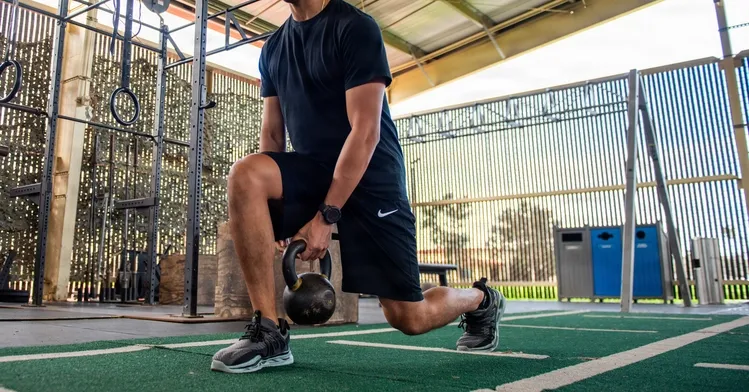
Deficit Reverse Lunge: Form, Muscles & Cues | Combat Fitness
Deficit Reverse Lunge: How to Do It, Muscles Worked & Why the Deficit Helps
The deficit reverse lunge is a reverse lunge performed with your front foot on a raised surface, usually a weight plate or low step, so your back knee can travel below the level of your front foot. That extra range of motion loads the glutes and quads through a deeper stretch than a flat-ground reverse lunge, without the forward knee travel that makes standard lunges hard on sore knees. It is a single-leg staple in our military fitness programs because it builds the hip and knee durability that rucking and uneven terrain demand.
Below, we cover what the movement trains, how to set it up, how high the deficit should be, how it compares to the standard reverse lunge and the Bulgarian split squat, how to load it, and how to program it. You may see it called a reverse lunge from deficit, a reverse deficit lunge, or simply deficit lunges. It is the same lift.
The quick version:
Stand on a 2 to 4 inch plate or step, feet hip-width apart.
Step one foot back off the platform and lower under control.
Let the back knee drop below the level of the front foot while the front shin stays close to vertical.
Hold a slight forward lean with your weight through the front mid-foot.
Drive through the front foot to stand back up onto the platform.
Key Takeaways:
The deficit adds range of motion, which puts the working glute and quad under load at longer muscle lengths, a strong driver of growth and strength.
Stepping backward keeps the front shin more vertical than a forward lunge, so the lift is more hip-dominant and easier on the knee.
Start with a 2 to 4 inch deficit. Raise it only when you can own the bottom position without losing balance or shortening the rep.
Dumbbells are the best starting load. Barbell back-rack and front-rack versions come later, once balance and control are solid.
Program it after your main lift: 2 to 4 sets of 6 to 12 reps per leg, with a controlled 2 to 3 second descent.
What Muscles Does the Deficit Reverse Lunge Work?
The deficit reverse lunge trains the glutes, quadriceps, and adductors of the front leg as prime movers, with the hamstrings, calves, and trunk working to stabilize. The deficit increases how far the front hip and knee flex, which lengthens the glutes and quads under load and raises the training stimulus over a flat-ground lunge.
The gluteus maximus does most of the work out of the bottom, extending the hip as you drive back up. The quadriceps extend the knee and control the descent. The adductors, especially adductor magnus, help extend the hip in deep flexion. The hamstrings assist hip extension and stabilize the knee, while the trunk and lateral hip (glute medius) keep your pelvis level on a narrow base.
Is the Deficit Reverse Lunge Good for Glutes?
Yes. Deeper hip flexion is what makes the deficit reverse lunge a strong glute builder. Kubo and colleagues (2019) found that full-depth squats grew the gluteus maximus and adductors more than half squats, while quad growth was similar. The deficit gives a lunge that same advantage: more hip range, more glute stimulus. A slight forward torso lean adds to it, since trunk position shifts lunge demand toward the hip extensors (Farrokhi et al., 2008).
How to Do a Deficit Reverse Lunge
A deficit reverse lunge is a controlled step-back from a raised platform into a lunge deeper than flat ground allows, followed by a drive through the front foot back to the start. The descent is where the value lives, so own it.
Set the deficit. Stand on a bumper plate, iron plate, or low aerobic step. Place it where you have room to step back onto the floor.
Brace and stand tall. Feet hip-width, ribs down, weight in the mid-foot.
Step back. Reach one foot straight back off the platform, landing on the ball of the foot. Keep your stance hip-width, not on a tightrope.
Lower under control. Take 2 to 3 seconds. Let the back knee drop below the platform until it nearly touches the floor, or until you reach the deepest position you can hold with a neutral spine.
Hold your positions. Front shin close to vertical, front knee tracking over the toes, slight forward lean from the hips.
Drive up. Push through the whole front foot and bring the back foot forward onto the platform. Reset, then repeat or switch legs.
The single-leg deficit reverse lunge is usually done for all reps on one side before switching, which keeps the working leg under continuous tension.
How High Should the Deficit Be?
The deficit should be 2 to 4 inches for most lifters. That is enough to add meaningful range without forcing the back knee into a depth your hips and ankles cannot control. In our coaching, we rarely take athletes past 6 inches. A high deficit reverse lunge is a tool for advanced lifters with the mobility to reach full depth with a neutral pelvis. If your lower back rounds or you start losing balance at the bottom, the platform is too high.
Why Add a Deficit? Range of Motion and Benefits
The deficit adds range of motion, and range of motion matters for strength and muscle. Reviews of the research show that training through a fuller range, particularly at long muscle lengths, tends to produce equal or better hypertrophy than partial ranges (Schoenfeld and Grgic, 2020; Wolf et al., 2023). Studies on the hamstrings and quads point the same way: loading muscles in their lengthened position drives more growth (Maeo et al., 2021; Pedrosa et al., 2022).
The reverse pattern is the second half of the case. A forward lunge forces you to brake your bodyweight with the front knee, and research on lunge mechanics shows that front knee position changes patellofemoral load (Escamilla et al., 2008). Stepping back lets the hip absorb more of the load and keeps the front shin upright. You get the deep range without the knee punishment.
For tactical athletes, the benefits go past aesthetics:
Single-leg strength: every stride under a pack and every step up a hillside is a single-leg effort.
Hip and knee durability: strength through deep ranges prepares tissue for the awkward positions that terrain forces on you.
Balance and control: a narrow base on a raised platform trains the stabilizers that keep ankles and knees safe on uneven ground.
Left-right balance: unilateral work exposes and corrects strength gaps that bilateral lifts hide.
Load carriage is a leading source of lower-extremity overuse injury in soldiers (Knapik et al., 2004), which is why single-leg work earns a permanent spot in functional strength for military performance.
Deficit Reverse Lunge vs. Reverse Lunge: When Is the Deficit Worth It?
The deficit reverse lunge is worth it once you can do a flat reverse lunge for clean reps with good balance. The standard version builds the pattern and lets you load heavier. The deficit version trades some load for range and adds a harder glute and quad stretch at the bottom.
Choose the standard reverse lunge when you are learning the pattern, returning from injury, or chasing heavier loads for strength. Choose the deficit reverse lunge when the flat version has stopped challenging the bottom of the movement, when you want more glute development, or when you want depth without adding knee stress. Many athletes rotate both across training blocks.
Deficit Reverse Lunge vs. Bulgarian Split Squat: Which Is Better?
Neither is better across the board. The Bulgarian split squat keeps your rear foot elevated and both feet planted, so it is more stable and easier to load heavy. The deficit reverse lunge adds a step on every rep, which demands more balance, deceleration, and coordination, closer to what you face on the move.
Use the Bulgarian split squat as a primary single-leg strength lift. Use the deficit reverse lunge when you want dynamic control and deep hip range in one movement. The standard split squat sits between them: static like the Bulgarian, flat like the lunge, and a good entry point for both. Unilateral training transfers well to sprinting and agility, often matching bilateral work (Speirs et al., 2016), so either belongs in a tactical plan.
Loading It: Dumbbell, Barbell, and Rack Variations
Load changes the demand. Start light and progress in this order.
Dumbbell Deficit Reverse Lunge
The dumbbell deficit reverse lunge (often written as the DB deficit reverse lunge) is the default. Dumbbells hang low, keep your center of mass stable, and let you drop the weight safely if you lose balance. Grip strength becomes a limiter as load climbs, which carries over to rucking and casualty drags.
Barbell Deficit Reverse Lunge (Back Rack)
The barbell deficit reverse lunge with a back rack allows heavier loads but raises the center of mass, so balance is harder and bailing is riskier. Use it only after you own the dumbbell version, and set up in a rack with safeties.
Front Rack Deficit Reverse Lunge
The front rack deficit reverse lunge, with a barbell or two kettlebells, forces a more upright torso and hits the quads and upper back harder. It also mimics carrying gear across the chest.
Common Deficit Reverse Lunge Mistakes
Deficit too high. The rep turns into a balance drill and the lower back rounds. Fix: drop to 2 to 4 inches.
Losing balance. Usually a narrow, inline stance. Fix: keep feet hip-width on the step-back, like standing on train tracks.
Dumping onto the front knee. The front knee shoots forward and the heel lifts. Fix: sit the hips back and down, front shin near vertical, weight through the mid-foot.
Short range of motion. Stopping high defeats the purpose of the platform. Fix: lighten the load and own full depth with a 2 to 3 second descent.
Pushing off the back foot. The back leg does the work and the front leg coasts. Fix: think of the back foot as a kickstand and drive through the front heel.
How to Program the Deficit Reverse Lunge
Program the deficit reverse lunge as an accessory after your main bilateral lift, such as a squat or trap bar deadlift. A solid starting prescription is 2 to 4 sets of 6 to 12 reps per leg, consistent with established resistance-training guidance (ACSM, 2009). Keep reps controlled and stop one or two reps short of failure, since balance breaks down before strength does.
Use it once or twice a week. Lower reps with heavier dumbbells build strength. Higher reps with a slower descent build muscle and work capacity. Avoid hard sets in the 48 hours before a long ruck, because deep eccentric work leaves the glutes and quads sore.
It fits naturally into a lower-body day built around a strength workout for athletes. If you are still deciding how lifts like this should sit alongside running and rucking, our guide to choosing a strength & endurance program breaks down what a balanced plan should include.
Deficit Reverse Lunge Alternatives and the Wider Lunge Family
The deficit reverse lunge is one branch of the lunge pattern. If you lack a platform, have balance limits, or need a different stimulus, the closest alternatives are:
Standard reverse lunge: same pattern, less range, easier to learn.
Split squat: static, no step, good for building depth.
Bulgarian split squat: rear foot elevated, more stable, heavier loads.
Walking lunge: continuous forward stepping, strong conditioning carryover.
Step-up: concentric single-leg strength, little eccentric soreness, useful during heavy ruck weeks.
Lunges as a whole train the stride pattern. Each variation shifts the balance between knee and hip demand, stability, and load, so the right pick depends on your training phase.
Frequently Asked Questions
What is a deficit reverse lunge?
A deficit reverse lunge is a reverse lunge performed with the front foot on a raised platform, such as a weight plate or low step. The platform lets the back knee drop below the front foot, which adds range of motion and increases the stretch and work on the front leg’s glutes and quads compared to a flat lunge.
Is the deficit reverse lunge good for glutes?
Yes. The deficit increases hip flexion at the bottom, which loads the gluteus maximus at a longer length, and research on full-depth squats shows greater glute growth than with partial depth. Add a slight forward lean and drive through the front heel to bias the glutes further.
Why do a deficit reverse lunge instead of a regular reverse lunge?
The deficit adds range of motion, which raises the training stimulus at the bottom of the lift where the glutes and quads are most stretched. Use the deficit version once the flat reverse lunge is easy to control and you want more depth without adding forward knee travel.
How high should the deficit be?
Start with 2 to 4 inches, the height of a bumper plate or low step. Go higher only when you can reach full depth with a neutral spine and steady balance. Most athletes never need more than 6 inches. If your back rounds or you wobble at the bottom, lower the platform.
Deficit reverse lunge vs. Bulgarian split squat: which is better?
The Bulgarian split squat is better for heavy single-leg strength because it is more stable. The deficit reverse lunge is better for dynamic balance, deceleration, and deep hip range because you step every rep. A complete tactical program can use both, typically in different blocks or on different days.
How do you program the deficit reverse lunge?
Program it after your main lower-body lift for 2 to 4 sets of 6 to 12 reps per leg, once or twice a week. Use a 2 to 3 second descent and stop short of failure. Keep hard sets away from the two days before a long ruck or a fitness test.
The deficit reverse lunge earns its place for one reason: it gives you more range, and more strength through that range, without the knee cost of a forward lunge. That is the kind of single-leg capacity that holds up under a pack on broken ground. Knowing the lift is the start. Putting it in the right week, at the right load, next to your running and rucking is where results come from. Start with a 2 to 4 inch deficit, own the bottom position, and build it into a structured plan instead of guessing.
References:
American College of Sports Medicine. Progression models in resistance training for healthy adults. Medicine & Science in Sports & Exercise. 2009;41(3):687-708.
Escamilla RF, Zheng N, MacLeod TD, et al. Patellofemoral joint force and stress between a short- and long-step forward lunge. Journal of Orthopaedic & Sports Physical Therapy. 2008;38(11):681-690.
Farrokhi S, Pollard CD, Souza RB, et al. Trunk position influences the kinematics, kinetics, and muscle activity of the lead lower extremity during the forward lunge exercise. Journal of Orthopaedic & Sports Physical Therapy. 2008;38(7):403-409.
Knapik JJ, Reynolds KL, Harman E. Soldier load carriage: historical, physiological, biomechanical, and medical aspects. Military Medicine. 2004;169(1):45-56.
Kubo K, Ikebukuro T, Yata H. Effects of squat training with different depths on lower limb muscle volumes. European Journal of Applied Physiology. 2019;119(9):1933-1942.
Maeo S, Huang M, Wu Y, et al. Greater hamstrings muscle hypertrophy but similar damage protection after training at long versus short muscle lengths. Medicine & Science in Sports & Exercise. 2021;53(4):825-837.
Pedrosa GF, Lima FV, Schoenfeld BJ, et al. Partial range of motion training elicits favorable improvements in muscular adaptations when carried out at long muscle lengths. European Journal of Sport Science. 2022;22(8):1250-1260.
Schoenfeld BJ, Grgic J. Effects of range of motion on muscle development during resistance training interventions: a systematic review. SAGE Open Medicine. 2020;8:2050312120901559.
Speirs DE, Bennett MA, Finn CV, Turner AP. Unilateral vs. bilateral squat training for strength, sprints, and agility in academy rugby players. Journal of Strength and Conditioning Research. 2016;30(2):386-392.
Wolf M, Androulakis-Korakakis P, Fisher J, et al. Partial vs full range of motion resistance training: a systematic review and meta-analysis. International Journal of Strength and Conditioning. 2023;3(1).
Headquarters, Department of the Army. FM 7-22: Holistic Health and Fitness. October 2020.
Disclaimer: This article is for educational purposes and is not medical advice. The deficit reverse lunge places high demands on balance and on the knee, hip, and ankle through a deep range of motion. If you have a current or past knee or ankle injury, or pain during the movement, consult a qualified healthcare provider or physical therapist before adding it to your training. Results vary with training history, programming, recovery, and individual factors.


