
CFA Naval Academy: Events, Scores & Prep | Combat Fitness
The Naval Academy CFA: Events, Scoring & How to Prepare
The CFA Naval Academy candidates take is the Candidate Fitness Assessment: a kneeling basketball throw, pull-ups, shuttle run, crunches, push-ups, and a 1-mile run, completed in a fixed order inside 40 minutes. Every USNA applicant must pass it, and the score moves your admissions file up or down. If you want the prep programmed for you, our military fitness programs build it into a structured plan.
Every standard below was checked against USNA Admissions on the date above.
Key Takeaways:
The CFA is one shared test for the Naval Academy, West Point, and the Air Force Academy.
Each event scores 0 to 100 points. USNA requires a pass, then adjusts your Whole Person Multiple by up to 5 percent either way.
The Class of 2030 averaged 13 pull-ups and a 6:37 mile for men, 4 pull-ups and a 7:29 mile for women. Treat averages as your floor.
The test stacks fatigue by design, so train the full sequence, not six separate events.
What Is the CFA Naval Academy Candidates Take?
The Candidate Fitness Assessment is a six-event physical test the U.S. Naval Academy uses to judge whether you can handle the physical program at Annapolis. West Point and the Air Force Academy use the same battery, so one test measures power, strength, muscular endurance, agility, and aerobic capacity for all three.
USNA sequences the events to produce a cumulative loading effect. By the mile, you have already thrown, pulled, sprinted, and done two minutes each of crunches and push-ups.
The test must be run by a PE teacher, coach, JROTC instructor, active duty commissioned officer, or your Blue and Gold Officer, and all scores must come from one session. Searches for the “naval academy PFT” usually mean this test; midshipmen face a separate readiness test once admitted.
What Are the 6 CFA Events?
The six CFA events, in required order, are the kneeling basketball throw, cadence pull-ups (or flexed-arm hang), shuttle run, crunches, push-ups, and the 1-mile run. Per USNA’s official instructions:
Kneeling basketball throw. Knees behind the baseline, throw a men’s basketball overhand for distance. Three attempts in two minutes, best counts. West Point’s instructions specify a one-handed throw.
Cadence pull-ups. Dead hang, overhand grip, jaw line above the bar, moving only on the scorer’s “up” and “down.” Two minutes, no kipping. Women who cannot do one pull-up take the flexed-arm hang for time, but one pull-up outscores a maxed hang.
Shuttle run. Sprint four 30-foot lengths (40 yards), touching each line with a hand and foot together. Two trials, one minute apart, faster time counts.
Crunches. Arms crossed, fingertips on shoulders, elbows to mid-thigh, shoulder blades back to the mat. Rest only in the up position. Two minutes.
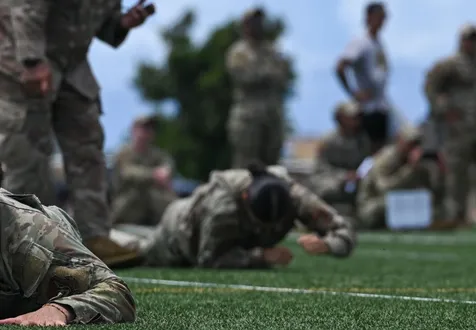
Push-ups. Straight body, upper arms to parallel, full lockout. Rest only in the up position; lifting a hand or foot ends the event. Two minutes.
1-mile run. One measured mile, no pacers. Walking is allowed but discouraged.
Each of the first five events gets two minutes of work and three of rest, starting at minutes 0, 5, 10, 15, and 20. The mile starts at minute 30. USNA recommends a 20 to 30 minute warm-up beforehand, since no extra warm-up is allowed once the clock starts.
Naval Academy CFA Standards and Scoring
Each raw CFA result converts to a 0 to 100 point scale score per event, on separate scales for men and women. USNA requires a passing CFA, then adjusts your Whole Person Multiple up by as much as 5 percent for a maximum score or down by as much as 5 percent for a minimum passing score.
A strong CFA can lift a borderline file; a bare pass can drag down a competitive one.
Maximum CFA Scores (100 Points)
These earn the full 100 points. Once you hit the maximum on any of the first five events, stop; extra reps add nothing.
Men: basketball throw 102 feet, pull-ups 18, shuttle run 7.8 seconds, crunches 95, push-ups 75, mile 5:20.
Women: basketball throw 66 feet, pull-ups 7, shuttle run 8.6 seconds, crunches 95, push-ups 50, mile 6:00.
Average CFA Scores at the Naval Academy
USNA’s published mean scores for the Class of 2030:
Men: basketball throw 68 feet, pull-ups 13, shuttle run 8.8 seconds, crunches 75, push-ups 61, mile 6:37.
Women: basketball throw 42 feet, pull-ups 4, shuttle run 9.6 seconds, crunches 73, push-ups 39, mile 7:29.
Below the mean, the CFA is costing you ground against your competition.
Minimums and Passing Scores
USNA does not publish per-event minimums or a passing total, which makes the averages your practical benchmark. USNA also encourages retaking the CFA for a top passing score, so treat a first attempt as a baseline.
The CFA Score Sheet and Score Calculators
USNA offers a printable score sheet, but your administrator submits official scores electronically. The raw-to-point conversion tables are not public, so third-party naval academy CFA score calculators are estimates. Plan around the official maximums and averages.
How Do You Prepare for the CFA?
Preparing for the CFA means training each event’s specific quality, then rehearsing the full six-event sequence on the official clock.
Train to the standard. A push-up that passes in a gym fails here if your upper arm stops short of parallel. Have a partner call reps like a scorer.
Attack your weakest event. Moving a below-average event to average usually gains more points than polishing a strong one.
Rehearse the sequence monthly. Only a full diagnostic CFA shows how your mile holds up after the first five events.
Strength and endurance compete for recovery, and concurrent-training research shows unmanaged running volume can blunt strength and power gains. Our guide to choosing a strength & endurance program covers what a hybrid plan has to get right.
How to Train the Basketball Throw and Shuttle Run
The throw and shuttle are power events, so train them fresh with full rest. The kneeling throw takes your legs out, so power must come from your trunk, lats, and shoulders firing in sequence. Train kneeling overhead medicine ball throws (3 to 5 sets of 3 to 5), strict pressing and pulling strength, and three to five full-effort basketball throws two or three times a week after your warm-up. This is where functional strength for military performance pays off: the throw rewards strength expressed quickly through the whole body.
On the shuttle, most time is lost at the turns. Drop your hips before the line, plant the outside foot, touch hand and foot together, and drive out low. Add 10 to 20 yard acceleration sprints with full recovery, because speed work done tired trains you to be slow.
How Do You Train CFA Pull-Ups?
You train CFA pull-ups with frequent, submaximal, strict sets from a dead hang, practiced on a partner’s cadence.
A pull-up bar routine for the CFA should include:
Several sets at half to two-thirds of your max, three or four days a week, building volume without hitting failure every session.
One weekly max set on cadence, with a partner calling “up” and “down.”
Three to five second negatives if you sit below the average.
Flexed-arm hang holds if you are working toward a first rep.
Pull-ups test relative strength, so extra body weight costs reps.
How to Train Crunches and Push-Ups for the CFA
Crunches and push-ups run back to back, and both allow rest only in the up position, so pacing and form discipline matter as much as capacity. Many candidates lose crunch reps to “no” calls, not fatigue: keep fingertips on shoulders and elbows to mid-thigh, and hold a steady rhythm instead of sprinting the first minute.
For push-ups, run sets at 50 to 70 percent of your max several days a week, plus timed or ladder sets. Practice resting in a locked-out plank, your only legal rest. Once a week, train them together: two minutes of crunches, three minutes of rest, two minutes of push-ups.
How to Run a Faster Mile for the CFA
To run a faster CFA mile, build an aerobic base, add weekly interval and tempo work, and practice running after calisthenics. Four sessions cover it:
Easy runs. Two or three conversational runs a week build the base that speeds recovery between events.
Intervals. 400-meter repeats slightly faster than goal mile pace, equal rest. Interval training is among the most effective ways to raise aerobic capacity.
Tempo. Fifteen to twenty minutes at a hard, sustained effort.
Bricks. A timed mile right after push-ups, because the CFA mile is never run fresh.
Add weekly mileage gradually. Rapid jumps in running distance are linked to more running injuries, and a stress injury in the final month costs more than any workout gains.
A Sample 8-Week CFA Prep Plan
An eight-week CFA prep plan opens with a diagnostic test, builds capacity with a mid-point retest, and tapers in the final week:
Week 1: Baseline. Run a full CFA on the official timeline and rank each event against the Class of 2030 averages.
Weeks 2 to 4: Build. Four to five days a week: two upper-body days (throws, pull-up and push-up volume, crunches), one interval run, one tempo run, and one easy run with shuttle turn drills.
Week 5: Retest. Run a second full CFA and shift volume toward the events that moved least.
Weeks 6 to 7: Specific. Same split, plus one weekly sequence rehearsal and at least one brick mile.
Week 8: Taper and test. Cut volume roughly in half, keep some intensity, and test fresh. Tapering this way consistently improves test performance.
Protect sleep throughout; extra sleep improves sprint speed and reaction time in athletes.
FAQ: Frequently Asked Questions
What is the Candidate Fitness Assessment (CFA)?
The Candidate Fitness Assessment is the six-event physical test required for admission to the Naval Academy, West Point, and the Air Force Academy. It measures strength, muscular and cardiorespiratory endurance, power, balance, and agility, completed in a fixed sequence within 40 minutes under an approved administrator.
What events are on the Naval Academy CFA?
The Naval Academy CFA events are the kneeling basketball throw, cadence pull-ups (or flexed-arm hang for women unable to do one pull-up), the 40-yard shuttle run, two minutes of crunches, two minutes of push-ups, and a 1-mile run, always in that order. Verified against USNA Admissions on October 29, 2026.
How is the CFA scored?
Each event’s raw result converts to a scale score from 0 to 100 points, with separate scales for men and women. USNA requires a passing CFA, then adjusts your Whole Person Multiple by as much as 5 percent up or down depending on how well you scored.
Is the CFA the same for West Point, the Air Force Academy, and ROTC?
The CFA is the same six-event test for the Naval Academy, West Point, and the Air Force Academy, and one administration serves all three. Naval ROTC uses a separate, shorter Applicant Fitness Assessment, so confirm your program’s test with your recruiter.
What is a good CFA score?
A good CFA score sits at or above USNA’s published averages in every event. For the Class of 2030, that meant about 13 pull-ups, 61 push-ups, and a 6:37 mile for men, and about 4 pull-ups, 39 push-ups, and a 7:29 mile for women.
How do you train for the CFA?
You train for the CFA by building each event’s specific quality (power, relative strength, muscular endurance, agility, and aerobic capacity), then rehearsing the full six-event sequence on the official clock. Retest every three to four weeks, prioritize your weakest events, and taper the final week.
The CFA Naval Academy admissions uses is a fatigue test as much as a fitness test: six events, one fixed order, 40 minutes, and up to 5 percent of your Whole Person Multiple on the line. The candidates who score well trained the sequence, not just the movements.
Run a diagnostic CFA this week, rank your events against the averages, and build around the gaps. If you want that plan written and progressed for you, CF ONE builds service academy and selection prep into a structured program, so test day is a rehearsal you have already run.
References:
United States Naval Academy Admissions. “The Candidate Fitness Assessment.” Accessed October 29, 2026.
United States Naval Academy Admissions. “USNA’s Whole Person Concept” (Whole Person Multiple and Class of 2030 CFA mean scores). Accessed October 29, 2026.
United States Military Academy at West Point Admissions. “Candidate Fitness Assessment Instructions.”
United States Military Academy at West Point Admissions. “Candidate Fitness Assessment Overview.”
United States Military Academy at West Point. “Candidate Fitness Assessment.”
Naval Service Training Command. “NROTC Applicant Fitness Assessment Instructions” (May 2022).
Haff, G. G., and Triplett, N. T. (Eds.). Essentials of Strength Training and Conditioning, 4th ed. National Strength and Conditioning Association. Human Kinetics, 2016.
Wilson, J. M., et al. “Concurrent training: a meta-analysis examining interference of aerobic and resistance exercises.” Journal of Strength and Conditioning Research, 26(8), 2012.
Milanović, Z., Sporiš, G., and Weston, M. “Effectiveness of high-intensity interval training (HIT) and continuous endurance training for VO2max improvements: a systematic review and meta-analysis of controlled trials.” Sports Medicine, 45(10), 2015.
Nielsen, R. O., et al. “Excessive progression in weekly running distance and risk of running-related injuries: an association which varies according to type of injury.” Journal of Orthopaedic & Sports Physical Therapy, 44(10), 2014.
Bosquet, L., et al. “Effects of tapering on performance: a meta-analysis.” Medicine & Science in Sports & Exercise, 39(8), 2007.
Mah, C. D., et al. “The effects of sleep extension on the athletic performance of collegiate basketball players.” Sleep, 34(7), 2011.
Fradkin, A. J., Zazryn, T. R., and Smoliga, J. M. “Effects of warming-up on physical performance: a systematic review with meta-analysis.” Journal of Strength and Conditioning Research, 24(1), 2010.
American College of Sports Medicine. ACSM’s Guidelines for Exercise Testing and Prescription, 11th ed. Wolters Kluwer, 2021.
Disclaimer: This article is for educational purposes only and is not medical advice. CFA events, standards, and averages are set by the service academies and can change; confirm current requirements with USNA Admissions or your Blue and Gold Officer before testing. Consult a qualified healthcare provider before starting a new training program, especially if you have an injury or medical condition.


