
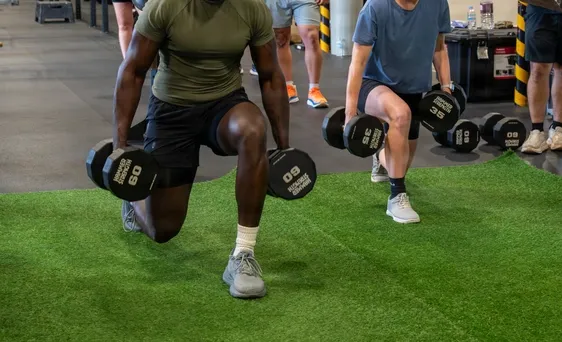
Bulgarian Split Squat Alternatives: 10 Best Substitutes
Bulgarian Split Squat Alternatives: The Best Substitute Exercises
The best Bulgarian split squat alternative keeps what the lift trains (single-leg strength, hip stability, and loaded hip and knee extension) and removes whatever is stopping you from doing it. For most athletes, that means sore knees, no bench, or balance limiting the load. Our tactical fitness programs use these substitutes every week, because a service member who can’t do one exercise still has to step off a vehicle, climb a wall, and carry a casualty one leg at a time.
The Army’s Holistic Health and Fitness doctrine (FM 7-22) builds the forward lunge and the step-up into its strength training circuit for the same reason. Below are 10 substitutes grouped by why you need one. Each comes with a short how-to, the reason it works as a swap, and how to program it so you keep the training effect.
Key Takeaways:
The reverse lunge is the best all-around substitute: the same single-leg demand, with less balance required and less stress on the front knee.
For bad knees, choose hip-dominant options that limit forward knee travel: high-box step-ups, hip thrusts, single-leg RDLs, and the leg press with your feet high.
With no bench, a stair, a sturdy chair, and a loaded backpack cover everything you need.
When you swap, match per-leg sets, reps, and effort, or the substitute won’t deliver the same result.
Why Look for a Bulgarian Split Squat Alternative?
A Bulgarian split squat alternative is any exercise that trains the same muscles (quads, glutes, and adductors) through single-leg or split-stance loading, without the rear-foot-elevated setup. Athletes look for a substitute for Bulgarian split squats for three reasons: knee pain, no bench, or a balance demand that caps how much load they can use.
The lift works because the elevated rear foot shifts most of the load onto the front leg. That trains each leg independently and exposes left-to-right gaps that a barbell squat hides. Biomechanical comparisons with the back squat show heavy demand on the lead leg’s hip and knee extensors, with far less load on the spine (Mackey and Riemann, 2021). Unilateral training programs also build strength comparable to bilateral ones (McCurdy et al., 2005; Speirs et al., 2016).
So what is an alternative to the Bulgarian split squat that keeps that stimulus? It needs three things: one leg doing most of the work, a real hip and knee extension pattern, and a stability challenge. If your problem is technique, fix the Bulgarian split squat setup first. Front foot distance and torso angle solve most complaints. Most athletes don’t need a substitute because the lift is bad. They need one because of their knees, their equipment, or their gym, and the rest of this guide is organized around those reasons.
The Best Bulgarian Split Squat Alternatives
We ranked these on three criteria: how closely each one replicates single-leg loading, how well it scales with weight, and how much equipment it needs. If you are weighing whole training plans rather than single exercises, our guide to choosing a strength & endurance program covers what separates a real program from a pile of workouts.
1. Reverse Lunge (Best Overall)
Step back, lower until the back knee nearly touches the floor, and drive through the front foot to return. The front leg does most of the work, and the backward step keeps the shin more vertical than a forward lunge does. Of all the lunges, the reverse lunge is the easiest to load heavy with dumbbells. Verdict: the default swap.
2. Step-Up
Plant your whole foot on a box and drive up to full hip extension without pushing off the trailing leg. Step-ups train the same single-leg drive as the BSS and carry over directly to stairs, walls, and vehicles. Verdict: best for knees and occupational carryover.
3. Flat Split Squat
Take a long split stance with both feet on the floor and lower straight down. With the rear foot on the floor, the balance demand drops but the pattern stays the same. Verdict: the easiest path back to the BSS.
4. Walking Lunge
Lunge forward and bring the back foot through into the next rep. This adds a deceleration demand, which matters for athletes who move under load. Verdict: a strong strength-conditioning hybrid if you have floor space.
5. Goblet Squat
Hold a dumbbell at your chest and squat to depth. The goblet squat loses the single-leg element but trains the same quads and glutes with an upright torso. Verdict: the fallback when no split-stance option is tolerable.
6. Single-Leg Romanian Deadlift
Hinge on one leg until you feel a stretch in the hamstring, then drive the hip forward to stand. The single-leg Romanian deadlift trains hip stability and the glutes with almost no knee bend. Verdict: the best hip-dominant swap.
7. Cossack Squat
From a wide stance, sit into one hip while the other leg stays straight with the toes up. This adds frontal-plane strength and heavy adductor loading. Verdict: best for mobility and lateral strength.
Knee-Friendly Alternatives to the Bulgarian Split Squat for Bad Knees
The best alternative to the Bulgarian split squat for bad knees is a hip-dominant exercise: a step-up, hip thrust, single-leg RDL, or leg press with the feet placed high. Each one limits forward knee travel, which shifts work from the knee to the hip and lowers the joint stress that makes the BSS uncomfortable.
The reason is mechanical. When the knee travels well past the toes, torque at the knee rises. Restricting that travel moves the demand to the hip (Fry et al., 2003; Schoenfeld, 2010). Patellofemoral stress also climbs as the knee bends deeper under load, in both squats and lunges (Wallace et al., 2002; Escamilla et al., 2008; Escamilla et al., 2009). Leaning the torso forward shifts effort toward the hip extensors (Farrokhi et al., 2008), and so does a high foot position on the leg press (Escamilla et al., 2001).
Knee-friendly options, in order:
A step-up to a box at or just below knee height, with the shin kept close to vertical.
A hip thrust, which loads the glutes while the knee stays nearly fixed.
A single-leg RDL, with a soft, almost static knee.
A single-leg leg press with the foot high on the platform, stopping short of deep knee flexion.
Knee durability is a readiness issue, not a comfort issue. Musculoskeletal injuries are a leading driver of limited duty in the Army, and the lower extremity accounts for a large share of them (Molloy et al., 2020). That is why functional strength for military performance treats pain-free single-leg strength as a priority, not an accessory. Pain that persists or worsens means seeing a clinician, not finding a cleverer exercise.
At-Home and No-Bench Bulgarian Split Squat Alternatives
A Bulgarian split squat alternative at home needs no bench. Reverse lunges, step-ups onto a stable stair or chair, and flat split squats loaded with a backpack all cover the same single-leg demand. A loaded ruck can stand in for dumbbells and adds the carry-specific challenge you need anyway.
Without heavy weights, make each rep harder:
Lower for three to four seconds.
Pause for two seconds at the bottom.
Use 1.5 reps (down, halfway up, down again, then stand).
Stand the front foot on a plate for a deficit reverse lunge.
Check that a chair or stair is stable before you load it.
Machine Alternatives to the Bulgarian Split Squat
Machines remove the balance limit, so you can load the legs harder. The trade-off is less stability training, so keep one free-weight single-leg exercise elsewhere in your week.
Single-Leg Leg Press
As a Bulgarian split squat alternative, the leg press keeps unilateral loading and lets you push hard safely. Feet high biases the hips and spares the knees. Feet low biases the quads.
Hack Squat
The fixed path and back support let you train the quads through a deep range. It is bilateral, so treat it as a quad-strength replacement.
Smith Machine Split Squat
This is the most direct machine substitute. The bar handles balance, so you can load heavier. Set the front foot far enough forward to keep the shin near vertical. If the BSS was standing in for quad isolation work, leg extension alternatives are a better place to look.
Glute-Focused Bulgarian Split Squat Alternatives
The best alternative to the Bulgarian split squat for glutes is the hip thrust, followed by the single-leg RDL, the high-box step-up, and the Cossack squat. All four bias the hip extensors over the quads, the same way a forward-leaning BSS trains the glutes.
Hip Thrust
With your upper back on a bench or couch and load across your hips, drive up until your torso and thighs form a straight line. Hip thrusts produce greater glute activation than back squats (Contreras et al., 2015), and a systematic review ranks them among the strongest glute exercises (Neto et al., 2020). Do them single-leg to keep the unilateral benefit.
Other Glute-Biased Options
A box above knee height turns the step-up into a glute exercise (Simenz et al., 2012). The single-leg RDL loads the glutes in a lengthened position. The Cossack squat adds adductor and lateral hip work.
How to Replace the Bulgarian Split Squat in Your Program
To replace the Bulgarian split squat, match what its slot was doing: the movement pattern, per-leg volume, rep range, and effort. Change the exercise and keep everything else the same.
Match the pattern. Replace a knee-dominant BSS with a reverse lunge, step-up, or Smith split squat. Replace a hip-focused BSS with a single-leg RDL or hip thrust.
Match per-leg volume. Weekly set volume drives growth in a dose-response pattern (Schoenfeld et al., 2017), so three sets of eight per leg stays three sets of eight per leg.
Match the rep range to your goal. Heavier, lower-rep work favors maximal strength. A broad range builds muscle when sets end close to failure (Schoenfeld et al., 2021).
Match effort by ending sets with the same reps in reserve.
Run the swap for four to six weeks before judging it.
For a dumbbell Bulgarian split squat alternative, the dumbbell reverse lunge and the dumbbell step-up are direct swaps. Slot the substitute where the BSS lived in a strength workout for athletes, usually after the main bilateral lift.
FAQ: Frequently Asked Questions
What is the best alternative to the Bulgarian split squat?
The reverse lunge is the best alternative for most athletes. It keeps most of the load on the front leg, trains the same quads and glutes, and is easier to balance and load heavy. Step-ups are a close second when knees or occupational carryover are the priority.
What is a knee-friendly alternative to the Bulgarian split squat?
Step-ups to a knee-height box, hip thrusts, single-leg RDLs, and the leg press with feet high are the most knee-friendly options. Each keeps the shin near vertical or the knee nearly static, which shifts work to the hip and reduces knee joint stress.
How can you replace the Bulgarian split squat at home with no bench?
Use reverse lunges, flat split squats, or step-ups onto a stable stair or chair, loaded with a backpack or ruck. Slow lowering, pauses, and 1.5 reps add difficulty without heavier weights, so you keep the single-leg demand with no gym equipment.
What machine exercises replace the Bulgarian split squat?
The Smith machine split squat is the closest machine replacement because it keeps the split stance. The single-leg leg press keeps unilateral loading with no balance demand. The hack squat trains the quads hard, but with both legs at once.
What is a good glute-focused alternative to the Bulgarian split squat?
The hip thrust is the strongest glute-focused option, with research showing higher glute activation than the back squat. The single-leg RDL, high-box step-up, and Cossack squat also bias the glutes. Do the hip thrust single-leg to keep the unilateral benefit.
Do the alternatives build the same muscles as the Bulgarian split squat?
Most do. Lunges, step-ups, and split squats train the quads, glutes, and adductors through the same single-leg pattern. Hip-dominant options bias the glutes and hamstrings, so pair one of them with a knee-dominant exercise to cover the full stimulus.
A Bulgarian split squat alternative earns its place only if it keeps the stimulus: one leg working, a real hip and knee extension pattern, and enough load to drive adaptation. Pick the substitute that solves your actual constraint, whether that is your knees, your equipment, or a glute focus, then match the volume and effort the original lift delivered. If you want every swap built into a plan that already accounts for your job and your next test, start a structured program and stop guessing set by set.
References:
Contreras B, Vigotsky AD, Schoenfeld BJ, Beardsley C, Cronin J. A comparison of gluteus maximus, biceps femoris, and vastus lateralis electromyographic activity in the back squat and barbell hip thrust exercises. Journal of Applied Biomechanics. 2015;31(6):452-458.
Escamilla RF, Fleisig GS, Zheng N, et al. Effects of technique variations on knee biomechanics during the squat and leg press. Medicine and Science in Sports and Exercise. 2001;33(9):1552-1566.
Escamilla RF, Zheng N, MacLeod TD, et al. Patellofemoral compressive force and stress during the forward and side lunges with and without a stride. Clinical Biomechanics. 2008;23(8):1026-1037.
Escamilla RF, Zheng N, MacLeod TD, et al. Patellofemoral joint force and stress during the wall squat and one-leg squat. Medicine and Science in Sports and Exercise. 2009;41(4):879-888.
Farrokhi S, Pollard CD, Souza RB, Chen YJ, Reischl S, Powers CM. Trunk position influences the kinematics, kinetics, and muscle activity of the lead lower extremity during the forward lunge exercise. Journal of Orthopaedic and Sports Physical Therapy. 2008;38(7):403-409.
Fry AC, Smith JC, Schilling BK. Effect of knee position on hip and knee torques during the barbell squat. Journal of Strength and Conditioning Research. 2003;17(4):629-633.
Headquarters, Department of the Army. FM 7-22, Holistic Health and Fitness. Washington, DC; 2020.
Mackey ER, Riemann BL. Biomechanical differences between the Bulgarian split-squat and back squat. International Journal of Exercise Science. 2021;14(1):533-543.
McCurdy KW, Langford GA, Doscher MW, Wiley LP, Mallard KG. The effects of short-term unilateral and bilateral lower-body resistance training on measures of strength and power. Journal of Strength and Conditioning Research. 2005;19(1):9-15.
Molloy JM, Pendergrass TL, Lee IE, et al. Musculoskeletal injuries and United States Army readiness part I: overview of injuries and their strategic impact. Military Medicine. 2020;185(9-10):e1461-e1471.
Neto WK, Soares EG, Vieira TL, et al. Gluteus maximus activation during common strength and hypertrophy exercises: a systematic review. Journal of Sports Science and Medicine. 2020;19(1):195-203.
Schoenfeld BJ. Squatting kinematics and kinetics and their application to exercise performance. Journal of Strength and Conditioning Research. 2010;24(12):3497-3506.
Schoenfeld BJ, Ogborn D, Krieger JW. Dose-response relationship between weekly resistance training volume and increases in muscle mass: a systematic review and meta-analysis. Journal of Sports Sciences. 2017;35(11):1073-1082.
Schoenfeld BJ, Grgic J, Van Every DW, Plotkin DL. Loading recommendations for muscle strength, hypertrophy, and local endurance: a re-examination of the repetition continuum. Sports. 2021;9(2):32.
Simenz CJ, Garceau LR, Lutsch BN, Suchomel TJ, Ebben WP. Electromyographical analysis of lower extremity muscle activation during variations of the loaded step-up exercise. Journal of Strength and Conditioning Research. 2012;26(12):3398-3405.
Speirs DE, Bennett MA, Finn CV, Turner AP. Unilateral vs. bilateral squat training for strength, sprints, and agility in academy rugby players. Journal of Strength and Conditioning Research. 2016;30(2):386-392.
Wallace DA, Salem GJ, Salinas R, Powers CM. Patellofemoral joint kinetics while squatting with and without an external load. Journal of Orthopaedic and Sports Physical Therapy. 2002;32(4):141-148.
Disclaimer: This article is for educational purposes only and is not medical advice. Consult a qualified healthcare provider before starting or changing a training program, especially if you have knee pain, a current injury, or a medical condition. Individual results vary.


