
Bulgarian Split Squat: Form & Muscles | Combat Fitness
Bulgarian Split Squat: Proper Form, Muscles Worked & Variations
The Bulgarian split squat is a single-leg squat done with your rear foot elevated on a bench, and it is one of the most transferable lower-body lifts a tactical athlete can train. Carrying a load over broken ground, stepping up into a vehicle, and driving over an obstacle all happen one leg at a time, which is why we build this movement into our tactical fitness programs from the first block.
This guide is built from the coaching we do with service members, police officers, and firefighters, and from the research on how the lift loads the hip and knee. You will get the muscles it works, how foot placement shifts the work between glutes and quads, a step-by-step form breakdown, every equipment variation, and the exact sets, reps, and load we program.
Key Takeaways:
The Bulgarian split squat is a rear-foot-elevated single-leg squat. The front leg does the work and the back leg only balances.
It trains the quads, glutes, adductors, and hamstrings, plus the hip stabilizers that keep your knee tracking under load.
A longer stance and a slight forward lean shift the emphasis to the glutes. A shorter stance and an upright torso shift it to the quads.
It builds strength with roughly half the external load of a back squat, which spares the spine and fits high-volume training cycles.
Most athletes should run 2 to 4 sets per leg, 6 to 12 reps, once or twice a week, and progress load only when every rep is clean.
What Is a Bulgarian Split Squat?
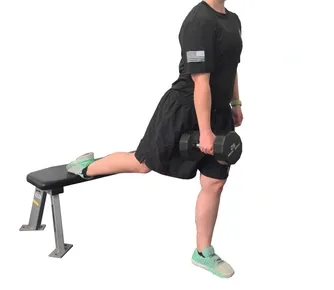
A Bulgarian split squat is a split squat with the top of your back foot resting on a bench behind you. You lower your body straight down on the front leg until the back knee nearly touches the floor, then drive back up. Elevating the rear foot pushes most of your bodyweight and load onto the front leg.
You will see it called the Bulgarian squat, the BSS, the rear-foot-elevated split squat (RFESS), and in some research, the Bulgarian lunge. All of these names describe the same lift.
To understand where it comes from, start with the basic version. A split squat is a squat performed from a staggered stance with both feet flat on the floor. The Bulgarian version raises the back foot, which increases the range of motion at the front hip and reduces how much the back leg can help. That is the whole point: more of the lift becomes a true single-leg effort.
What Muscles Do Bulgarian Split Squats Work?
Bulgarian split squats work the quadriceps and gluteus maximus of the front leg as the primary movers, with heavy help from the adductors and hamstrings. The gluteus medius and trunk muscles work hard to stop the pelvis and knee from collapsing. The rear leg’s hip flexors get a loaded stretch on every rep.
Here is what each group contributes:
Quadriceps: extend the knee out of the bottom position. They are the main limiter for most people.
Gluteus maximus: extends the hip and does more of the work as you lean forward or lengthen your stance.
Adductors: the adductor magnus works as a hip extensor deep in the squat and stabilizes the thigh.
Hamstrings: co-contract to stabilize the knee. In one EMG study, the rear-foot-elevated version produced higher biceps femoris activity than a flat split squat.
Gluteus medius and core: resist the hip dropping and the knee caving inward, which is the stability quality that protects your knees in the field.
Researchers who tested the split squat, single-leg squat, and rear-foot-elevated split squat to failure at the same relative load found similar peak glute max and quad activity across all three. The RFESS stood out for hamstring co-activation. A separate study of female athletes found higher activation in a modified single-leg squat than in a two-leg squat at the same relative intensity. A joint-level analysis comparing the Bulgarian split squat to the back squat found the hip did most of the work in both lifts.
Bulgarian Split Squat for Glutes vs. Quads: How Foot Placement Shifts the Work
Foot placement decides what the Bulgarian split squat targets. Put your front foot farther from the bench and lean your torso slightly forward, and the glutes and hip extensors take more of the load. Bring the front foot closer and stay upright, letting the knee travel forward, and the quads do more of the work.
The research supports this. A 2023 biomechanics study found that a longer step length in the split squat raised hip extensor activation while having limited effect on the knee extensors. A 2025 study examined how trunk position changes muscle activation in the Bulgarian split squat specifically, and a forward lean is the standard coaching lever for loading the posterior chain.
For a tactical athlete, neither option is wrong. Our default is a middle stance with a slight forward lean, because that position looks the most like climbing and loaded stepping. Bias toward the quads if knee extension strength is your weak point, and toward the glutes if hip power is.
Why Is the Bulgarian Split Squat a Top Movement for Tactical Athletes?
The Bulgarian split squat builds strength one leg at a time, which is how tactical work loads the body. Rucking, climbing, stepping over obstacles, and dragging a casualty all put force through a single leg. The lift also exposes and fixes left-to-right imbalances and builds knee control without heavy spinal loading.
These are the benefits that matter in uniform:
Load carriage on uneven ground. Each step under a ruck is a single-leg effort. Load carriage research shows that heavy loads increase stress on the lower body and raise injury risk, so single-leg strength is part of carrying a pack well.
Imbalance correction. Bilateral lifts let a stronger leg cover for a weaker one. Training each leg alone shows you the gap and closes it. A systematic review found that larger differences between limbs tend to be linked to worse jumping and change-of-direction performance.
Knee durability. The hip stabilizers that keep your knee over your foot work hard here. Musculoskeletal injuries are a leading cause of lost duty time in the Army, and the lower extremity takes a large share of them.
Less spinal load. Because of the bilateral deficit, each leg working alone can produce more than its share of two-leg force. You can train the legs hard with far less weight on your back.
Real transfer. In one five-week study of academy rugby players, athletes who trained only the rear-foot-elevated split squat improved back squat strength, 40-meter sprint, and agility as much as athletes who trained only the back squat.
This is why we treat single-leg work as core training, not accessory work. It is also a central idea in functional strength for military performance: strength only counts when it shows up in the positions the job demands. If you are weighing how lifts like this fit into a complete plan, our guide to choosing a strength & endurance program explains what to look for.
How to Do a Bulgarian Split Squat With Proper Form
Proper Bulgarian split squat form comes from three setup decisions: bench height, stance length, and foot width. Get those right, then lower straight down on the front leg until the back knee is just off the floor and drive up through the whole front foot. Most bad reps come from a rushed setup, not the rep itself.
How to Set Up a Bulgarian Split Squat
Set the bench height. Use a bench at knee height or slightly lower. A higher bench pulls the rear hip into extension too early and limits your depth.
Place your back foot. Rest the top of your foot (laces down) on the bench. Tucking the toes works too, but laces-down is more comfortable for most people under load.
Find your stance length. Hop the front foot out until, at the bottom, your front shin is close to vertical or slightly forward. A step length around the length of your leg is a good starting point, based on the research above.
Set your width. Keep the feet about hip-width apart, not lined up like you are on a tightrope. A narrow base turns the set into a balance drill.
Brace. Ribs down, a firm breath into the belly, and hold the load before the first rep.
How to Perform the Rep
Lower straight down, not forward. Think of the back knee dropping toward the floor.
Descend until the back knee is an inch or two off the ground or the front thigh is about parallel.
Keep the front heel planted and the knee tracking over the middle toes.
Drive up through the midfoot and heel of the front leg, keeping the back leg passive.
Finish every rep on one side before switching, and start with your weaker leg.
Letting the front knee travel past the toes is not a fault in itself. A classic barbell squat study found that restricting forward knee movement shifted more torque to the hips and lower back. As long as the heel stays down and the knee feels good, let it move.
Common Bulgarian Split Squat Mistakes
Pushing off the back foot. The rear leg only balances. If you feel it driving, shorten the bench height or lighten the load.
Stance too short. The front heel lifts and the knee takes all the stress. Lengthen the stance.
Tightrope feet. Balance fails before the legs do. Widen to hip-width.
Knee caving inward. Usually a glute medius limit. Lower the load and slow the descent.
Partial reps. Stopping halfway removes the deep-range strength that makes the lift worth doing.
Bulgarian Split Squat Variations by Equipment
Every Bulgarian split squat variation uses the same setup. What changes is where the load sits, and that affects balance, grip, and how heavy you can go. Choose the variation that matches your goal and what you have available.
Bodyweight Bulgarian Split Squat
Start here. Master three sets of 12 to 15 clean reps per leg before adding load. Bodyweight sets also work well as a high-rep finisher or a field option when you have nothing but a bench, curb, or tailgate.
Dumbbell Bulgarian Split Squat
The DB Bulgarian split squat is the standard loaded version. Holding the dumbbells at your sides keeps your center of mass low and stable. Grip often gives out first, so use straps on heavy sets if grip is not what you are training.
Goblet-Loaded Bulgarian Split Squat
Holding one dumbbell or kettlebell at your chest makes you brace your trunk more and helps keep your torso upright, which pushes the work toward the quads. It applies the same front-loaded idea as the goblet squat and suits moderate loads and higher reps.
Kettlebell Bulgarian Split Squat
Kettlebells can be held at your sides, at your chest, or in the front rack. The double front rack is the most demanding on your trunk and the most useful for anyone who carries weight on their chest, such as plate carriers or SCBA harnesses.
Barbell Bulgarian Split Squat
A barbell on your back allows the heaviest loading but adds balance risk, since you cannot drop the weight easily. Use a safety-bar setup or squat rack pins, and save this version for athletes who are already stable with heavy dumbbells.
Smith Machine and Weighted Vest Options
The Smith machine removes most of the balance demand, which lets you push the front leg closer to failure. That is useful for building muscle but transfers less to real-world stability. A weighted vest or a loaded ruck worn on your back is a strong tactical choice: it loads you the way the job does and leaves your hands free.
Bulgarian Split Squat vs. Split Squat vs. Lunge: What Is the Difference?
The difference is what the feet do. In a Bulgarian split squat, the rear foot is elevated on a bench and both feet stay in place. In a split squat, both feet are flat and stay in place. In a lunge, one foot steps out and back on every rep, which adds deceleration.
Bulgarian split squat: the most single-leg demand, the deepest front-hip range, and the highest hamstring co-activation of the three.
Split squat: more stable, so it allows more load and suits beginners or rehab phases.
Lunge: the most dynamic option, since it trains braking and pushing off with every step, which carries over to stepping and changing direction.
The split squat has enough search demand to justify its own guide, which we will publish. For now, think of it as the step before the Bulgarian version. Lunges follow the same split-stance pattern but add movement, and they pair well with this lift on the same day.
Against the back squat, the Bulgarian split squat holds up well. In one lab comparison, lifters used 35 percent of their back squat one-rep max for the Bulgarian split squat versus 70 percent for the back squat, and the hip did most of the work in both lifts. Against the single-leg press, the Bulgarian split squat wins on carryover because you have to stabilize yourself rather than relying on the machine.
How Should You Program Bulgarian Split Squats? (Sets, Reps & Load)
Program Bulgarian split squats for 2 to 4 working sets per leg, once or twice a week, after your main bilateral lift or as the main lift on a second lower-body day. Use 5 to 8 reps for strength, 8 to 12 for muscle, and 12 to 20 for work capacity, keeping one or two reps in reserve.
These ranges follow the American College of Sports Medicine’s resistance training guidelines. Muscle growth research also shows that lighter loads build muscle about as well as heavy ones when sets are taken close to failure, while heavier loads build more maximal strength.
Strength: 3 to 4 sets of 5 to 8 per leg with heavy dumbbells or a barbell. Rest 2 to 3 minutes.
Hypertrophy: 2 to 4 sets of 8 to 12 per leg. Rest 90 seconds.
Work capacity: 2 to 3 sets of 12 to 20 with bodyweight or a vest. Rest 60 seconds.
How much weight to use: there is no single correct number, since it depends on your bodyweight, stance, and balance. Start with bodyweight. Once you can do every set at the top of your rep range with clean form on both legs, add the smallest jump available and work back up. This is double progression, and it keeps weak-side reps honest.
How many sets: for most athletes who are also running and rucking, 2 to 3 hard sets per leg is enough. Adding more volume grows soreness faster than strength, which costs you on the next day’s run.
A sample lower-body day built around this lift:
Trap bar deadlift: 4 sets of 4 to 6
Bulgarian split squat: 3 sets of 6 to 8 per leg
Single-leg Romanian deadlift: 3 sets of 8 per leg
Copenhagen plank: 3 sets of 20 to 30 seconds per side
Farmer carry: 3 rounds of 40 meters
For a full session framework that shows where single-leg work sits next to your main lifts, see our guide to a strength workout for athletes.
Frequently Asked Questions
What muscles do Bulgarian split squats work?
Bulgarian split squats mainly work the quadriceps and gluteus maximus of the front leg. The adductors and hamstrings help with hip extension and knee stability, and the gluteus medius and core keep the pelvis level. The rear leg’s hip flexors get stretched under load, which is one reason the lift feels hard even at light weights.
Are Bulgarian split squats better for glutes or quads?
Bulgarian split squats train both, and your setup decides the balance. A longer stance with a slight forward lean shifts the work to the glutes and hip extensors. A shorter stance with an upright torso and the knee moving forward shifts it to the quads. A middle stance trains both well.
How do you do a Bulgarian split squat with proper form?
Put the top of your back foot on a knee-height bench, step the front foot out until the shin is close to vertical at the bottom, and set your feet hip-width apart. Brace, lower straight down until the back knee nearly touches the floor, then drive up through the whole front foot without pushing off the back leg.
How high should the bench be for a Bulgarian split squat?
The bench should be at knee height or a little lower. Most standard flat gym benches work. A bench that is too high pulls the rear hip into extension early, cuts your depth, and loads the back knee. If you are tall or tight through the hip flexors, use a lower box or a stack of plates.
What is the difference between a Bulgarian split squat and a regular split squat?
A regular split squat keeps both feet flat on the floor in a staggered stance. A Bulgarian split squat raises the back foot on a bench. Raising the back foot moves more load onto the front leg, increases the range of motion at the front hip, and makes it harder to balance, so expect to use less weight.
How much weight should you use for Bulgarian split squats?
Use only as much weight as you can handle for the full rep range with clean form on your weaker leg. Most athletes should start with bodyweight, move to light dumbbells once 3 sets of 12 are easy, and increase in small jumps. Expect to use far less weight than you use for a back squat.
How many sets and reps of Bulgarian split squats should you do?
Do 2 to 4 sets per leg, one or two times per week. Use 5 to 8 reps for strength, 8 to 12 for muscle, and 12 to 20 for work capacity. Stop each set with one or two good reps left, and do your weaker leg first.
The Bulgarian split squat earns its place because it trains strength the way the job loads you: one leg at a time, under load, with the knee and hip working together to keep you upright. Set the bench and stance correctly, own the full range, and build up load patiently, and it will carry over to every ruck, climb, and stair you take on.
Knowing the lift is the first step. The results come from programming it for weeks, alongside your running, carries, and conditioning. Start a structured plan that does that for you, and make single-leg strength something you can count on when it matters.
References:
Mackey ER, Riemann BL. Biomechanical Differences Between the Bulgarian Split-Squat and Back Squat. International Journal of Exercise Science. 2021;14(1):533-543.
Mausehund L, Skard AE, Krosshaug T. Muscle Activation in Unilateral Barbell Exercises: Implications for Strength Training and Rehabilitation. Journal of Strength and Conditioning Research. 2019;33(Suppl 1):S85-S94. doi:10.1519/JSC.0000000000002617
Song Q, Ma M, Liu H, Wei X, Chen X. Effects of Step Lengths on Biomechanical Characteristics of Lower Extremity During Split Squat Movement. Frontiers in Bioengineering and Biotechnology. 2023;11:1277493. doi:10.3389/fbioe.2023.1277493
Targeted Muscle Activation in Bulgarian Split Squat Variations: Effects of Trunk Position and Suspension-Based Execution. BMC Sports Science, Medicine and Rehabilitation. 2025;17:251.
Speirs DE, Bennett MA, Finn CV, Turner AP. Unilateral vs. Bilateral Squat Training for Strength, Sprints, and Agility in Academy Rugby Players. Journal of Strength and Conditioning Research. 2016;30(2):386-392.
McCurdy K, O’Kelley E, Kutz M, Langford G, Ernest J, Torres M. Comparison of Lower Extremity EMG Between the 2-Leg Squat and Modified Single-Leg Squat in Female Athletes. Journal of Sport Rehabilitation. 2010;19(1):57-70.
Fry AC, Smith JC, Schilling BK. Effect of Knee Position on Hip and Knee Torques During the Barbell Squat. Journal of Strength and Conditioning Research. 2003;17(4):629-633.
Knapik JJ, Reynolds KL, Harman E. Soldier Load Carriage: Historical, Physiological, Biomechanical, and Medical Aspects. Military Medicine. 2004;169(1):45-56.
Molloy JM, Pendergrass TL, Lee IE, et al. Musculoskeletal Injuries and United States Army Readiness Part I: Overview of Injuries and Their Strategic Impact. Military Medicine. 2020;185(9-10):e1461-e1471.
Bishop C, Turner A, Read P. Effects of Inter-Limb Asymmetries on Physical and Sports Performance: A Systematic Review. Journal of Sports Sciences. 2018;36(10):1135-1144.
Škarabot J, Cronin N, Strojnik V, Avela J. Bilateral Deficit in Maximal Force Production. European Journal of Applied Physiology. 2016;116(11-12):2057-2084.
American College of Sports Medicine. Position Stand: Progression Models in Resistance Training for Healthy Adults. Medicine and Science in Sports and Exercise. 2009;41(3):687-708.
Schoenfeld BJ, Grgic J, Ogborn D, Krieger JW. Strength and Hypertrophy Adaptations Between Low- vs. High-Load Resistance Training: A Systematic Review and Meta-Analysis. Journal of Strength and Conditioning Research. 2017;31(12):3508-3523.
Haff GG, Triplett NT, eds. Essentials of Strength Training and Conditioning. 4th ed. Human Kinetics; 2016.
Headquarters, Department of the Army. FM 7-22: Holistic Health and Fitness. October 2020.
Disclaimer: This article is for educational purposes only and is not medical advice. Talk to a qualified healthcare provider before starting a new training program, especially if you have a current or past knee, hip, or back injury. Stop any exercise that causes sharp or worsening pain. Individual results depend on training history, consistency, recovery, and other factors.


