
Barbell Pull-Up: Setup, Muscles, Scaling | Combat Fitness
The Barbell Pull-Up: How to Do the Horizontal Inverted Row on a Barbell
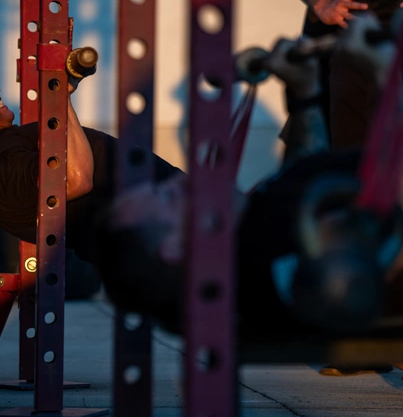
The barbell pull-up is a horizontal bodyweight pull: you rack a barbell at hip to chest height, hang underneath it with your heels on the floor, and pull your chest to the bar. It is an inverted row on a barbell, and it trains your lats, mid-back, and biceps with nothing more than a bar and a rack.
We use it inside our tactical fitness programs because the strict pull-up decides real scores, and both the Marine Corps PFT and the Navy SEAL PST test it. Below: what the movement is, the muscles it works, how to set it up safely, how to scale it, and how it builds toward your first vertical pull-up.
What Is the Barbell Pull-Up, and What Muscles Does It Work?
The barbell pull-up is an inverted row performed under a racked barbell. Your body stays straight from heels to head and you pull from straight arms until your chest meets the bar. It loads the same muscles as a row, using your own bodyweight.
This is an honest inverted row, not a magic move, and that is its value: simple, measurable, and scalable in seconds.
Barbell Pull-Up Muscles Worked
The barbell pull-up for back strength hits four groups:
Latissimus dorsi: drives the elbows toward your hips.
Mid-back (middle trapezius, rhomboids): squeezes the shoulder blades together.
Rear delts: finish the pull.
Biceps and forearms: bend the elbow and hold the grip.
Your glutes and trunk hold the straight body line, which is why it is also called a barbell pull-up row: a row with a plank built in.
Fenwick, Brown, and McGill (2009) compared the inverted row with the bent-over row and the one-arm cable row. The inverted row produced the highest lat, upper-back, and hip extensor activation of the three, with the lowest lumbar spine load. Youdas and colleagues (2016) found high biceps, lat, lower trapezius, and rear delt activation in bodyweight inverted rows.
How Do You Set Up a Barbell for Inverted Pull-Ups?
Rack the barbell at about hip height with the safeties set, grip it overhand just outside shoulder width, lock your body straight, and pull your chest to the bar.
Follow this sequence every time:
Secure the bar. Rest it on the safety pins, or sit it in the J-hooks with the safeties just below. A bar that shifts drops you on your back.
Set the height. Hip height is the standard starting point. Higher is easier, lower is harder.
Grip it. Overhand, just outside shoulder width, thumbs wrapped.
Build the line. Heels down, glutes and abs braced, chin tucked.
Pull. Drive your elbows toward your hips until your lower chest touches the bar.
Lower under control. Take two to three seconds to return to straight arms.
The cue that fixes most reps: bar to chest, not chin to bar. Reaching with your chin breaks the body line.
Can You Use a Barbell as a Pull-Up Bar?
You can use a barbell as a pull-up bar for horizontal pulls in almost any rack. Vertical hanging is different: only do it if the rack is bolted down or weighted and the bar sits on locked pins, not open J-hooks. Otherwise, use the rack’s built-in pull-up bar.
How Do You Make the Barbell Pull-Up Easier or Harder?
You scale the barbell pull-up by changing your body angle. Raise the bar or bend your knees to make it easier. Lower the bar, straighten your legs, or put your feet on a bench to make it harder. The more horizontal your body, the more bodyweight you pull.
Move to the next step once you own three sets of 10 to 12 clean reps:
Bar at chest height, knees bent, feet flat. The barbell assisted pull-up for true beginners.
Bar at chest height, legs straight.
Bar at hip height, knees bent.
Bar at hip height, legs straight. The standard version.
Bar at hip height, feet on a bench so your body is parallel to the floor.
Feet on a bench plus a pause at the top, or a weight vest.
Angle changes add load in small, controlled steps, and steady progressive overload is how strength improves (ACSM, 2009). Youdas and colleagues (2016) found no meaningful activation difference between single-leg and double-leg versions, so change the angle first. No rack? Suspension straps load the lats, mid-back, and rear delts about as well as a fixed bar (Snarr and Esco, 2013), which makes them the best barbell pull-up alternative on the road.
Would rather follow a structured plan? Our guide to choosing a strength & endurance program walks through how to pick one that fits your test date.
Barbell Pull-Up vs. Barbell Row vs. Vertical Pull-Up: What Is the Difference?
The barbell pull-up and barbell row are horizontal pulls; the pull-up is vertical. Horizontal pulls build mid-back thickness and shoulder balance. Vertical pulls train the lats overhead, the position the PFT tests. You need both.
Barbell Pull-Up vs. Barbell Row
The bent-over row lets you load more weight, but Fenwick and colleagues (2009) measured much higher lumbar compression in it than in the inverted row. After a ruck or a heavy deadlift day, the barbell pull-up gives you the back work without that cost.
Barbell Row vs. Pull-Up
The pull-up trains an overhead range a row never reaches, with high lat activation (Youdas et al., 2010; Dickie et al., 2017). A row will not replace pull-up practice for a pull-up test. It builds the back and grip that make that practice productive.
Our full pull-up routine covers the vertical side. For how pulling fits a complete strength week, see a strength workout for athletes.
How to Use the Barbell Pull-Up to Build Your First Pull-Up
The barbell pull-up builds your first vertical pull-up by strengthening the same lats, mid-back, and biceps at a load you control. Progress the angle toward horizontal, add negatives and dead hangs, and retest a strict pull-up every two to three weeks.
A simple bridge we use:
Two to three times per week: three to four sets of barbell pull-ups at the hardest angle you can hold for 8 to 12 strict reps.
Same session: three to five slow pull-up negatives and two 20- to 30-second dead hangs.
Once feet-up reps reach 12 or more, start daily low-rep pull-up practice. Grease the groove for pull-ups is the method we use for that stage.
Already have five strict pull-ups? The barbell pull-up becomes your go-to source of extra back volume, without taxing the grip and elbows you need for a block like the Fighter Pullup Program.
Walls, casualty drags, and obstacles all demand pulling strength, which is why our breakdown of functional strength for military performance treats it as core tactical capacity.
Frequently Asked Questions
What is a barbell pull-up?
A barbell pull-up is a horizontal bodyweight pull, also called an inverted row. You rack a barbell at hip to chest height, hang underneath it with heels down and body straight, and pull your chest to the bar. It trains the back and biceps at any level.
What muscles does the barbell pull-up work?
The barbell pull-up works the lats, middle trapezius, rhomboids, rear delts, and biceps, with the glutes and abs holding the body line. Research shows the inverted row produces high lat and upper-back activation with low lower-back load.
How do you set up a barbell for inverted pull-ups?
Rack the barbell at about hip height with the safeties set. Grip it overhand, slightly wider than shoulder width, heels down and body straight. Pull your chest to the bar and lower slowly. Raise the bar to make it easier.
Can you use a barbell as a pull-up bar?
You can use a barbell for horizontal pull-ups in nearly any rack with the safeties set. Vertical pull-ups from a barbell are only safe if the rack is bolted down or weighted and the bar sits on locked pins. Otherwise, use the rack’s own pull-up bar.
How do you make the barbell pull-up easier or harder?
Raise the bar or bend your knees to make the barbell pull-up easier. Lower the bar, straighten your legs, or put your feet on a bench to make it harder. Then add a pause or a weight vest, one variable at a time.
Does the barbell pull-up help build a real pull-up?
The barbell pull-up helps build a real pull-up by strengthening the lats, mid-back, and biceps, but it does not replace vertical practice. Pair it with pull-up negatives and dead hangs, then move to daily low-rep pull-up practice once you can do 12 or more feet-up reps.
The barbell pull-up is the most useful horizontal pull you can do with a bar and a rack: straight body, chest to the bar, and an angle that scales from beginner to selection candidate. Use it to build your back, spare your spine on heavy weeks, and bridge to strict pull-ups. Set the bar, log your angle and reps, and earn the next harder version.
References:
Fenwick CMJ, Brown SHM, McGill SM. Comparison of different rowing exercises: trunk muscle activation and lumbar spine motion, load, and stiffness. Journal of Strength and Conditioning Research. 2009;23(2):350-358.
Youdas JW, Keith JM, Nonn DE, Squires AC, Hollman JH. Activation of spinal stabilizers and shoulder complex muscles during an inverted row using a portable pull-up device and body weight resistance. Journal of Strength and Conditioning Research. 2016;30(7):1933-1941.
Snarr RL, Esco MR. Comparison of electromyographic activity when performing an inverted row with and without a suspension device. Journal of Exercise Physiology Online. 2013;16(6):51-58.
Youdas JW, Amundson CL, Cicero KS, Hahn JJ, Harezlak DT, Hollman JH. Surface electromyographic activation patterns and elbow joint motion during a pull-up, chin-up, or perfect-pullup rotational exercise. Journal of Strength and Conditioning Research. 2010;24(12):3404-3414.
Dickie JA, Faulkner JA, Barnes MJ, Lark SD. Electromyographic analysis of muscle activation during pull-up variations. Journal of Electromyography and Kinesiology. 2017;32:30-36.
American College of Sports Medicine. Progression models in resistance training for healthy adults. Medicine and Science in Sports and Exercise. 2009;41(3):687-708.
U.S. Marine Corps. Marine Corps Order 6100.13A with Change 4: Marine Corps Physical Fitness and Combat Fitness Tests. 2022.
U.S. Navy. MILPERSMAN 1220-410: Navy Special Warfare Physical Screening Test Standards.
Disclaimer: This article is for educational purposes and is not medical advice. Always secure the barbell in a rack with safeties set before you hang from it, and never hang vertically from a bar resting in open J-hooks. If you have shoulder, elbow, wrist, or back pain or a diagnosed condition, get cleared by a qualified medical provider before starting. Stop any exercise that causes sharp or worsening pain.


