
AFT & PFT Training: Max Your Military Fitness Test Score
How to Train for Military Fitness Tests Without Burning Out or Leaving Points on the Table
Military fitness test training is not about grinding test events until you burn out, it is about building the physical systems each event actually measures. Tests like the Army Fitness Test (AFT, formerly the ACFT), the Marine Corps PFT, and similar assessments across branches reward a broad range of qualities, not one-dimensional athletes. They reward those who can run, carry, lift, sprint, and perform repeated efforts under fatigue.
This applies whether you are an active-duty soldier prepping for the AFT, a Marine chasing a first-class PFT, or a law enforcement or fire-service candidate facing an academy fitness battery. The events differ, but the underlying demands, strength, aerobic capacity, repeat-effort tolerance, are identical across every tactical population. Building the qualities instead of the events is the whole idea behind proven tactical athlete training systems, so you train the qualities, not the specific test, and arrive ready for whatever assessment your branch or department puts in front of you.
Many service members approach these tests the wrong way. Some overemphasize running and ignore strength. Others lift heavy but avoid conditioning. Some just repeat the test events every week without building the systems that actually drive performance. If your goal is to dominate a military fitness test, the answer is not random workouts. It is a structured, balanced approach that builds the specific qualities those events measure.
What These Tests Actually Measure
Most military fitness tests are built around a small number of core physical capacities:
Aerobic endurance
Maximal and submaximal strength
Muscular endurance
Anaerobic power
Movement efficiency under fatigue
Each event is simply a different way of expressing one or more of these qualities.
For example:
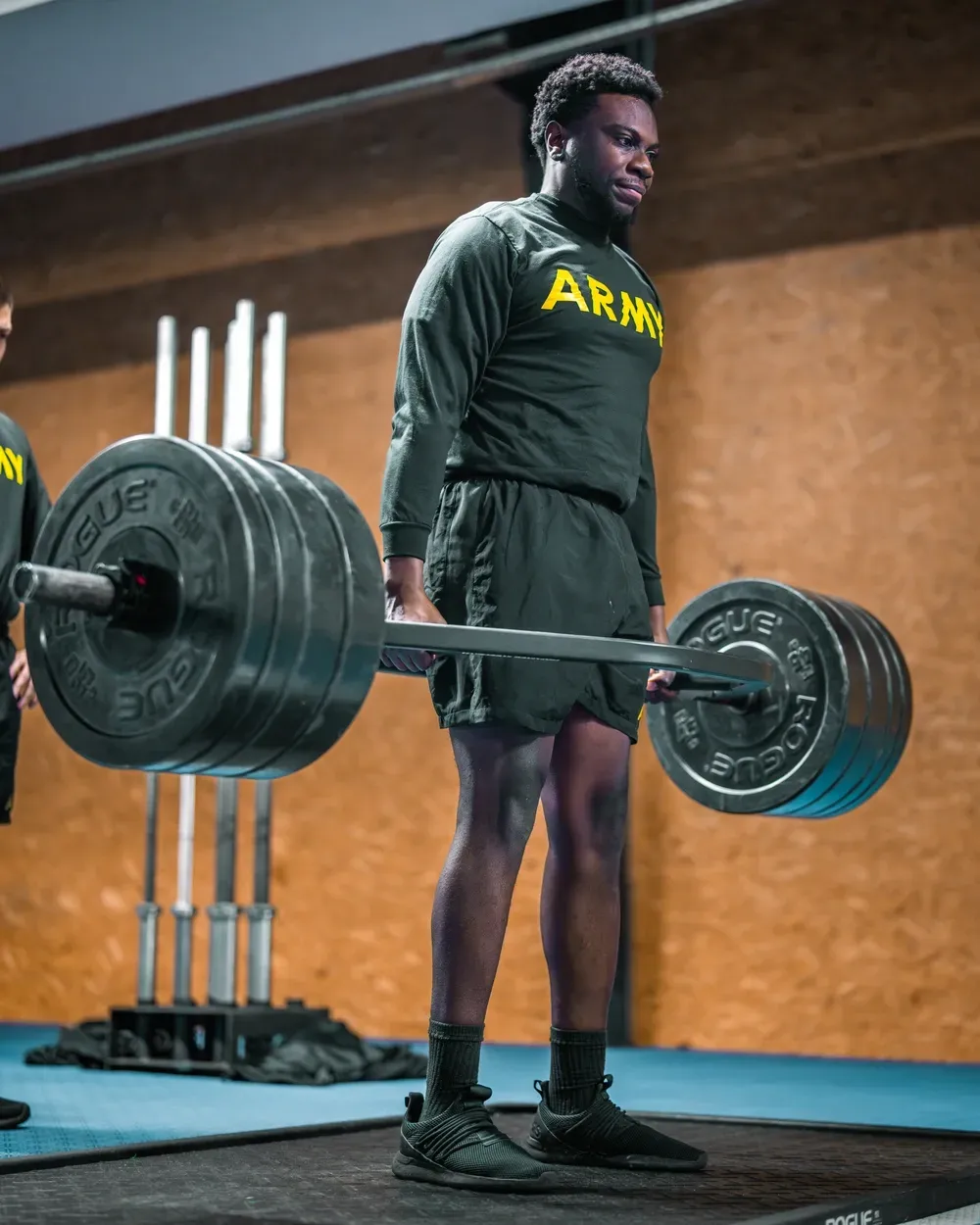
Deadlift or loaded strength event
Tests lower body and posterior chain strength, grip strength, and the ability to produce force safely under load.
Sprint or short-shuttle event
Measures explosive power, coordination, and nervous system output.
Push-ups or pull-ups
Assess upper body muscular endurance and structural resilience.
Sprint-drag-carry or shuttle work
Tests anaerobic power, change of direction, grip endurance, and repeat-effort capacity.
Core or plank event
Measures trunk stability and fatigue resistance.
Timed run (1.5–3 miles depending on branch)
Tests aerobic capacity, pacing, and mental discipline.
When you break the test down like this, it becomes clear: each event is not random. It represents a specific physical system. On the AFT, for example, those qualities are scored across five events, the three-rep-max deadlift, hand-release push-up, sprint-drag-carry, plank, and two-mile run, for a 500-point total, with a passing standard of 300 points (350 for combat specialties) and a floor of 60 in every event. The standing power throw was retired when the AFT replaced the ACFT in June 2025, which is exactly the point: every current test rewards the complete athlete, not a one-event specialist.
Before you build a plan, find your limiter. Run through a recent test or a self-administered trial and ask which capacity failed first: did your grip give out on the carry, did your run fall apart in the final half-mile, or did the deadlift feel heavier than it should? That weakest link is where your next training block earns the most points. Most people instead pour time into the event they already enjoy, which is exactly why their scores stall.
The Biggest Training Mistakes
Most poor test performances come from predictable training errors.
Only running
This may improve run times, but strength and power events suffer.
Only lifting
Strength improves, but run times and repeat-effort events decline.
Repeating test events weekly
This leads to stagnation because you are practicing the outcome instead of building the systems behind it.
No recovery structure
High intensity every day produces fatigue, not adaptation.
A structured program is the real fix, and if you are deciding which platform should run that program, it pays to compare Combat Fitness and other training programs before you commit to either one. Picture the runner who logs forty miles a week and nothing else. For the first few months, the two-mile improves and the deadlift holds. Then progress stalls everywhere at once: the run plateaus because there is no strength supporting stride mechanics, and the strength events slide because nothing is loading the posterior chain. This is the predictable end state of single-quality training, a ceiling you cannot run your way past. The fix is not more miles. It is the missing capacity.
The Foundation: Strength + Aerobic Capacity
The highest performers across most military tests share two key traits:
A solid strength base
A well-developed aerobic engine
Strength supports:
Deadlifts and carries
Sprint acceleration
Push-up and pull-up efficiency
Injury resistance
Aerobic capacity supports:
Run performance
Recovery between events
Work tolerance across the entire test
Without these two foundations, test prep becomes a constant struggle, which is why choosing the right tactical program to build both is worth more than any single clever workout. There is real science behind sequencing these qualities rather than cramming them together. In the foundational concurrent-training study, Hickson (1980) showed that athletes who trained strength and endurance simultaneously developed strength more slowly than those who trained strength alone, while their aerobic gains were left untouched. The practical takeaway for test prep is clear: your aerobic engine is hard to blunt, but your strength is fragile under heavy endurance volume. Protect strength work by giving it its own quality sessions, not the leftovers after a long run.
Why Strength Improves Running Events
Many candidates fear that strength work will slow them down. In reality, properly programmed strength training improves running economy and durability.
Stronger muscles:
Absorb impact forces more efficiently
Improve stride mechanics
Reduce fatigue accumulation
Lower injury risk
This allows you to run faster with less effort. This is not just theory. In a frequently cited study, Paavolainen and colleagues (1999) found that replacing part of an endurance block with explosive strength training improved running economy and 5 km time in already-trained runners, without adding aerobic mileage. For a soldier chasing a faster two-mile run, that means well-placed strength work can buy seconds the treadmill alone will not.
The mechanism is running economy, how much oxygen you burn to hold a given pace. Heavy and explosive strength work stiffens tendons and sharpens motor-unit recruitment, so each stride returns more elastic energy and wastes less. Over a two-mile run, a few percent better economy is the difference between fading in the final quarter and holding pace to the line. This is why the strongest finishers in a unit are rarely the ones who only run, they have a strength base quietly subsidizing every step.
The Role of Anaerobic and Muscular Endurance
Sprint-drag-carry events, shuttle runs, and high-rep calisthenics rely on anaerobic and muscular endurance systems.
Training these systems involves:
Short intervals
Work-capacity circuits
Repeated effort training
Strength endurance sessions
These teach the body to sustain output under fatigue, which is exactly what most test events demand.
The sprint-drag-carry is the clearest example. It strings together a sprint, a sled drag, a lateral shuffle, a loaded carry, and a final sprint, all under a ticking clock and a climbing heart rate. It punishes anyone whose anaerobic system, grip, and work capacity were trained in isolation. Build for it with short, dense circuits: thirty to sixty seconds of hard effort against incomplete rest, repeated until form starts to degrade. That teaches the body to buffer fatigue and keep producing force when lactate is high, which is exactly the test.
How to Think About Each Test Event
Instead of viewing the test as a single challenge, think of it as a collection of mini-tests:
Deadlift:
Train heavy posterior chain strength and hinge mechanics.
Sprint and short shuttles:
Develop explosive strength, sprint mechanics, and coordination.
Push-ups or pull-ups:
Build upper body endurance through progressive volume and strength support.
Sprint-drag-carry:
Train repeated high-intensity efforts, direction changes, and loaded movement.
Core event:
Develop trunk stability and fatigue-resistant posture.
Run:
Build aerobic capacity through a mix of easy runs, tempo efforts, and intervals.
Each event should have a corresponding training element in your weekly structure. It also helps to know exactly how your branch scores each event, and Marines can pin down their targets with this Marine Corps PFT scoring breakdown before the first training block. How you distribute run intensity matters as much as how much you run. Seiler and Kjerland (2006) found that elite endurance athletes spend roughly eighty percent of their time at easy, conversational efforts and only twenty percent at genuinely hard intensities, a pattern now known as polarized training. Most test candidates invert this, grinding every run at a moderate, uncomfortable pace that is too hard to build a base and too easy to sharpen speed. Keep most runs easy, make the hard ones truly hard, and the two-mile takes care of itself.
What a Balanced Training Week Looks Like
You do not need six days of suffering to cover every quality. A workable week might open with a heavy lower-body strength day built around the deadlift, follow with an easy aerobic run, then a work-capacity or sprint-drag-carry circuit midweek. Later, pair an upper-body strength session with calisthenics volume for the push-up event, add a second easy run, and finish with one harder interval or tempo effort. That is three strength touches, two easy aerobic sessions, and one quality conditioning day, with a full rest day protecting recovery. Each test event has a home in the week, and nothing is trained into the ground. Shift the emphasis toward your limiter, but keep all five qualities in rotation rather than chasing one at the expense of the rest.
Peaking for the Test
In the final 3–4 weeks before the test:
Reduce total training volume
Maintain intensity in key sessions
Add occasional test-specific practice
Prioritize sleep and recovery
You want to arrive fresh and sharp, not exhausted. Tapering works because fatigue fades faster than fitness. In the final week or two, cut your weekly training volume by roughly half while keeping the intensity of your key sessions intact, a few sharp, short efforts that remind the nervous system how to fire without digging a new hole. This is also the moment to bank sleep and dial in nutrition, since recovery is what converts months of work into a fresh, capable body on test day. Candidates who train hard right up to the morning of the test almost always under-perform what their fitness should allow.
The Big Picture
Military fitness tests reward balanced athletes. Not the strongest. Not the fastest. The most complete.
To dominate these tests:
Build real strength
Develop aerobic capacity
Train speed and endurance
Structure recovery
Peak intelligently
When you train the underlying systems instead of just repeating the test, performance improves across every event.
So here is the honest verdict. The athlete who wins these tests is rarely the most gifted in any single event, it is the one with no glaring weakness and a recovery structure that lets them show up sharp. Start this week by naming your weakest capacity and giving it a dedicated session, then protect your strength and aerobic base while you bring it up. Do that consistently for one training cycle and the score takes care of itself, because you will have built the exact machine the test was designed to measure.
References:
Hickson, R.C. (1980). Interference of strength development by simultaneously training for strength and endurance. European Journal of Applied Physiology and Occupational Physiology, 45(2–3), 255–263.
Jones, A.M. & Carter, H. (2000). The effect of endurance training on parameters of aerobic fitness. Sports Medicine, 29(6), 373–386.
Kraemer, W.J. & Ratamess, N.A. (2004). Fundamentals of resistance training: progression and exercise prescription. Medicine & Science in Sports & Exercise, 36(4), 674–688.
MacInnis, M.J. & Gibala, M.J. (2017). Physiological adaptations to interval training and the role of exercise intensity. The Journal of Physiology, 595(9), 2915–2930.
Paavolainen, L., Häkkinen, K., Hämäläinen, I., Nummela, A. & Rusko, H. (1999). Explosive-strength training improves 5-km running time by improving running economy and muscle power. Journal of Applied Physiology, 86(5), 1527–1533.
Seiler, K.S. & Kjerland, G.Ø. (2006). Quantifying training intensity distribution in elite endurance athletes: is there evidence for an "optimal" distribution? Scandinavian Journal of Medicine & Science in Sports, 16(1), 49–56.


